








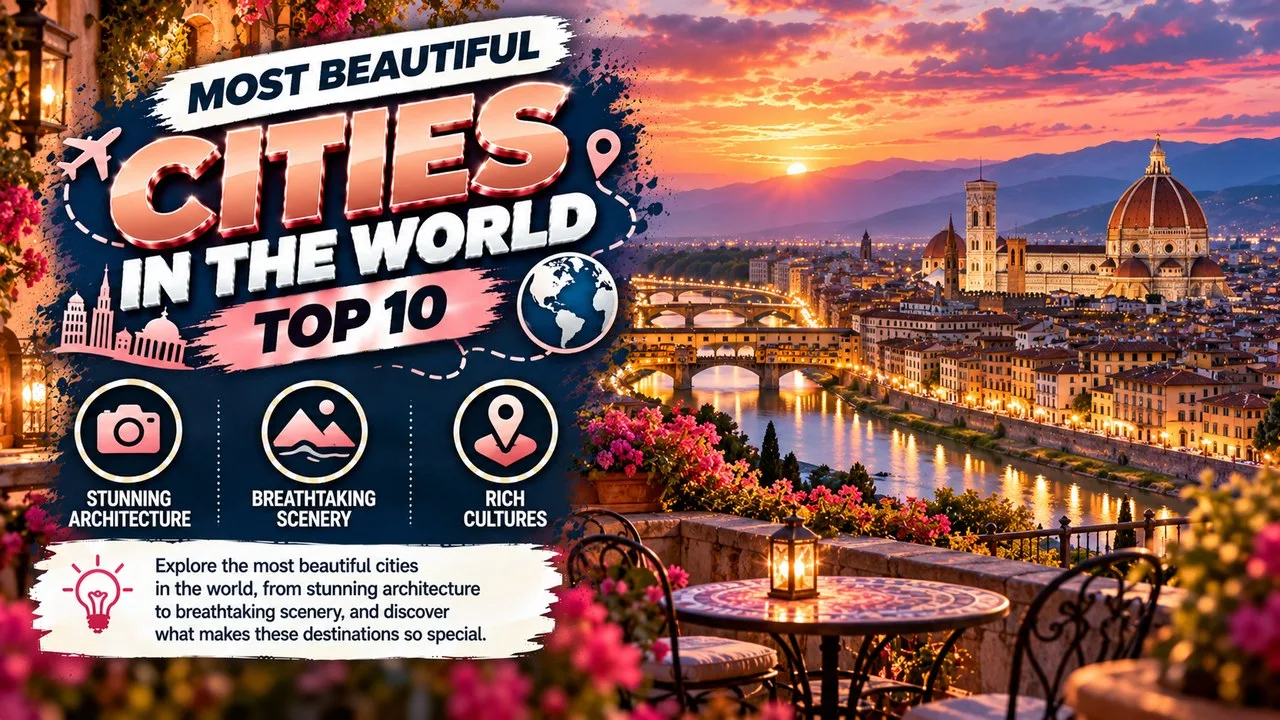
The most beautiful cities in the world, as of October 2026, pair striking settings with historic architecture, from Paris and Kyoto to Rio and Cape Town.
Beauty in a city is never just one thing. It is the way a river bends past a cathedral, the way a mountain rises straight out of a neighbourhood, or the way a skyline of domes and minarets catches the evening light. Some cities earn their reputation through centuries of careful building, while others were handed a spectacular landscape and grew up around it.
This Finepedia guide picks ten cities that combine both gifts, spread across five continents rather than crowded into a single corner of Europe. For each one you will find a Quick Facts table, a short history, what makes the place so photogenic, the sights worth your time and a few facts that surprise even seasoned travellers. Population figures, founding dates, UNESCO inscription years and ranking positions have all been checked against official statistics offices, the UNESCO World Heritage Centre and the publishers of each ranking.
How We Ranked the Most Beautiful Cities
Beauty is subjective, so there is no official scoreboard for it. Finepedia's list is an editorial judgement built on three openly stated factors, weighed together rather than added up as a precise score.
- Setting: rivers, harbours, lagoons, lakes, mountains and coastline that shape the way the city looks from almost every angle.
- Architecture and heritage: the quality and preservation of historic districts, including listings by the UNESCO World Heritage Centre, along with landmark modern buildings.
- Recognition: how often a city appears in respected travel rankings such as the Condé Nast Traveler Readers' Choice Awards, Time Out's Best Cities list, Travel + Leisure's World's Best Awards and Euromonitor International's Top 100 City Destinations Index.
Geographic balance mattered too. Europe has an extraordinary concentration of historic cities, but a list made only of European capitals would ignore Kyoto's temples, Rio's granite peaks and Cape Town's mountain-and-ocean scenery. Wherever a ranking is quoted below, the year and the publisher are given, because these lists change every year and measure different things, from reader satisfaction to visitor numbers.
What the Rankings Actually Measure
It helps to know what each ranking is based on before treating it as proof of beauty.
- Condé Nast Traveler's Readers' Choice Awards are a reader poll. The 2026 edition, announced on 6 October 2026, drew 798,867 votes across all categories.
- Time Out's Best Cities list combines a survey of locals with the views of its city editors. The 2026 edition surveyed more than 24,000 people.
- Euromonitor International's index scores cities on more than 50 indicators, from tourism performance to infrastructure and sustainability, and also counts international arrivals.
- Travel + Leisure's World's Best Awards are another long-running reader survey.
None of these lists measures beauty directly, which is why Finepedia weighs them alongside setting and heritage rather than copying any single table.
Most Beautiful Cities in the World at a Glance
| Rank | City | Country | Signature setting | UNESCO World Heritage link |
|---|---|---|---|---|
| 1 | Paris | France | River Seine and its islands | Paris, Banks of the Seine (1991) |
| 2 | Kyoto | Japan | Wooded hills around a former imperial capital | Historic Monuments of Ancient Kyoto (1994) |
| 3 | Venice | Italy | Lagoon city spread over 118 islands | Venice and its Lagoon (1987) |
| 4 | Rio de Janeiro | Brazil | Granite peaks above Guanabara Bay and Atlantic beaches | Carioca Landscapes between the Mountain and the Sea (2012) |
| 5 | Cape Town | South Africa | Table Mountain above the Atlantic coast and Table Bay | Cape Floral Region Protected Areas (2004); Robben Island (1999) |
| 6 | Prague | Czechia | Spires on both banks of the Vltava | Historic Centre of Prague (1992) |
| 7 | Istanbul | Türkiye | Domes and minarets above the Bosphorus | Historic Areas of Istanbul (1985) |
| 8 | Sydney | Australia | Harbour framed by the Opera House and Harbour Bridge | Sydney Opera House (2007); Australian Convict Sites (2010) |
| 9 | Quebec City | Canada | Walled clifftop town above the St Lawrence | Historic District of Old Québec (1985) |
| 10 | Udaipur | India | Palaces rising from a chain of lakes | No city listing; Hill Forts of Rajasthan (2013) nearby |
If bright paint and pastel streets are what you love most, Finepedia's separate guide to the most colorful cities in the world focuses on colour rather than overall beauty and features a completely different ten.
1. Paris, France
| Attribute | Details |
|---|---|
| Country | France |
| Population | 2,103,778 in the city proper (INSEE reference population for 1 January 2023, published December 2025) |
| Known for | The Seine and its bridges, Haussmann boulevards, the Eiffel Tower, Notre-Dame and the Louvre |
| UNESCO status | Paris, Banks of the Seine, inscribed in 1991 |
| Best time to visit | April to June and September to October, when days are mild and queues are shorter than in midsummer |
Origins and History
Paris began as a settlement of the Parisii, a Celtic tribe living on and around the Île de la Cité. After the Romans took the area in 52 BC they called the town Lutetia, and over the following centuries it grew into the capital of one of Europe's first great nation states. Gothic masterpieces such as Notre-Dame and the Sainte-Chapelle date from the Middle Ages, while the classical façades of the Louvre, Les Invalides and the Mint followed in later centuries.
The city most visitors picture today owes a great deal to Baron Georges-Eugène Haussmann. Between 1853 and 1870, under Napoleon III, he cut wide boulevards through crowded medieval lanes, added parks and new sewers, and set the cream-coloured stone apartment blocks that give central Paris its remarkable uniformity. The Eiffel Tower, completed on 31 March 1889 for the Universal Exhibition, was the final flourish of that century.
What Makes It Beautiful
- UNESCO describes the stretch of river between the Pont de Sully and the Pont d'Iéna as an exceptional example of riverside urban architecture, with layers of history visible from the water.
- Haussmann's consistent building heights and stone façades create long, harmonious street views that end in monuments.
- Two river islands, the Île de la Cité and the Île Saint-Louis, sit at the heart of the city like anchored ships.
- Evening light on the Seine, the illuminated Eiffel Tower and the grand squares make Paris as striking after dark as it is at noon.
Must-See Sights
- Notre-Dame de Paris, reopened on 7 December 2024 after the restoration that followed the 2019 fire.
- The Louvre and the Musée d'Orsay, facing each other across the river.
- Sainte-Chapelle, famous for its walls of stained glass.
- The hill of Montmartre and the Sacré-Cœur basilica for a view across the rooftops.
- A boat ride on the Seine, passing under the Pont Neuf and the Pont Alexandre III.
Interesting Facts
- Euromonitor International named Paris the world's leading city destination in its Top 100 City Destinations Index 2025, the fifth year in a row it took first place.
- The Eiffel Tower now measures 330 metres including its antennas, and the official tower website explains that the iron structure expands slightly in summer heat.
- Despite its name, which means New Bridge, the Pont Neuf is the oldest standing bridge across the Seine in Paris.
- Paris ranked seventh among the best large cities in the world in Condé Nast Traveler's 2026 Readers' Choice Awards.
Paris also scores highly for exploring on foot, which is why it features in Finepedia's list of the most walkable cities in the world.
2. Kyoto, Japan
| Attribute | Details |
|---|---|
| Country | Japan |
| Population | 1,430,062 (2025 national census, final figures published by Kyoto City) |
| Known for | Buddhist temples, Shinto shrines, Zen gardens, wooden townhouses and the Gion geisha district |
| UNESCO status | Historic Monuments of Ancient Kyoto (Kyoto, Uji and Otsu Cities), inscribed in 1994 |
| Best time to visit | Late March to early April for cherry blossom, or mid to late November for autumn leaves |
Origins and History
Kyoto was laid out in AD 794 as Heian-kyō, a new imperial capital modelled on the grid plan of an ancient Chinese capital. It remained the home of the emperor until the middle of the 19th century, when the court moved to Tokyo, and for more than a thousand years it was the centre of Japanese art, religion and craft.
That long reign left an astonishing concentration of heritage. UNESCO's listing covers seventeen component sites, made up of 198 buildings and 12 gardens, most of them built or designed between the 10th and 17th centuries. All but one are temples or shrines; the exception is Nijō Castle, the Kyoto residence of the Tokugawa shoguns.
What Makes It Beautiful
- Forested hills wrap around the city on three sides, so temple roofs often appear against a backdrop of green or, in autumn, deep red maple.
- Japanese garden design reached its peak here, and UNESCO notes that Kyoto's gardens went on to influence landscape design around the world.
- Narrow lanes of wooden machiya townhouses survive in districts such as Gion and Higashiyama.
- The seasons are part of the scenery: blossom in spring, lush moss in the rainy season and blazing foliage in late autumn.
Must-See Sights
- Kinkaku-ji, the Golden Pavilion, reflected in its mirror pond.
- Kiyomizu-dera, whose wooden stage juts out over the hillside.
- Fushimi Inari Taisha and its tunnels of vermilion torii gates.
- The Arashiyama bamboo grove on the western edge of the city.
- Ryōan-ji's raked-gravel rock garden and the canal-side Philosopher's Path.
Interesting Facts
- Condé Nast Traveler readers voted Kyoto the second-best large city in the world in 2025 and tenth in 2026.
- From 1 March 2026, Kyoto's accommodation tax rose to as much as ¥10,000 per person per night for rooms costing ¥100,000 or more, with revenue earmarked for infrastructure and measures against overtourism.
- Residents of Gion put up signs in 2024 asking tourists to stay out of certain private alleys, citing harassment of geiko and maiko.
- Kyoto's famous view of rows of red gates at Fushimi Inari lies outside the UNESCO listing, which shows how much heritage exists beyond the official sites.
Kyoto's scenery is so photogenic that it also appears in Finepedia's guide to the most Instagrammable places to visit.
3. Venice, Italy
| Attribute | Details |
|---|---|
| Country | Italy |
| Population | Fewer than 48,000 residents in the historic centre (Comune di Venezia figures for 2025); the wider municipality includes Mestre on the mainland |
| Known for | Canals instead of streets, the Grand Canal, St Mark's Basilica, the Doge's Palace and Murano glass |
| UNESCO status | Venice and its Lagoon, inscribed in 1987 |
| Best time to visit | April to May and September to early November, avoiding the busiest summer weekends |
Origins and History
According to UNESCO, people first took refuge on the sandy islands of the lagoon in the 5th century AD, escaping the raids that followed the collapse of Roman rule on the mainland. Temporary shelters slowly became a permanent city, and by the 10th century Venice had grown into a major maritime power trading across the Mediterranean.
For roughly a thousand years the Republic of Venice built palaces, churches and warehouses on wooden piles driven into the mud of 118 small islands. Painters such as Giorgione, Titian, Tintoretto and Veronese filled its buildings with art. The republic fell to Napoleon in 1797, but the city it left behind has changed remarkably little since.
What Makes It Beautiful
- Water replaces roads, so every façade is doubled by its reflection in a canal.
- The Grand Canal curves through the city past Gothic and Renaissance palaces, forming one of the grandest waterways anywhere.
- UNESCO calls the whole city an extraordinary architectural masterpiece in which even modest buildings hold works by great artists.
- The surrounding lagoon, covering more than 70,000 hectares, adds islands such as Burano, Murano and Torcello, each with its own character.
Must-See Sights
- St Mark's Square, St Mark's Basilica and the Doge's Palace.
- The Rialto Bridge and the market beside it.
- A vaporetto ride along the full length of the Grand Canal.
- The Gallerie dell'Accademia for Venetian painting.
- The lagoon islands of Murano and Burano; Burano's painted houses appear in Finepedia's colorful cities guide.
Interesting Facts
- The MOSE system of mobile flood barriers was raised for the first time in October 2020 to hold back a high tide.
- In September 2023, UNESCO's World Heritage Committee decided not to place Venice on its List of World Heritage in Danger, while keeping concerns about mass tourism and climate change on record.
- In 2026 Venice charged day visitors an access fee on 60 days between 3 April and 26 July: €5 if booked by the fourth day before the visit, €10 if booked later.
- The number of people living in the historic centre has kept falling, dropping below 48,000 in 2025.
4. Rio de Janeiro, Brazil
| Attribute | Details |
|---|---|
| Country | Brazil |
| Population | 6,211,223 (IBGE, 2022 census, municipality of Rio de Janeiro) |
| Known for | Sugarloaf Mountain, Christ the Redeemer, Copacabana and Ipanema beaches, Carnival |
| UNESCO status | Rio de Janeiro: Carioca Landscapes between the Mountain and the Sea, inscribed in 2012 |
| Best time to visit | May to October for cooler, drier weather; February or March for Carnival, depending on the year's dates |
Origins and History
Portuguese forces under Estácio de Sá founded the city in 1565 on the shores of Guanabara Bay. It grew rich on gold and sugar shipped through its harbour, and when Napoleon invaded Portugal in 1807 the Portuguese royal court sailed across the Atlantic and ruled its empire from Rio from 1808. The city remained the capital of Brazil until 1960, when the government moved to the purpose-built city of Brasília.
The court's arrival left lasting marks, including the Botanical Garden founded in 1808. In the 20th century, planners reclaimed land along the bay and the ocean, creating the curving promenades and parks of Flamengo and Copacabana that define the waterfront today.
What Makes It Beautiful
- Few cities sit in such dramatic terrain: forested mountains rise to 1,021 metres in the Tijuca massif and drop almost straight into the sea.
- UNESCO recognised the city for the way its people have shaped this landscape, from mountain viewpoints and forts to beachfront parks, rather than for a single historic district.
- The steep granite cones of Sugarloaf, Urca and Corcovado frame the wide sweep of Guanabara Bay.
- Long crescents of sand at Copacabana and Ipanema make the beach part of everyday city life.
Must-See Sights
- Christ the Redeemer on the summit of Corcovado, about 709 metres above sea level.
- The cable cars up Sugarloaf Mountain at sunset.
- Tijuca National Park, a restored Atlantic forest inside city limits.
- The tiled Selarón Steps between Lapa and Santa Teresa.
- The Botanical Garden and its avenue of royal palms.
Interesting Facts
- Christ the Redeemer was inaugurated on 12 October 1931; the statue is 30 metres tall and stands on an 8-metre pedestal.
- The statue was chosen as one of the New Seven Wonders of the World in an online vote announced on 7 July 2007.
- Rio was the highest-placed South American city in Time Out's Best Cities 2026 list, ranking 12th in the world.
- Its 2012 UNESCO listing protects a city landscape as a whole, including mountains, a forest, a bay and beaches.
5. Cape Town, South Africa
| Attribute | Details |
|---|---|
| Country | South Africa |
| Population | 4,772,846 (Statistics South Africa, Census 2022, City of Cape Town metropolitan municipality) |
| Known for | Table Mountain, the Cape Peninsula, Robben Island, the Bo-Kaap and nearby winelands |
| UNESCO status | Table Mountain National Park forms part of the Cape Floral Region Protected Areas (2004); Robben Island inscribed in 1999 |
| Best time to visit | November to March, the dry southern summer, or September for spring wildflowers |
Origins and History
Khoekhoe herders and San hunter-gatherers lived around the Cape for thousands of years before Europeans arrived. On 6 April 1652, Jan van Riebeeck landed in Table Bay to set up a supply station for ships of the Dutch East India Company, and the settlement that grew around it became Cape Town, still affectionately called the Mother City.
The city's later history includes British rule, the forced removals of the apartheid era and the long imprisonment of Nelson Mandela on Robben Island, just offshore. Today the island is a museum and a UNESCO site, a reminder that Cape Town's beauty sits beside a difficult past.
What Makes It Beautiful
- Table Mountain's flat summit, reaching 1,085 metres at Maclear's Beacon, looms directly over the city centre.
- The mountain is part of the Cape Floral Kingdom, which UNESCO describes as the smallest of the world's six floral kingdoms and relatively the most diverse.
- Beaches, coves and cliff roads ring the Cape Peninsula all the way to the Cape of Good Hope.
- The brightly painted houses of the Bo-Kaap add colour against the mountain's grey rock.
Must-See Sights
- The cableway or a hiking trail to the top of Table Mountain.
- Kirstenbosch National Botanical Garden on the mountain's eastern slopes.
- A ferry to Robben Island from the V&A Waterfront.
- The African penguin colony at Boulders Beach near Simon's Town.
- Chapman's Peak Drive along the cliffs south of Hout Bay.
Interesting Facts
- Time Out named Cape Town the best city in the world in its 2025 ranking; it placed sixth in 2026.
- Condé Nast Traveler readers ranked Cape Town third among large cities in 2025 and eighth in 2026.
- Table Mountain was confirmed as one of the New7Wonders of Nature in 2012.
- The cliff road at Chapman's Peak also appears in Finepedia's guide to the most beautiful highways in the world.
6. Prague, Czechia
| Attribute | Details |
|---|---|
| Country | Czechia (Czech Republic) |
| Population | 1,407,084 (Czech Statistical Office, preliminary figure for 31 December 2025) |
| Known for | Prague Castle, Charles Bridge, the Old Town Square and its astronomical clock, Gothic and Baroque spires |
| UNESCO status | Historic Centre of Prague, inscribed in 1992 |
| Best time to visit | May to June and September, or December for the Christmas markets |
Origins and History
Prague grew up around a castle founded on a ridge above the Vltava River in the 9th century. Over roughly 1,100 years it became the seat of Bohemian kings and, under Charles IV in the 14th century, an imperial capital. Charles founded the New Town and began the stone bridge that now carries his name.
Crucially, Prague escaped the large-scale demolition that reshaped many European capitals. UNESCO notes that the historic centre has avoided major urban renewal and therefore keeps its medieval layout, with Gothic, Baroque and early modernist buildings standing side by side.
What Makes It Beautiful
- UNESCO's own description calls Prague one of the most beautiful cities in Europe, thanks to its setting on both banks of the Vltava.
- The skyline is crowded with towers, domes and spires, best seen from the river or from the castle hill.
- Cobbled lanes in the Lesser Town and the Old Town lead to hidden courtyards and Baroque palaces.
- Bridges line up one after another along the river, creating classic sunset views.
Must-See Sights
- Prague Castle and St Vitus Cathedral.
- Charles Bridge at dawn, before the crowds arrive.
- The Old Town Square, its Týn Church and the astronomical clock.
- The Lesser Town (Malá Strana) and Petřín Hill.
- The Dancing House, a 1990s landmark on the riverbank.
Interesting Facts
- Guinness World Records lists Prague Castle as the largest ancient castle in the world, covering 7.28 hectares.
- According to Prague City Tourism, Charles IV laid the foundation stone of Charles Bridge on 9 July 1357, at a time chosen to form the palindrome 1-3-5-7-9-7-5-3-1.
- Charles Bridge is about 516 metres long and is lined with 30 statues and sculptural groups.
- The UNESCO listing also includes Průhonice Park, a landscaped park just outside the city.
7. Istanbul, Türkiye
| Attribute | Details |
|---|---|
| Country | Türkiye |
| Population | 15,754,053 (Turkish Statistical Institute, address-based registration results for 2025, Istanbul province) |
| Known for | Hagia Sophia, the Blue Mosque, Topkapı Palace, the Grand Bazaar and the Bosphorus strait between Europe and Asia |
| UNESCO status | Historic Areas of Istanbul, inscribed in 1985 |
| Best time to visit | April to May and September to October, when temperatures are comfortable for walking |
Origins and History
Greek colonists from Megara founded Byzantium on this peninsula in the 7th century BC. In AD 330 the Roman emperor Constantine made it his new capital, Constantinople, and for more than a thousand years it was the heart of the Eastern Roman Empire. In 1453 the Ottomans captured the city, which then served as the Ottoman capital until the empire's end.
Each empire left its mark on the skyline. The Theodosian walls date from the early 5th century, Hagia Sophia was completed in AD 537 under Justinian, and the Ottoman architect Sinan crowned the hills with great mosque complexes in the 16th century.
What Makes It Beautiful
- UNESCO highlights Istanbul's incomparable skyline, built up over centuries by Byzantine and Ottoman architects.
- Water surrounds the historic peninsula on three sides: the Golden Horn, the Bosphorus and the Sea of Marmara.
- Domes and slender minarets rise in layers, best seen from a ferry crossing between continents.
- Wooden waterside mansions and palaces line the Bosphorus north of the old city.
Must-See Sights
- Hagia Sophia and the Sultan Ahmed (Blue) Mosque facing each other across a square.
- Topkapı Palace, home of Ottoman sultans for centuries.
- The Süleymaniye Mosque, Sinan's masterpiece on the city's third hill.
- The Basilica Cistern beneath the old city.
- A public ferry ride on the Bosphorus at sunset.
Interesting Facts
- Istanbul is one of very few major cities that spans two continents, Europe and Asia.
- Euromonitor International counted 19.7 million international arrivals to Istanbul in 2025, fifth in the world.
- Hagia Sophia's vast dome was a landmark of 6th-century engineering and influenced religious architecture for centuries.
- The Istanbul province is home to about 18.3 percent of Türkiye's population, according to the 2025 registration results.
Istanbul's crowds are part of its energy; it also appears in Finepedia's ranking of the busiest cities in the world.
8. Sydney, Australia
| Attribute | Details |
|---|---|
| Country | Australia |
| Population | 5,638,830 in Greater Sydney (Australian Bureau of Statistics, preliminary estimate for 30 June 2025) |
| Known for | Sydney Harbour, the Opera House, the Harbour Bridge, Bondi Beach and coastal walks |
| UNESCO status | Sydney Opera House, inscribed in 2007; several Sydney sites form part of the Australian Convict Sites listing (2010) |
| Best time to visit | September to November and March to May, when weather is warm but not extreme |
Origins and History
The Sydney area has been home to Aboriginal peoples for tens of thousands of years, and the City of Sydney acknowledges the Gadigal of the Eora Nation as the traditional custodians of its land. In January 1788 the British First Fleet arrived and founded a penal colony at Sydney Cove, the start of modern Australia.
Convict-era buildings such as the Hyde Park Barracks still stand in the centre. The 20th century added the two structures that now define the harbour: the steel arch of the Harbour Bridge, opened on 19 March 1932, and the sail-like shells of the Opera House, opened by Queen Elizabeth II on 20 October 1973.
What Makes It Beautiful
- Sydney Harbour's long, winding shoreline of bays, headlands and coves gives the city waterfront views in every direction.
- UNESCO calls the Opera House a great architectural work of the 20th century, carefully set in a remarkable waterscape.
- Ocean beaches such as Bondi and Manly sit within easy reach of the business district.
- National parks and bushland reach right into the suburbs along the harbour's edge.
Must-See Sights
- A tour or performance at the Sydney Opera House.
- The BridgeClimb or the free pedestrian walkway across the Harbour Bridge.
- The ferry from Circular Quay to Manly.
- The Bondi to Coogee coastal walk.
- The Royal Botanic Garden and Mrs Macquarie's Chair viewpoint.
Interesting Facts
- The Opera House was designed by Danish architect Jørn Utzon, and UNESCO credits engineer Ove Arup's team with making his vision possible.
- The Harbour Bridge rises 134 metres from the water to the top of its arch.
- Sydney placed fifth among large cities in Condé Nast Traveler's 2026 Readers' Choice Awards and 21st in Time Out's Best Cities 2026.
- The Australian Convict Sites listing includes the Hyde Park Barracks and Cockatoo Island in Sydney Harbour.
9. Quebec City, Canada
| Attribute | Details |
|---|---|
| Country | Canada |
| Population | 549,459 (Statistics Canada, 2021 census, city of Québec) |
| Known for | City walls, the Château Frontenac, the cliffs of Cap Diamant, French-speaking culture and winter festivals |
| UNESCO status | Historic District of Old Québec, inscribed in 1985 |
| Best time to visit | June to September for warm weather, early October for autumn colour, or February for the Winter Carnival |
Origins and History
French explorer Samuel de Champlain founded Québec in 1608 on a narrow point where the St Lawrence River tightens below a cliff. The settlement became the capital of New France and, after the British conquest in 1760, the capital of the new British colony.
Because of its strategic position, the city was fortified again and again. UNESCO describes Old Québec, an area of about 135 hectares, as the most complete fortified colonial town north of Mexico, with an Upper Town protected by ramparts and a citadel and a Lower Town built around the harbour.
What Makes It Beautiful
- The Upper Town sits high on Cap Diamant, giving sweeping views over the St Lawrence.
- Stone houses with steep metal roofs and dormer windows recall the towns of northern France.
- The copper roofs and turrets of the Château Frontenac dominate the skyline.
- In winter, snow, festival lights and the frozen edges of the river create a fairy-tale scene.
Must-See Sights
- The Château Frontenac and the Dufferin Terrace boardwalk.
- The narrow streets of the Quartier Petit-Champlain in the Lower Town.
- Place Royale, the site of Champlain's first settlement.
- A walk on the city walls and around the star-shaped Citadelle.
- Montmorency Falls, a short drive from the centre.
Interesting Facts
- The Château Frontenac opened in 1893 and is often described as the most photographed hotel in the world.
- Montmorency Falls drop about 83 metres, roughly 30 metres more than Niagara Falls.
- An old funicular links the Upper Town and the Lower Town, saving visitors a steep climb up the cliff stairways.
- The city celebrated its 400th anniversary in 2008.
10. Udaipur, India
| Attribute | Details |
|---|---|
| Country | India |
| Population | 451,100 (Census of India 2011, Udaipur city; the most recent completed national census) |
| Known for | Lake Pichola, the City Palace, the Lake Palace, havelis and Rajput architecture |
| UNESCO status | The city itself is not inscribed; Kumbhalgarh and Chittorgarh forts in the wider Mewar region belong to the Hill Forts of Rajasthan listing (2013) |
| Best time to visit | October to March, after the monsoon has filled the lakes and the heat has eased |
Origins and History
Maharana Udai Singh II founded Udaipur in 1559 as a new capital for the Rajput kingdom of Mewar, away from the exposed hilltop fortress of Chittorgarh. He chose a site beside Lake Pichola, protected by the Aravalli hills, and began the City Palace on its eastern shore.
Later rulers kept adding to the palace complex and built pleasure palaces on the lake islands. The Jag Niwas palace, now the Taj Lake Palace hotel, was built between 1743 and 1746 under Maharana Jagat Singh II as a royal summer retreat. It opened as a hotel in 1963.
What Makes It Beautiful
- White marble and sandstone palaces seem to float on the still water of Lake Pichola.
- The City Palace stretches along the shore, a long ridge of balconies, domes and towers.
- Green hills circle the lakes, turning gold at sunset.
- Old havelis, ghats and temples cluster along the water's edge in the old city.
Must-See Sights
- The City Palace and its museum.
- A boat ride on Lake Pichola past the Lake Palace and Jag Mandir.
- Fateh Sagar Lake and the hilltop Sajjangarh (Monsoon) Palace.
- Bagore Ki Haveli, a historic mansion on Gangaur Ghat.
- The Saheliyon-ki-Bari garden with its fountains.
Interesting Facts
- Readers of Travel + Leisure voted Udaipur the best city in the world in the magazine's 2009 World's Best Awards.
- Scenes from the 1983 James Bond film Octopussy were filmed at the Lake Palace and the nearby Jag Mandir.
- Udaipur is widely known as the City of Lakes because of its chain of man-made lakes.
- The Udaipur Municipal Corporation was created in 2013 when the municipal council was upgraded.
Comparison: Setting, Signature View and Best Season
| City | Setting | Signature view | Best season |
|---|---|---|---|
| Paris | River with two islands | The Seine from the Pont Neuf or the Eiffel Tower lit at night | Spring and early autumn |
| Kyoto | Basin ringed by wooded hills | Kiyomizu-dera's wooden stage above autumn maples | Cherry blossom season or November |
| Venice | Lagoon islands | The Grand Canal from the Rialto Bridge | Spring and early autumn |
| Rio de Janeiro | Mountains meeting the ocean | Guanabara Bay from Sugarloaf at sunset | May to October |
| Cape Town | Mountain above two coastlines | The city bowl from Table Mountain | November to March |
| Prague | River valley with castle hill | Spires from Charles Bridge at dawn | May, June, September or December |
| Istanbul | Peninsula between two seas | Domes and minarets from a Bosphorus ferry | April, May, September and October |
| Sydney | Natural harbour | The Opera House and Harbour Bridge from Mrs Macquarie's Chair | Spring and autumn |
| Quebec City | Clifftop above a great river | The Château Frontenac from the Lower Town | Summer, early October or February |
| Udaipur | Lakes within hills | The City Palace and Lake Palace from a Pichola boat | October to March |
Cities That Just Missed the List
Many other cities could easily make a top ten on a different day. These are the closest contenders Finepedia considered.
- Florence, Italy: the cradle of the Renaissance, whose historic centre was inscribed by UNESCO in 1982.
- Budapest, Hungary: the banks of the Danube, the Buda Castle Quarter and Andrássy Avenue have been UNESCO-listed since 1987.
- Edinburgh, United Kingdom: its Old and New Towns were inscribed in 1995, and Time Out ranked it third in its Best Cities 2026 list.
- Vienna, Austria: a historic centre of palaces and coffee houses, inscribed in 2001.
- Dubrovnik, Croatia: walled Old City on the Adriatic, inscribed in 1979.
- Cusco, Peru: the former Inca capital, inscribed in 1983, high in the Andes.
- Vancouver, Canada: mountains and ocean around a modern skyline; seventh among large cities in Condé Nast Traveler's 2025 Readers' Choice Awards.
- Lisbon, Portugal, and Seville, Spain: hills, tiles and river views that came very close.
Tips for Visiting Beautiful Cities Responsibly
The beauty that draws travellers to these cities can also be damaged by too many visitors arriving at the same time. Several of them have introduced rules and charges to manage crowds, and a little planning makes a visit better for everyone.
- Check local fees before you go. Venice ran its day-visitor access fee on 60 days in 2026, from 8:30 am to 4 pm, and the city council decides whether it returns in later years. Kyoto raised its accommodation tax in March 2026.
- Stay overnight rather than day-tripping. Overnight guests in Venice were exempt from the 2026 access fee, and longer stays spread spending across local businesses.
- Travel outside peak weeks. Shoulder seasons offer softer light, cooler weather and fewer queues at major sights.
- Respect residents' space. Follow signs in places such as Gion in Kyoto, where some private alleys are off limits, and never photograph people without permission.
- Book tickets online for headline attractions such as the Louvre, Prague Castle and the Table Mountain cableway to avoid long waits.
- Use public transport and walk. Vaporetti in Venice, ferries in Sydney and Istanbul, and metro systems elsewhere let you see the city as locals do.
- Leave natural areas as you found them. On Table Mountain and in Tijuca National Park, stick to marked trails and carry out your rubbish.
Frequently Asked Questions
What is the most beautiful city in the world?
There is no official answer, because beauty cannot be measured objectively. Finepedia ranks Paris first as of October 2026 for its riverside architecture, UNESCO-listed Seine banks and global recognition, including first place in Euromonitor's 2025 city destinations index. Kyoto, Venice, Rio de Janeiro and Cape Town follow closely.
How did Finepedia choose the most beautiful cities in the world?
The list blends three factors: natural setting, the quality and protection of historic architecture, and recognition in major travel rankings such as Condé Nast Traveler, Time Out, Travel + Leisure and Euromonitor. It is an editorial judgement, and it deliberately includes cities from five continents rather than only Europe.
Which beautiful cities are UNESCO World Heritage Sites?
Nine of the ten have a UNESCO listing that covers part of the city: Paris (1991), Kyoto (1994), Venice (1987), Rio de Janeiro (2012), Prague (1992), Istanbul (1985), Sydney's Opera House (2007) and Old Québec (1985). Cape Town's Table Mountain is part of the Cape Floral Region listing (2004). Udaipur itself has no listing.
Do you have to pay to enter Venice?
In 2026 Venice charged day visitors an access fee on 60 selected days between 3 April and 26 July, from 8:30 am to 4 pm. It cost €5 if paid by the fourth day before the visit and €10 after that. Overnight guests and residents of the Veneto region were exempt. The trial ended on 27 July.
When is the best time to visit the most beautiful cities?
For most cities in the Northern Hemisphere, spring and early autumn bring mild weather and thinner crowds. Kyoto is best in cherry blossom season or November. Cape Town and Sydney are in the Southern Hemisphere, so their summer falls between November and March. Udaipur is most pleasant from October to March.
Which city on the list is best for nature lovers?
Cape Town and Rio de Janeiro stand out. Cape Town has Table Mountain National Park, part of a UNESCO-listed floral kingdom, plus beaches and penguin colonies. Rio has Tijuca National Park, a restored Atlantic forest inside the city, and dramatic granite peaks above Guanabara Bay. Both reward hikers with views over the whole city.
Conclusion
The most beautiful cities in the world share a rare balance between what nature provided and what people built. Paris shaped its river into a grand architectural stage, Kyoto filled its hills with temples and gardens, and Venice turned a lagoon into a city of palaces. Rio de Janeiro and Cape Town show how mountains and ocean can define an entire city, while Prague, Istanbul and Quebec City prove the value of protecting old streets instead of tearing them down. Sydney adds modern landmarks to a superb natural harbour, and Udaipur shows that a city does not need to be large to be unforgettable.
Rankings will change next year, as they always do, but the qualities that make these places special will not. Visit with patience and respect, travel outside the busiest weeks if you can, and these cities will repay you with views you will remember for a lifetime.
- UNESCO World Heritage Centre, Paris, Banks of the Seine: https://whc.unesco.org/en/list/600/
- UNESCO World Heritage Centre, Historic Monuments of Ancient Kyoto (Kyoto, Uji and Otsu Cities): https://whc.unesco.org/en/list/688/
- UNESCO World Heritage Centre, Venice and its Lagoon: https://whc.unesco.org/en/list/394/
- UNESCO World Heritage Centre, Rio de Janeiro: Carioca Landscapes between the Mountain and the Sea: https://whc.unesco.org/en/list/1100/
- UNESCO World Heritage Centre, Cape Floral Region Protected Areas: https://whc.unesco.org/en/list/1007/
- UNESCO World Heritage Centre, Robben Island: https://whc.unesco.org/en/list/916/
- UNESCO World Heritage Centre, Historic Centre of Prague: https://whc.unesco.org/en/list/616/
- UNESCO World Heritage Centre, Historic Areas of Istanbul: https://whc.unesco.org/en/list/356/
- UNESCO World Heritage Centre, Sydney Opera House: https://whc.unesco.org/en/list/166/
- UNESCO World Heritage Centre, Australian Convict Sites: https://whc.unesco.org/en/list/1306/
- UNESCO World Heritage Centre, Historic District of Old Québec: https://whc.unesco.org/en/list/300/
- UNESCO World Heritage Centre, Hill Forts of Rajasthan: https://whc.unesco.org/en/list/247/
- INSEE, Populations de référence 2023, Commune de Paris: https://www.insee.fr/fr/statistiques/8643952?geo=COM-75056
- Euromonitor International, Top 100 City Destinations for 2025 (5 December 2025): https://www.euromonitor.com/newsroom/press-releases/december-2025/euromonitor-international-unveils-worlds-top-100-city-destinations-for-2025
- Time Out, The world's most visited cities by international arrivals in 2025: https://www.timeout.com/news/revealed-the-worlds-most-visited-cities-by-international-arrivals-in-2025-120525
- Tour Eiffel (official site), History of the Eiffel Tower: https://www.toureiffel.paris/en/the-monument/history
- Notre-Dame de Paris, Reopening ceremonies: https://www.notredamedeparis.fr/en/reopening-ceremonies/
- Kyoto City, 2025 census population results: https://www2.city.kyoto.lg.jp/sogo/toukei/Population/Census/Data/2025/census2025.pdf
- Kyoto City Official Travel Guide, Kyoto's accommodation tax to change starting March: https://kyoto.travel/en/news/tax-change/
- The Asahi Shimbun, Kyoto to slap tourists with levy of up to 10,000 yen per night: https://www.asahi.com/ajw/articles/16071465
- The Japan News, Kyoto's Gion district erects signs banning tourists from private alleyway (2024): https://japannews.yomiuri.co.jp/society/general-news/20240531-189134/
- Japan National Tourism Organization, Japan named world's number one destination by Condé Nast Traveler readers (7 October 2025): https://www.japan.travel/en/us/press-release/japan-named-worlds-1-destination-for-third-consecutive-year-by-conde-nast-travelers-readers/
- Seoul Metropolitan Government, Seoul named the world's number one best big city in Condé Nast Traveler (October 2026): https://english.seoul.go.kr/seoul-named-the-worlds-no-1-best-big-city-in-leading-u-s-travel-magazine-topping-tokyo-for-the-first-time/
- MTL Blog, Condé Nast Traveler 2026 best large cities ranking: https://www.mtlblog.com/best-cities-montreal-paris
- Comune di Venezia, Access Fee 2026 calendar and rates: https://live.comune.venezia.it/it/2026/03/domani-apre-il-portale-il-contributo-di-accesso-2026-confermata-quota-da-5-10-euro
- Venice Access Fee official portal: https://cda.ve.it/en/
- Il Post, Venice historic centre residents fall below 48,000 (September 2025): https://www.ilpost.it/2025/09/08/venezia-residenti-centro-storico-meno-48mila/
- Reuters, Venice avoids being added to UNESCO list of endangered sites (14 September 2023): https://www.reuters.com/world/europe/venice-avoids-being-added-unesco-list-endangered-sites-2023-09-14/
- Reuters, Mose flood barrier holds the waters back for Venice (October 2020): https://www.reuters.com/article/world/mose-flood-barrier-finally-holds-the-waters-back-for-fragile-venice-idUSKBN26O0AU/
- IBGE, Rio de Janeiro city profile (Census 2022): https://www.ibge.gov.br/cidades-e-estados/rj/rio-de-janeiro.html
- Sanctuary of Christ the Redeemer, History: https://en.santuariocristoredentor.com.br/a-historia-em-um-clique
- Time Out, The 50 best cities in the world in 2026: https://www.timeout.com/travel/best-cities-2026
- Time Out, Melbourne tops Time Out's Best Cities 2026 list (11 March 2026): https://www.timeout.com/about/latest-news/melbourne-tops-time-outs-best-cities-2026-list-031126
- Statistics South Africa, Census 2022 Provincial Profile: Western Cape: https://www.statssa.gov.za/publications/Report-03-01-70/Report-03-01-702022.pdf
- South African History Online, The arrival of Jan van Riebeeck in the Cape, 6 April 1652: https://sahistory.org.za/article/arrival-jan-van-riebeeck-cape-6-april-1652
- New7Wonders, Table Mountain confirmed as one of the New7Wonders of Nature (2012): https://about.new7wonders.com/2012/05/03/table-mountain-confirmed-as-one-of-the-new7wonders-of-nature/
- Time Out Cape Town, Cape Town in Time Out's World's Best Cities 2026: https://www.timeout.com/cape-town/news/cape-town-shines-in-time-outs-list-of-the-worlds-best-cities-for-2026-031126
- Condé Nast Traveller, The best cities in the world: 2025 Readers' Choice Awards: https://www.cntraveller.com/gallery/best-cities-in-world
- Czech Statistical Office, Population change in Prague in 2025: https://csu.gov.cz/pha/pohyb-obyvatelstva-v-hl-m-praze-v-roce-2025
- Prague City Tourism, Charles Bridge: https://prague.eu/en/objevujte/charles-bridge-karluv-most/
- Guinness World Records, Largest ancient castle: https://guinnessworldrecords.com/world-records/69343-largest-ancient-castle
- DW Türkçe, TÜİK 2025 population results (9 February 2026): https://www.dw.com/tr/t%C3%BCi%CC%87k-t%C3%BCrkiyenin-n%C3%BCfusu-86-milyonu-ge%C3%A7ti/a-75871694
- The Metropolitan Museum of Art, Hagia Sophia, 532–37: https://www.metmuseum.org/toah/hd/haso/hd_haso.htm
- Australian Bureau of Statistics, Regional population 2024-25: https://www.abs.gov.au/statistics/people/population/regional-population/latest-release
- National Museum of Australia, Sydney Harbour Bridge opens: https://www.nma.gov.au/defining-moments/resources/sydney-harbour-bridge-opens
- Department of the Prime Minister and Cabinet, 1973 Royal Visit: https://www.pmc.gov.au/government/protocol-and-international-visits/royal-visits/1973-royal-visit
- Statistics Canada, Census Profile 2021, Québec (city): https://www12.statcan.gc.ca/census-recensement/2021/as-sa/fogs-spg/page.cfm?dguid=2021A00052423027&lang=e&topic=1
- The Canadian Encyclopedia, Old Quebec: https://thecanadianencyclopedia.ca/en/article/old-quebec
- The Canadian Encyclopedia, Chute Montmorency: https://thecanadianencyclopedia.ca/en/article/chute-montmorency
- National Geographic, Quebec's grande dame: Château Frontenac: https://www.nationalgeographic.com/travel/article/quebecs-grande-dame-chateau-frontenac-afitz
- Udaipur Municipal Corporation, About UMC: https://udaipurmc.org/pages/aboutumc
- Taj Hotels, History and lore of Jagniwas, the Lake Palace hotel: https://www.tajhotels.com/en-in/blog/travel-inspiration/the-lake-palace-hotel
- The Indian Express, Udaipur voted world's best city in travel poll (2009): https://indianexpress.com/article/india/regional/udaipur-voted-worlds-best-city-in-travel-poll/
- Mid-day, Udaipur voted world's best city (2009): https://www.mid-day.com/news/world-news/article/udaipur-voted-world-s-best-city-51178
- Topic prompt reference only (its list, order and wording were not reused): https://10mosttoday.com/10-most-beautiful-cities-in-the-world/












Log in with