





 By
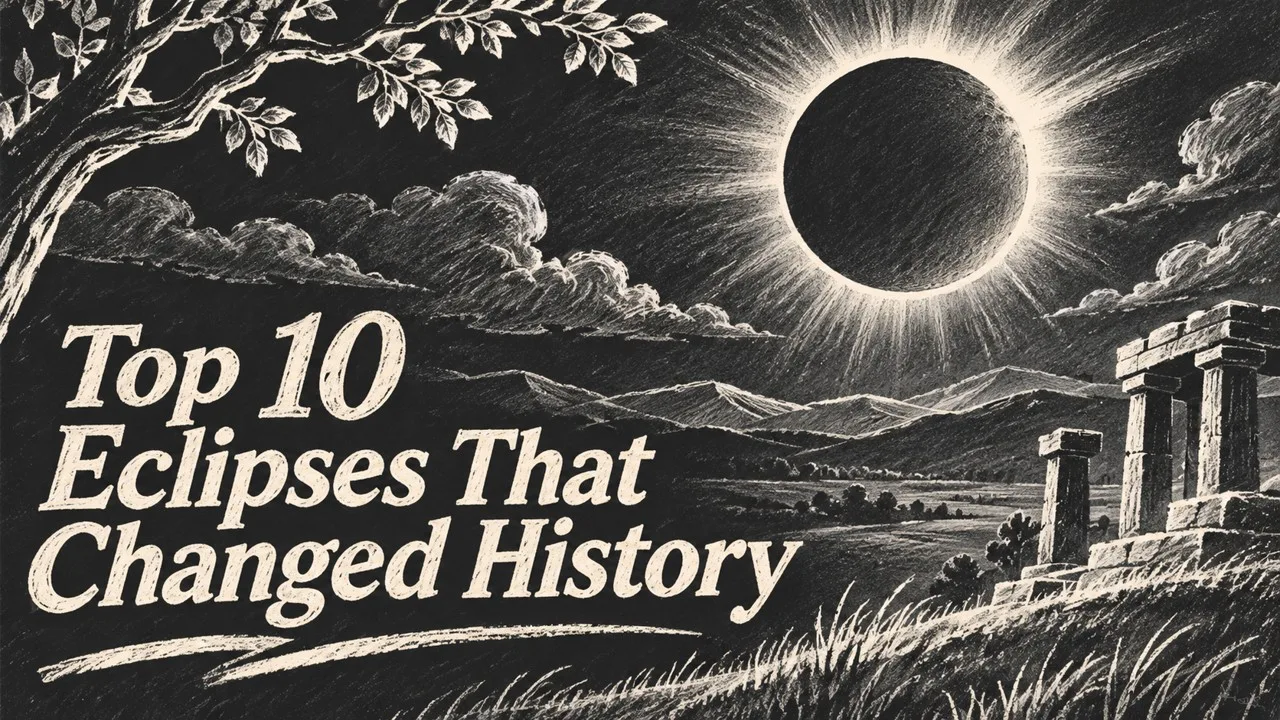
Eclipses have halted a battle, fixed ancient dates, doomed an army, revealed a new element and helped prove Einstein right. For most of history, eclipses were frightening. A sudden darkness at midday, or a Moon turning the color of blood, seemed to many people like a sign from the gods. Rulers consulted priests, armies paused and chroniclers wrote down what they saw. Those records now help historians date events precisely, because modern astronomers can calculate exactly when past eclipses happened.
As scientific knowledge grew, eclipses became opportunities rather than omens. Astronomers traveled across oceans to observe them, using the brief darkness to study the Sun's atmosphere, test new theories and photograph things that could not be seen at any other time.
The ten eclipses below are the eclipse said to have stopped a battle in 585 BC, the Assyrian eclipse of 763 BC, the lunar eclipse at Syracuse in 413 BC, the eclipses Aristotle used to argue that Earth is round, Columbus's lunar eclipse in Jamaica, Halley's eclipse map of 1715, the first photograph of a total eclipse in 1851, the eclipse that revealed helium in 1868, the 1919 eclipse that tested general relativity and the Great American Eclipse of 2017.
Key Facts
| # | Eclipse | Date | Why it mattered |
|---|---|---|---|
| 1 | The eclipse of Thales | 585 BC | Said to have stopped a battle between the Medes and Lydians |
| 2 | The Assyrian eclipse | 15 June 763 BC | Fixes the chronology of the ancient Near East |
| 3 | The lunar eclipse at Syracuse | 27 August 413 BC | Delayed the Athenian retreat, contributing to disaster |
| 4 | Aristotle's argument | Fourth century BC | Curved shadows during lunar eclipses |
| 5 | Columbus's lunar eclipse | 29 February 1504 | Used to persuade islanders to keep supplying food |
| 6 | Halley's eclipse | 3 May 1715 | A predicted path drawn on a map before the event |
| 7 | The eclipse of 1851 | 28 July 1851 | A daguerreotype captured the corona for the first time |
| 8 | The eclipse of 1868 | 18 August 1868 | Led to the discovery of helium |
| 9 | The Eddington eclipse | 29 May 1919 | Supported general relativity and made Einstein famous |
| 10 | The Great American Eclipse | 21 August 2017 | Watched by one of the largest audiences in history |
1. An Eclipse That Ended a War
According to the Greek historian Herodotus, the Medes and the Lydians had been at war for five years when, in the middle of a battle, day suddenly turned into night. Both sides were so alarmed that they stopped fighting and agreed to make peace [1].
Herodotus also wrote that the philosopher Thales of Miletus had predicted the eclipse. Modern astronomers identify it with a total solar eclipse on 28 May 585 BC, which crossed Asia Minor. This makes the battle, near the Halys River in modern Turkey, one of the earliest events in history that can be dated to the exact day [1].
Historians debate whether Thales could really have predicted the eclipse, since the methods available to him were limited. He may have known of a Babylonian cycle that allowed rough predictions. Either way, the story shows how a celestial event could change the course of a war.
2. A Date That Anchors History
Assyrian scribes kept lists of officials called eponyms, after whom each year was named. One entry, for the year of an official named Bur-Sagale, records that the Sun was eclipsed in the month of Simanu, a month that fell in late spring or early summer [2].
Astronomers have identified this event with a total solar eclipse on 15 June 763 BC. Because the eponym lists cover many consecutive years, this single date allows historians to fix the dates of other events in Assyrian history with great accuracy [2].
The Assyrian eclipse has become one of the cornerstones of ancient Near Eastern chronology. Through links with other kingdoms, it helps date events in the history of Babylon, Israel and Egypt. An entry of only a few words, written by a scribe almost 2,800 years ago, still shapes the way historians count time.
Related: Quasars: Distant Beacons or Local Oddballs?
3. An Army Doomed by a Delay
During the Peloponnesian War, Athens sent a huge expedition to attack the city of Syracuse in Sicily. By 413 BC, the campaign was going badly, and the Athenian commanders decided to withdraw [3].
Just as they prepared to leave, a lunar eclipse occurred. According to the historian Thucydides, many soldiers took it as a bad omen, and the general Nicias, who was known for his religious caution, agreed with the soothsayers to delay departure for a long period, often given as 27 days [3].
The delay allowed the Syracusans to trap the Athenian fleet in the harbor. The Athenian army was destroyed in the retreat that followed, and thousands of survivors were captured. The disaster was a major turning point in the war, which Athens eventually lost to Sparta.
4. A Shadow That Showed Earth Is Round
Ancient Greek thinkers had several reasons to believe that Earth is a sphere. One of the clearest was given by the philosopher Aristotle in his work On the Heavens, written in the fourth century BC [4].
Aristotle noted that during a lunar eclipse, the shadow that Earth casts on the Moon always has a curved edge. Only a sphere casts a round shadow from every direction, so he argued that Earth must be spherical. He also pointed out that travelers saw different stars as they moved north or south [4].
The argument from eclipses became a standard part of education in the ancient and medieval worlds. Contrary to a popular modern myth, educated people in the Middle Ages generally knew that Earth is round. Lunar eclipses gave anyone a chance to see the evidence directly.
5. A Navigator's Prediction
During his fourth voyage to the Americas, Christopher Columbus and his crew were stranded on the island of Jamaica after their ships became unusable. At first, the local Taíno people supplied them with food, but after months the supplies began to dwindle [5].
Related: Top 10 Famous Astronomical Observatories
Columbus carried an almanac by the German astronomer Regiomontanus, which predicted a lunar eclipse on 29 February 1504. According to the account of his son Ferdinand, Columbus told the local leaders that his God was angry and would make the Moon disappear. When the eclipse occurred, the islanders resumed supplying food [5].
The story is told from the Spanish point of view and should be read critically, since it reflects the attitudes of the colonizers. It shows how astronomical knowledge could be used as a tool of power. Columbus and his crew were eventually rescued later that year.
6. The First Eclipse Map
Before 1715, eclipses were often predicted, but the exact path of totality on the ground was rarely mapped. The English astronomer Edmond Halley calculated the path of a total solar eclipse that was due to cross England in May 1715 and published a map showing where it would be visible [6].
Halley also asked observers across the country to record the timing and duration of totality. His prediction proved accurate to within about four minutes, and the observations helped him refine his calculations of the Moon's orbit [6].
Halley's map is considered the first modern eclipse map. It also encouraged ordinary people to observe without fear, since the event had been explained in advance. His approach, combining prediction with organized public observation, is an early example of what we now call citizen science.
7. The First Photograph of Totality
Photography was still young in 1851 when a total solar eclipse crossed northern Europe. At the Royal Observatory in Königsberg, then in Prussia, a photographer named Johann Julius Friedrich Berkowski made a daguerreotype of the totally eclipsed Sun [7].
The image is considered the first correctly exposed photograph of a total solar eclipse. It shows the corona, the faint outer atmosphere of the Sun, which is visible only during totality. The exposure lasted for less than a minute [7].
Related: History of Human Civilization: From Ancient Times to the Modern Age
The photograph marked the beginning of astronomical photography as a scientific tool. Before then, observers had to rely on drawings, which varied widely. Photographs allowed astronomers to compare observations and to study features of the Sun objectively, transforming eclipse science in the decades that followed.
8. A New Element in the Sun
In August 1868, a total solar eclipse crossed India and Southeast Asia. The French astronomer Jules Janssen observed it from Guntur in India, using a spectroscope to study the light from the Sun's prominences [8].
Janssen and others noticed a bright yellow line in the spectrum that did not match any known element. The English astronomer Norman Lockyer studied the line further and, with the chemist Edward Frankland, proposed that it came from a new element, which they named helium, from the Greek word for the Sun [8].
Helium was not found on Earth until 1895, when the Scottish chemist William Ramsay isolated it from a mineral. It is the only element discovered in space before it was found on Earth. Today, helium is used in medical scanners, scientific research and balloons.
9. A Test of Einstein's Theory
Albert Einstein's general theory of relativity predicted that the Sun's gravity would bend the light of stars passing close to it by a specific amount. The only way to test this at the time was to photograph stars near the Sun during a total eclipse [9].
In 1919, British expeditions led by Arthur Eddington and others traveled to the island of Príncipe off West Africa and to Sobral in Brazil to observe a total eclipse. Their measurements, announced in November 1919, were consistent with Einstein's prediction rather than with the Newtonian value [9].
Related: Top 10 Interesting Facts About the Milky Way Galaxy
The announcement made headlines around the world and turned Einstein into a celebrity. Some historians have questioned the precision of the 1919 measurements, but later eclipses and modern techniques have confirmed the result many times. The eclipse is remembered as a turning point in physics.
10. A Continent Looks Up
On 21 August 2017, a total solar eclipse crossed the continental United States from Oregon to South Carolina. It was the first total eclipse to cross the country from coast to coast since 1918 [10].
Huge numbers of people traveled to the path of totality, causing traffic jams in rural areas, and many more watched a partial eclipse or followed live broadcasts. Surveys suggested that a large majority of American adults watched the eclipse in some form [10].
The eclipse also became a major scientific and educational event. Scientists used aircraft, balloons and networks of telescopes to study the corona, and thousands of volunteers collected data. It showed how eclipses that once caused fear could bring people together in shared wonder and learning.
Conclusion
The ten eclipses above show how the same natural event has changed meaning over time. In the ancient world, eclipses stopped battles, delayed armies and were recorded as omens. Those records now anchor historical chronology and allow precise dating of the past.
In the modern era, eclipses became laboratories in the sky, revealing helium, testing Einstein's theory and inspiring public science. Every eclipse is predictable to the minute, but the experience of totality still has the power to move people, just as it did thousands of years ago.
- ^ [1] Accounts of the eclipse of Thales and Herodotus's report. Wikipedia: eclipse of Thales Wikipedia: Battle of Halys
- ^ [2] Accounts of the Assyrian eclipse and eponym lists. Wikipedia: Assyrian eclipse Wikipedia: limmu
- ^ [3] Accounts of the 413 BC eclipse and the Sicilian Expedition. Wikipedia: Sicilian Expedition Wikipedia: Nicias
- ^ [4] Accounts of Aristotle's argument for a spherical Earth. Wikipedia: spherical Earth Wikipedia: On the Heavens
- ^ [5] Accounts of Columbus and the 1504 lunar eclipse. Wikipedia: fourth voyage of Christopher Columbus Wikipedia: Regiomontanus
- ^ [6] Accounts of Halley's 1715 eclipse map. Wikipedia: solar eclipse of 3 May 1715 Wikipedia: Edmond Halley
- ^ [7] Accounts of the 1851 eclipse photograph. Wikipedia: solar eclipse of 28 July 1851 Wikipedia: Johann Julius Friedrich Berkowski
- ^ [8] Accounts of the 1868 eclipse and the discovery of helium. Wikipedia: solar eclipse of 18 August 1868 Wikipedia: helium
- ^ [9] Accounts of the 1919 eclipse expeditions. Wikipedia: Eddington experiment Wikipedia: tests of general relativity
- ^ [10] Accounts of the 2017 total solar eclipse. Wikipedia: solar eclipse of 21 August 2017 Wikipedia: corona





















Discussion
Log in with