



Top 10 Holiday Songs With Surprising Origin Stories
 By Dhiraj Sharma · Published
Share Post
Loading…
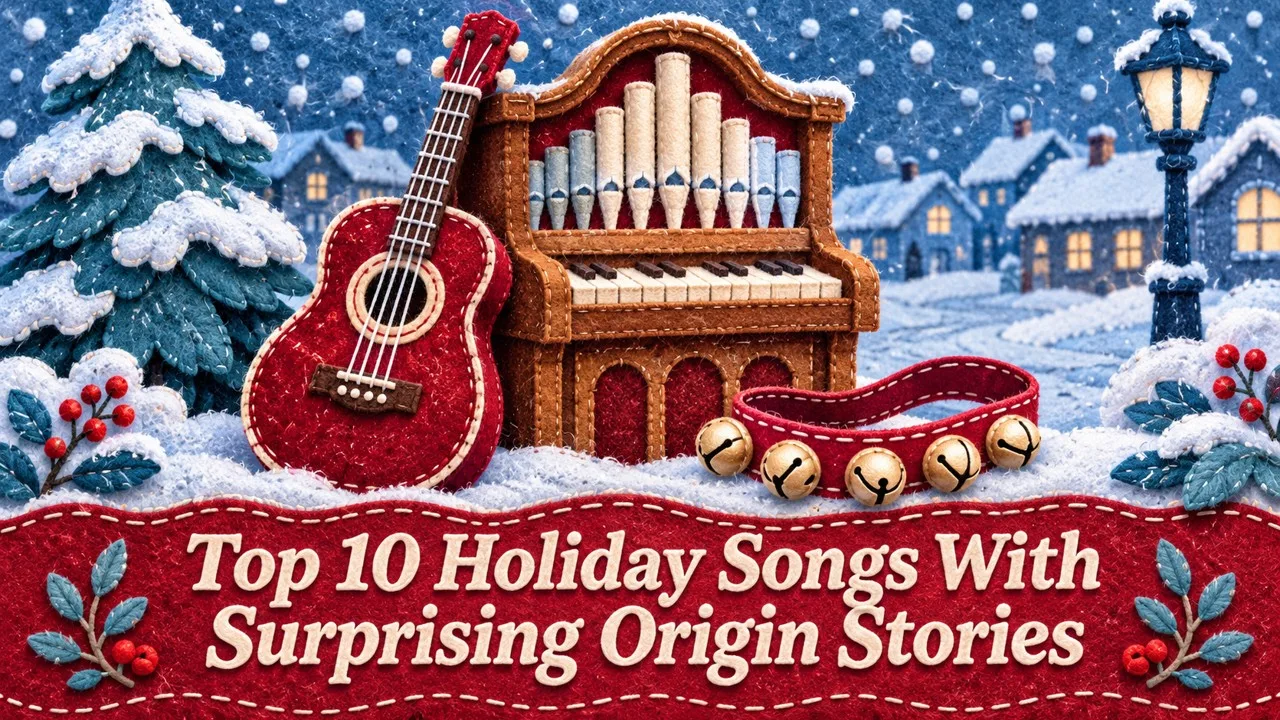
A Ukrainian New Year chant, a song written in a heat wave and a tune its composer said was unfit for sacred words: ten holiday songs with surprising origins. Every December, the same songs fill shops, radio stations, churches and living rooms. They are so familiar that it can feel as if they have always existed, passed down unchanged from some distant past. In reality, each one has a specific origin, and many of those origins are surprising.
Some of the best-loved carols began as poems or hymns that had nothing to do with Christmas. Others were written for films, advertising campaigns or entirely different seasons. Several were changed dramatically before they became the versions we know, with new words, new tunes or new meanings.
Behind these songs are poets, priests, composers, copywriters and film stars, as well as wars, tours and accidents of timing. Their stories show how music travels and transforms, picking up new associations as it moves from one country and generation to another.
Holiday songs are also surrounded by myths. Popular stories about secret codes, broken organs and famous broadcasts are often repeated without evidence. Where a well-known story is doubtful or disputed, that is noted below.
The ten songs in this article include traditional carols from Europe, a chant from Ukraine and popular songs from the golden age of American film and radio. Together, they span nearly three centuries of music.
Each has become part of the holiday season for millions of people around the world, often far from the place where it was first sung.
Knowing where these songs came from can add a new layer of meaning the next time they are heard, whether in a cathedral, a shopping mall or around a piano at home.
It can also be a reminder that traditions are always being made. Songs that now seem timeless were once new, and some were written within living memory.
Key Facts
| # | Song | Origin | Year |
|---|---|---|---|
| 1 | Silent Night | A poem by a young priest set to music in an Austrian village church | 1818 |
| 2 | Hark! The Herald Angels Sing | Words by Charles Wesley later joined to music by Felix Mendelssohn | 1739 and 1840 |
| 3 | Joy to the World | A paraphrase of a psalm by Isaac Watts | 1719 |
| 4 | O Holy Night | A poem by a wine merchant set to music by Adolphe Adam | 1847 |
| 5 | The Twelve Days of Christmas | A cumulative counting song first printed in England | 1780 |
| 6 | Carol of the Bells | A New Year chant arranged by Mykola Leontovych | 1916 |
| 7 | Rudolph the Red-Nosed Reindeer | A promotional booklet that became a hit song | 1939 and 1949 |
| 8 | White Christmas | Written by Irving Berlin for the film Holiday Inn | 1942 |
| 9 | The Christmas Song | Written by Mel Torme and Bob Wells on a hot summer day | 1945 |
| 10 | Have Yourself a Merry Little Christmas | Written for the film Meet Me in St. Louis | 1944 |
1. A Carol First Sung With a Guitar
Silent Night was first performed on Christmas Eve in 1818 at the Church of St. Nicholas in Oberndorf, a village near Salzburg in Austria. The words had been written two years earlier by Joseph Mohr, a young assistant priest, and the melody was composed by the local teacher and organist Franz Xaver Gruber [1].
The first performance was accompanied by a guitar rather than the church organ. A popular story says the organ had been damaged, sometimes by mice, but there is no firm evidence for this, and Mohr may simply have wanted a guitar accompaniment. The song spread through traveling folk singers and was later translated into many languages [1].
During the Christmas truce of 1914, soldiers on the Western Front are reported to have sung Silent Night in German and English across the trenches. In 2011, the song was recognized as part of Austria's intangible cultural heritage.
Related: Top 10 Best-Selling Albums of All Time
2. A Tune Its Composer Thought Unsuitable
The words of Hark! The Herald Angels Sing were written by Charles Wesley, one of the founders of Methodism, and published in 1739. His original first line was quite different: Hark how all the welkin rings, using an old word for the sky. Other writers, including the preacher George Whitefield, later altered the text [2].
The familiar tune came from an unexpected source. In 1840, the German composer Felix Mendelssohn wrote a cantata to celebrate the four hundredth anniversary of Johannes Gutenberg's invention of printing with movable type. Mendelssohn reportedly said that one of its melodies would never do for sacred words [2].
After Mendelssohn's death, the English musician William Hayman Cummings adapted the melody to fit Wesley's words in the 1850s. The combination proved enormously popular, and it became one of the most famous carols in the English-speaking world.
3. A Psalm, Not a Nativity Song
Joy to the World was written by the English hymn writer Isaac Watts and published in 1719 in a collection of verses based on the Psalms. It is a free paraphrase of Psalm 98, which calls on the earth and the seas to rejoice [3].
The text does not mention shepherds, angels or a manger. Many scholars read it as a celebration of the reign of Christ, and some interpret it as being about his return rather than his birth. Over time, however, it became firmly associated with Christmas [3].
The tune most often used today was arranged by the American musician Lowell Mason in the nineteenth century. It was long attributed to George Frideric Handel, and although it echoes phrases from his music, the link is uncertain.
4. A French Poem With a Radio Legend
O Holy Night began as a French poem, Minuit, chretiens, written by Placide Cappeau, a wine merchant and poet, at the request of a parish priest. The composer Adolphe Adam, best known for the ballet Giselle, set it to music in 1847 [4].
The American writer John Sullivan Dwight produced an English version in the 1850s. His translation included the lines about chains being broken because the slave is our brother, which resonated with the movement to abolish slavery in the United States [4].
A famous story claims that O Holy Night was the first piece of music broadcast by radio, played by the inventor Reginald Fessenden on Christmas Eve in 1906. Historians have questioned whether this broadcast took place as described, so the claim should be treated with caution.
Related: Top 10 Unlikely Songs That Reached Number One
5. A Memory Game, Not a Secret Code
The Twelve Days of Christmas was first printed in England in 1780, in a children's book called Mirth Without Mischief. It was originally used as a memory and forfeit game, in which players had to repeat the growing list of gifts without making a mistake [5].
The twelve days refer to the period from Christmas Day to the eve of Epiphany in early January. The familiar tune was arranged in the early twentieth century by the English composer Frederic Austin, who added the long, drawn out five gold rings [5].
In the 1990s, a claim spread that the song was a secret code used to teach Catholic beliefs in England during times of persecution. Historians have found no evidence to support this idea, and the song's origins appear to be playful rather than secret.
6. A Ukrainian Song About a Swallow
Carol of the Bells began as Shchedryk, a choral arrangement by the Ukrainian composer Mykola Leontovych of a traditional folk chant. It was first performed in Kyiv in the 1910s. The original words tell of a swallow flying into a house and promising the family a prosperous year ahead [6].
The song belongs to a tradition of shchedrivky, songs sung at the New Year. It was originally connected with the coming of spring rather than with Christmas bells [6].
In 1922, the Ukrainian National Chorus performed Shchedryk at Carnegie Hall in New York during an international tour. The American composer Peter Wilhousky later wrote new English words about bells, published in 1936, transforming it into one of the most recognizable holiday songs in the world.
7. A Department Store Giveaway
Rudolph the Red-Nosed Reindeer was created in 1939 by Robert L. May, a copywriter at the Montgomery Ward department store chain in Chicago. The company asked him to write a Christmas story that could be given away to shoppers as a promotional booklet [7].
The booklet was a huge success, with millions of copies distributed. In 1947, the company gave May the rights to the character, a generous gesture at a time when he was facing financial difficulties after his wife's illness and death [7].
Related: Top 10 Famous Bands That Began with Worse Names
May's brother-in-law, the songwriter Johnny Marks, turned the story into a song. Recorded by the singing cowboy Gene Autry in 1949, it became a best-seller, and Rudolph went on to star in a famous animated television special in 1964.
8. A Film Song That Comforted Soldiers
White Christmas was written by Irving Berlin and sung by Bing Crosby in the 1942 film Holiday Inn. The film featured songs for holidays throughout the year, and White Christmas was not at first expected to be its biggest hit [8].
The song was released during the Second World War, and its wistful longing for home struck a chord with soldiers serving overseas and their families. It became a huge success, winning an Academy Award for Best Original Song [8].
Crosby's recording of White Christmas is often cited as the best-selling single of all time, with estimates of more than fifty million copies sold. Berlin, who was Jewish, wrote one of the most famous Christmas songs ever recorded.
9. Written in a Heat Wave
The Christmas Song, with its opening line about chestnuts roasting on an open fire, was written in the summer of 1945. According to the singer and songwriter Mel Torme, it was a very hot day in California, and his writing partner Bob Wells had jotted down wintry phrases to try to stay cool by thinking cool [9].
Torme saw the lines and the two men turned them into a song in a short time. They then brought it to the singer Nat King Cole, who recorded it in 1946 [9].
Cole recorded the song several times, and his 1961 version became the most famous. It remains one of the most frequently performed holiday songs, and it reflects a cozy picture of winter written in the middle of summer.
10. A Song That Was Made Less Gloomy
Have Yourself a Merry Little Christmas was written by Hugh Martin and Ralph Blane for the 1944 film Meet Me in St. Louis, starring Judy Garland. In the film, her character sings it to comfort her younger sister, who is upset about the family's planned move to New York [10].
Related: Top 10 Songs and Products That Became Hits the Second Time
Martin's original lyrics were much darker, suggesting it might be the family's last Christmas together. Garland and others found them too sad, and Martin rewrote them to sound more hopeful, though the song kept a bittersweet tone [10].
In 1957, Frank Sinatra asked Martin to change another line, about muddling through somehow, to make it more cheerful. The revised line about hanging a shining star is now the version most people know.
Conclusion
These songs show that holiday traditions are often younger, and more complicated, than they seem. Carols that sound ancient were sometimes stitched together from different sources, while modern favorites were written for films, advertising and radio.
Their origins also reflect the times in which they were created. War, migration, faith, commerce and even the weather all played a part in shaping the songs we now sing every year.
Many of the popular myths about these songs turn out to be unproven, but the true stories are often just as interesting. A Ukrainian chant about a swallow, a hymn based on a psalm and a song written in a heat wave all found their way into the holiday season.
Songs continue to evolve as new artists record them and new generations discover them. The holiday playlist is a living tradition, constantly renewed.
The next time a familiar carol plays, it may be worth listening a little more closely to the long and surprising journey behind it.
- ^ [1] Accounts of Silent Night. Wikipedia: Silent Night Wikipedia: Christmas truce
- ^ [2] Accounts of Hark! The Herald Angels Sing. Wikipedia: Hark! The Herald Angels Sing Wikipedia: Felix Mendelssohn
- ^ [3] Accounts of Joy to the World. Wikipedia: Joy to the World Wikipedia: Isaac Watts
- ^ [4] Accounts of O Holy Night. Wikipedia: O Holy Night Wikipedia: Reginald Fessenden
- ^ [5] Accounts of The Twelve Days of Christmas. Wikipedia: The Twelve Days of Christmas (song) Wikipedia: Twelve Days of Christmas
- ^ [6] Accounts of Carol of the Bells. Wikipedia: Carol of the Bells Wikipedia: Mykola Leontovych
- ^ [7] Accounts of Rudolph. Wikipedia: Rudolph the Red-Nosed Reindeer Wikipedia: Robert L. May
- ^ [8] Accounts of White Christmas. Wikipedia: White Christmas (song) Wikipedia: Irving Berlin
- ^ [9] Accounts of The Christmas Song. Wikipedia: The Christmas Song Wikipedia: Mel Torme
- ^ [10] Accounts of Have Yourself a Merry Little Christmas. Wikipedia: Have Yourself a Merry Little Christmas Wikipedia: Meet Me in St. Louis






















Discussion
Log in with