






 By
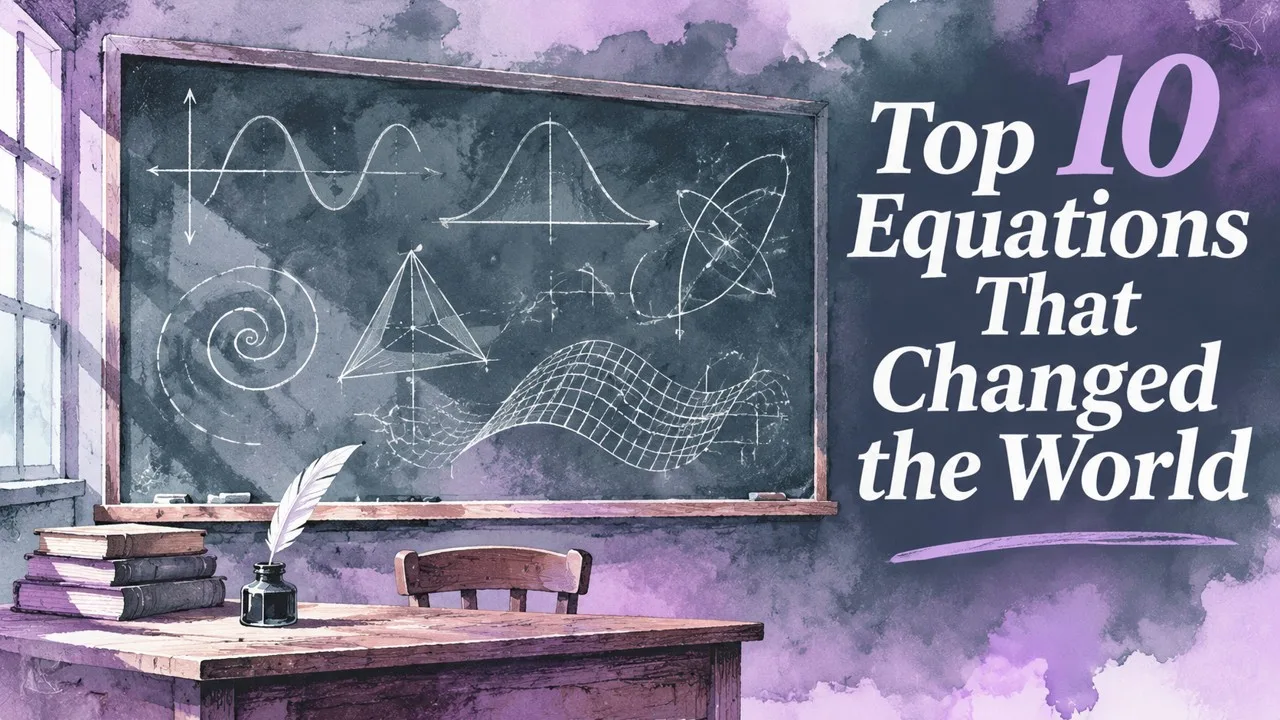
From Pythagoras' theorem to Einstein's E equals mc squared, these ten equations that changed the world gave us bridges, radio, nuclear power and the internet. An equation is a statement that two things are equal, written in the language of mathematics. A short line of symbols can describe the motion of planets, the behaviour of light or the flow of information through a cable.
This list explains ten equations that changed science and daily life, without needing advanced mathematics. Each one opened new ways of understanding the world and led to technologies we now take for granted.
Key Facts
The ten equations below range from ancient geometry to the information age of 1948.
World-Changing Equations at a Glance
| # | Equation | Year | Creator | What it made possible |
|---|---|---|---|---|
| 1 | Pythagorean Theorem | Ancient, proved by Euclid around 300 BC | Pythagorean tradition | Measuring distances and shapes |
| 2 | Logarithms | 1614 | John Napier | Turned multiplication into addition |
| 3 | Newton's Law of Gravitation | 1687 | Isaac Newton | Explained the motion of the planets |
| 4 | Euler's Identity | 1748 | Leonhard Euler | Links the key numbers of mathematics |
| 5 | Fourier Transform | 1822 | Joseph Fourier | Breaking signals into waves |
| 6 | Maxwell's Equations | 1865 | James Clerk Maxwell | Explained light and predicted radio waves |
| 7 | Boltzmann's Entropy Formula | 1870s | Ludwig Boltzmann | Explained why time has a direction |
| 8 | Mass-energy Equivalence | 1905 | Albert Einstein | Mass and energy are interchangeable |
| 9 | Schrodinger Equation | 1926 | Erwin Schrodinger | The rules of the quantum world |
| 10 | Shannon's Information Entropy | 1948 | Claude Shannon | Founded the information age |
1. Pythagorean Theorem
The Pythagorean theorem states that in a right-angled triangle, the square of the longest side equals the sum of the squares of the other two sides. [1]
The relationship was known long before Pythagoras. A Babylonian clay tablet known as Plimpton 322, from around 1800 BC, lists sets of numbers that fit it, and Indian texts called the Sulba Sutras describe it for building altars. [1]
The Greek mathematician Euclid gave a famous proof in his Elements around 300 BC.
The theorem is used to calculate distances in surveying, construction, navigation and computer graphics. Satellite navigation systems rely on related geometry to work out positions.
More than three hundred different proofs of the theorem have been published, including one by the American president James Garfield.
Key Figures
- Statement: square of the hypotenuse equals the sum of the other two squares
- Babylonian evidence: Plimpton 322
- Classic proof: Euclid's Elements
- Uses: surveying, navigation, graphics
Why It Made the List
The Pythagorean theorem is one of the most useful facts in mathematics. It underpins how we measure space.
2. Logarithms
In 1614 the Scottish mathematician John Napier published tables of logarithms. A logarithm tells you what power a number must be raised to in order to produce another number. [2]
Logarithms turn multiplication into addition and division into subtraction, making long calculations far easier. The English mathematician Henry Briggs soon produced tables using base 10. [2]
Astronomers, navigators and engineers used logarithm tables for centuries. The French scientist Pierre-Simon Laplace said logarithms had in effect doubled the life of the astronomer by shortening their labours.
The slide rule, invented in the 1620s, used logarithmic scales and was the main calculating tool for engineers until electronic calculators arrived in the 1970s.
Logarithmic scales are still used for measuring earthquakes, sound levels and acidity.
Napier spent about twenty years calculating his tables by hand.
Key Figures
- Inventor: John Napier
- Published: 1614
- Base-10 tables: Henry Briggs
- Tool: the slide rule
Why It Made the List
Logarithms made complex calculation practical. They powered science and engineering for three centuries.
3. Newton's Law of Gravitation
In his Principia, published in 1687, Isaac Newton stated that every object attracts every other object with a force that depends on their masses and decreases with the square of the distance between them. [3]
Related: Top 10 Remarkable Numbers and the Ideas Behind Them
This single law explained why apples fall, why the Moon orbits the Earth and why planets follow the elliptical orbits described by Johannes Kepler. [3]
Using Newton's ideas, Edmond Halley predicted the return of a comet in 1758. Its return, after Halley's death, was a triumph for Newton's theory.
In 1846 astronomers found the planet Neptune after Urbain Le Verrier used Newton's law to predict its position from irregularities in the orbit of Uranus.
Newton's law is still used to plan space missions and satellite orbits.
Key Figures
- Published: 1687, in the Principia
- Key idea: force falls with distance squared
- Triumph: Halley's comet returned, 1758
- Discovery: Neptune, 1846
Why It Made the List
Newton's law united heaven and Earth under one rule. It made the solar system predictable.
4. Euler's Identity
Euler's identity connects five of the most important numbers in mathematics: zero, one, pi, the number e and the imaginary unit i, in a single short equation. [4]
It is a special case of Euler's formula, which links exponential functions with sine and cosine. The Swiss mathematician Leonhard Euler published the formula in 1748. [4]
Many mathematicians consider Euler's identity the most beautiful equation in mathematics, and it has topped polls of mathematicians' favourite formulas.
Euler's formula is not just elegant. It is used daily by engineers to analyse alternating current, sound waves, radio signals and vibrations.
Euler was one of the most productive mathematicians in history, publishing hundreds of works even after losing his sight.
The number e, about 2.718, appears naturally in growth and decay, such as compound interest and radioactive decay.
Key Figures
- Mathematician: Leonhard Euler
- Formula published: 1748
- Constants linked: five
- Practical use: electrical engineering
Why It Made the List
Euler's identity reveals deep connections in mathematics. Its formula is a workhorse of modern engineering.
5. Fourier Transform
In 1822 the French mathematician Joseph Fourier published The Analytical Theory of Heat. To study how heat spreads, he showed that complicated patterns can be described as sums of simple waves. [5]
The Fourier transform turns a signal, such as a sound, into the set of frequencies that make it up, and back again. [5]
It is used everywhere in modern technology, including music and image compression, mobile phone signals, medical scanners and the analysis of earthquakes.
Related: Top 10 Accidental Inventions That Changed Everyday Life
In 1965 James Cooley and John Tukey published the Fast Fourier Transform, a method that made these calculations practical on computers.
Fourier is also credited with first describing what is now called the greenhouse effect, in the 1820s.
Our ears do something similar naturally, separating sounds into different pitches.
Key Figures
- Mathematician: Joseph Fourier
- Published: 1822
- Key idea: signals as sums of waves
- Fast method: 1965, Cooley and Tukey
Why It Made the List
Fourier's idea is behind much of digital technology. It lets machines understand sound, images and signals.
6. Maxwell's Equations
In 1865 the Scottish physicist James Clerk Maxwell published a set of equations describing how electric and magnetic fields behave and interact. [6]
His equations showed that changing electric and magnetic fields create waves that travel at the speed of light. Maxwell concluded that light itself is an electromagnetic wave. [6]
The equations predicted other electromagnetic waves. In the late 1880s, the German physicist Heinrich Hertz produced and detected radio waves in his laboratory.
The English engineer Oliver Heaviside later rewrote Maxwell's work into the four compact equations known today.
Maxwell's equations are the foundation of radio, television, radar, mobile phones and Wi-Fi.
Albert Einstein kept a picture of Maxwell on his study wall, alongside Newton and Faraday, and said Maxwell's work was the most profound and fruitful physics had experienced since Newton. Maxwell also took one of the first colour photographs, in 1861.
Key Figures
- Physicist: James Clerk Maxwell
- Published: 1865
- Prediction: electromagnetic waves
- Confirmed by: Heinrich Hertz, late 1880s
Why It Made the List
Maxwell's equations unified electricity, magnetism and light. They made wireless communication possible.
7. Boltzmann's Entropy Formula
The second law of thermodynamics says that in an isolated system, entropy, a measure of disorder, never decreases. The German physicist Rudolf Clausius coined the word entropy in 1865. [7]
The Austrian physicist Ludwig Boltzmann explained entropy in terms of atoms. His formula links entropy to the number of ways the particles in a system can be arranged. [7]
Related: Top 10 Overlooked Mathematicians Who Shaped the Modern World
It explains why heat flows from hot to cold, why ice melts in a warm drink and why mixed things do not unmix by themselves.
Boltzmann's ideas were controversial because many scientists doubted atoms existed. His formula is engraved on his tombstone in Vienna.
Entropy is central to engines, refrigerators, chemistry and the study of information.
His ideas later shaped quantum physics and computing.
Key Figures
- Physicist: Ludwig Boltzmann
- Word entropy coined: 1865, by Clausius
- Key idea: entropy counts arrangements
- Tombstone: Vienna
Why It Made the List
Boltzmann's formula explained the arrow of time. It linked the behaviour of atoms to everyday experience.
8. Mass-energy Equivalence
In 1905 Albert Einstein published a short paper showing that mass and energy are equivalent. The equation E equals mc squared states that energy equals mass multiplied by the speed of light squared. [8]
Because the speed of light is so large, a tiny amount of mass corresponds to an enormous amount of energy. [8]
The equation explains how the Sun shines, by converting mass into energy through nuclear fusion.
In 1932 John Cockcroft and Ernest Walton split atomic nuclei in an experiment that confirmed Einstein's formula.
The equation underlies nuclear power stations and medical technologies such as PET scanners, and it has become a symbol of science itself.
The paper was one of four groundbreaking papers Einstein published in 1905, while working as a patent clerk in Bern, a year often called his miracle year.
Key Figures
- Scientist: Albert Einstein
- Year: 1905
- Meaning: energy equals mass times light speed squared
- Experimental test: 1932, Cockcroft and Walton
Why It Made the List
E equals mc squared is the most famous equation in the world. It revealed the energy locked inside matter.
9. Schrodinger Equation
In 1926 the Austrian physicist Erwin Schrodinger published an equation describing how quantum systems, such as electrons in atoms, change over time. [9]
The equation uses a wave function to describe a particle. Max Born showed that the wave function gives the probability of finding a particle in a particular place. [9]
Related: Albert Einstein: The Theoretical Physicist Who Redefined Science
The Schrodinger equation explains the structure of atoms, the periodic table and how chemical bonds form.
It is essential to technologies such as transistors, lasers and computer chips.
Schrodinger shared the 1933 Nobel Prize in Physics with Paul Dirac, and in 1935 he proposed his famous thought experiment about a cat.
Today supercomputers solve versions of it to design new medicines, materials and batteries.
Schrodinger developed the equation while on a holiday in the Swiss Alps.
Key Figures
- Physicist: Erwin Schrodinger
- Published: 1926
- Interpretation: probability, by Max Born
- Nobel Prize: 1933
Why It Made the List
The Schrodinger equation is the foundation of quantum chemistry and electronics. It explains why matter behaves as it does.
10. Shannon's Information Entropy
In 1948 the American engineer and mathematician Claude Shannon published A Mathematical Theory of Communication while working at Bell Labs. [10]
He defined a way to measure information and showed how much information can be sent over a noisy channel without errors. [10]
Shannon popularised the bit, short for binary digit, as the basic unit of information, a term credited to his colleague John Tukey.
His work set the limits of data compression and error-correcting codes, which are essential for the internet, mobile phones and digital storage.
Shannon is often called the father of information theory. He also built playful machines, including a mechanical mouse that could solve a maze.
His master's thesis of 1937 had already shown how electrical switching circuits could carry out logic, a foundation of digital computers.
Key Figures
- Scientist: Claude Shannon
- Published: 1948
- Workplace: Bell Labs
- Unit: the bit
Why It Made the List
Shannon's equation made digital communication possible. Every message sent online relies on his ideas.
Conclusion
These ten equations show how mathematics can describe the world with remarkable power. Many began as abstract ideas and later became the basis of everyday technologies.
From bridges and satellites to radios and smartphones, modern life is built on equations. Understanding them, even simply, reveals how the world works.
- ^ [1] "Pythagorean Theorem". Wikipedia. Wikipedia: Pythagorean theorem Wikipedia: Plimpton 322
- ^ [2] "Logarithms". Wikipedia. Wikipedia: Logarithm Wikipedia: John Napier
- ^ [3] "Newton's Law of Gravitation". Wikipedia. Wikipedia: Newton's law of universal gravitation Wikipedia: Philosophiæ Naturalis Principia Mathematica
- ^ [4] "Euler's Identity". Wikipedia. Wikipedia: Euler's identity Wikipedia: Euler's formula
- ^ [5] "Fourier Transform". Wikipedia. Wikipedia: Fourier transform Wikipedia: Joseph Fourier
- ^ [6] "Maxwell's Equations". Wikipedia. Wikipedia: Maxwell's equations Wikipedia: James Clerk Maxwell
- ^ [7] "Boltzmann's Entropy Formula". Wikipedia. Wikipedia: Boltzmann's entropy formula Wikipedia: Second law of thermodynamics
- ^ [8] "Mass-energy Equivalence". Wikipedia. Wikipedia: Mass–energy equivalence Wikipedia: Annus mirabilis papers
- ^ [9] "Schrodinger Equation". Wikipedia. Wikipedia: Schrödinger equation Wikipedia: Erwin Schrödinger
- ^ [10] "Shannon's Information Entropy". Wikipedia. Wikipedia: Entropy (information theory) Wikipedia: Claude Shannon





















Discussion
Log in with