





 By
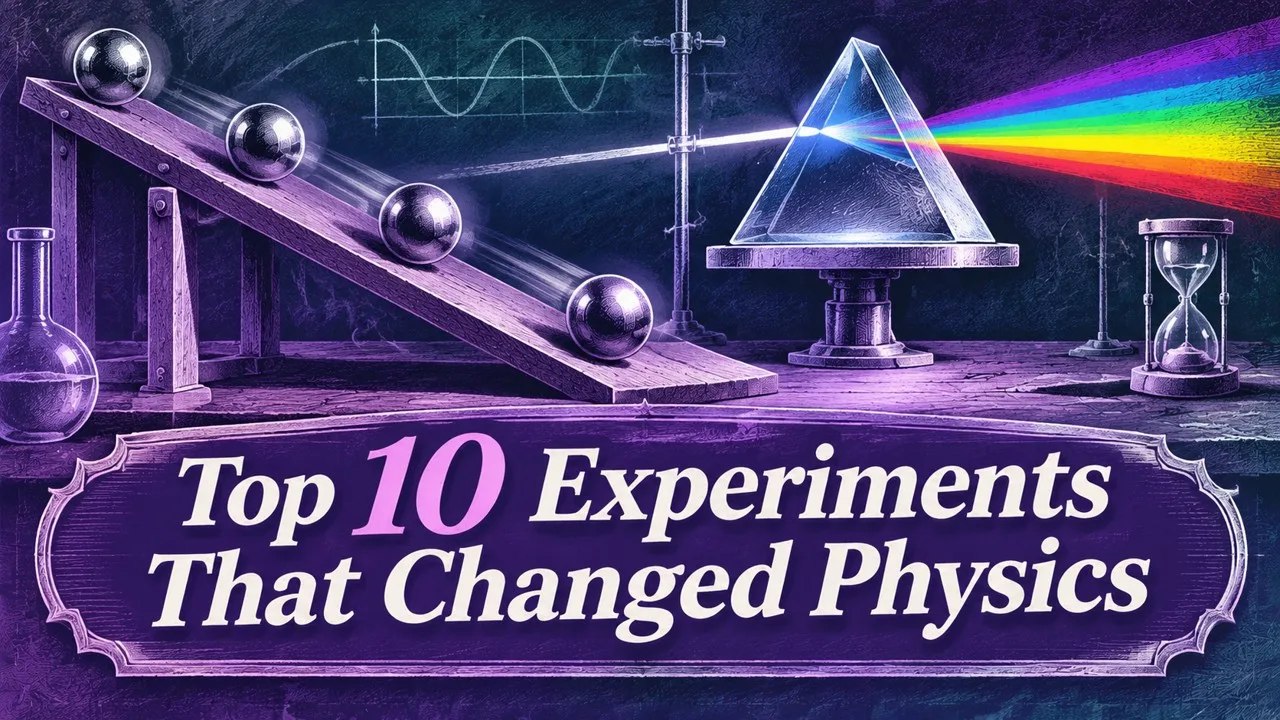
From Galileo's rolling balls to Chien-Shiung Wu's cobalt test, these ten experiments that changed physics overturned old ideas about light, matter and motion. Physics advances when ideas are tested against nature. Some experiments confirm what scientists expect, but the most important ones often produce surprising results that force them to rethink their theories completely.
This list describes ten landmark experiments, from the seventeenth to the twentieth century. They changed our understanding of motion, light, gravity, electricity and the structure of atoms, and several led directly to new theories or technologies.
Key Facts
The ten experiments below were carried out between the early 1600s and 1957.
Landmark Physics Experiments at a Glance
| # | Experiment | Year | Scientist | What it showed |
|---|---|---|---|---|
| 1 | Galileo's Inclined Plane | Early 1600s | Galileo Galilei | Objects accelerate evenly as they fall |
| 2 | Newton's Prism Experiments | 1666 to 1672 | Isaac Newton | White light is a mixture of colours |
| 3 | Cavendish Experiment | 1797 to 1798 | Henry Cavendish | Weighed the Earth |
| 4 | Young's Double-slit Experiment | 1801 to 1803 | Thomas Young | Light behaves as a wave |
| 5 | Faraday's Induction Experiment | 1831 | Michael Faraday | Magnetism can create electricity |
| 6 | Michelson-Morley Experiment | 1887 | Albert Michelson and Edward Morley | No sign of the aether |
| 7 | Millikan's Oil-drop Experiment | 1909 to 1913 | Robert Millikan | Measured the charge of the electron |
| 8 | Gold Foil Experiment | 1909 | Hans Geiger and Ernest Marsden under Ernest Rutherford | Atoms have a tiny nucleus |
| 9 | Eddington's Eclipse Observations | 1919 | Arthur Eddington and colleagues | Gravity bends light |
| 10 | Wu Experiment | 1956 to 1957 | Chien-Shiung Wu | Nature can tell left from right |
1. Galileo's Inclined Plane
In the early seventeenth century, the Italian scientist Galileo Galilei studied falling objects by rolling balls down gently sloping wooden ramps. The slope slowed the motion enough for him to measure it. [1]
He timed the balls using a water clock, weighing the water that flowed out during each run. He found that the distance travelled increased with the square of the time, showing that the balls accelerated at a steady rate. [1]
Galileo concluded that, without air resistance, all objects would fall with the same acceleration, regardless of their weight. This overturned Aristotle's idea that heavier objects fall faster.
The famous story of Galileo dropping balls from the Leaning Tower of Pisa may be a legend, but his ramp experiments are well documented.
He published his results in Two New Sciences in 1638, laying foundations for Newton's laws of motion.
Key Figures
- Scientist: Galileo Galilei
- Method: balls rolled down ramps
- Timing: a water clock
- Published: Two New Sciences, 1638
Why It Made the List
Galileo's experiments founded the science of motion. They showed the power of measuring nature rather than relying on authority.
2. Newton's Prism Experiments
In the 1660s, Isaac Newton passed a beam of sunlight through a glass prism in a darkened room. The light spread out into a band of colours, which he called a spectrum. [2]
Earlier thinkers believed the prism added colour to light. In his key experiment, Newton passed a single colour from one prism through a second prism and found that it did not change further. [2]
He concluded that white light is a mixture of all colours and that each colour is bent by a different amount. He reported his results to the Royal Society in 1672.
His work explained rainbows and the colour fringes seen in telescopes. To avoid those fringes, Newton built a reflecting telescope using a mirror instead of lenses.
His book Opticks, published in 1704, became a classic of experimental science.
Key Figures
- Scientist: Isaac Newton
- Report to the Royal Society: 1672
- Discovery: white light contains all colours
- Book: Opticks, 1704
Why It Made the List
Newton's prism experiments founded the modern science of light and colour. They also inspired better telescopes.
3. Cavendish Experiment
In 1797 and 1798 the English scientist Henry Cavendish measured the tiny gravitational attraction between lead balls in his laboratory. [3]
Related: Top 10 Surprising Facts About Benjamin Franklin
He used a torsion balance, a rod with small lead balls at each end hung from a thin wire, designed by John Michell. Larger lead balls placed nearby pulled the small ones, twisting the wire by a tiny amount. [3]
Cavendish observed the apparatus through a telescope from outside the room, so that his body heat and air currents would not disturb it.
From his measurements he calculated the density of the Earth to be about 5.45 times that of water, very close to the modern figure of about 5.51. This allowed scientists to calculate the Earth's mass.
His results also made it possible to determine the gravitational constant, a fundamental number in physics.
Key Figures
- Scientist: Henry Cavendish
- Apparatus: torsion balance designed by John Michell
- Earth's density found: about 5.45 times water
- Modern value: about 5.51
Why It Made the List
Cavendish measured gravity between ordinary objects for the first time. His experiment effectively weighed the planet.
4. Young's Double-slit Experiment
In the early 1800s, the English scientist Thomas Young shone light through two narrow slits or around a thin card and observed the pattern it made on a screen. [4]
Instead of two bright lines, he saw a pattern of light and dark bands. These bands, called interference fringes, form when waves overlap and either strengthen or cancel each other. [4]
Young's results supported the idea that light travels as a wave, challenging Newton's view that light was made of particles.
In the twentieth century, the double-slit experiment became central to quantum physics, when scientists found that even single electrons and photons produce interference patterns.
Young was a remarkable polymath who also contributed to deciphering Egyptian hieroglyphs from the Rosetta Stone.
Key Figures
- Scientist: Thomas Young
- Presented: about 1803
- Pattern: interference fringes
- Conclusion: light acts as a wave
Why It Made the List
The double-slit experiment proved light's wave nature. It later became the most famous demonstration of quantum strangeness.
5. Faraday's Induction Experiment
On 29 August 1831, Michael Faraday wound two coils of wire around opposite sides of an iron ring. When he connected one coil to a battery, a brief current flowed in the other coil. [5]
Faraday then showed that moving a magnet in and out of a coil of wire produced an electric current. He called this electromagnetic induction. [5]
Related: Top 10 Strange States of Matter Created in Labs
He built a simple electric generator, a copper disc spinning between the poles of a magnet, which produced a steady current.
Faraday had little formal education and began as a bookbinder's apprentice, but he became one of the greatest experimental scientists in history.
Electromagnetic induction is the principle behind electric generators, transformers and induction cooktops, making the modern electrical age possible.
Key Figures
- Date: 29 August 1831
- Scientist: Michael Faraday
- Discovery: electromagnetic induction
- Invention: the disc generator
Why It Made the List
Faraday's experiment showed how to turn motion into electricity. Nearly all electricity today is generated by his principle.
6. Michelson-Morley Experiment
In the nineteenth century, scientists believed light waves travelled through an invisible substance called the luminiferous aether, which filled space. [6]
In 1887 Albert Michelson and Edward Morley, working in Cleveland, Ohio, built a sensitive instrument called an interferometer. It split a beam of light in two, sent the beams in different directions and recombined them. [6]
If the Earth was moving through the aether, light should travel at slightly different speeds in different directions, shifting the pattern. The instrument floated on a pool of mercury so it could be rotated smoothly.
They found no meaningful difference, a result known as the null result.
The experiment helped lead to Albert Einstein's special theory of relativity in 1905, which did away with the aether. Michelson became the first American to win a Nobel Prize in science, in 1907.
Key Figures
- Year: 1887
- Scientists: Michelson and Morley
- Instrument: interferometer
- Result: no aether detected
Why It Made the List
The Michelson-Morley experiment is the most famous failed experiment in history. Its null result transformed physics.
7. Millikan's Oil-drop Experiment
Beginning in 1909, the American physicist Robert Millikan, working with Harvey Fletcher, sprayed tiny drops of oil into a chamber between two metal plates. [7]
Some drops picked up electric charge. By adjusting the voltage on the plates, Millikan could make a charged drop float or rise, and from its motion he calculated its charge. [7]
He found that every charge was a whole-number multiple of a basic unit. This showed that electric charge comes in fixed amounts and gave an accurate value for the charge of a single electron.
Related: Top 10 Extreme Forces Scientists Have Recreated in the Lab
Millikan published his main results in 1913 and received the Nobel Prize in Physics in 1923.
Later historians debated how he selected his data, but his value was close to the modern figure.
Key Figures
- Began: 1909
- Scientists: Robert Millikan and Harvey Fletcher
- Measured: the electron's charge
- Nobel Prize: 1923
Why It Made the List
The oil-drop experiment showed that electric charge is quantised. It provided one of the basic constants of physics.
8. Gold Foil Experiment
In 1909 at the University of Manchester, Hans Geiger and Ernest Marsden fired alpha particles at a very thin sheet of gold foil, under the direction of Ernest Rutherford. [8]
Most of the particles passed straight through, but a few bounced off at large angles, and a very small number bounced almost straight back. [8]
Rutherford was astonished, later saying it was like firing a large shell at tissue paper and having it come back.
In 1911 he explained the results with a new model of the atom: a tiny, dense, positively charged nucleus surrounded by mostly empty space.
This nuclear model replaced the earlier plum pudding model and became the basis of atomic and nuclear physics.
Geiger later developed the Geiger counter for detecting radiation.
Key Figures
- Year: 1909
- Experimenters: Geiger and Marsden
- Leader: Ernest Rutherford
- New model: 1911, the nuclear atom
Why It Made the List
The gold foil experiment revealed the atomic nucleus. It changed our picture of matter forever.
9. Eddington's Eclipse Observations
Albert Einstein's general theory of relativity, published in 1915, predicted that the Sun's gravity would bend light from distant stars by a specific amount. [9]
To test this, British astronomers organised expeditions to observe a total eclipse on 29 May 1919, when stars near the Sun could be photographed. Arthur Eddington went to the island of Principe, off West Africa, while another team went to Sobral in Brazil. [9]
The photographs showed that starlight was bent by an amount consistent with Einstein's prediction, not the smaller amount expected from Newton's theory.
Related: Top 10 Real Experiments Behind the Idea of Teleportation
The results were announced in London in November 1919 and made headlines worldwide, turning Einstein into a celebrity.
Later, more precise measurements using radio telescopes have confirmed the result with great accuracy.
Key Figures
- Date: 29 May 1919
- Sites: Principe and Sobral
- Tested: general relativity
- Announced: November 1919
Why It Made the List
The eclipse observations confirmed Einstein's theory of gravity. They changed our understanding of space and time.
10. Wu Experiment
Physicists long assumed that the laws of nature are the same in a mirror image, a principle called parity conservation. [10]
In 1956 the theorists Tsung-Dao Lee and Chen-Ning Yang suggested that parity might not be conserved in the weak nuclear force, which causes some radioactive decay. [10]
The Chinese-American physicist Chien-Shiung Wu designed an experiment to test this. Working with a team at the National Bureau of Standards, she cooled radioactive cobalt-60 to near absolute zero and aligned its nuclei with a magnetic field.
The electrons emitted during decay came out more in one direction than the other, proving that parity was violated.
Lee and Yang received the Nobel Prize in 1957, but Wu was not included, a decision widely criticised. She later won the first Wolf Prize in Physics in 1978.
Key Figures
- Scientist: Chien-Shiung Wu
- Material: cobalt-60
- Discovery: parity violation
- Honour: Wolf Prize, 1978
Why It Made the List
Wu's experiment showed that nature is not perfectly symmetrical. It reshaped particle physics.
Conclusion
These ten experiments show how careful measurement can overturn long-held beliefs. Several produced results no one expected.
Together, they built the foundations of classical physics, electromagnetism, relativity and quantum physics, and they remain classic lessons in how science works.
- ^ [1] "Galileo's Inclined Plane". Wikipedia. Wikipedia: Galileo Galilei Wikipedia: Two New Sciences
- ^ [2] "Newton's Prism Experiments". Wikipedia. Wikipedia: Opticks Wikipedia: Isaac Newton
- ^ [3] "Cavendish Experiment". Wikipedia. Wikipedia: Cavendish experiment Wikipedia: Henry Cavendish
- ^ [4] "Young's Double-slit Experiment". Wikipedia. Wikipedia: Double-slit experiment Wikipedia: Thomas Young (scientist)
- ^ [5] "Faraday's Induction Experiment". Wikipedia. Wikipedia: Michael Faraday Wikipedia: Electromagnetic induction
- ^ [6] "Michelson-Morley Experiment". Wikipedia. Wikipedia: Michelson–Morley experiment Wikipedia: Luminiferous aether
- ^ [7] "Millikan's Oil-drop Experiment". Wikipedia. Wikipedia: Oil drop experiment Wikipedia: Robert A. Millikan
- ^ [8] "Gold Foil Experiment". Wikipedia. Wikipedia: Rutherford model Wikipedia: Geiger–Marsden experiments
- ^ [9] "Eddington's Eclipse Observations". Wikipedia. Wikipedia: Eddington experiment Wikipedia: General relativity
- ^ [10] "Wu Experiment". Wikipedia. Wikipedia: Wu experiment Wikipedia: Chien-Shiung Wu




















Discussion
Log in with