





 By
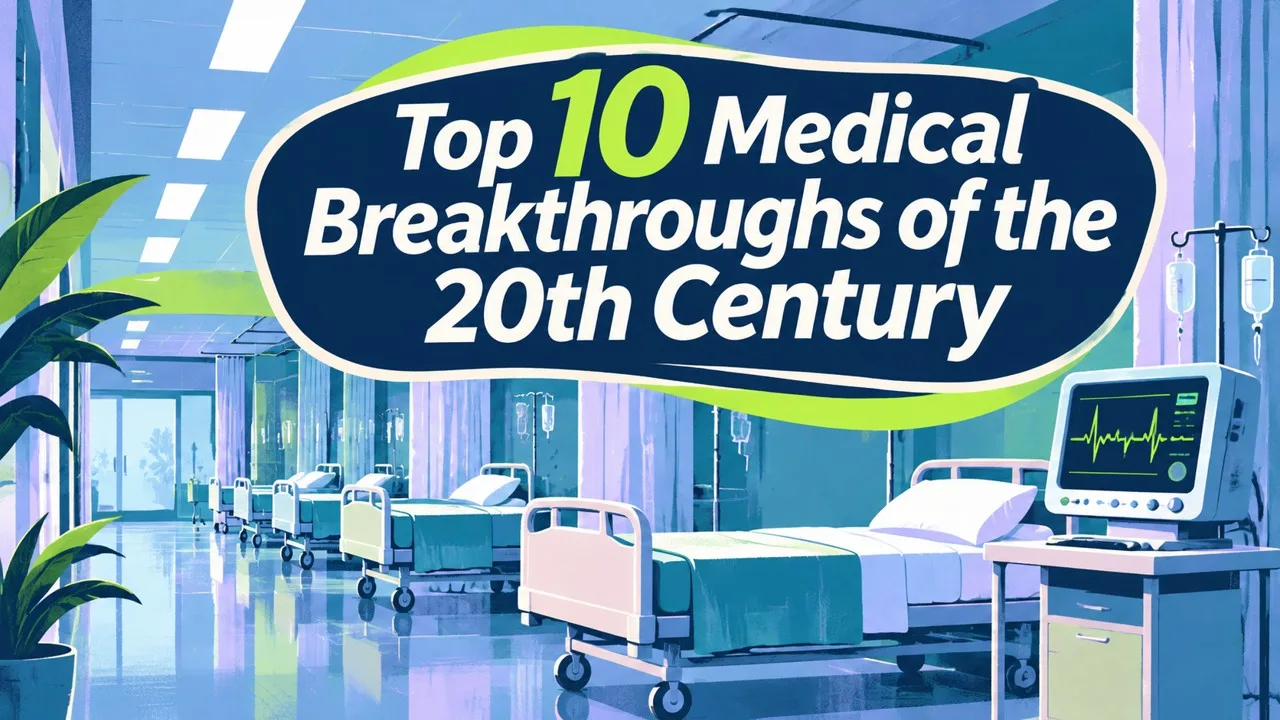
From blood groups and insulin to IVF and oral rehydration salts, these ten medical breakthroughs of the 20th century saved millions and changed modern care. The twentieth century transformed medicine more than any period before it. Life expectancy around the world rose dramatically, thanks to better nutrition, sanitation, vaccines and antibiotics, as well as new ways to diagnose and treat disease.
This list highlights ten breakthroughs from that century, from safe blood transfusion to organ transplants and imaging. Vaccines, antibiotics and the pacemaker are covered in other Finepedia articles, so this list focuses on other milestones.
Key Facts
The ten breakthroughs below date from 1901 to the 1970s.
20th-Century Medical Breakthroughs at a Glance
| # | Breakthrough | Year | Pioneers | Impact |
|---|---|---|---|---|
| 1 | Blood Groups | 1901 | Karl Landsteiner | Made blood transfusion safe |
| 2 | Electrocardiogram | 1903 | Willem Einthoven | Recorded the heart's electrical activity |
| 3 | Insulin | 1921 to 1922 | Frederick Banting and Charles Best | Turned diabetes from fatal to treatable |
| 4 | Kidney Dialysis | 1943 to 1945 | Willem Kolff | An artificial kidney |
| 5 | Heart-lung Machine | 1953 | John Gibbon | Made open-heart surgery possible |
| 6 | Kidney Transplant | 1954 | Joseph Murray | First successful organ transplant |
| 7 | Heart Transplant | 1967 | Christiaan Barnard | A new heart for a dying patient |
| 8 | CT Scanner | 1971 | Godfrey Hounsfield | Images of slices inside the body |
| 9 | In Vitro Fertilisation | 1978 | Robert Edwards and Patrick Steptoe | Helped millions of couples have children |
| 10 | Oral Rehydration Therapy | 1960s to 1970s | Researchers in Dhaka and Kolkata | A simple cure for deadly dehydration |
1. Blood Groups
In 1901 the Austrian scientist Karl Landsteiner, working in Vienna, discovered that human blood falls into different groups. He identified the groups now called A, B and O, and a fourth group, AB, was described by his colleagues soon after. [1]
Before this discovery, blood transfusions were dangerous and often fatal, because mixing incompatible blood caused clumping and severe reactions. [1]
Matching donors and patients by blood group made transfusion much safer, and blood banks developed in the 1930s and during the Second World War.
Landsteiner received the Nobel Prize in Physiology or Medicine in 1930. In 1940 he and Alexander Wiener described the Rh factor, another important blood group system.
World Blood Donor Day is held each year on 14 June, Landsteiner's birthday.
Key Figures
- Discovered: 1901
- Scientist: Karl Landsteiner
- Groups found: A, B and O
- Nobel Prize: 1930
Why It Made the List
Blood groups made safe transfusions possible. Millions of lives are saved every year by donated blood.
2. Electrocardiogram
In 1903 the Dutch physiologist Willem Einthoven, working in Leiden, developed a sensitive instrument called a string galvanometer to record the electrical signals of the heart. [2]
The early machine weighed about 270 kilograms and needed several people to operate it. Patients placed their hands and feet in buckets of salt water, which acted as electrodes. [2]
Einthoven named the waves on the recording P, Q, R, S and T, labels still used by doctors today.
The electrocardiogram, or ECG, allowed doctors to diagnose heart rhythm problems and heart attacks.
Einthoven received the Nobel Prize in 1924. Today ECGs are quick, portable and even built into some smartwatches.
In 1905 Einthoven even transmitted heart recordings by telephone wire from a hospital to his laboratory about 1.5 kilometres away, an early form of telemedicine.
Key Figures
- Year: 1903
- Inventor: Willem Einthoven
- Early machine weight: about 270 kg
- Nobel Prize: 1924
Why It Made the List
The ECG became one of medicine's most important diagnostic tools. It is used millions of times every day.
3. Insulin
Before insulin, type 1 diabetes was almost always fatal, and patients were kept alive briefly on starvation diets. [3]
Related: Top 10 Accidental Medical Discoveries
In 1921 Frederick Banting and his student assistant Charles Best, working in the laboratory of John Macleod at the University of Toronto, extracted insulin from the pancreas of dogs. The biochemist James Collip helped purify it. [3]
In January 1922, a 14-year-old boy named Leonard Thompson became the first person to receive an insulin injection for diabetes, and his condition improved dramatically.
Banting and Macleod received the Nobel Prize in 1923 and shared the money with Best and Collip.
The discoverers sold their patent to the University of Toronto for a token sum, hoping insulin would be available to all.
Each of the three received just one dollar for his share.
Key Figures
- Discovered: 1921, Toronto
- Researchers: Banting, Best, Macleod, Collip
- First patient: Leonard Thompson, 1922
- Nobel Prize: 1923
Why It Made the List
Insulin turned a deadly disease into a manageable condition. It has saved countless lives.
4. Kidney Dialysis
During the Second World War, the Dutch doctor Willem Kolff built an artificial kidney in the occupied Netherlands, using sausage casings, cans and parts from a washing machine. [4]
The machine filtered waste from a patient's blood, doing the work of failing kidneys. His early patients died, but in 1945 a 67-year-old woman recovered after dialysis, the first major success. [4]
Kolff gave away his machines and plans to help other hospitals start dialysis.
In 1960 the American doctor Belding Scribner developed a shunt that allowed patients to be connected to dialysis repeatedly, making long-term treatment possible.
Today millions of people around the world rely on dialysis to stay alive.
Kolff later moved to the United States, where he worked on artificial hearts and other artificial organs.
Key Figures
- Inventor: Willem Kolff
- Built: 1943, the Netherlands
- First major success: 1945
- Long-term access: Scribner shunt, 1960
Why It Made the List
Dialysis was the first artificial organ to save lives. It keeps millions of people with kidney failure alive.
5. Heart-lung Machine
Surgeons could not operate inside the heart while it was pumping blood. The American surgeon John Gibbon spent about twenty years developing a machine to take over the work of the heart and lungs. [5]
On 6 May 1953 in Philadelphia, Gibbon used his heart-lung machine during surgery to close a hole in the heart of an 18-year-old woman, Cecelia Bavolek. She recovered fully. [5]
The machine pumped blood around the body and added oxygen to it, allowing surgeons to stop the heart and repair it.
Related: Top 10 Medical Conditions Named After Mythical Figures
Engineers from IBM helped Gibbon build the machine.
Heart-lung machines are now used in many thousands of operations every day, including bypass surgery and valve replacement.
Gibbon's wife, Mary Hopkinson Gibbon, worked alongside him in the laboratory for many years. Their early experiments were carried out on cats before the machine was large enough for humans.
Key Figures
- Inventor: John Gibbon
- First successful use: 6 May 1953
- Patient: Cecelia Bavolek
- Helped by: IBM engineers
Why It Made the List
The heart-lung machine opened the era of open-heart surgery. Many common heart operations depend on it.
6. Kidney Transplant
On 23 December 1954 in Boston, a team led by the surgeon Joseph Murray transplanted a kidney from Ronald Herrick into his identical twin brother, Richard, who had kidney failure. [6]
Because the twins were genetically identical, Richard's immune system did not reject the new kidney. He lived for eight more years. [6]
Transplants between unrelated people became possible later, after the development of drugs that suppress the immune system, such as azathioprine and ciclosporin.
Murray received the Nobel Prize in 1990.
Today kidney transplants are the most common type of organ transplant, carried out in tens of thousands of operations each year.
The donor, Ronald Herrick, lived for more than fifty years after the operation. Before the surgery, doctors confirmed the twins were identical partly by comparing their fingerprints and testing small skin grafts.
Key Figures
- Date: 23 December 1954
- Surgeon: Joseph Murray
- Donor and recipient: identical twins
- Nobel Prize: 1990
Why It Made the List
The first successful kidney transplant launched the field of organ transplantation. It gave hope to millions.
7. Heart Transplant
On 3 December 1967, the South African surgeon Christiaan Barnard performed the first human-to-human heart transplant at Groote Schuur Hospital in Cape Town. [7]
The patient, Louis Washkansky, received the heart of a young woman, Denise Darvall, who had died after a road accident. [7]
Washkansky lived for 18 days before dying of pneumonia, but the operation made headlines around the world.
Related: Top 10 Vaccines That Changed Medicine
Early survival rates were poor, but the introduction of ciclosporin in the early 1980s greatly improved results.
In India, the first successful heart transplant was performed at AIIMS in New Delhi in 1994.
Barnard's second heart transplant patient, Philip Blaiberg, lived for about nineteen months, showing that longer survival was possible. Many hospitals soon tried the operation.
Key Figures
- Date: 3 December 1967
- Surgeon: Christiaan Barnard
- Patient: Louis Washkansky
- India's first: AIIMS, 1994
Why It Made the List
The first heart transplant showed that even the heart could be replaced. Thousands of transplants now take place each year.
8. CT Scanner
The English engineer Godfrey Hounsfield, working at the company EMI, developed computed tomography, or CT. The South African-born physicist Allan Cormack had worked out related mathematics earlier. [8]
CT scanners take many X-ray images from different angles and use a computer to build cross-sectional pictures of the body. [8]
On 1 October 1971, the first CT scan of a patient was performed at Atkinson Morley Hospital in London, revealing a brain cyst.
Hounsfield and Cormack shared the Nobel Prize in 1979.
CT scans transformed the diagnosis of strokes, injuries and cancers, and paved the way for other imaging methods such as MRI.
The first scanners could image only the head, and body scanners followed in the mid-1970s. A single early scan took several minutes, and processing the image took longer still.
Key Figures
- Inventor: Godfrey Hounsfield
- First patient scan: 1 October 1971
- Hospital: Atkinson Morley, London
- Nobel Prize: 1979
Why It Made the List
CT let doctors see inside the body without surgery. It remains one of medicine's most important tools.
9. In Vitro Fertilisation
On 25 July 1978, Louise Brown was born in Oldham, England, the world's first baby conceived through in vitro fertilisation, or IVF. [9]
IVF involves fertilising an egg with sperm outside the body and then placing the embryo in the womb. It was developed by the scientist Robert Edwards and the gynaecologist Patrick Steptoe. [9]
Related: Top 10 Most Bizarre Phobias: Strange Fears That Exist
Just 67 days later, on 3 October 1978, a baby girl named Durga was born in Kolkata through IVF work by the Indian doctor Subhash Mukhopadhyay, whose achievement was recognised only years later.
Edwards received the Nobel Prize in 2010.
More than ten million babies have since been born worldwide through IVF and related techniques.
Steptoe used a then-new technique called laparoscopy to collect eggs, and the work took about a decade of research.
Key Figures
- First IVF baby: Louise Brown, 25 July 1978
- Pioneers: Edwards and Steptoe
- India's first: Durga, Kolkata, 3 October 1978
- Nobel Prize: 2010
Why It Made the List
IVF transformed fertility treatment. It has helped millions of families around the world.
10. Oral Rehydration Therapy
Diarrhoeal diseases such as cholera kill by draining the body of water and salts. Oral rehydration therapy uses a simple solution of water, salt and sugar, which the gut can absorb even during severe illness. [10]
The treatment was developed in the 1960s by researchers in Dhaka and Kolkata who showed that glucose helps the gut absorb sodium and water. [10]
During the 1971 Bangladesh Liberation War, the Indian doctor Dilip Mahalanabis used oral rehydration in refugee camps, and the death rate from cholera fell dramatically.
In 1978 the medical journal The Lancet called it potentially the most important medical advance of the century.
Oral rehydration salts are cheap and easy to use, and they have saved tens of millions of lives, especially children.
Key Figures
- Ingredients: water, salt and sugar
- Developed: 1960s, Dhaka and Kolkata
- Field test: 1971 refugee camps
- Lancet praise: 1978
Why It Made the List
Oral rehydration therapy is one of the simplest and most effective treatments ever found. It saves lives where hospitals are far away.
Conclusion
These ten breakthroughs show how medicine advanced through careful research, bold surgery and simple solutions. Many began with a single patient and spread to millions.
Together with vaccines and antibiotics, they helped make the twentieth century the era when life expectancy rose fastest in human history.
- ^ [1] "Blood Groups". Wikipedia. Wikipedia: Karl Landsteiner Wikipedia: ABO blood group system
- ^ [2] "Electrocardiogram". Wikipedia. Wikipedia: Electrocardiography Wikipedia: Willem Einthoven
- ^ [3] "Insulin". Wikipedia. Wikipedia: Insulin Wikipedia: Frederick Banting
- ^ [4] "Kidney Dialysis". Wikipedia. Wikipedia: Willem Johan Kolff Wikipedia: Kidney dialysis
- ^ [5] "Heart-lung Machine". Wikipedia. Wikipedia: Cardiopulmonary bypass Wikipedia: John Heysham Gibbon
- ^ [6] "Kidney Transplant". Wikipedia. Wikipedia: Kidney transplantation Wikipedia: Joseph Murray
- ^ [7] "Heart Transplant". Wikipedia. Wikipedia: Heart transplantation Wikipedia: Christiaan Barnard
- ^ [8] "CT Scanner". Wikipedia. Wikipedia: CT scan Wikipedia: Godfrey Hounsfield
- ^ [9] "In Vitro Fertilisation". Wikipedia. Wikipedia: In vitro fertilisation Wikipedia: Subhash Mukhopadhyay (physician)
- ^ [10] "Oral Rehydration Therapy". Wikipedia. Wikipedia: Oral rehydration therapy Wikipedia: Dilip Mahalanabis
















Discussion
Log in with