






Top 10 Extreme Forces Scientists Have Recreated in the Lab
 By Dhiraj Sharma · Published
Share Post
Loading…
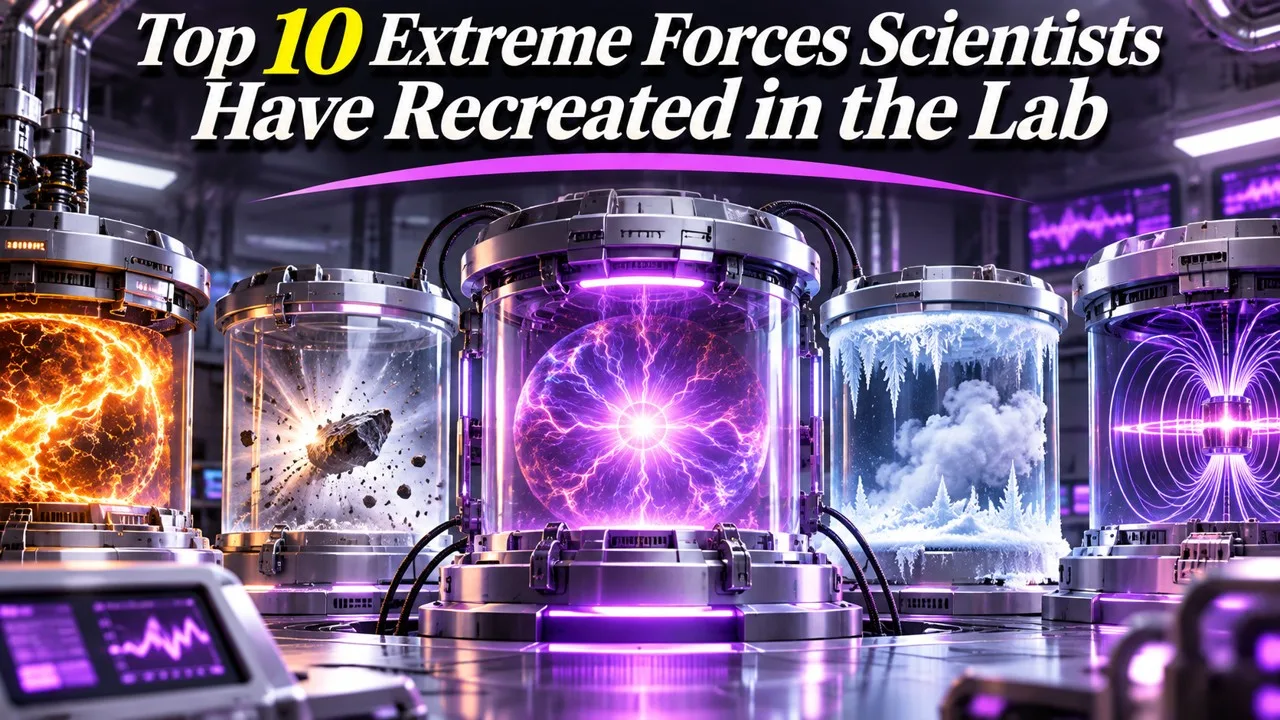
Labs have made quark-gluon plasma, horizon analogs and shake-table quakes; this list skips pathogen work and treats a world-ending vacuum as a headline. "Recreated in the lab" is a phrase that can mean a careful analog, a pulse that lasts a fraction of a second, or, in a bad headline, a doomsday that did not happen [5][8][10]. The ten items below are documented experiments or documented public arguments about experiments [2][9][10]. One popular slot on lists of this kind, a laboratory "smallpox attack," is not going to be written up here as a method, a scenario, or a curiosity with details, because it belongs in the wrong category for a general article [1]. In its place is a safer, independently interesting extreme: the pressures and shocks used to imitate planetary interiors and impacts [1].
No entry is a protocol. Nuclear weapons design, in particular, is outside the job of this page [5].
Key Facts
These are extreme laboratory conditions, analogs, and tests. Several famous claims are larger than the result.
Ten Experiments at a Glance
| Rank | Claim | Careful version |
|---|---|---|
| 1 | A pathogen "attack" | Substituted: diamond-anvil and shock experiments that imitate deep-Earth pressures or impact conditions, described at a high level only |
| 2 | A tiny sun with flares | Some plasma devices produce loops and bursts that analogize solar activity; they are not stars |
| 3 | Ball lightning | Laboratory claims of floating, glowing plasma balls exist and remain uneven; the natural phenomenon is still debated |
| 4 | A supernova | High-energy lasers and pulsed machines can imitate some aspects of a stellar explosion, not the star itself |
| 5 | Fallout | Facilities have tested materials and instruments against radiation environments; this is not a weapons manual |
| 6 | A horizon | Fluids, optics, and other systems can mimic some features of a black hole's horizon; no lab has made a stellar-mass black hole |
| 7 | A field that wrecked a machine | Fusion and high-field experiments have seen plasmas and fields damage their own hardware; the stories are engineering, not a recipe |
| 8 | A vacuum that ends the world | Vacuum decay is a theoretical question; collider-doomsday headlines have not been a laboratory result |
| 9 | A bridge on a shake table | Engineers put large pieces of real structures, sometimes whole spans, through simulated earthquakes |
| 10 | The hottest stuff | Collider experiments have produced quark-gluon plasma, briefly, at temperatures far above ordinary matter |
1. Pressure and Shock, not a Pathogen Plot
Lists of "terrifying" laboratory forces sometimes include a staged biological attack. That item will not be developed here, even as a historical curiosity with a procedure attached, because a general-audience article is the wrong place for pathogen work [1]. The safer extreme, and a real one, is mechanical. In diamond-anvil cells and in shock experiments, researchers routinely reach pressures comparable to those in planetary interiors, or brief shock conditions comparable to those in impacts, in volumes the size of a pinhead or a pulse [1]. They do this to watch minerals, ices, and metals change phase, not to end a city. The unexpected fact is the compactness of the violence. A force that sounds geological can sit on an optical bench. The careful fact is the substitution itself, which is a feature of this list, not a gap in it.
A press can be extreme and still be a press. It does not need a biological headline to earn a place among laboratory forces.
2. Loops of Plasma, with a Family Resemblance
Some laboratory plasma devices, including magnetized, pulsed machines and certain fusion and space-physics experiments, produce arched, flaring structures that researchers study as analogs of solar loops and coronal bursts [2]. The resemblance can be striking in a photograph, and it is useful: a "tiny sun" in this sense is a chunk of ionized gas in a known field, not a self-gravitating star [2]. The unexpected fact is the pedagogical one. A star is inconveniently large and distant. A plasma in a chamber can be probed, repeated, and compared with models of the solar atmosphere, as long as no one mistakes the analog for a second sun on the floor.
A flare in a lab is a family resemblance. The family is electromagnetism, not astrophysical scale.
Related: Ball Lightning: The Mysterious Spherical Phenomenon
3. A Glow that May, or May not, Be the Thing in the Stories
Ball lightning is a stubborn field report: a floating, often hissing or glowing ball, sometimes associated with thunderstorms, and still without a single agreed mechanism [3]. Laboratories have claimed, at various times, to have made a similar object, using microwaves, silicon, electrochemical tricks, or other setups, and those claims have a mixed record of replication and of really matching the folklore [3]. The unexpected fact is the unfinished state of both sides. The natural phenomenon is poorly constrained, and the laboratory balls are easy to over-identify with it. The careful fact is that a glowing lump of plasma in a room can be real and still not settle a century of storm stories.
A headline that says "ball lightning made in the lab" should be read as "a glowing ball was made, and someone compared it." The comparison can be fair or premature.
4. A Pulse that Imitates a Star's Last Hour
A supernova is the destruction of a star. No laboratory has made one. What high-energy-density facilities can do, with lasers or pulsed power, is to drive a tiny sample into a state that, for a moment, resembles some of the pressures, shocks, or nucleosynthetic conditions theorists associate with those explosions [4]. The unexpected fact is the ambition of the analogy. A pulse the size of a coin can be a tool for thinking about an event the size of a solar system. The careful fact is the word "some." Opacity, turbulence, and the mere fact of gravity are not all on the bench. A "lab supernova" is a contribution to a model, not a second Crab Nebula.
Scale is the whole joke, and the whole method. The joke should be left in the sentence, so that the method is not mistaken for the sky.
5. A Radiation Environment, Described as a Test
Weapons tests, in history, produced fallout, and later laboratories have built ways to expose materials, electronics, and sometimes biological samples to radiation environments without repeating those tests [5]. The work can involve reactors, accelerators, or sealed sources, and it is used to ask whether a component will survive, or how a material changes [5]. This article will go no further than that outline. It will not discuss weapons design, yield, or how fallout is produced in an explosion. The unexpected fact, for a list of "forces," is institutional rather than scenic. An extreme environment can be standardized, in a shielded room, as a test condition. The careful fact is the purpose: survivability and science, as reported in the open literature, not a manual.
Related: Top 10 Ideas That Changed How We Think About Black Holes
A test chamber can be dangerous to the people who run it, which is why it is regulated. It is still not a battlefield, and it will not be written as one.
6. A Horizon you can, in a Sense, Table-top
Black holes, in astrophysics, have event horizons, surfaces from which light, in the classical picture, does not return [6]. Laboratories cannot make a stellar-mass or supermassive black hole. They can, in fluids, in Bose-Einstein condensates, in optical systems, and in other carefully arranged media, build analogs in which waves encounter a point of no return of a formal kind, useful for testing ideas that are hard to reach in the sky [6]. The unexpected fact is the translation. A mathematical horizon can sometimes be built out of flowing water or out of light in a changing medium. The careful fact is that an analog is not an object with a gravitational pull that swallows a bench.
A "point of no return" in a tank is a teaching device of a very high order. It should be allowed to keep the word "analog" in its title.
7. When a Machine is Bitten by its own Field
Fusion devices and other high-field, high-current machines have, in documented incidents, damaged themselves: a plasma disruption can dump energy into a wall, a quench can wrack a magnet, a field can wreck a poorly designed conductor [7]. Those events are unwelcome data, and they are part of why such machines are engineered with interlocks, cooling, and margins [7]. This article will not specify a setup that would invite imitation, and it will not wander into weapons-related pulse-power methods. The unexpected fact is reflexive. An experiment can be an extreme force, and then the force can turn, without malice, on the experiment. The careful fact is that "destroyed its own generator" is usually an engineering failure report, later folded into a better design, not a demonstration for its own sake.
A scar on a machine is a kind of measurement. The people who run the machine would prefer a less expensive measurement.
Related: Top 10 Most Bizarre Phobias: Strange Fears That Exist
8. A Theoretical Vacuum, and a Headline
Physicists discuss, as theory, whether the vacuum of our universe is fully stable or is a long-lived "false" vacuum that could, in principle, decay [8]. That discussion has, at times, been attached to headlines about colliders "destroying the universe." The professional answers have been that the processes already occurring in cosmic rays outrun the laboratory, and that a world-ending vacuum decay is not a result anyone has produced, or expects to produce, in a tunnel [8]. The unexpected fact is the mismatch. A deep, legitimate theoretical question can be dressed as a laboratory stunt it was never going to be. The careful fact is the substitution of scale: the universe is already running a higher-energy experiment, in that sense, than a ring under the countryside.
A headline can be louder than a paper. This list is with the paper, and with the statement that the universe-ending laboratory is a fiction.
9. A Span that is Asked to Survive a Fake Earthquake
Earthquake engineers have, for decades, put large pieces of real structures, including concrete columns, building sections, and, in some famous tests, substantial bridge spans, on shake tables that replay recorded or designed ground motions [9]. The "force" is inertia, applied honestly, and the point is to see whether a design fails in the way the models said, before the next real earthquake asks the same question in public [9]. The unexpected fact is the bluntness of the method. A laboratory can have, inside it, a piece of a highway or a building, and can then try to break it on purpose, in a controlled way, with instruments watching. The careful fact is that a table is not a fault line. It is a way of borrowing one.
A ruined test specimen can be a success, if it fails where the engineer predicted, or a lesson, if it does not. Either way, it is cheaper than learning the lesson in a city.
Related: Top 10 Oldest Buildings in the World
10. A Brief, Extreme State of Matter
In heavy-ion collisions at facilities such as Brookhaven's Relativistic Heavy Ion Collider and at CERN's Large Hadron Collider, experimenters have produced, for an instant, a quark-gluon plasma, a state in which quarks and gluons are not confined in ordinary protons and neutrons [10]. The temperatures inferred for that state are trillions of degrees, far above the center of the Sun, which is why popular lists call it the hottest thing ever made, with the usual caveats about what "made" and "hottest" mean in a fleck of matter that lives for a tiny fraction of a second [10]. The unexpected fact is the reach. A collider can briefly recapture a condition associated with the early universe, not as a landscape, as a measurement. The careful fact is the brevity, and the size.
A record temperature in a detector is still a temperature. It is not a new sun, and it does not sit, glowing, on the floor of the hall after the shift is over.
Conclusion
The ten items above are a defense of proportion. Laboratories can press a mineral until it becomes something else, light a plasma that looks a little like a solar loop, argue about a glowing ball, and drive a sample until it is a stanza in a supernova model. They can irradiate a coupon, analogize a horizon, lose a machine to its own field, put a bridge on a table, and make, for a blink, a plasma of quarks. They have not, in any honest sense, staged a world-ending vacuum, and this article has not filled a tenth slot with a pathogen. The extreme, in a good laboratory, is a controlled, measured, often tiny version of a force that, in nature, is large, brief, or far away.
A headline will always try to make the tiny version sound like the natural one. The useful list is the one that refuses the translation.
- ^ [1] Overviews of diamond-anvil-cell and shock-wave experiments on planetary and impact conditions; this item substitutes for any laboratory pathogen-attack headline. Britannica: High-pressure phenomena
- ^ [2] Laboratory plasma studies used as analogs of solar loops and flares. Britannica: Plasma
- ^ [3] Reviews of ball-lightning reports and of laboratory claims to have produced a similar discharge. Britannica: Ball lightning
- ^ [4] High-energy-density experiments that analogize some conditions of supernovae. Britannica: Supernova
- ^ [5] High-level accounts of laboratory radiation environments used to test materials and instruments, without weapons methods. Britannica: Radiation
- ^ [6] Experimental analog gravity, including fluid and optical stand-ins for a horizon. Britannica: Black hole
- ^ [7] Engineering accounts of plasma disruptions and other self-damage in high-field machines, described without transferable setups. Britannica: Fusion reactor
- ^ [8] Theoretical discussion of vacuum decay, distinguished from collider-doomsday headlines. Britannica: Vacuum
- ^ [9] Shake-table testing of large structural specimens, including bridge components. Britannica: Earthquake engineering
- ^ [10] Experimental production of quark-gluon plasma in heavy-ion collisions at RHIC and the LHC. Britannica: Quark-gluon plasma





















Discussion
Log in with