






 By
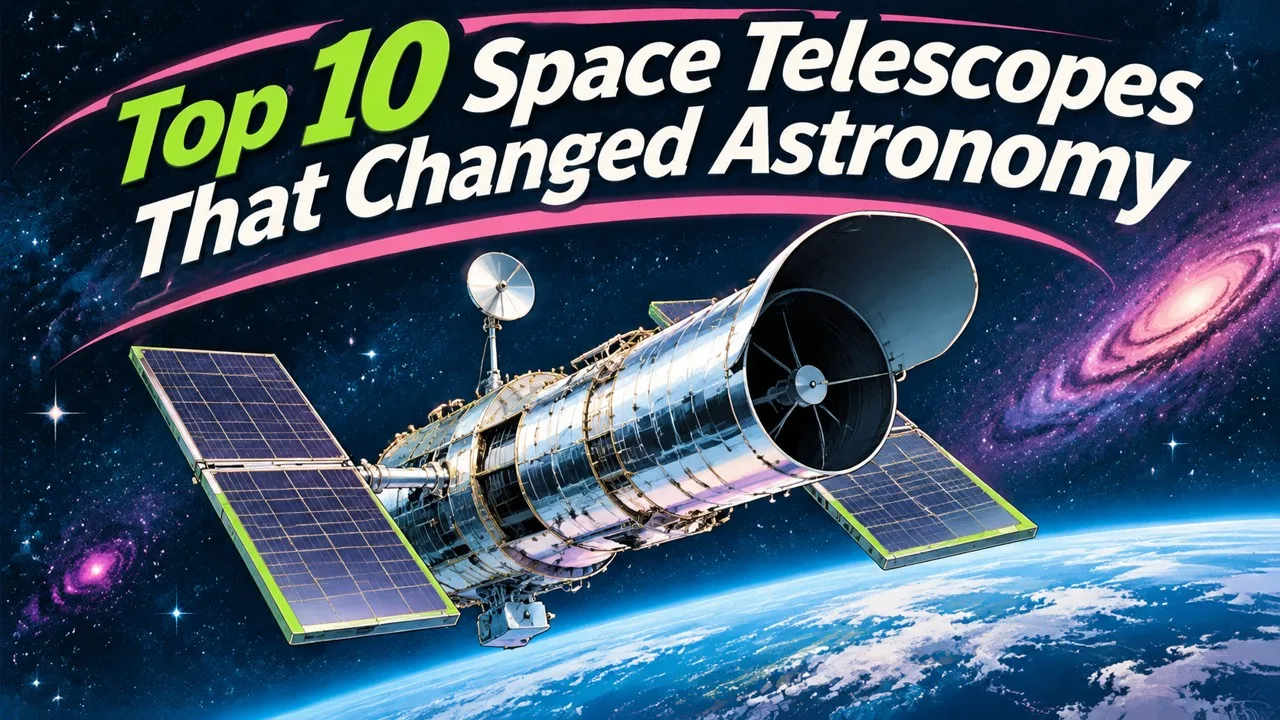
From Uhuru's X-ray maps to Hubble and James Webb, these ten space telescopes that changed astronomy revealed black holes, exoplanets and the early universe. The Earth's atmosphere blurs starlight and blocks many kinds of light, including most X-rays, gamma rays and much of the infrared. By placing telescopes in space, astronomers can see the universe clearly and in wavelengths invisible from the ground.
Since the 1960s, dozens of space telescopes have been launched. This list highlights ten that transformed astronomy, from the first X-ray survey satellite to the James Webb Space Telescope, and explains what each one revealed.
Key Facts
The ten telescopes below were launched between 1970 and 2021 by NASA, the European Space Agency and their partners.
Landmark Space Telescopes at a Glance
| # | Telescope | Launched | Type of light | Key discovery |
|---|---|---|---|---|
| 1 | Uhuru | 1970 | X-rays | First survey of the X-ray sky |
| 2 | IRAS | 1983 | Infrared | First infrared map of the whole sky |
| 3 | COBE | 1989 | Microwaves | Measured the afterglow of the Big Bang |
| 4 | Hubble Space Telescope | 1990 | Visible, ultraviolet and near-infrared | Sharp views of the universe |
| 5 | Compton Gamma Ray Observatory | 1991 | Gamma rays | Solved the puzzle of gamma-ray bursts |
| 6 | Chandra X-ray Observatory | 1999 | X-rays | Revealed black holes and dark matter |
| 7 | Spitzer Space Telescope | 2003 | Infrared | Studied the atmospheres of other worlds |
| 8 | Kepler Space Telescope | 2009 | Visible | Showed that planets are everywhere |
| 9 | Gaia | 2013 | Visible | A three-dimensional map of the galaxy |
| 10 | James Webb Space Telescope | 2021 | Infrared | Seeing the first galaxies |
1. Uhuru
Uhuru was launched on 12 December 1970 from an Italian launch platform off the coast of Kenya. Its name means freedom in Swahili, chosen because it was launched on Kenya's independence day. [1]
It was the first satellite dedicated to X-ray astronomy. Over about two years, it mapped the sky and catalogued 339 X-ray sources. [1]
Uhuru found that some X-ray sources were binary stars, in which matter flows from a normal star onto a very compact companion. Observations of Cygnus X-1 provided some of the first strong evidence for black holes.
The physicist Riccardo Giacconi, who led much of this work, received the Nobel Prize in Physics in 2002 for founding X-ray astronomy.
Uhuru opened the way for later, more powerful X-ray telescopes.
It weighed only about 64 kilograms.
Key Figures
- Launched: 12 December 1970
- Name meaning: freedom
- Sources catalogued: 339
- Pioneer: Riccardo Giacconi
Why It Made the List
Uhuru revealed a violent universe hidden from ground-based telescopes. It launched the science of X-ray astronomy.
2. IRAS
The Infrared Astronomical Satellite, or IRAS, was launched in January 1983 as a joint project of the United States, the United Kingdom and the Netherlands. [2]
Cooled by liquid helium, it surveyed almost the entire sky in infrared light over ten months, until its coolant ran out. [2]
IRAS detected about 350,000 infrared sources, including many young stars and galaxies glowing with dust.
It discovered discs of dust around stars such as Vega, the first evidence of material that might form planets around other stars.
IRAS also discovered several comets, including one that passed unusually close to Earth in 1983.
Its survey revealed that many galaxies shine far more brightly in infrared than in visible light, because of intense star formation hidden by dust. Its data were later released as catalogues still used by astronomers today.
Key Figures
- Launched: January 1983
- Partners: US, UK and Netherlands
- Sources detected: about 350,000
- Discovery: dust disc around Vega
Why It Made the List
IRAS showed the universe in infrared for the first time. It revealed hidden star birth and planet-forming discs.
3. COBE
NASA's Cosmic Background Explorer, or COBE, was launched in November 1989 to study the cosmic microwave background, the faint radiation left over from the early universe. [3]
Related: Top 10 Most Expensive Megaprojects in History
COBE showed that this radiation matches the spectrum of a perfect heat source, at a temperature of about 2.7 degrees above absolute zero, strongly supporting the Big Bang theory. [3]
In 1992 COBE scientists announced that they had detected tiny variations in the background radiation. These ripples were the seeds of galaxies and galaxy clusters.
John Mather and George Smoot received the Nobel Prize in Physics in 2006 for this work.
Later missions, such as WMAP and Planck, mapped these variations in much greater detail.
Stephen Hawking reportedly described the 1992 result as the discovery of the century, if not of all time.
Key Figures
- Launched: November 1989
- Temperature measured: about 2.7 K
- Ripples announced: 1992
- Nobel Prize: 2006
Why It Made the List
COBE provided some of the strongest evidence for the Big Bang. It began precision cosmology.
4. Hubble Space Telescope
The Hubble Space Telescope was launched on 24 April 1990 aboard the space shuttle Discovery. It is named after the astronomer Edwin Hubble. [4]
Soon after launch, scientists found that its 2.4-metre main mirror had a tiny flaw that blurred images. In December 1993, astronauts installed corrective optics, and Hubble's images became spectacularly sharp. [4]
Hubble helped pin down the age of the universe at about 13.8 billion years, and observations of distant supernovae with Hubble and ground telescopes showed that the expansion of the universe is speeding up.
Its Hubble Deep Field image of 1995 revealed thousands of galaxies in a tiny patch of sky.
Hubble was serviced by astronauts five times and has made more than a million observations.
Key Figures
- Launched: 24 April 1990
- Mirror size: 2.4 metres
- Repair mission: December 1993
- Famous image: Hubble Deep Field, 1995
Why It Made the List
Hubble is the most famous telescope ever built. Its images changed how the public sees the universe.
5. Compton Gamma Ray Observatory
NASA's Compton Gamma Ray Observatory was launched in April 1991 aboard the space shuttle Atlantis. Weighing about 17 tonnes, it was one of the heaviest scientific payloads carried by the shuttle. [5]
It studied gamma rays, the most energetic form of light, produced by extreme events such as exploding stars and matter falling into black holes. [5]
Related: Top 10 Famous Comets in History
Compton's observations showed that mysterious flashes called gamma-ray bursts come evenly from all directions in the sky, indicating that they originate far beyond our galaxy.
It also discovered many new gamma-ray sources, including powerful active galaxies.
Compton was deliberately brought down into the Pacific Ocean in June 2000 after one of its gyroscopes failed.
It carried four instruments covering a wide range of gamma-ray energies. Its BATSE instrument recorded thousands of gamma-ray bursts during the mission.
Key Figures
- Launched: April 1991
- Mass: about 17 tonnes
- Key finding: gamma-ray bursts are distant
- Mission ended: June 2000
Why It Made the List
Compton opened the gamma-ray universe. It revealed the most powerful explosions known.
6. Chandra X-ray Observatory
The Chandra X-ray Observatory was launched on 23 July 1999 aboard the space shuttle Columbia, commanded by Eileen Collins, the first woman to command a shuttle mission. [6]
It is named after the Indian-American astrophysicist Subrahmanyan Chandrasekhar, who won the Nobel Prize in Physics in 1983 for his work on the structure and evolution of stars. [6]
Chandra's sharp X-ray images reveal hot gas around black holes, the remains of exploded stars and clusters of galaxies.
In 2006, Chandra observations of the Bullet Cluster, a collision between two galaxy clusters, provided striking evidence for dark matter.
Chandra has operated for more than two decades, far beyond its planned lifetime.
Its mirrors are among the smoothest ever made. NASA has compared them to an Earth so smooth that its tallest mountain would be only a couple of metres high.
Key Figures
- Launched: 23 July 1999
- Named after: Subrahmanyan Chandrasekhar
- Shuttle commander: Eileen Collins
- Key evidence: Bullet Cluster, 2006
Why It Made the List
Chandra is the sharpest X-ray telescope ever built. Its images reveal the hottest regions of the universe.
7. Spitzer Space Telescope
NASA's Spitzer Space Telescope was launched in August 2003 to observe the universe in infrared light. It followed Earth in its orbit around the Sun rather than circling Earth. [7]
In 2005, Spitzer became one of the first telescopes to directly detect light from planets orbiting other stars. [7]
Related: Top 25 Interesting Facts About the Solar System
It helped confirm that the star TRAPPIST-1 has seven Earth-sized planets, announced in 2017.
Spitzer also discovered a huge, faint ring around Saturn, far larger than its famous rings.
The telescope was retired in January 2020 after more than sixteen years.
It was the last of NASA's four Great Observatories, alongside Hubble, Compton and Chandra. It was named after the astrophysicist Lyman Spitzer, who first proposed placing telescopes in space in the 1940s. Its coolant ran out in 2009, but some of its cameras continued working for another decade.
Key Figures
- Launched: August 2003
- Orbit: trailing Earth around the Sun
- Famous finding: TRAPPIST-1 planets
- Retired: January 2020
Why It Made the List
Spitzer pioneered the study of exoplanet atmospheres. It showed the cool, dusty side of the universe.
8. Kepler Space Telescope
NASA's Kepler Space Telescope was launched in March 2009 to find planets orbiting other stars. [8]
For about four years, it stared at a single patch of sky containing about 150,000 stars, watching for tiny dips in brightness when planets passed in front of them. [8]
Kepler discovered more than 2,600 confirmed planets, showing that planets are common and that many stars have them.
It found planets in the habitable zone of their stars, where liquid water could exist, such as Kepler-186f.
After a mechanical failure in 2013, the mission continued as K2 until Kepler ran out of fuel in 2018.
The telescope was named after Johannes Kepler, the astronomer who described the laws of planetary motion. Its data continue to reveal new planets years after the mission ended.
Key Figures
- Launched: March 2009
- Stars watched: about 150,000
- Confirmed planets: more than 2,600
- Retired: 2018
Why It Made the List
Kepler transformed the search for planets. It showed that our galaxy contains billions of worlds.
9. Gaia
The European Space Agency's Gaia spacecraft was launched in December 2013 to measure the positions, distances and motions of stars with extraordinary precision. [9]
Gaia has mapped about 1.8 billion stars in the Milky Way, creating the most detailed map of our galaxy ever made. [9]
Related: Top 10 Interesting Facts About the Milky Way Galaxy
Its data revealed that the Milky Way merged with a smaller galaxy billions of years ago, an event named Gaia-Enceladus.
In 2024 Gaia data led to the discovery of Gaia BH3, the most massive stellar black hole known in our galaxy.
Gaia completed its science observations in early 2025 and was switched off in March 2025, but its data will be used for decades.
It spun slowly, scanning the whole sky repeatedly and measuring each star dozens of times. The European Space Agency has compared its precision to measuring the size of a coin on the Moon from Earth.
Key Figures
- Launched: December 2013
- Stars mapped: about 1.8 billion
- Discovery: Gaia-Enceladus merger
- Switched off: March 2025
Why It Made the List
Gaia gave us a three-dimensional map of the Milky Way. It revealed our galaxy's history.
10. James Webb Space Telescope
The James Webb Space Telescope was launched on 25 December 2021 on an Ariane 5 rocket from French Guiana. It is a joint project of NASA, the European Space Agency and the Canadian Space Agency. [10]
Webb's main mirror is 6.5 metres across, made of 18 hexagonal segments. A sunshield about the size of a tennis court keeps it extremely cold. [10]
It orbits about 1.5 million kilometres from Earth, near a point called L2.
Its first images were released in July 2022. Webb has observed galaxies that formed only a few hundred million years after the Big Bang.
Webb has also detected carbon dioxide and other molecules in the atmospheres of exoplanets.
The telescope had to unfold its mirror and sunshield in space, a complex sequence that took about two weeks.
Key Figures
- Launched: 25 December 2021
- Mirror: 6.5 metres, 18 segments
- Location: near L2, 1.5 million km away
- First images: July 2022
Why It Made the List
Webb is the most powerful space telescope ever built. It is revealing the earliest chapters of cosmic history.
Conclusion
Space telescopes have opened every window on the universe, from gamma rays to microwaves. Each new telescope has revealed surprises.
Together, these ten telescopes found black holes, mapped the Big Bang's afterglow, discovered thousands of planets and saw the first galaxies. Future telescopes will build on their legacy.
- ^ [1] "Uhuru". Wikipedia. Wikipedia: Uhuru (satellite) Wikipedia: Riccardo Giacconi
- ^ [2] "IRAS". Wikipedia. Wikipedia: IRAS Wikipedia: Vega
- ^ [3] "COBE". Wikipedia. Wikipedia: Cosmic Background Explorer Wikipedia: Cosmic microwave background
- ^ [4] "Hubble Space Telescope". Wikipedia. Wikipedia: Hubble Space Telescope Wikipedia: Hubble Deep Field
- ^ [5] "Compton Gamma Ray Observatory". Wikipedia. Wikipedia: Compton Gamma Ray Observatory Wikipedia: Gamma-ray burst
- ^ [6] "Chandra X-ray Observatory". Wikipedia. Wikipedia: Chandra X-ray Observatory Wikipedia: Subrahmanyan Chandrasekhar
- ^ [7] "Spitzer Space Telescope". Wikipedia. Wikipedia: Spitzer Space Telescope Wikipedia: TRAPPIST-1
- ^ [8] "Kepler Space Telescope". Wikipedia. Wikipedia: Kepler space telescope Wikipedia: Transit method
- ^ [9] "Gaia". Wikipedia. Wikipedia: Gaia (spacecraft) Wikipedia: Gaia Sausage
- ^ [10] "James Webb Space Telescope". Wikipedia. Wikipedia: James Webb Space Telescope Wikipedia: Lagrange point






















Discussion
Log in with