






 By
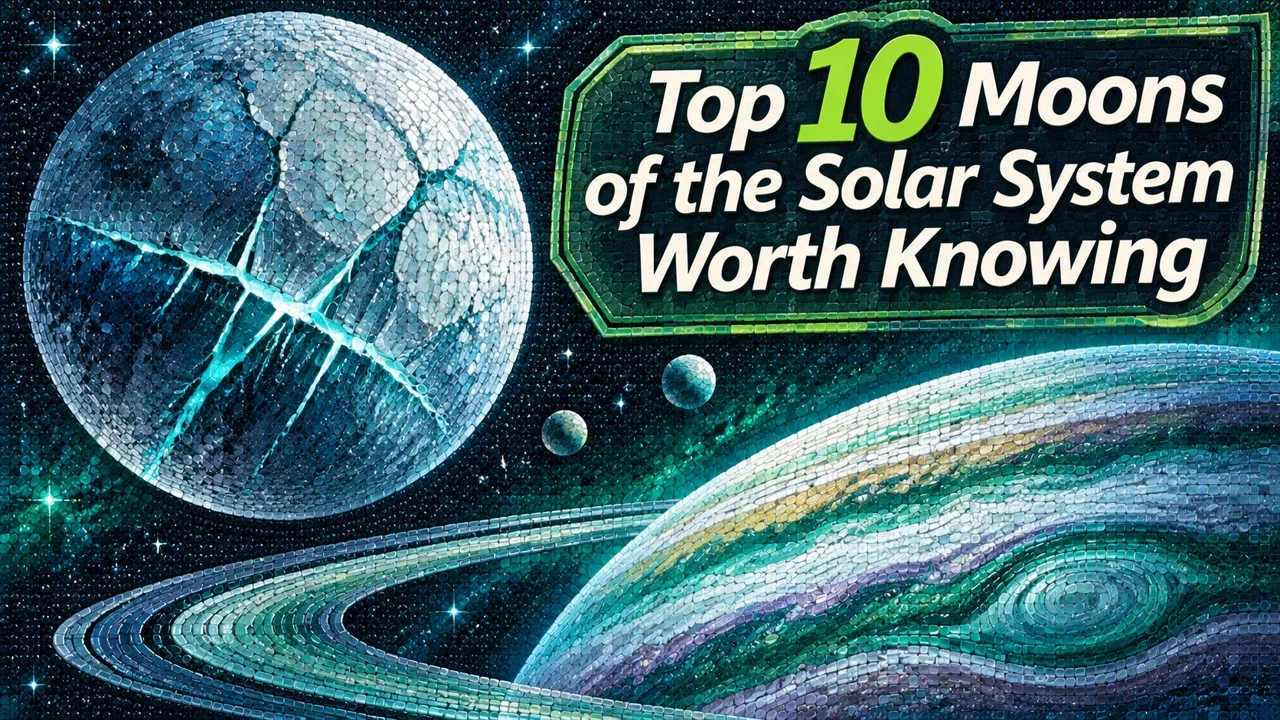
From volcanic Io and ocean-hiding Europa to Titan's methane seas, these ten moons of the solar system worth knowing are among space science's top targets. The solar system has hundreds of known moons, from tiny captured rocks a few kilometres across to worlds larger than the planet Mercury. Many were little more than points of light until space probes such as Voyager, Galileo and Cassini visited them.
Those missions revealed volcanoes, hidden oceans, methane lakes and geysers, making some moons among the best places to search for life beyond Earth. This list introduces ten of the most fascinating moons, excluding our own Moon, which is covered in other Finepedia articles.
Key Facts
The ten moons below orbit Mars, Jupiter, Saturn, Uranus and Neptune.
Remarkable Moons at a Glance
| # | Moon | Planet | Size | Standout feature |
|---|---|---|---|---|
| 1 | Phobos | Mars | About 22 km across | A moon spiralling towards its planet |
| 2 | Io | Jupiter | 3,643 km across | The most volcanic world |
| 3 | Europa | Jupiter | 3,122 km across | An ocean beneath the ice |
| 4 | Ganymede | Jupiter | 5,268 km across | The largest moon in the solar system |
| 5 | Callisto | Jupiter | 4,821 km across | One of the most cratered surfaces |
| 6 | Titan | Saturn | 5,150 km across | Lakes of liquid methane |
| 7 | Enceladus | Saturn | About 500 km across | Geysers from a hidden ocean |
| 8 | Iapetus | Saturn | About 1,470 km across | A moon with two faces |
| 9 | Miranda | Uranus | About 470 km across | Home of the tallest cliff |
| 10 | Triton | Neptune | About 2,710 km across | A captured world with geysers |
1. Phobos
Phobos is the larger of Mars's two small moons. Both were discovered in 1877 by the American astronomer Asaph Hall, and Phobos takes its name from the Greek word for fear. [1]
Phobos is a lumpy, potato-shaped body about 22 kilometres across. It orbits only about 6,000 kilometres above the Martian surface, closer than any other known moon to its planet, and circles Mars about three times a day. [1]
Its largest crater, Stickney, is about 9 kilometres wide, almost half the size of the moon itself.
Phobos is slowly spiralling inward. In tens of millions of years, it will either crash into Mars or be torn apart to form a ring.
Scientists are unsure whether Phobos is a captured asteroid or formed from debris after a giant impact on Mars. Japan's MMX mission aims to bring back samples of its surface.
Key Figures
- Discovered: 1877, by Asaph Hall
- Size: about 22 km across
- Orbit height: about 6,000 km above Mars
- Largest crater: Stickney, about 9 km
Why It Made the List
Phobos is a moon with a limited future. Its fate shows how gravity reshapes planetary systems.
2. Io
Io is the innermost of Jupiter's four large moons, discovered by Galileo Galilei in January 1610. It is slightly larger than Earth's Moon. [2]
Io is the most volcanically active body in the solar system, with hundreds of active volcanoes. Some throw sulphur and lava plumes hundreds of kilometres above the surface. [2]
Its volcanoes were discovered in 1979 in images taken by the Voyager 1 spacecraft.
Io's heat comes from tides. As it orbits Jupiter in a rhythm with the moons Europa and Ganymede, its interior is squeezed and stretched, producing intense heat.
Sulphur compounds give Io's surface striking colours of yellow, red, white and black.
Its largest lava lake, Loki Patera, is about 200 kilometres across.
Key Figures
- Discovered: January 1610, by Galileo
- Diameter: about 3,643 km
- Volcanoes found: 1979, Voyager 1
- Heat source: tidal squeezing
Why It Made the List
Io is the solar system's most active volcanic world. It shows how tides can heat a moon from inside.
3. Europa
Europa, another of Jupiter's Galilean moons, is slightly smaller than Earth's Moon. Its surface is a bright shell of ice crossed by long cracks and ridges. [3]
Related: Top 25 Interesting Facts About the Solar System
Measurements by NASA's Galileo spacecraft in the 1990s strongly suggested that a salty liquid ocean lies beneath the ice, possibly containing more water than all of Earth's oceans. [3]
Because liquid water is essential to life as we know it, Europa is one of the best places to search for life beyond Earth.
NASA's Europa Clipper spacecraft launched in October 2024 and is due to arrive at Jupiter in 2030 to study Europa in detail.
Europa's surface has few craters, suggesting it is geologically young and constantly renewed.
Reddish-brown streaks on the ice may contain salts brought up from below.
Key Figures
- Discovered: 1610, by Galileo
- Diameter: about 3,122 km
- Hidden feature: salty subsurface ocean
- Mission: Europa Clipper, launched 2024
Why It Made the List
Europa may hold more water than Earth. It is a leading target in the search for life.
4. Ganymede
Ganymede is the largest moon in the solar system, with a diameter of about 5,268 kilometres. It is larger than the planet Mercury, though less massive. [4]
In 1996 the Galileo spacecraft discovered that Ganymede has its own magnetic field, making it the only moon known to have one. [4]
Scientists believe Ganymede has a salty ocean buried deep beneath its icy crust, sandwiched between layers of ice.
Its surface has dark, heavily cratered regions and lighter grooved areas, showing a complex geological history.
The European Space Agency's JUICE mission, launched in 2023, is planned to orbit Ganymede in the 2030s, the first spacecraft to orbit a moon other than our own.
Hubble Space Telescope observations of its aurorae in 2015 added strong evidence for the hidden ocean.
Key Figures
- Diameter: about 5,268 km
- Compared with Mercury: larger
- Unique feature: its own magnetic field
- Mission: ESA's JUICE, launched 2023
Why It Made the List
Ganymede is the giant among moons. Its magnetic field and hidden ocean make it unique.
5. Callisto
Callisto, the outermost of the Galilean moons, is the third largest moon in the solar system. [5]
Related: Top 10 Interesting Facts About the Milky Way Galaxy
Its dark surface is one of the most heavily cratered in the solar system, showing that it has changed little for billions of years. [5]
Callisto's largest feature, Valhalla, is a giant impact basin surrounded by rings of ridges stretching thousands of kilometres across.
Like Europa and Ganymede, Callisto may have a subsurface ocean.
Because it lies outside Jupiter's most intense radiation belts, NASA studies have suggested it as a possible site for a future human base in the outer solar system.
Like the other Galilean moons, it always keeps the same face towards Jupiter. It takes about 17 days to complete one orbit. Its surface is a mix of rock and ice, and it may never have separated fully into layers like other large moons.
Key Figures
- Rank: third largest moon
- Diameter: about 4,821 km
- Largest basin: Valhalla
- Advantage: lower radiation
Why It Made the List
Callisto preserves an ancient record of impacts. It could one day host human explorers.
6. Titan
Titan is Saturn's largest moon and the second largest in the solar system. It was discovered in 1655 by the Dutch astronomer Christiaan Huygens. [6]
Titan is the only moon with a thick atmosphere, made mostly of nitrogen, with a surface pressure about one and a half times that of Earth. [6]
It is so cold that methane and ethane exist as liquids, forming rivers, lakes and seas on the surface. It is the only other world known to have stable bodies of surface liquid.
On 14 January 2005, the European Huygens probe landed on Titan, the most distant landing ever made.
NASA's Dragonfly mission plans to send a nuclear-powered drone to fly between sites on Titan in the 2030s.
Key Figures
- Discovered: 1655, by Christiaan Huygens
- Atmosphere: thick nitrogen
- Surface liquids: methane and ethane
- Huygens landing: 14 January 2005
Why It Made the List
Titan is the most Earth-like moon in some ways. Its chemistry may resemble early Earth.
7. Enceladus
Enceladus is a small moon of Saturn, only about 500 kilometres across. Its icy surface reflects almost all the sunlight that hits it, making it one of the brightest objects in the solar system. [7]
Related: The Eight Planets Compared: Size, Gravity, Days and Moons
In 2005 NASA's Cassini spacecraft discovered jets of water vapour and ice erupting from long cracks near the moon's south pole, nicknamed tiger stripes. [7]
The jets come from a global ocean beneath the ice. Cassini flew through the plumes and detected salts, organic molecules and other chemicals.
Material from these jets feeds Saturn's faint E ring.
Scientists consider Enceladus one of the most promising places to look for life beyond Earth.
Cassini also found tiny grains of silica that suggest hot water may be reacting with rock on the ocean floor.
Key Figures
- Diameter: about 500 km
- Plumes found: 2005, by Cassini
- Source: subsurface ocean
- Feeds: Saturn's E ring
Why It Made the List
Enceladus sprays samples of its hidden ocean into space. It offers an easy way to study a possible habitable world.
8. Iapetus
Iapetus was discovered by the astronomer Giovanni Domenico Cassini in 1671. He noticed that it could be seen clearly on one side of Saturn but almost disappeared on the other. [8]
The reason is that Iapetus has two faces: one hemisphere is very dark, while the other is bright and icy. [8]
The dark material is thought to come partly from dust knocked off another moon, Phoebe, which coats the leading side of Iapetus as it orbits.
Iapetus also has a strange ridge running along much of its equator, up to about 20 kilometres high, giving it a walnut-like shape.
The origin of the ridge is still debated.
It orbits far from Saturn, taking about 79 days to complete each orbit.
Key Figures
- Discovered: 1671, by Cassini
- Diameter: about 1,470 km
- Feature: one dark and one bright side
- Equatorial ridge: up to about 20 km high
Why It Made the List
Iapetus is one of the strangest-looking moons. Its two faces puzzled astronomers for centuries.
9. Miranda
Miranda is a small moon of Uranus, discovered in 1948 by the astronomer Gerard Kuiper. [9]
When Voyager 2 flew past in January 1986, it revealed a bizarre surface with patchwork regions, deep canyons and grooved terrain, as if the moon had been broken apart and reassembled. [9]
Related: Top 10 Famous Astronomical Observatories
Miranda has Verona Rupes, a cliff estimated to be about 20 kilometres high, the tallest known cliff in the solar system.
Scientists think tidal heating in the past may have reshaped its surface.
Voyager 2 remains the only spacecraft to have visited Miranda.
Its name comes from a character in Shakespeare's play The Tempest, like many moons of Uranus. A rock dropped from the top of Verona Rupes would take several minutes to reach the bottom in the moon's weak gravity.
Key Figures
- Discovered: 1948, by Gerard Kuiper
- Diameter: about 470 km
- Tallest cliff: Verona Rupes
- Only visit: Voyager 2, 1986
Why It Made the List
Miranda's surface is one of the most unusual in the solar system. Its giant cliff is a natural wonder.
10. Triton
Triton is Neptune's largest moon. It was discovered in October 1846 by the English astronomer William Lassell, only seventeen days after Neptune itself was found. [10]
Triton orbits Neptune in the opposite direction to the planet's rotation. It is the only large moon in the solar system to do so, suggesting it was captured from the Kuiper Belt. [10]
When Voyager 2 flew past in August 1989, it photographed dark plumes of nitrogen gas erupting from the surface.
Triton is one of the coldest known bodies in the solar system, with surface temperatures around minus 235 degrees Celsius.
Its orbit is slowly shrinking, and it may eventually be torn apart by Neptune's gravity.
Its thin atmosphere is made mostly of nitrogen.
Key Figures
- Discovered: October 1846, by William Lassell
- Diameter: about 2,710 km
- Orbit: retrograde
- Visit: Voyager 2, 1989
Why It Made the List
Triton is likely a captured dwarf planet. Its geysers show that even frozen worlds can be active.
Conclusion
Moons are far more varied than scientists once imagined. Some have volcanoes, others hide oceans, and a few have thick atmospheres.
Missions such as Europa Clipper, JUICE and Dragonfly will explore several of them in the coming years. These worlds may hold clues to how life could arise beyond Earth.
- ^ [1] "Phobos". Wikipedia. Wikipedia: Phobos (moon) Wikipedia: Asaph Hall
- ^ [2] "Io". Wikipedia. Wikipedia: Io (moon) Wikipedia: Volcanism on Io
- ^ [3] "Europa". Wikipedia. Wikipedia: Europa (moon) Wikipedia: Europa Clipper
- ^ [4] "Ganymede". Wikipedia. Wikipedia: Ganymede (moon) Wikipedia: Jupiter Icy Moons Explorer
- ^ [5] "Callisto". Wikipedia. Wikipedia: Callisto (moon) Wikipedia: Valhalla (crater)
- ^ [6] "Titan". Wikipedia. Wikipedia: Titan (moon) Wikipedia: Huygens (spacecraft)
- ^ [7] "Enceladus". Wikipedia. Wikipedia: Enceladus Wikipedia: Cassini–Huygens
- ^ [8] "Iapetus". Wikipedia. Wikipedia: Iapetus (moon) Wikipedia: Giovanni Domenico Cassini
- ^ [9] "Miranda". Wikipedia. Wikipedia: Miranda (moon) Wikipedia: Verona Rupes
- ^ [10] "Triton". Wikipedia. Wikipedia: Triton (moon) Wikipedia: William Lassell





















Discussion
Log in with