





 By
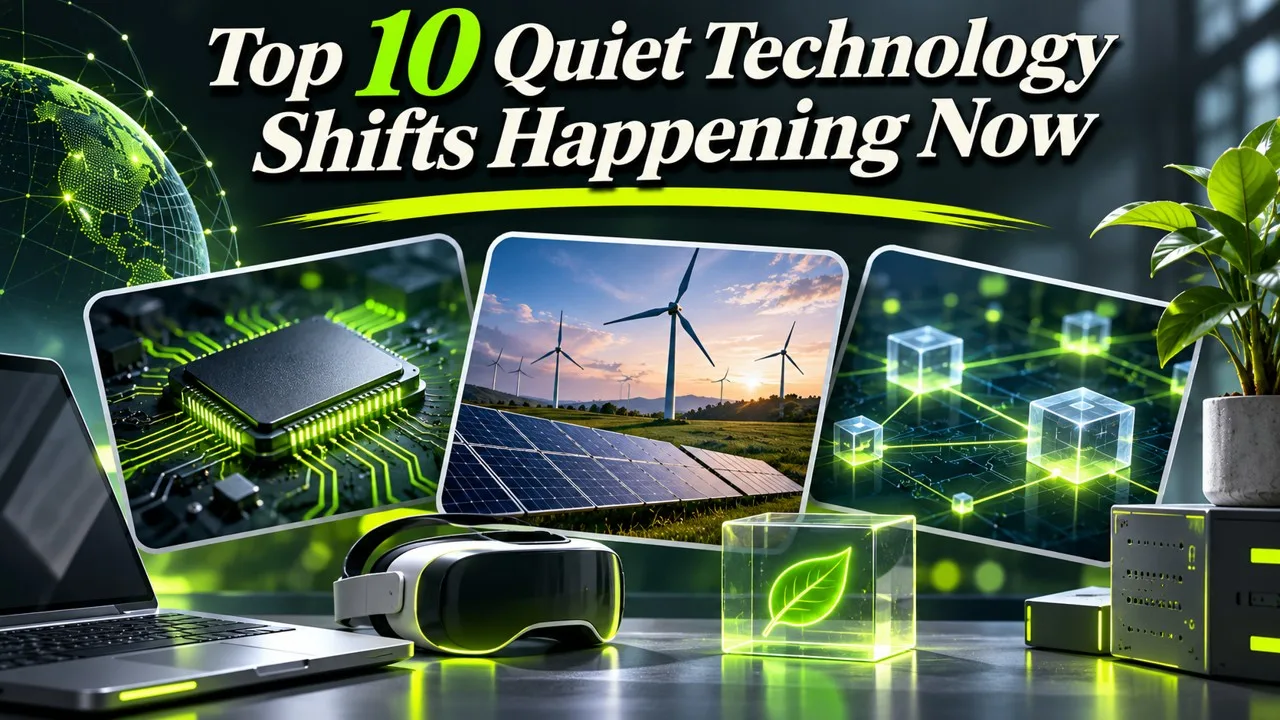
Governments are quietly moving office work to Linux, medical drones are on trial, and a NASA file format is being used to archive fragile manuscripts. Not every technology shift arrives as a keynote. Some of the more consequential ones are happening in ministries, clinics, fields, and deserts, with less advertising than a new phone [1][9][10]. The ten items below are documented programs and proposals, not a prediction that any one of them will "win" the decade [2][4]. A legal right to a broadband connection, an internet vote, or a repairable laptop can all matter without being cinematic [4][6][7].
Two of the entries concern open-source software in Europe. They are not the same story: one is about administrations already switching desktops, and the other is about a broader, still-proposed digital-sovereignty stack [1][2].
Key Facts
These are quiet, checkable changes in how software, energy, logistics, and archives are being run, with the usual duty not to turn a trial or a proposal into a finished revolution.
Ten Shifts at a Glance
| Rank | Shift | Careful version |
|---|---|---|
| 1 | European desktops | Several public bodies have moved, or are moving, office software to Linux and LibreOffice; it is a procurement and skills story, not a completed continent-wide cutover |
| 2 | A European Linux? | Proposals for an EU-backed open-source stack, sometimes including a common Linux effort, remain plans and pilots |
| 3 | Medical drones | Countries including Uganda have tested or used drones to carry blood and medicines; this is a logistics trial, not a how-to |
| 4 | Floating solar | The Philippines has built and expanded floating photovoltaic plants on reservoirs, with the usual questions of cost, grid, and upkeep |
| 5 | Repairable laptops | Repair-first machines, including Framework's smaller education-oriented model, revive an old idea: a computer that can be fixed and kept |
| 6 | Broadband as a right | Finland made a broadband connection a legal right, which is a regulatory baseline, not a claim that every home is perfectly served |
| 7 | A space format in a library | The Vatican Apostolic Library has used the FITS format, developed for astronomy, to store high-resolution images of manuscripts |
| 8 | Internet voting | Estonia has offered remote internet voting since 2005; security debates have not disappeared |
| 9 | Crop diagnosis apps | Image-based tools can help flag plant disease; they are an aid, not a substitute for agronomy, and accuracy varies |
| 10 | Desert solar | Large photovoltaic projects in Inner Mongolia are being paired, in some sites, with land use under the panels; scale is real, and so are grid and ecological questions |
1. Office Suites, Switched in Public
A number of European administrations have, over the last two decades and again in recent waves, moved thousands of workplace computers from proprietary office stacks to Linux and to LibreOffice or similar suites [1]. The reasons are usually written in procurement language: cost, control over updates, and a wish not to be locked to a single vendor. A German state's move of tens of thousands of government seats, and earlier experiments in cities and ministries, are the visible edge of that habit [1]. The shift is quiet because it fails, when it fails, in training and in file compatibility, and it succeeds, when it succeeds, as a boring improvement in a back office. It is not a completed European switch, and it should not be narrated as one.
The unexpected fact is institutional stamina. A desktop can be a policy instrument, and a finance ministry can care about a kernel.
2. A Stack that Is Still a Proposal
Alongside those national and regional switches sits a larger conversation about "digital sovereignty": whether Europe should fund, and standardize, more of its own cloud, identity, and office infrastructure as open source [2]. In that conversation, a common, publicly backed Linux distribution, sometimes discussed under labels such as a European open-source stack, has been floated as a proof of concept rather than as a finished product on every desk [2]. The proposal is interesting, and it is still a proposal. It should not be collapsed into the already happening desktop migrations, and it should not be sold as a single operating system that has already replaced American vendors across the union.
A plan can be a real technology shift if money and law follow it. Until then, it is a document, and documents are allowed to be listed as such.
Related: The Phenomenon of Solar Flares: Unlocking Solar Mysteries
3. A Medicine Chest with Rotors
In several countries, including trials and operational routes in Uganda and elsewhere in East Africa, drones have been used to move blood products and other essential medicines to clinics that are hard to reach by road, especially in wet seasons [3]. The idea is simple to state and hard to run: a reliable aircraft, a cold chain, a place to land or drop, and a health system that can use what arrives [3]. This article will not treat the item as a manual for flying or for unlicensed medical transport. The unexpected fact, kept at a high level, is that a logistics problem which used to wait on a washed-out road can, in documented programs, be shortened to a short flight.
A trial is not a universal health system. It is a change in how a few routes work, and that is already a shift worth noticing.
4. Panels on a Reservoir
The Philippines has installed floating solar plants on reservoirs, a way of adding photovoltaic capacity without taking as much scarce farmland, and of using water that is already part of a power or water system [4]. Floating arrays have spread in a number of countries; the Philippine projects are a regional example of a technology that used to be a curiosity and is now a procurement category [4]. There are trade-offs: mooring, corrosion, effects on water quality and fishing, and the cost of working on water rather than on a dry field. Those trade-offs are why the shift is quiet. It is engineering, not a ribbon-cutting that ends the argument.
A reservoir can wear a second job. The quiet part is the maintenance contract.
5. A Computer Meant to Be Opened
The old "one laptop per child" idea was that a cheap, tough, repairable machine could change who got to use a computer. The market that followed went, in the main, the other way: sealed, thin, and disposable [5]. Companies that design modular, user-repairable laptops, including Framework's smaller, education-oriented model, are a later attempt to make opening the case a feature again [5]. This is not a claim that a single product has revived a whole development program, and it is not an advertisement. It is a shift in what a slice of the industry is willing to sell: sockets, spare parts, and a longer life for a machine that would otherwise have been e-waste.
The unexpected lineage is moral as much as technical. A laptop can be designed so that the first failure is not the last day of its life.
Related: Top 10 Most Bizarre Phobias: Strange Fears That Exist
6. A Connection Written into the Rules
In 2010 Finland became a widely cited case of a country that treated a broadband connection as a legal right, a universal-service obligation updated for the internet rather than only for a copper telephone [6]. The right is a regulatory floor: a defined speed, a defined availability, and a duty on designated providers. It is not a magic wand that makes every apartment perfectly served, and speeds that once looked ambitious have had to be revised as ordinary use changed [6]. The quiet shift is the legal category. Access is not only a market outcome. It is, in that system, a claim a household can make.
A right is only as good as the enforcement behind it. Even so, writing the internet into the same family of duties as a phone line is a change that other countries still argue about.
7. Manuscripts, Stored like Sky Data
The Vatican Apostolic Library holds tens of thousands of manuscripts that are too fragile, and too valuable, to be handled casually [7]. In digitization work reported in recent years, the library has used FITS, the Flexible Image Transport System, a format invented for astronomical images and long maintained in that community, including work associated with NASA and the European Space Agency [7]. The point of FITS, for an archive, is not romance. It is a way to keep high-bit-depth images, metadata, and scientific integrity over decades, instead of leaning only on consumer photograph formats that age badly. The "team-up" is therefore a format, a set of tools, and a shared problem: how to store a picture so that it is still a picture, and still measurable, in a century.
A space-agency standard in a reading room is an unexpected reuse, and a quiet one, which is why it belongs on this list.
Related: Top 10 Oldest Buildings in the World
8. A Ballot that Can Be Cast at Home
Estonia has allowed citizens to vote in public elections over the internet since 2005, a first among countries that have kept the practice in ordinary national and local contests [8]. The system is built around a national digital identity, and official descriptions emphasize a separation between the voter's identity and the vote itself, plus a window in which a person can change a remote vote or vote in person instead [8]. Computer-security researchers have continued to argue about the risks of remote voting, and those arguments have not been retired by habit. The unexpected fact is simply the duration. For two decades, a small state has treated an internet ballot as a normal option, while most of the world has not.
A long-running system can still be debated. Duration is not the same as a settled proof that the model should be copied everywhere.
9. A Photograph of a Sick Leaf
Image-recognition tools, including apps associated with projects such as PlantVillage, now let a farmer take a picture of a damaged leaf and receive a suggested diagnosis and some next-step information [9]. In places far from a plant clinic, that can be a real change in who gets a first answer. It is not a complete agronomist, and error rates, lighting, unusual pests, and the gap between a label and a safe treatment all still matter [9]. This article will not offer pesticide or medical-style advice. The quiet shift is access: a first-pass identification that used to require a specialist visit can start on a phone, if the model has been trained on the right crops and the user knows the answer is a suggestion.
An algorithm can be useful and still be wrong. The shift is that the suggestion now arrives in the field, not only in a laboratory after the harvest is lost.
Related: 10 Sikh Gurus: The Pillars of Sikhism Who Shaped Faith, Equality, Courage, and Humanity
10. Power, and a Second Use of the Sand
In the deserts of Inner Mongolia, China has built photovoltaic plants at a scale that would have sounded like a brochure a decade ago, including projects that combine generation with planting or grazing in the shade of the arrays [10]. The dual aim is electricity and a check, in some sites, on drifting sand, though the ecology of a desert under glass and steel is not automatically a restoration [10]. Grid connections, water for cleaning, land rights, and the carbon cost of manufacturing the panels are part of the same story. The quiet part, for readers far from the Ulan Buh and similar deserts, is that a large share of new solar capacity is now a landscape story, not only a rooftop one.
A desert can become a power plant. Whether it also becomes a better desert is a measurement, not a slogan, and the measurements are still coming in.
Conclusion
The ten shifts share a lack of spectacle. A ministry can change its office suite. A clinic can receive blood by air. A reservoir can wear a floating farm, a laptop can be designed to be opened, and a household can have a legal claim to a connection. A library can store a manuscript in a format built for telescopes, a citizen can vote from a laptop in a system that is twenty years old, a farmer can photograph a leaf, and a desert can be lined with glass. None of these items is finished, and several are still argued. That is what a shift looks like when it is actually happening, rather than when it is being announced.
The quiet ones are often the ones that last, if the maintenance budgets do.
- ^ [1] Reporting and official notices on European public-sector migrations to Linux and LibreOffice, including recent German state-level desktop programs. Britannica: Linux
- ^ [2] Policy discussions of a European open-source "stack" and proposed common Linux efforts, treated here as proposals and pilots. Britannica: Open source
- ^ [3] Documented drone logistics programs for blood and medicines, including routes trialled or operated in Uganda, described at a high level only. Britannica: Unmanned aerial vehicle
- ^ [4] Accounts of floating photovoltaic projects in the Philippines and the wider technology. Britannica: Solar energy
- ^ [5] The design idea of repairable, modular laptops, including education-oriented models, placed in the longer history of low-cost, fixable machines. Britannica: Laptop computer
- ^ [6] Finland's universal-service broadband right and later speed revisions. Britannica: Broadband technology
- ^ [7] Vatican Apostolic Library digitization work using the FITS astronomical image format. Britannica: Vatican Apostolic Library
- ^ [8] Official and academic overviews of Estonian internet voting since 2005, including ongoing security debates. Britannica: Estonia
- ^ [9] Image-based crop-disease tools, including work associated with PlantVillage, treated as decision aids rather than final diagnoses. Britannica: Plant disease
- ^ [10] Reporting on large photovoltaic projects in Inner Mongolia and combined land use under arrays, with ecological claims kept provisional. Britannica: Inner Mongolia



















Discussion
Log in with