






 By

A flytrap can count touches, and trees share fungal networks, but vine mimicry and plant memory are still argued, and none of it is a human mind. "Plant intelligence" is a useful irritant of a phrase [2][8]. It points at real systems for counting, timing, signaling, and competing, and it tempts a leap into language that belongs to animals with brains [1][8]. This list keeps the leap in view. The ten puzzles below are documented behaviors or engineering projects. Several are still in dispute, and the disputes are part of the story, not a footnote to be tidied away [6][8].
A plant can be sophisticated and still not be a person. That sentence will have to do as a policy for the whole article.
Key Facts
Plants sense, signal, and sometimes appear to remember. How far those verbs can be pushed is the scientific argument, not a settled verdict.
Ten Puzzles at a Glance
| Rank | Claim | Careful version |
|---|---|---|
| 1 | Plant arithmetic | A Venus flytrap, among other examples, counts mechanical stimuli before it closes or starts digesting; broader "math" claims are shakier |
| 2 | Chemical talk | Plants release and detect volatile compounds that can warn or alter neighbors; the range and intent of that signaling are still studied |
| 3 | Wood-wide web | Mycorrhizal fungi link roots and can move materials; the popular "forest internet," especially as altruism, is debated |
| 4 | Thermogenesis | Some plants generate heat, a hard physiological fact with ecological uses |
| 5 | Boquila mimicry | A Chilean vine has been reported to mimic the leaves of its hosts; the claim, and later extensions, remain contested |
| 6 | Root hearing | Experiments suggesting roots grow toward the sound of water have been challenged; treat them as unproven |
| 7 | Plantoid robots | Engineers have built machines that copy root-like growth and search, an engineering fact, not a proof of plant minds |
| 8 | Photoperiod | Plants measure night length and can anticipate seasons with a circadian clock; that is timing, not prophecy |
| 9 | Mimosa "memory" | Habituation in Mimosa pudica has been offered as memory; the interpretation is argued |
| 10 | Bad neighbors | Plants detect and compete with neighbors, sometimes with chemical inhibition; "spite" is a metaphor |
1. A Trap that Counts, within Limits
The Venus flytrap does not close on every accidental brush. It typically requires two mechanical stimuli, close together in time, before the trap shuts, and further stimuli after closing help decide whether to invest in digestion [1]. That is a genuine counting device, built from electrical signals and memory of a kind that lasts seconds to minutes, not a classroom of arithmetic [1]. Other popular claims that plants "do math" in a more abstract sense, sometimes based on resource-allocation models or on a few controversial experiments, should be kept apart from this clean example. The puzzle is already good: a plant can require a number of events before it spends energy, which looks, from the outside, like a decision.
A count is not a mind. It is a threshold, and thresholds can be elegant.
2. A Warning on the Air
When a plant is damaged by insects, it can release volatile organic compounds that change the defenses of neighboring plants, or that recruit predators of those insects [2]. The chemistry is real and, in many species, well mapped. What remains a puzzle is how often this amounts to a "message" in nature, how specific it is, and whether the receiving plant is best described as listening or as merely stumbling into a useful chemical plume [2]. Laboratory clearances are not a forest. Still, the unexpected fact stands: a leaf can change the air, and another leaf can change its physiology after that air arrives. That is communication in a broad biological sense, without a conference.
Intent is the word to watch. Chemistry can coordinate without a plan that looks like ours.
3. A Network, Not a Simple Internet
Roots are often linked by mycorrhizal fungi, and those fungal networks can move carbon, nutrients, and chemical signals among plants [3]. That much is established. The popular "wood-wide web," especially in the version where mother trees altruistically feed and warn their kin through a forest internet, has been pushed harder than some later reviews are willing to go [3]. Critics have argued that the evidence for widespread, targeted, helpful transfer in real forests is thinner than the metaphor, and that fungi have their own interests. The puzzle is therefore still open: a below-ground network exists, materials can move, and the social story told about that movement is only partly constrained by data.
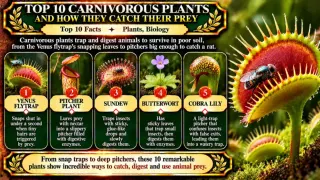
Related: Top 10 Carnivorous Plants and How They Catch Their Prey
A metaphor can be a good teaching tool and a bad map. The fungi remain, whether or not they are an internet.
4. A Flower that Makes Heat
Some plants, including skunk cabbages, the titan arum, and the sacred lotus, can raise their temperature above the air around them, a process called thermogenesis [4]. The heat can spread odor, protect tissues in cold weather, or reward visiting insects. The physiology is not a mystery in outline: stored fuel is burned in a way that produces warmth rather than ordinary growth [4]. The puzzle is comparative. Why have a few lineages invested in a trick that most plants never use, and how precisely is the temperature controlled? Those are research questions. They do not require a metaphor about intelligence, only a respect for metabolism that can, for a time, look like a warm-blooded act.
A heated flower is a fact you can measure with a thermometer. That is the right instrument, not a personality test.
5. A Vine, and a Claim under Review
Boquila trifoliolata, a vine from Chilean temperate forest, has been reported to change the size, shape, and color of its leaves to match the plant it is climbing, a mimicry more flexible than the usual fixed camouflage [5]. Later work claimed that the vine could even approach the look of artificial leaves, which would make a simple chemical cue harder to invoke. Other researchers have been skeptical, pointing to limits in the original designs, alternative explanations, and a need for stronger, independent tests [5]. This entry treats the mimicry as a live, unsettled puzzle, not as a settled marvel, and not as evidence that the vine "sees" in any ordinary sense. If the strongest version survives replication, it will be one of the stranger facts in botany. If it does not, the weaker, still interesting version may remain.
A sensational plant should be asked for its paperwork. The paperwork, in this case, is still being marked.
Related: Top 10 Most Bizarre Phobias: Strange Fears That Exist
6. Sound, Roots, and a High Bar
A set of experiments has suggested that plant roots can grow toward the sound of flowing water, or otherwise respond to acoustic cues, as if they were "hearing" [6]. The idea is not physically absurd: sound is a mechanical disturbance, and plants are full of mechanical sensors. The published evidence, however, has been challenged on methods, controls, and replication, and it should not be listed as a demonstrated sense on the same shelf as light or gravity [6]. The puzzle is whether roots use sound at all, in soil, at the volumes that matter. Until cleaner tests are in, "root hearing" is a hypothesis with a catchy name.
A catchy name can outrun a lab. This one should be allowed to wait.
7. A Robot that Grows like a Root
Engineers have built "plantoid" robots, machines whose tips elongate, branch, and search in a way inspired by growing roots, sometimes by adding material at the tip rather than by rolling on wheels [7]. The projects are a branch of soft and growing robotics, and they are documented in papers and prototypes. They do not prove that plants are intelligent in a human sense. They prove that plant growth is a good engineering idea: a searcher that leaves its body behind as a structure, that can penetrate a medium, and that can branch when a path is promising [7]. The unexpected fact is technological. A root is a strategy, and a strategy can be copied in plastic and in code.
A robot can honor a plant without turning the plant into a tiny engineer. The honor, here, is the imitation.
8. Measuring the Night, Anticipating a Season
Plants measure the length of the night, and they run circadian clocks that let them anticipate dawn, adjust metabolism, and, in many species, flower only when the day length is right [8]. The photoperiod pathway, involving phytochromes and a set of clock genes, is one of the great successes of plant biology. "Anticipation" in this setting is a technical word: the plant changes state before the environmental cue peaks, because a clock and a calendar of light have been integrated [8]. It is not a prophecy, and it is not a feeling about the future. The puzzle that remains is mostly detail: how so many species, in so many climates, tune the same kind of clock to different seasons.
Related: Top 10 Oldest Buildings in the World
A calendar made of light is already strange enough. It does not need to be sold as foresight of a human kind.
9. A Folded Leaf, and an Argument about Memory
Mimosa pudica folds its leaves when they are touched. In a widely discussed 2014 experiment, plants that were repeatedly dropped, a harmless if rude treatment, stopped folding, and the habituation appeared to last for weeks, even after the plants were moved [9]. The authors described this as a form of memory. Critics have asked whether the design separates true learned memory from fatigue, growth, or other physiological change, and whether the result is as robust as the headline [9]. Habituation is a real biological category. Calling it memory, in a plant, is a definitional fight as well as an empirical one. The honest status is "argued."
If the effect holds, it is a long-lasting change in a touch response, which is remarkable. If it does not, the ordinary rapid folding of Mimosa is still a fine puzzle, and it never needed a stronger word than it can support.
10. Neighbors, Kin, and Chemical Space
Plants detect neighbors by light quality, by touch, by nutrients, and, in some cases, by chemicals released into soil or air, and they change their growth accordingly, often by reaching for light or by inhibiting a nearby root [10]. Some species also appear to treat kin a little differently from strangers, though that literature is uneven. Allelopathy, the release of compounds that suppress other plants, is a documented "bad neighbor" strategy in some crops and weeds, and it is easy to over-credit when mere shade or thirst would suffice [10]. The puzzle is how much of plant social life is precise recognition and how much is ordinary selfish growth in a crowded bed. "Spite" and "kindness" are metaphors. Competition is the safer noun.
Related: 10 Sikh Gurus: The Pillars of Sikhism Who Shaped Faith, Equality, Courage, and Humanity
A forest or a field is a crowd. The unexpected fact is how many sensors a rooted organism can use to notice that crowd, without ever taking a step.
Conclusion
The ten puzzles above are enough to justify curiosity and not enough, together, to justify a courtroom claim that plants think as we do. A trap can count. A leaf can change the air. A fungus can link roots, even if the internet story runs ahead of the data. A flower can be warm, a clock can measure night, and a robot can grow like a root. Mimicry, hearing, and memory, in their stronger versions, are still in the argument. Neighbors can be detected and resisted with chemistry and shade. The right tone is a raised eyebrow and a demand for the next experiment, not a conversion to a new metaphysics.
Intelligence, if the word is going to be used at all, should be used as a research program. In plants, that program is unfinished, which is the most interesting thing about it.
- ^ [1] Physiological studies of stimulus counting and digestive investment in the Venus flytrap. Britannica: Venus flytrap
- ^ [2] Research on plant volatile organic compounds and neighbor or tritrophic signaling. Britannica: Allelopathy, and related chemical-ecology reviews
- ^ [3] Work on mycorrhizal networks, including later reviews that question the strongest "wood-wide web" claims. Britannica: Mycorrhiza
- ^ [4] Accounts of thermogenesis in skunk cabbage, titan arum, lotus, and related plants. Britannica: Thermogenesis
- ^ [5] Papers and critiques concerning leaf mimicry in Boquila trifoliolata, treated here as an open debate. Britannica: Mimicry
- ^ [6] Experimental claims and methodological critiques of acoustic responses in roots. Britannica: Root
- ^ [7] Engineering papers on plantoid and growing robots inspired by root tips. Britannica: Robot
- ^ [8] The photoperiod and circadian literature on flowering and daily anticipation in plants. Britannica: Photoperiodism
- ^ [9] The 2014 Mimosa pudica habituation study and subsequent debate over plant "memory." Britannica: Mimosa pudica
- ^ [10] Research on neighbor detection, competition, kin effects, and allelopathy. Britannica: Competition




















Discussion
Log in with