





 By
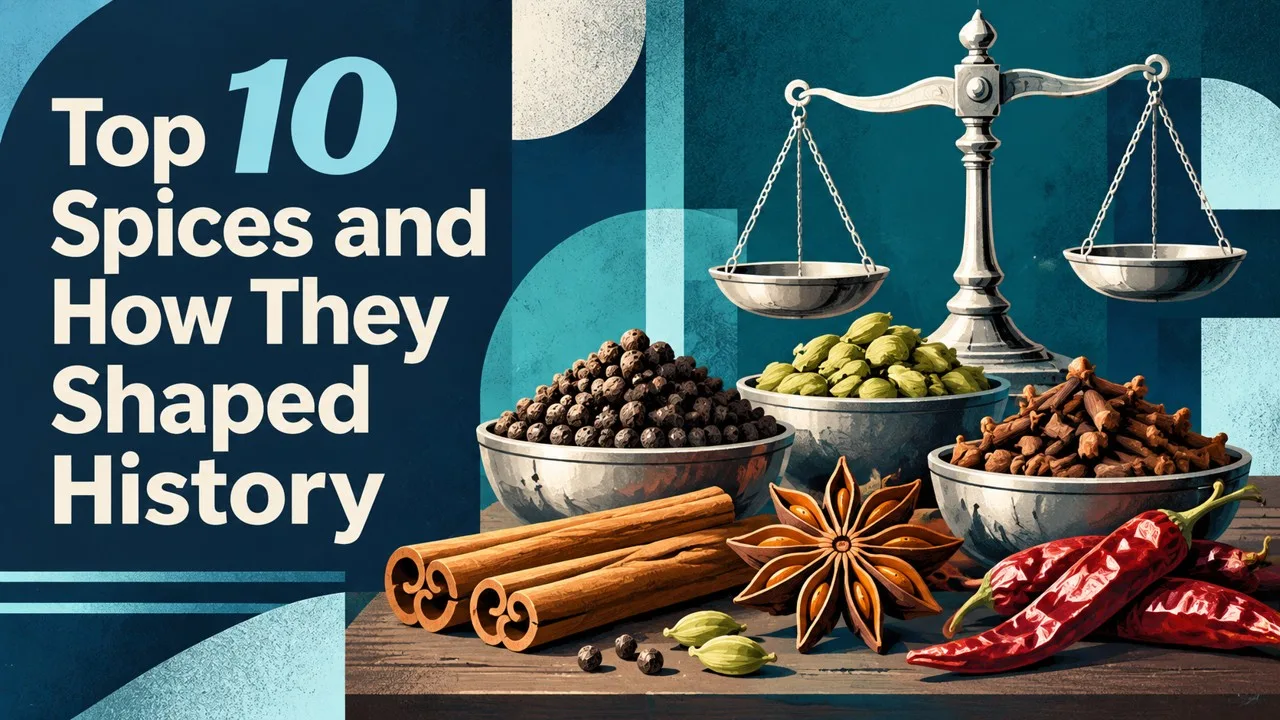
From black pepper and cloves to nutmeg and vanilla, these ten spices and how they shaped history explain voyages, empires and wars fought over flavour. For thousands of years, spices were among the most valuable goods in the world. They flavoured food, preserved it, perfumed homes and were used in medicine and religious rituals. Because many grew only in a few tropical regions, they travelled thousands of kilometres before reaching European, African and Middle Eastern markets.
The desire for spices drove the voyages of the Age of Discovery, founded powerful trading companies and led to brutal colonial conquests. This list looks at ten spices and the remarkable stories of how they shaped history.
Key Facts
The ten spices below come from South and South-East Asia, the Middle East and the Americas.
History-Shaping Spices at a Glance
| # | Spice | Plant part | Original home | Historical impact |
|---|---|---|---|---|
| 1 | Black Pepper | Dried berries | Malabar Coast, India | The king of spices |
| 2 | Cinnamon | Inner bark | Sri Lanka | A spice wrapped in legend |
| 3 | Cloves | Dried flower buds | Maluku Islands, Indonesia | From a few islands to the world |
| 4 | Nutmeg and Mace | Seed and its covering | Banda Islands, Indonesia | A spice worth a massacre |
| 5 | Saffron | Flower stigmas | Mediterranean and Western Asia | The most expensive spice |
| 6 | Ginger | Root-like stem | South-East Asia | A spice and a medicine |
| 7 | Turmeric | Root-like stem | India | Colour, cooking and ceremony |
| 8 | Cardamom | Seed pods | Western Ghats, India | The queen of spices |
| 9 | Chili Pepper | Fruit | The Americas | A New World spice that conquered Asia |
| 10 | Vanilla | Seed pods | Mexico | An orchid saved by a young man's discovery |
1. Black Pepper
Black pepper comes from the berries of Piper nigrum, a climbing vine native to the Western Ghats and Malabar Coast of southern India, in present-day Kerala. [1]
Pepper was traded from India to the Roman Empire through ports such as Muziris. The Roman writer Pliny the Elder complained about the huge sums of money flowing east to pay for it. [1]
In AD 408, when the Visigoth leader Alaric besieged Rome, his demands for lifting the siege reportedly included 3,000 pounds of pepper.
Pepper remained so valuable in medieval Europe that it was sometimes used to pay rents and taxes. It was one of the main goods Vasco da Gama sought when he sailed to India in 1498.
Today pepper is the world's most widely traded spice, and Vietnam is the largest producer.
Key Figures
- Plant: Piper nigrum
- Origin: Malabar Coast, India
- Alaric's demand: 3,000 pounds, AD 408
- Largest producer today: Vietnam
Why It Made the List
Pepper drove trade between India and Europe for two thousand years. It helped inspire the search for a sea route to Asia.
2. Cinnamon
True cinnamon comes from the inner bark of Cinnamomum verum, a tree native to Sri Lanka. A related spice called cassia comes from trees grown in China and South-East Asia. [2]
Ancient Egyptians used cinnamon in perfumes and embalming. To protect their trade, Arab merchants told tales that cinnamon was gathered from the nests of giant birds, a story repeated by Herodotus. [2]
In the sixteenth century, the Portuguese took control of the cinnamon trade in Sri Lanka. The Dutch drove them out in the seventeenth century, and the British took over in 1796.
Each colonial power tried to control the supply, sometimes destroying crops to keep prices high.
Sri Lanka remains famous for producing high-quality true cinnamon, sold as thin, papery quills.
Key Figures
- Plant: Cinnamomum verum
- Origin: Sri Lanka
- Ancient use: Egyptian embalming
- Colonial controllers: Portuguese, Dutch, British
Why It Made the List
Cinnamon was one of the most prized spices of the ancient world. Its trade drew European powers to Sri Lanka.
Related: Top 10 Most Bizarre Phobias: Strange Fears That Exist
3. Cloves
Cloves are the dried flower buds of a tree native to a handful of islands in the Maluku Islands of Indonesia, including Ternate and Tidore. [3]
Cloves travelled astonishingly far in ancient times. Archaeologists found cloves at Terqa in Syria dating to around 1700 BC. [3]
In Han dynasty China, officials reportedly chewed cloves to sweeten their breath before speaking to the emperor.
When Magellan's surviving ship returned to Spain in 1522, its cargo of cloves was valuable enough to cover the cost of the expedition.
In 1770, the French official Pierre Poivre smuggled clove seedlings to Mauritius, breaking the Dutch monopoly. Later, Zanzibar became one of the world's leading producers.
Clove oil contains eugenol, which has long been used to ease toothache.
Key Figures
- Plant part: flower buds
- Origin: Maluku Islands
- Ancient find: Terqa, Syria, about 1700 BC
- Monopoly broken: 1770
Why It Made the List
Cloves linked tiny islands to markets across the world. The fight to control them shaped colonial history.
4. Nutmeg and Mace
Nutmeg is the seed of the tree Myristica fragrans, and mace is the red, lacy covering around the seed. For centuries, the trees grew only on the tiny Banda Islands in eastern Indonesia. [4]
In the early seventeenth century, the Dutch East India Company tried to control the nutmeg trade completely. In 1621 the company's governor-general, Jan Pieterszoon Coen, conquered the islands, and most of the Bandanese population was killed, enslaved or driven away. [4]
The English held one small Banda island, Run. Under the Treaty of Breda in 1667, the Dutch kept Run and the English kept New Amsterdam, which became New York.
Nutmeg was used in cooking, medicine and perfume and was believed to protect against plague.
Today nutmeg is grown in many tropical places, including Grenada, which shows a nutmeg on its flag.
Key Figures
- Plant: Myristica fragrans
- Original source: Banda Islands only
- Dutch conquest: 1621
- Treaty of Breda: 1667
Why It Made the List
Nutmeg's story shows the violence behind the spice trade. It even played a part in the history of Manhattan.
5. Saffron
Saffron comes from the thread-like stigmas of the saffron crocus. Each flower has only three stigmas, picked by hand, and around 150,000 flowers are needed to produce a kilogram. [5]
Saffron has been used for more than 3,000 years. A Bronze Age fresco from the island of Thera, in the Aegean, shows women gathering saffron. [5]
Related: Top 10 Oldest Buildings in the World
It was used as a dye, a medicine and a flavouring in dishes such as Spanish paella, Italian risotto and Indian biryani.
In 1374, a stolen shipment of saffron sparked a fourteen-week conflict in Basel known as the Saffron War.
Today Iran produces most of the world's saffron, and Kashmir in India is also famous for it.
Because it is so costly, saffron has often been faked with cheaper materials, and in medieval Nuremberg people caught selling fake saffron could be punished severely, even executed.
Key Figures
- Plant: saffron crocus
- Flowers per kilogram: about 150,000
- Ancient evidence: Thera fresco
- Largest producer: Iran
Why It Made the List
Saffron is the world's most expensive spice by weight. Its history spans civilisations across three continents.
6. Ginger
Ginger is the underground stem, or rhizome, of the plant Zingiber officinale, which probably originated in maritime South-East Asia. [6]
It was used early in China and India as both food and medicine. The Chinese philosopher Confucius is said to have eaten ginger with every meal. [6]
Ginger reached the Roman world through trade and became popular in medieval Europe, where it was used in sauces and sweets such as gingerbread.
Because it could be transported as a living root, ginger spread easily to other tropical regions, including Africa and the Caribbean.
Today India is the world's largest producer, and ginger is widely used in teas and remedies for nausea.
Fresh, dried, pickled and candied ginger are all used in different cuisines, and ginger beer became popular in Britain in the eighteenth century.
Key Figures
- Plant: Zingiber officinale
- Origin: maritime South-East Asia
- Medieval treat: gingerbread
- Largest producer: India
Why It Made the List
Ginger is one of the oldest traded spices. It remains a key flavour in cuisines worldwide.
7. Turmeric
Turmeric comes from the rhizome of Curcuma longa, a plant of the ginger family native to South Asia. India produces most of the world's turmeric. [7]
Related: 10 Sikh Gurus: The Pillars of Sikhism Who Shaped Faith, Equality, Courage, and Humanity
Its bright yellow colour comes from curcumin, and it has been used for thousands of years as a dye, a spice and in traditional medicine such as Ayurveda. [7]
In India, turmeric plays a role in religious ceremonies and weddings, including the haldi ceremony, when a turmeric paste is applied to the bride and groom.
In 1995, a US patent was granted for using turmeric to heal wounds. India's Council of Scientific and Industrial Research challenged it, showing the use was traditional knowledge, and the patent was revoked in 1997.
Turmeric gives curry powders their typical golden colour.
Key Figures
- Plant: Curcuma longa
- Main producer: India
- Colouring compound: curcumin
- Patent revoked: 1997
Why It Made the List
Turmeric is central to South Asian cooking and culture. Its patent case became a landmark in protecting traditional knowledge.
8. Cardamom
Green cardamom comes from the seed pods of Elettaria cardamomum, a plant native to the forests of the Western Ghats in southern India. It is often called the queen of spices. [8]
Cardamom has been traded for thousands of years and was valued in ancient India, Greece and Rome for flavour and perfume. [8]
It is one of the world's most expensive spices, after saffron and vanilla, because the pods must be picked by hand.
It is used in Indian sweets and chai, Arabic coffee and Scandinavian baking.
In the twentieth century, cardamom was introduced to Guatemala, which became the world's largest producer.
A smaller crop of black cardamom, from a related plant grown in the Himalayan foothills, has a smoky flavour. Green cardamom pods are harvested before they ripen and are dried carefully to keep their colour.
Key Figures
- Plant: Elettaria cardamomum
- Origin: Western Ghats
- Nickname: queen of spices
- Largest producer today: Guatemala
Why It Made the List
Cardamom links Indian forests with kitchens around the world. Its rise in Guatemala shows how spices migrate.
9. Chili Pepper
Chili peppers belong to the genus Capsicum and were domesticated in Mexico thousands of years ago. [9]
Christopher Columbus brought chili peppers back to Spain after his voyages, calling them peppers because their heat reminded him of black pepper. [9]
Portuguese traders carried chilies to Africa, India and South-East Asia in the sixteenth century. They became so popular that it is hard to imagine Indian, Thai or Korean cooking without them.
Related: General Knowledge Facts About the Banyan Tree: Botany, Records and Culture
Their heat comes from a compound called capsaicin. In 1912 the American pharmacist Wilbur Scoville devised a scale to measure it.
India is now the world's largest producer and consumer of chili peppers.
Some of the hottest chilies, such as India's bhut jolokia, rate more than a million units on the Scoville scale. Dried and ground chilies are used to make paprika and cayenne pepper.
Key Figures
- Genus: Capsicum
- Domesticated: Mexico
- Spread by: Portuguese traders
- Heat scale: Scoville, 1912
Why It Made the List
Chili peppers transformed cuisines across the world within a century. They are a key example of the Columbian Exchange.
10. Vanilla
Vanilla comes from the pods of an orchid, Vanilla planifolia, native to Mexico. The Totonac people cultivated it, and the Aztecs used it to flavour chocolate drinks. [10]
Spanish explorers brought vanilla to Europe, but attempts to grow it elsewhere failed because the flowers were naturally pollinated only by certain insects found in Mexico. [10]
In 1841, Edmond Albius, a twelve-year-old enslaved boy on the island of Reunion, invented a quick way to pollinate vanilla flowers by hand.
His method allowed vanilla to be grown in many tropical regions. Madagascar now produces most of the world's natural vanilla.
Vanilla is the second most expensive spice after saffron, because each flower must still be pollinated by hand.
Much of the vanilla flavour used in food today is artificial vanillin, made in factories.
Key Figures
- Plant: Vanilla planifolia orchid
- Origin: Mexico
- Hand pollination: 1841, Edmond Albius
- Largest producer: Madagascar
Why It Made the List
Vanilla is one of the world's favourite flavours. Its global spread depended on a young enslaved boy's discovery.
Conclusion
Spices have shaped history far beyond the kitchen. They drove exploration, created vast fortunes and caused wars, conquests and suffering.
Today spices are cheap and widely available, but their stories remind us of the long journeys and complex histories behind everyday flavours.
- ^ [1] "Black Pepper". Wikipedia. Wikipedia: Black pepper Wikipedia: Muziris
- ^ [2] "Cinnamon". Wikipedia. Wikipedia: Cinnamon Wikipedia: Cinnamomum verum
- ^ [3] "Cloves". Wikipedia. Wikipedia: Clove Wikipedia: Maluku Islands
- ^ [4] "Nutmeg and Mace". Wikipedia. Wikipedia: Nutmeg Wikipedia: Banda Islands
- ^ [5] "Saffron". Wikipedia. Wikipedia: Saffron Wikipedia: Crocus sativus
- ^ [6] "Ginger". Wikipedia. Wikipedia: Ginger Wikipedia: Rhizome
- ^ [7] "Turmeric". Wikipedia. Wikipedia: Turmeric Wikipedia: Curcumin
- ^ [8] "Cardamom". Wikipedia. Wikipedia: Cardamom Wikipedia: Elettaria cardamomum
- ^ [9] "Chili Pepper". Wikipedia. Wikipedia: Chili pepper Wikipedia: Scoville scale
- ^ [10] "Vanilla". Wikipedia. Wikipedia: Vanilla Wikipedia: Edmond Albius



















Discussion
Log in with