





 By
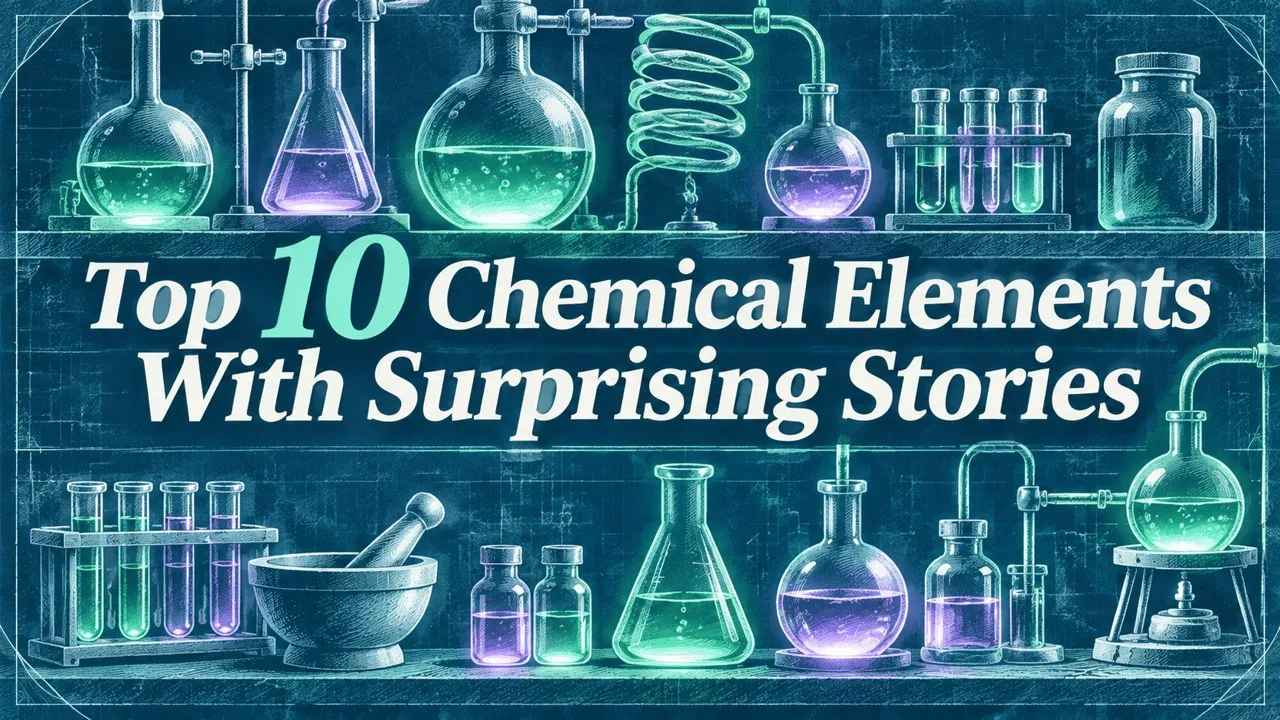
From phosphorus boiled out of urine to helium found in the Sun first, these ten chemical elements with surprising stories reveal chemistry's strange history. The periodic table lists 118 known elements, the basic substances from which everything is made. Behind each element is a story of discovery, and some of those stories are stranger than fiction, involving alchemists, eclipses, dangerous experiments and a single Swedish village.
This list explores ten elements whose discovery or history took surprising turns. Together they show how chemistry developed from alchemy into a modern science, and how elements have shaped industry, medicine and everyday life.
Key Facts
The ten elements below were discovered or isolated between 1669 and 1937.
Elements With Surprising Stories at a Glance
| # | Element | Symbol | Discovered | Surprising story |
|---|---|---|---|---|
| 1 | Phosphorus | P | 1669 | Boiled out of urine by an alchemist |
| 2 | Oxygen | O | 1770s | Discovered twice and named by mistake |
| 3 | Platinum | Pt | 1748 | Once thrown away as unwanted silver |
| 4 | Helium | He | 1868 | Found in the Sun before the Earth |
| 5 | Gallium | Ga | 1875 | Predicted before it was found |
| 6 | Aluminium | Al | 1825 | Once more valuable than gold |
| 7 | Radium | Ra | 1898 | From miracle cure to deadly danger |
| 8 | Fluorine | F | 1886 | The element that hurt its hunters |
| 9 | Yttrium and the Ytterby Elements | Y | 1794 | One village, four elements |
| 10 | Technetium | Tc | 1937 | The first artificially made element |
1. Phosphorus
Phosphorus was discovered in 1669 by Hennig Brand, an alchemist in Hamburg, Germany. He was searching for the philosopher's stone, a legendary substance believed to turn metals into gold. [1]
Brand collected large amounts of urine, let it stand for days and then boiled it down. The result was a white, waxy substance that glowed in the dark, which he kept secret for some time. [1]
He was the first person known by name to have discovered an element. The name phosphorus comes from Greek words meaning light-bearer.
Phosphorus was later used in matches. Workers in match factories who handled white phosphorus often suffered a terrible bone disease called phossy jaw, and poor conditions led to the London matchgirls' strike of 1888.
Phosphorus is essential to life, found in DNA, bones and teeth, and is a key ingredient in fertilisers.
Key Figures
- Discoverer: Hennig Brand
- Year: 1669
- Source: urine
- Name meaning: light-bearer
Why It Made the List
Phosphorus was the first element discovered by a known person. Its story links alchemy with modern chemistry.
2. Oxygen
Oxygen was discovered independently by two chemists in the 1770s. The Swedish chemist Carl Wilhelm Scheele produced it around 1771 and 1772, calling it fire air, but his results were published later. [2]
In August 1774, the English chemist Joseph Priestley made the gas by heating mercury oxide. He found that a candle burned brightly in it and that a mouse could survive longer in it than in ordinary air. [2]
Priestley called it dephlogisticated air, based on the old phlogiston theory of burning.
The French chemist Antoine Lavoisier showed that burning involves combining with this gas, overturning the phlogiston theory. He named it oxygen, meaning acid-former, wrongly believing that all acids contained it.
Oxygen makes up about 21 percent of the air and is the most abundant element in the Earth's crust.
Key Figures
- Discoverers: Scheele and Priestley
- Priestley's experiment: August 1774
- Named by: Antoine Lavoisier
- Share of air: about 21 percent
Why It Made the List
The discovery of oxygen transformed chemistry. It ended the phlogiston theory and launched modern chemistry.
3. Platinum
Platinum was used by Indigenous craftsmen in South America, in what is now Ecuador and Colombia, long before Europeans arrived. [3]
Related: Top 10 Most Bizarre Phobias: Strange Fears That Exist
Spanish miners searching for gold found grains of a white metal they could not melt. They called it platina, meaning little silver, and regarded it as a nuisance, sometimes throwing it back into rivers. [3]
The Spanish scientist Antonio de Ulloa described it in a book published in 1748, bringing it to the attention of European scientists.
Because platinum is very stable and resistant to corrosion, it was used to make standard measuring objects. The international prototype of the kilogram, made of platinum and iridium in 1889, defined the kilogram until 2019.
Today platinum is used in jewellery, catalytic converters in cars and medical devices.
Key Figures
- Spanish name: platina, little silver
- Described in Europe: 1748
- Prototype kilogram: 1889 to 2019
- Modern use: catalytic converters
Why It Made the List
Platinum went from discarded waste to one of the most precious metals. It defined the world's kilogram for 130 years.
4. Helium
Helium was first detected not on Earth but in the Sun. During a solar eclipse in August 1868, the French astronomer Jules Janssen saw a bright yellow line in the light of the Sun's outer layers. [4]
The English astronomer Norman Lockyer concluded that it came from an unknown element, which he and the chemist Edward Frankland named helium, from the Greek word for the Sun. [4]
Helium was found on Earth only in 1895, when the Scottish chemist William Ramsay detected it in gas released from a uranium mineral.
Helium is the second most abundant element in the universe, but it is relatively rare on Earth and is mostly obtained from natural gas.
It is used in balloons, for cooling the magnets in MRI scanners and in deep-sea diving gas mixtures.
Key Figures
- First detected: in the Sun, 1868
- Named by: Lockyer and Frankland
- Found on Earth: 1895, by William Ramsay
- Cosmic rank: second most abundant element
Why It Made the List
Helium is the only element discovered in space before Earth. It shows the power of studying light from stars.
5. Gallium
In 1871 the Russian chemist Dmitri Mendeleev used his new periodic table to predict elements that had not yet been discovered. One, which he called eka-aluminium, would fill a gap below aluminium. [5]
In 1875 the French chemist Paul-Emile Lecoq de Boisbaudran discovered a new element using spectroscopy and named it gallium, after Gallia, the Latin name for France. [5]
Related: Top 10 Oldest Buildings in the World
When the first measurement of gallium's density did not match Mendeleev's prediction, Mendeleev suggested it be measured again. The new measurement matched his forecast closely.
Gallium melts at about 30 degrees Celsius, so a piece will melt in a person's hand.
Today gallium compounds are used in electronics, including the light-emitting diodes found in many screens and lamps.
Mendeleev also correctly predicted the properties of scandium and germanium, discovered in 1879 and 1886.
Key Figures
- Predicted: 1871, by Mendeleev
- Discovered: 1875
- Named after: Gallia, France
- Melting point: about 30 degrees Celsius
Why It Made the List
Gallium proved the power of the periodic table. Its discovery convinced scientists that Mendeleev's system was correct.
6. Aluminium
Aluminium is the most abundant metal in the Earth's crust, but it is very difficult to separate from its ores. It was first isolated in impure form in 1825 by the Danish scientist Hans Christian Orsted. [6]
For decades, aluminium was so hard to produce that it was more expensive than gold. The French emperor Napoleon III reportedly served his most honoured guests with aluminium cutlery. [6]
In 1884, a small aluminium pyramid was placed at the top of the Washington Monument, then a showcase of a rare and modern metal.
In 1886 Charles Martin Hall in the United States and Paul Heroult in France independently invented an electrical process for producing aluminium cheaply.
Aluminium became one of the most widely used metals, essential for aircraft, cans, cars and buildings.
Key Figures
- First isolated: 1825
- Status in the 1850s: more costly than gold
- Monument cap: Washington Monument, 1884
- Cheap process: Hall and Heroult, 1886
Why It Made the List
Aluminium went from luxury to everyday material in a few decades. Its story shows how technology changes the value of materials.
7. Radium
Radium was discovered in December 1898 by Marie and Pierre Curie, who extracted it from tonnes of a uranium ore called pitchblende. [7]
Radium is intensely radioactive and gives off a faint glow. In the early twentieth century, it was widely promoted as a health product and added to toothpaste, cosmetics and drinks. [7]
Related: 10 Sikh Gurus: The Pillars of Sikhism Who Shaped Faith, Equality, Courage, and Humanity
Workers known as the Radium Girls painted watch dials with radium paint in the United States. Many were told to shape their brushes with their lips, and they later suffered severe illness.
Their legal cases in the 1920s helped establish workers' rights to sue for occupational harm and improved safety standards.
Radium was once used in cancer treatment, but safer sources of radiation have replaced it.
Key Figures
- Discovered: December 1898
- Discoverers: Marie and Pierre Curie
- Source: pitchblende
- Famous victims: the Radium Girls
Why It Made the List
Radium's story shows both the promise and danger of new science. It changed laws on workplace safety.
8. Fluorine
Fluorine is the most reactive of all elements, so it was extremely difficult to isolate. Chemists had suspected its existence for decades. [8]
Several chemists who tried to isolate it were seriously injured or killed by toxic fumes. They are sometimes called the fluorine martyrs. [8]
In 1886 the French chemist Henri Moissan finally isolated fluorine using electrolysis at low temperatures. He received the Nobel Prize in Chemistry in 1906.
Fluorine compounds are now widely used. Fluoride in toothpaste helps prevent tooth decay, and a fluorine-containing plastic is used in non-stick cookware.
Fluorine is also used in processing uranium for nuclear power.
The element's name comes from the mineral fluorite, which was used as a flux to help metals melt, from the Latin word for flow. Fluorine gas is pale yellow and can react with almost every other element, even some noble gases.
Key Figures
- Isolated: 1886
- Chemist: Henri Moissan
- Nobel Prize: 1906
- Common use: fluoride toothpaste
Why It Made the List
Fluorine resisted isolation for decades and cost lives. Its compounds are now part of daily life.
9. Yttrium and the Ytterby Elements
In 1787 a lieutenant named Carl Axel Arrhenius found an unusual black rock in a quarry near the village of Ytterby, on an island near Stockholm in Sweden. [9]
In 1794 the Finnish chemist Johan Gadolin identified a new earth in the mineral, later called yttria. Over the next century, chemists discovered several new elements in minerals from the same quarry. [9]
Related: General Knowledge Facts About the Banyan Tree: Botany, Records and Culture
Four elements are named after the village: yttrium, terbium, erbium and ytterbium. No other place on Earth has given its name to so many elements.
Others from the same minerals include gadolinium, named after Gadolin, and holmium, named after Stockholm.
These rare earth elements are now vital to modern technology, including magnets, lasers and screens.
Key Figures
- Village: Ytterby, Sweden
- Rock found: 1787
- First element identified: 1794, by Johan Gadolin
- Elements named after Ytterby: four
Why It Made the List
Ytterby is the most productive place in the history of element discovery. Its rare earths power modern electronics.
10. Technetium
For decades, there was a gap at element 43 in the periodic table. Several scientists claimed to have found it, but none could prove it. [10]
In 1937 the Italian scientists Carlo Perrier and Emilio Segre discovered element 43 in a piece of molybdenum that had been bombarded with particles in a cyclotron at the University of California, Berkeley. [10]
It was the first element to be produced artificially. Its name comes from the Greek word for artificial.
Technetium has no stable form, so almost none exists naturally on Earth.
A form called technetium-99m is now used in tens of millions of medical imaging scans each year.
Mendeleev had predicted the element in 1871 and called it eka-manganese. Tiny traces of technetium were later found in some stars, which helped prove that stars create elements.
Key Figures
- Element number: 43
- Discovered: 1937
- Discoverers: Perrier and Segre
- Medical use: technetium-99m imaging
Why It Made the List
Technetium was the first element made by humans. It opened the way for creating many new elements.
Conclusion
Each element has a story of curiosity, danger, luck or brilliant prediction. Together they show how chemistry grew into a precise science.
These ten elements remind us that the substances in our phones, medicines and bodies were once mysteries waiting to be discovered.
- ^ [1] "Phosphorus". Wikipedia. Wikipedia: Phosphorus Wikipedia: Hennig Brand
- ^ [2] "Oxygen". Wikipedia. Wikipedia: Oxygen Wikipedia: Joseph Priestley
- ^ [3] "Platinum". Wikipedia. Wikipedia: Platinum Wikipedia: International Prototype of the Kilogram
- ^ [4] "Helium". Wikipedia. Wikipedia: Helium Wikipedia: Norman Lockyer
- ^ [5] "Gallium". Wikipedia. Wikipedia: Gallium Wikipedia: Mendeleev's predicted elements
- ^ [6] "Aluminium". Wikipedia. Wikipedia: Aluminium Wikipedia: Hall-Héroult process
- ^ [7] "Radium". Wikipedia. Wikipedia: Radium Wikipedia: Radium Girls
- ^ [8] "Fluorine". Wikipedia. Wikipedia: Fluorine Wikipedia: Henri Moissan
- ^ [9] "Yttrium and the Ytterby Elements". Wikipedia. Wikipedia: Ytterby Wikipedia: Yttrium
- ^ [10] "Technetium". Wikipedia. Wikipedia: Technetium Wikipedia: Technetium-99m





















Discussion
Log in with