






 By
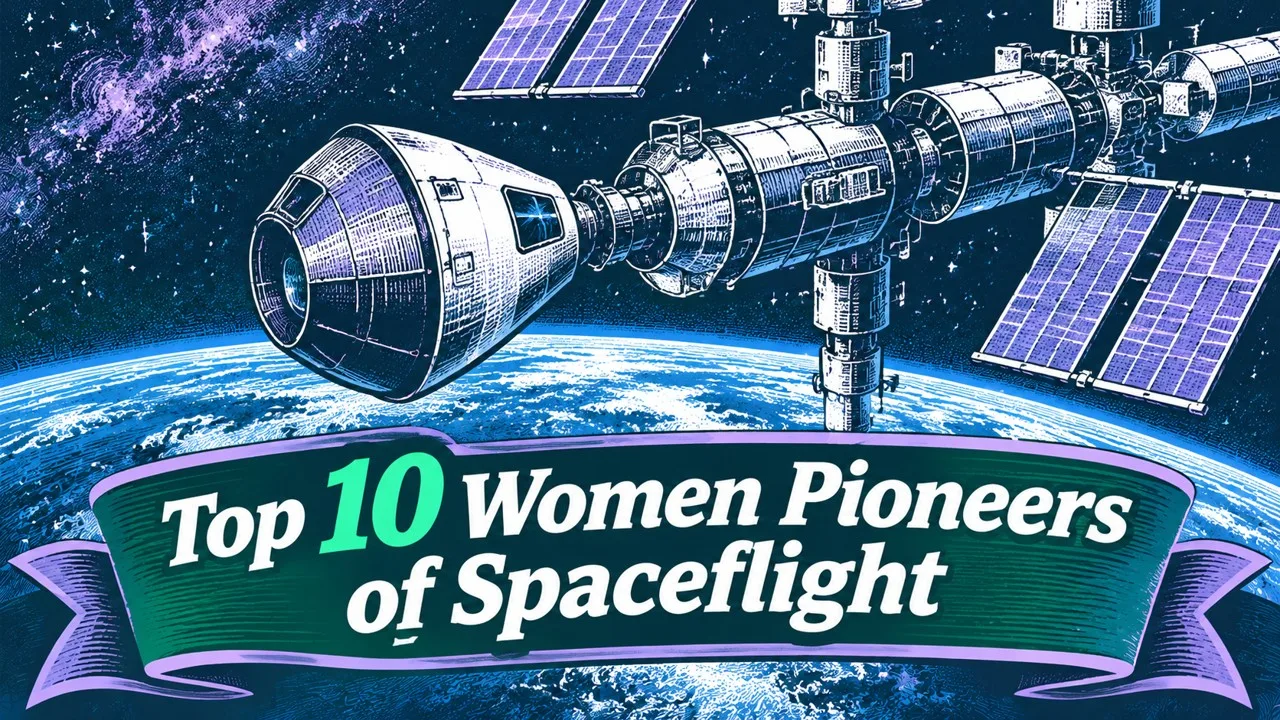
From Valentina Tereshkova in 1963 to Christina Koch's flight around the Moon, these ten women pioneers of spaceflight broke records and barriers in orbit. When the space age began, flying into orbit was seen as a job for military test pilots, and almost all of them were men. Over the following decades, women proved again and again that they belonged in space, as pilots, commanders, scientists and spacewalkers.
This list celebrates ten women whose spaceflights set records or opened doors. Some were the first of their nation, some set endurance records, and two of them, Kalpana Chawla and Sunita Williams, have special significance for readers in India.
Key Facts
The ten pioneers below flew between 1963 and 2026, with milestones ranging from the first woman in orbit to the first woman to travel around the Moon.
Women Pioneers of Spaceflight at a Glance
| # | Name | First flight | Country | Milestone |
|---|---|---|---|---|
| 1 | Valentina Tereshkova | 1963 | Soviet Union | First woman in space |
| 2 | Svetlana Savitskaya | 1982 | Soviet Union | First woman to walk in space |
| 3 | Sally Ride | 1983 | United States | First American woman in space |
| 4 | Kathryn Sullivan | 1984 | United States | First American woman to walk in space |
| 5 | Mae Jemison | 1992 | United States | First African American woman in space |
| 6 | Eileen Collins | 1995 | United States | First woman to pilot and command the space shuttle |
| 7 | Kalpana Chawla | 1997 | United States | First woman of Indian origin in space |
| 8 | Peggy Whitson | 2002 | United States | First woman to command the International Space Station |
| 9 | Christina Koch | 2019 | United States | Longest spaceflight by a woman and first woman around the Moon |
| 10 | Sunita Williams | 2006 | United States | Most spacewalking time by a woman |
1. Valentina Tereshkova
Valentina Tereshkova became the first woman in space on 16 June 1963, when she was launched aboard Vostok 6. [1]
Before becoming a cosmonaut, she worked in a textile factory and was an amateur parachutist. Her parachuting skill mattered, because Vostok pilots ejected from their capsules and landed separately. [1]
Tereshkova spent almost three days in orbit and circled Earth 48 times, more time in space than all American astronauts who had flown up to then combined.
Her radio call sign was Chaika, meaning seagull, and she became an instant celebrity around the world.
She remains the only woman to have flown a solo spaceflight.
Another Soviet woman would not fly to space for nearly two decades, and she later became a prominent figure in Soviet and Russian public life.
Key Figures
- Born: 1937
- Mission: Vostok 6
- Launched: 16 June 1963
- Orbits: 48
Why It Made the List
Tereshkova showed that women could fly in space from the very start of the space age. Her flight remains a historic first.
2. Svetlana Savitskaya
Svetlana Savitskaya was a record-setting test pilot and aerobatic champion before she became a cosmonaut. [2]
In August 1982, she flew aboard Soyuz T-7 to the Salyut 7 space station, becoming the second woman in space, nineteen years after Tereshkova. [2]
On her second flight, on 25 July 1984, she became the first woman to perform a spacewalk. She spent more than three hours outside the station, testing tools for cutting and welding metal.
She was also the first woman to fly into space twice.
Her flights came just before and after American women began flying, during a period of friendly competition between the two space programmes.
Savitskaya later became a politician, serving for many years in the Russian parliament.
Key Figures
- Born: 1948
- First flight: Soyuz T-7, 1982
- First spacewalk: 25 July 1984
- Station: Salyut 7
Why It Made the List
Savitskaya was the first woman to work outside a spacecraft. She proved women could take on the most demanding tasks in space.
Related: Top 10 Underrated Space Missions That Made History
3. Sally Ride
Sally Ride became the first American woman in space on 18 June 1983, flying aboard the space shuttle Challenger on mission STS-7. [3]
She was a physicist with a doctorate from Stanford University, and she was selected as an astronaut in 1978, in the first NASA class to include women. [3]
At 32, she was the youngest American to travel to space at that time. During the mission, she operated the shuttle's robotic arm to release and retrieve a satellite.
Ride flew again in 1984 and later served on the investigation boards for both the Challenger and Columbia shuttle disasters.
After leaving NASA, she founded a company called Sally Ride Science to encourage girls and young people to study science and mathematics.
Ride died in 2012, and NASA later named a lunar impact site after her.
Key Figures
- Born: 1951
- Mission: STS-7
- Launched: 18 June 1983
- Age at flight: 32
Why It Made the List
Sally Ride opened the American space programme to women. She spent her life inspiring young people to pursue science.
4. Kathryn Sullivan
Kathryn Sullivan was selected in the same 1978 astronaut class as Sally Ride. She was a geologist and oceanographer by training. [4]
On 11 October 1984, during mission STS-41-G, she became the first American woman to perform a spacewalk, demonstrating a system for refuelling satellites in orbit. [4]
In 1990 she flew on the mission that deployed the Hubble Space Telescope.
After leaving NASA, she led the National Oceanic and Atmospheric Administration, the American agency responsible for weather and ocean science.
In 2020 she travelled in a submersible to the Challenger Deep, the deepest point of the ocean. She became the first person to both walk in space and reach the deepest part of the sea.
Her career linked the exploration of space and the oceans.
Key Figures
- Born: 1951
- First spacewalk: 11 October 1984
- Hubble mission: 1990
- Challenger Deep dive: 2020
Why It Made the List
Sullivan opened spacewalking to American women. Her journey from orbit to ocean floor is unique in exploration history.
5. Mae Jemison
Mae Jemison became the first African American woman in space on 12 September 1992, flying aboard the space shuttle Endeavour on mission STS-47. [5]
She trained as a chemical engineer and physician and worked as a doctor with the Peace Corps in Sierra Leone and Liberia before joining NASA. [5]
Related: Quasars: Distant Beacons or Local Oddballs?
During her mission, she conducted experiments on bone loss and motion sickness, and studied how frog eggs developed in weightlessness.
Jemison was also a trained dancer and spoke several languages.
After leaving NASA, she founded a technology company and led a project called 100 Year Starship, which explores the ideas needed for travel to other stars.
She also made a guest appearance in an episode of the television series Star Trek: The Next Generation.
Key Figures
- Born: 1956
- Mission: STS-47
- Launched: 12 September 1992
- Professions: engineer and physician
Why It Made the List
Jemison broke a major barrier in American spaceflight. She remains a champion of science education for all.
6. Eileen Collins
Eileen Collins was a US Air Force test pilot. In February 1995 she became the first woman to pilot a space shuttle, on mission STS-63. [6]
In July 1999 she became the first woman to command a shuttle mission, STS-93, which deployed the Chandra X-ray Observatory. [6]
In 2005 she commanded STS-114, the first shuttle flight after the loss of Columbia, known as the Return to Flight mission.
During that mission she guided the shuttle through a full backflip near the International Space Station, so the crew aboard could photograph its heat shield for damage.
Collins flew four shuttle missions in total and spent more than 38 days in space.
She is remembered as a calm leader during one of NASA's most difficult periods.
Key Figures
- Born: 1956
- First pilot: STS-63, 1995
- First female commander: STS-93, 1999
- Shuttle missions: 4
Why It Made the List
Collins took women into the pilot's and commander's seats. She led NASA back to space after the Columbia disaster.
7. Kalpana Chawla
Kalpana Chawla was born in Karnal, Haryana, and studied aeronautical engineering in Chandigarh before moving to the United States. [7]
She earned a doctorate in aerospace engineering and worked on computational fluid dynamics before being selected as an astronaut. [7]
In November 1997 she flew aboard Columbia on STS-87, becoming the first woman of Indian origin to go to space. She operated the shuttle's robotic arm.
Related: Top 10 Famous Astronomical Observatories
Her second flight was STS-107 on Columbia in 2003, a research mission with dozens of experiments.
On 1 February 2003, Columbia broke apart during re-entry, killing Chawla and her six crewmates.
She is remembered in India and around the world, with scholarships, a satellite and many institutions named in her honour.
She was also a licensed pilot and flight instructor.
Key Figures
- Born: 1962, Karnal, Haryana
- First flight: STS-87, 1997
- Final mission: STS-107, 2003
- Profession: aerospace engineer
Why It Made the List
Chawla inspired millions of young Indians to dream of space. Her legacy lives on in science education.
8. Peggy Whitson
Peggy Whitson is a biochemist who first flew to the International Space Station in 2002. [8]
In 2007 she became the first woman to command the ISS, leading Expedition 16. She later commanded the station a second time. [8]
She was the first woman, and the first non-military astronaut, to serve as chief of the NASA Astronaut Office.
Whitson holds the American record for the most total time spent in space, at more than 675 days, and she has performed ten spacewalks.
After retiring from NASA, she joined the private company Axiom Space and commanded the Ax-2 mission in 2023 and the Ax-4 mission in 2025, which carried Indian astronaut Shubhanshu Shukla.
Her career spans government and commercial spaceflight.
Key Figures
- Born: 1960
- First ISS command: Expedition 16, 2007
- Spacewalks: 10
- Commercial commands: Ax-2 and Ax-4
Why It Made the List
Whitson set the American record for time in space. She has led missions in both government and private spaceflight.
9. Christina Koch
Christina Koch is an electrical engineer who worked at research stations in Antarctica and the Arctic before becoming an astronaut. [9]
During her 2019 to 2020 mission aboard the ISS, she spent 328 days in space, setting the record for the longest single spaceflight by a woman. [9]
Related: Top 10 Countries by Number of Satellites
On 18 October 2019, she and Jessica Meir carried out the first all-woman spacewalk.
In April 2026 she flew on Artemis II, the first crewed flight of the Artemis programme. The crew flew around the Moon and reached a greater distance from Earth than any humans before.
Koch became the first woman to travel beyond low Earth orbit and to fly around the Moon.
Her flights have helped prepare the way for astronauts to return to the lunar surface.
Key Figures
- Born: 1979
- Longest flight: 328 days
- All-woman spacewalk: 18 October 2019
- Lunar flyby: Artemis II, April 2026
Why It Made the List
Koch holds the endurance record for women and has flown around the Moon. She represents the new era of lunar exploration.
10. Sunita Williams
Sunita Williams is an American astronaut with Indian roots on her father's side, whose family came from Gujarat. She served as a US Navy helicopter pilot before joining NASA. [10]
She first flew to the ISS in December 2006. During that stay, she ran the Boston Marathon on a treadmill aboard the station. [10]
Williams later commanded the ISS during Expedition 33 and Expedition 72.
In 2024 she flew on the first crewed test flight of Boeing's Starliner spacecraft. Problems with the capsule meant her planned short stay stretched to more than nine months.
She has made nine spacewalks, and her total spacewalking time of 62 hours and 6 minutes is the most by any woman.
Williams is widely admired in India, which she has visited several times.
Key Figures
- Born: 1965
- First flight: December 2006
- Spacewalks: 9
- Spacewalking time: 62 hours 6 minutes
Why It Made the List
Williams set the women's record for spacewalking time. Her calm during the Starliner mission won admiration worldwide.
Conclusion
These women flew into space when doing so meant breaking barriers as well as gravity. Each of them made the path easier for those who followed.
Today women command space stations, walk in space and fly around the Moon. The next milestone may be the first woman on the lunar surface.
- ^ [1] "Valentina Tereshkova". Wikipedia. Wikipedia: Valentina Tereshkova Wikipedia: Vostok 6
- ^ [2] "Svetlana Savitskaya". Wikipedia. Wikipedia: Svetlana Savitskaya Wikipedia: Salyut 7
- ^ [3] "Sally Ride". Wikipedia. Wikipedia: Sally Ride Wikipedia: STS-7
- ^ [4] "Kathryn Sullivan". Wikipedia. Wikipedia: Kathryn D. Sullivan Wikipedia: STS-41-G
- ^ [5] "Mae Jemison". Wikipedia. Wikipedia: Mae Jemison Wikipedia: STS-47
- ^ [6] "Eileen Collins". Wikipedia. Wikipedia: Eileen Collins Wikipedia: STS-93
- ^ [7] "Kalpana Chawla". Wikipedia. Wikipedia: Kalpana Chawla Wikipedia: STS-107
- ^ [8] "Peggy Whitson". Wikipedia. Wikipedia: Peggy Whitson Wikipedia: Axiom Mission 4
- ^ [9] "Christina Koch". Wikipedia. Wikipedia: Christina Koch Wikipedia: Artemis II
- ^ [10] "Sunita Williams". Wikipedia. Wikipedia: Sunita Williams Wikipedia: Boeing Crew Flight Test






















Discussion
Log in with