






 By
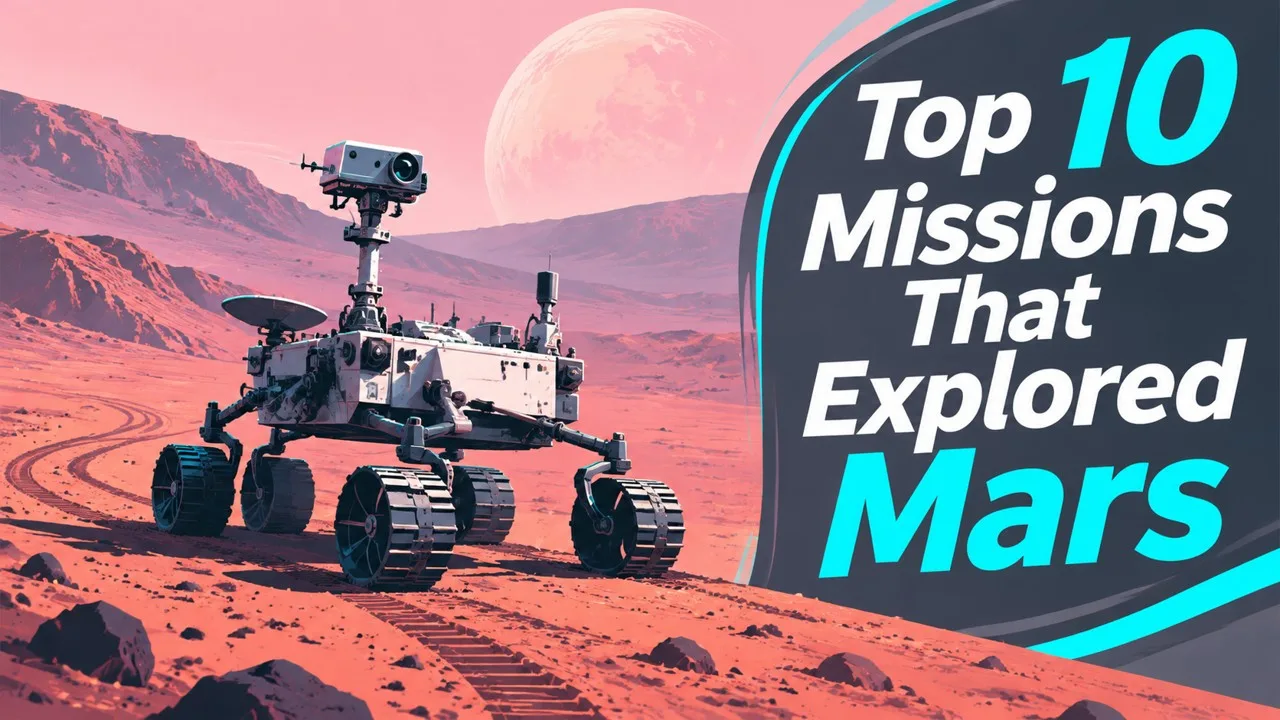
From Mariner 4's first close-up photos to Perseverance and its helicopter, these ten missions that explored Mars turned a red dot into a world we know well. Mars has fascinated people for centuries, and since the 1960s it has been the most visited planet beyond Earth. Getting there is hard: about half of all missions sent to Mars have failed, through launch problems, lost contact or crash landings.
The successful missions have transformed our view of the planet. They revealed ancient riverbeds, lake beds, ice and a thin atmosphere, and they keep asking whether Mars was ever home to life. This list follows ten of the most important missions, from the first flyby to the latest rovers.
Key Facts
The ten missions below reached Mars between 1965 and 2021 and came from the United States, the Soviet Union, India and China.
Missions to Mars at a Glance
| # | Mission | Arrived | Agency | Achievement |
|---|---|---|---|---|
| 1 | Mariner 4 | 1965 | NASA | First close-up pictures of Mars |
| 2 | Mars 3 | 1971 | Soviet Union | First soft landing on Mars |
| 3 | Viking 1 and Viking 2 | 1976 | NASA | First long-lived landers and a search for life |
| 4 | Mars Pathfinder | 1997 | NASA | The first Mars rover |
| 5 | Spirit and Opportunity | 2004 | NASA | Rovers that found evidence of ancient water |
| 6 | Mars Reconnaissance Orbiter | 2006 | NASA | The sharpest camera at Mars |
| 7 | Curiosity | 2012 | NASA | Found that Mars could have supported life |
| 8 | Mars Orbiter Mission | 2014 | ISRO, India | India reached Mars on its first attempt |
| 9 | Perseverance and Ingenuity | 2021 | NASA | Collecting samples and flying on Mars |
| 10 | Tianwen-1 and Zhurong | 2021 | CNSA, China | China's first Mars rover |
1. Mariner 4
NASA's Mariner 4 was launched in November 1964 and flew past Mars on 14 and 15 July 1965, becoming the first spacecraft to successfully visit the planet. [1]
It returned 21 complete images of the Martian surface, taken from about 10,000 kilometres away. The pictures showed a cratered, Moon-like landscape. [1]
Mariner 4 also found that the Martian atmosphere was much thinner than expected, with a surface pressure less than one percent of Earth's.
These results disappointed people who had hoped for a world with canals or plant life, and they changed scientific expectations about the planet.
The images were transmitted very slowly, at about 8 bits per second, and the full set took days to arrive. Each picture took hours to send back to Earth.
Key Figures
- Launched: November 1964
- Flyby: 14 to 15 July 1965
- Images returned: 21
- Finding: thin atmosphere and craters
Why It Made the List
Mariner 4 gave humanity its first close look at Mars. It replaced centuries of speculation with real data.
2. Mars 3
The Soviet Union launched two spacecraft, Mars 2 and Mars 3, in May 1971. Each carried an orbiter and a lander. [2]
The Mars 2 lander crashed, becoming the first human-made object to reach the Martian surface. On 2 December 1971, the Mars 3 lander made the first soft landing on Mars. [2]
Shortly after landing, it began sending data, but transmission stopped after about 20 seconds, possibly due to a huge dust storm raging across the planet.
The lander carried a small rover on skis attached by a cable, although it never had the chance to move.
The Mars 3 orbiter returned data about the Martian atmosphere and surface temperatures for several months.
Although brief, the landing proved that a spacecraft could survive the descent through the thin Martian atmosphere.
Key Figures
- Launched: May 1971
- Soft landing: 2 December 1971
- Transmission: about 20 seconds
- Challenge: a global dust storm
Why It Made the List
Mars 3 achieved the first soft landing on Mars. It showed how difficult landing on the planet can be.
Related: Top 10 Unexpected Facts About Mars
3. Viking 1 and Viking 2
NASA's two Viking missions each included an orbiter and a lander. Viking 1 landed on 20 July 1976 in Chryse Planitia, and Viking 2 landed on 3 September 1976 in Utopia Planitia. [3]
The landers sent back the first colour pictures from the surface of Mars, showing a rocky, reddish desert under a pinkish sky. [3]
They carried biology experiments designed to detect microbes in the soil. One gave puzzling positive results, but most scientists concluded the reactions were chemical, not biological.
The Viking orbiters mapped the planet in detail and photographed ancient river channels.
The Viking 1 lander operated until November 1982, more than six years after landing.
The landers also measured weather every day, recording temperatures, winds and pressure changes through the Martian seasons.
Key Figures
- Viking 1 landing: 20 July 1976
- Viking 2 landing: 3 September 1976
- First: colour images from the surface
- Viking 1 lander active: until 1982
Why It Made the List
Viking was the first search for life on another planet. Its data guided Mars science for decades.
4. Mars Pathfinder
Mars Pathfinder landed on 4 July 1997 in an ancient flood channel called Ares Vallis. It used a new landing method, bouncing on the surface inside giant airbags. [4]
Pathfinder carried Sojourner, a small six-wheeled rover weighing about 11.5 kilograms. It was the first rover to operate on another planet. [4]
Sojourner studied rocks near the lander, measuring their chemical makeup, while the lander took thousands of pictures.
The mission operated for about three months, far longer than planned.
It was cheap by NASA standards and attracted huge public interest online, with millions of people viewing its images on the early internet.
The airbag method was later reused for the Spirit and Opportunity rovers. Pathfinder's final transmission came in late September 1997, after the lander had sent back more than 16,000 images and many chemical analyses of rocks and soil.
Key Figures
- Landing: 4 July 1997
- Site: Ares Vallis
- Rover: Sojourner, about 11.5 kg
- Landing method: airbags
Why It Made the List
Pathfinder proved that rovers could explore Mars. It paved the way for every rover since.
5. Spirit and Opportunity
NASA's twin Mars Exploration Rovers, Spirit and Opportunity, landed in January 2004 on opposite sides of the planet. Each was planned to work for about 90 Martian days. [5]
Related: Top 10 Underrated Space Missions That Made History
Opportunity found small spheres rich in the mineral hematite, nicknamed blueberries, and layered rocks showing that liquid water once soaked the area. [5]
Spirit found evidence of hot springs or steam vents in the past. It became stuck in soft sand in 2009 and lost contact in 2010.
Opportunity lasted far longer, operating until a planet-wide dust storm in June 2018. It drove more than 45 kilometres, a record for driving on another world.
The twin rovers' unexpected longevity made them famous around the world.
Their solar panels were often cleaned by passing gusts of wind, which helped them keep working long after engineers expected dust to end their missions.
Key Figures
- Landings: January 2004
- Planned mission: about 90 Martian days
- Opportunity worked until: June 2018
- Opportunity distance: more than 45 km
Why It Made the List
Spirit and Opportunity showed that Mars was once wet. Their endurance became a story of engineering triumph.
6. Mars Reconnaissance Orbiter
NASA's Mars Reconnaissance Orbiter arrived at Mars in March 2006. It carries HiRISE, the most powerful camera ever sent to another planet, able to see objects about a metre across. [6]
MRO has photographed landers and rovers on the surface, and even captured Phoenix and Curiosity descending on their parachutes. [6]
Its instruments have mapped minerals formed in water, studied layers of ice and tracked seasonal changes such as dust storms and avalanches.
MRO also acts as a communications relay, passing data from rovers on the surface back to Earth.
It has operated for more than a decade and a half, far beyond its planned lifetime.
Its radar can peer beneath the surface, revealing buried ice sheets and layers in the polar caps. Its images are freely available to the public.
Key Figures
- Arrived: March 2006
- Camera: HiRISE
- Resolution: objects about 1 m across
- Role: relay for rovers
Why It Made the List
MRO has transformed our maps of Mars. It supports almost every surface mission.
7. Curiosity
NASA's Curiosity rover landed in Gale Crater on 6 August 2012. It was lowered to the surface by a rocket-powered sky crane, a daring new landing method. [7]
Curiosity is about the size of a small car, weighing around 900 kilograms, and is powered by a nuclear generator rather than solar panels. [7]
Soon after landing, it found evidence of an ancient lake bed with water that could have supported microbial life.
Related: Quasars: Distant Beacons or Local Oddballs?
Curiosity has also detected organic molecules in rocks and measured changing amounts of methane in the air.
The rover has been climbing Mount Sharp, a mountain of layered rocks in the centre of Gale Crater, studying how the Martian climate changed over time.
Its laser instrument can vaporise tiny spots on rocks from several metres away and read their chemistry from the light produced.
Key Figures
- Landing: 6 August 2012
- Site: Gale Crater
- Mass: about 900 kg
- Finding: ancient habitable lake
Why It Made the List
Curiosity showed that Mars once had conditions suitable for life. It remains one of NASA's longest-working rovers.
8. Mars Orbiter Mission
India's Mars Orbiter Mission, popularly called Mangalyaan, was launched by the Indian Space Research Organisation on 5 November 2013. [8]
On 24 September 2014, it entered orbit around Mars, making India the first Asian nation to reach Mars orbit and the first country to do so on its first attempt. [8]
The mission cost about 74 million dollars, less than many films, and became a symbol of India's low-cost space engineering.
Its instruments studied the Martian surface and atmosphere, and its camera captured full-disc images of the planet.
Planned to last six months, Mangalyaan operated for about eight years, until contact was lost in 2022.
The launch used India's workhorse PSLV rocket, and the spacecraft slowly raised its orbit around Earth before heading out towards Mars. Its success was widely celebrated across India.
Key Figures
- Launched: 5 November 2013
- Entered orbit: 24 September 2014
- Cost: about 74 million dollars
- Operated: about eight years
Why It Made the List
Mangalyaan made India a Mars-faring nation on its first try. It inspired a generation of Indian scientists.
9. Perseverance and Ingenuity
NASA's Perseverance rover landed in Jezero Crater on 18 February 2021. The crater once held a lake fed by a river, making it a promising place to look for signs of ancient life. [9]
Perseverance is collecting rock samples and sealing them in tubes, intended for a future mission to return to Earth. [9]
Related: Top 10 Famous Astronomical Observatories
An experiment called MOXIE produced oxygen from the carbon dioxide in the Martian air, testing technology for future human explorers.
Perseverance carried a small helicopter called Ingenuity. On 19 April 2021, Ingenuity made the first powered, controlled flight on another planet.
Ingenuity went on to fly 72 times before its mission ended in January 2024.
Its descent was filmed by onboard cameras, giving the public the first video of a landing on Mars.
Key Figures
- Landing: 18 February 2021
- Site: Jezero Crater
- Ingenuity's first flight: 19 April 2021
- Ingenuity flights: 72
Why It Made the List
Perseverance is preparing the first return of Martian samples. Ingenuity proved that aircraft can fly on Mars.
10. Tianwen-1 and Zhurong
China's Tianwen-1 mission was launched on 23 July 2020 and entered Mars orbit in February 2021. It carried an orbiter, a lander and a rover in a single mission. [10]
On 14 May 2021, the lander touched down in Utopia Planitia, and the rover Zhurong drove onto the surface soon after. [10]
China became the second country to successfully land and operate a rover on Mars.
Zhurong used ground-penetrating radar to study layers beneath the surface and found signs of past water activity.
The solar-powered rover went into hibernation in May 2022 as the Martian winter approached and dust built up.
The rover was named after a fire god in Chinese mythology. The orbiter continued to study Mars from above and relayed data from the surface back to Earth.
Key Figures
- Launched: 23 July 2020
- Landing: 14 May 2021
- Site: Utopia Planitia
- Rover: Zhurong
Why It Made the List
Tianwen-1 achieved orbit, landing and roving in one mission. It made China a major player in Mars exploration.
Conclusion
Missions to Mars have changed it from a mysterious red light into a world mapped in remarkable detail. Each mission has built on the successes and failures of those before.
Future missions aim to bring samples back to Earth and, one day, to send human explorers. These ten missions laid the path.
- ^ [1] "Mariner 4". Wikipedia. Wikipedia: Mariner 4 Wikipedia: Exploration of Mars
- ^ [2] "Mars 3". Wikipedia. Wikipedia: Mars 3 Wikipedia: Mars 2
- ^ [3] "Viking 1 and Viking 2". Wikipedia. Wikipedia: Viking program Wikipedia: Viking lander biological experiments
- ^ [4] "Mars Pathfinder". Wikipedia. Wikipedia: Mars Pathfinder Wikipedia: Sojourner (rover)
- ^ [5] "Spirit and Opportunity". Wikipedia. Wikipedia: Mars Exploration Rover Wikipedia: Opportunity (rover)
- ^ [6] "Mars Reconnaissance Orbiter". Wikipedia. Wikipedia: Mars Reconnaissance Orbiter Wikipedia: HiRISE
- ^ [7] "Curiosity". Wikipedia. Wikipedia: Curiosity (rover) Wikipedia: Gale (crater)
- ^ [8] "Mars Orbiter Mission". Wikipedia. Wikipedia: Mars Orbiter Mission Wikipedia: Indian Space Research Organisation
- ^ [9] "Perseverance and Ingenuity". Wikipedia. Wikipedia: Perseverance (rover) Wikipedia: Ingenuity (helicopter)
- ^ [10] "Tianwen-1 and Zhurong". Wikipedia. Wikipedia: Tianwen-1 Wikipedia: Zhurong (rover)





















Discussion
Log in with