






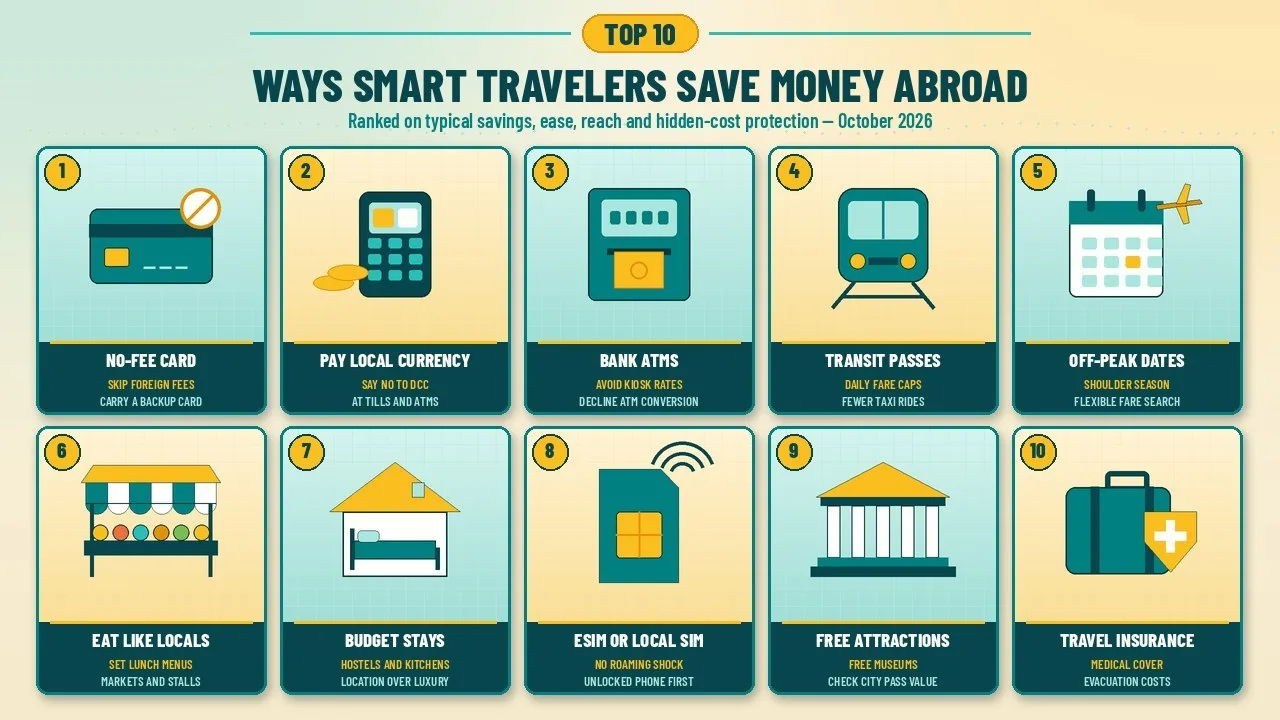
These ways to save money abroad cut card fees, transport bills and food costs, ranked by typical savings, ease of use and how widely each tip works.
A trip overseas rarely gets expensive because of one big purchase. It gets expensive through dozens of small leaks: a percentage skimmed off every card payment, a poor exchange rate at an airport counter, a taxi taken because the metro map looked confusing, a roaming bill that arrives a month later. Smart travelers simply plug the leaks that deliver nothing in return.
This Finepedia ranking, written as of October 2026, covers ten habits that consistently lower the cost of international travel without turning a holiday into an exercise in deprivation. It leans on guidance from consumer-finance regulators, government travel and health agencies, European Union law, official tourism bodies and transport operators. Specific prices change quickly, so the article avoids quoting fares or fees that could go stale, except where a dated official figure helps explain a point. Nothing here is a product endorsement; card, phone and insurance offers differ by country, and readers should compare current terms from their own banks and providers.
How We Ranked These Ways to Save Money Abroad
Each habit was scored from 1 to 5 on four criteria, giving a total out of 20. The scores are Finepedia's editorial judgement, applied with the same definitions to every entry and cross-checked against official and consumer-finance sources listed at the end of this article.
- Typical savings (1 to 5): how much money the habit usually saves on an ordinary one- or two-week trip, rather than in a rare best case.
- Ease (1 to 5): how little effort, planning or local knowledge it needs; a habit you can adopt in five minutes scores higher than one that requires research.
- Reach (1 to 5): how many destinations and types of traveler it helps, from city breaks to long overland journeys.
- Hidden-cost protection (1 to 5): how well it shields you from charges you might not notice until later, such as conversion markups, roaming bills or emergency medical costs.
When totals tie, the easier habit ranks higher, because a tip that people actually use beats a clever one they forget. If Ease is also level, the habit with stronger Hidden-cost protection goes first. Honorable Mentions near the end cover useful habits that did not make the top ten.
The Scorecard
| Rank | Habit | Savings | Ease | Reach | Protection | Total |
|---|---|---|---|---|---|---|
| 1 | Use a card with no foreign transaction fees | 4 | 5 | 5 | 5 | 19 |
| 2 | Pay in local currency and decline DCC | 4 | 5 | 4 | 5 | 18 |
| 3 | Withdraw cash from bank ATMs, not kiosks | 4 | 4 | 5 | 4 | 17 |
| 4 | Ride public transport with passes and fare caps | 4 | 4 | 4 | 4 | 16 |
| 5 | Travel off-peak with flexible dates | 5 | 3 | 5 | 3 | 16 |
| 6 | Eat where locals eat | 4 | 4 | 5 | 2 | 15 |
| 7 | Stay in hostels, guesthouses or apartments | 5 | 3 | 5 | 2 | 15 |
| 8 | Use an eSIM or local SIM instead of roaming | 3 | 4 | 3 | 4 | 14 |
| 9 | Plan around free attractions | 3 | 4 | 4 | 3 | 14 |
| 10 | Buy travel insurance before you go | 1 | 3 | 5 | 5 | 14 |
Travel insurance scores only 1 for typical savings because, on most trips, it is a cost rather than a saving. It still earns a place because a single uninsured emergency can wipe out every other saving on this list many times over. Off-peak travel ties with transport passes on 16 points but ranks fifth because it needs more planning.
Ways to Save Money Abroad at a Glance
| Rank | Habit | What it avoids | Best moment to act | Main caution |
|---|---|---|---|---|
| 1 | No-fee card | Percentage fee on every foreign purchase | Weeks before departure | Annual fees can cancel out savings |
| 2 | Pay in local currency | Dynamic currency conversion markups | Every time a terminal asks | Some screens are designed to nudge you |
| 3 | Bank ATMs | Weak exchange-counter rates | On arrival and as needed | Operator fees and ATM conversion offers |
| 4 | Transit passes and caps | Taxi and single-ticket costs | Before your first ride | Passes only pay off with enough trips |
| 5 | Off-peak, flexible dates | Peak-season fares and room rates | At the planning stage | Weather, closures and shorter hours |
| 6 | Eat like a local | Tourist-strip menu pricing | Every meal | Food safety and cover charges |
| 7 | Budget stays | High hotel rates and restaurant-only eating | When booking | Location, reviews and security |
| 8 | eSIM or local SIM | Roaming charges | Before or on landing | Phone must be unlocked and compatible |
| 9 | Free attractions | Paid entry for every sight | While building the itinerary | City passes rarely suit slow travelers |
| 10 | Travel insurance | Catastrophic medical and cancellation costs | As soon as you book | Exclusions and pre-existing conditions |
For in-transit comfort on a tight budget, Finepedia readers may also enjoy Things to Do on a Long-Haul Flight: Top 10 Ideas, Best Snacks to Bring on a Plane: Top 10 Picks, Hotel Room Secrets You Should Know: Top 10 and Most Walkable Cities in the World: Top 10.
1. Use a Card With No Foreign Transaction Fees
| Attribute | Details |
|---|---|
| What it is | A debit or credit card that does not add a surcharge when you pay in a foreign currency or at a foreign merchant |
| Typical cost avoided | Foreign transaction fees commonly run from about 1 to 3 percent of each purchase, according to U.S. consumer-finance guides |
| Who benefits most | Anyone paying by card for hotels, meals, transport and shopping abroad |
| Effort needed | Check your current card terms; apply for a different card if needed well before you travel |
| Main caution | Annual fees, interest charges and cash-withdrawal fees can outweigh the benefit if the card is misused |
The card in your wallet quietly decides how much every foreign purchase really costs. Many cards add a percentage surcharge to transactions made in another currency or processed by an overseas merchant, and that surcharge applies to everything from a coffee to a week of hotel nights. Switching to a card that waives this fee is a one-time task that keeps paying off for the whole trip, which is why it tops this list.
How It Works
When you pay abroad, your card network converts the amount into your home currency at its own wholesale-based rate. Your card issuer may then add a foreign transaction fee on top. Consumer-finance explainers from outlets such as Bankrate and Investopedia describe this fee as usually falling between 1 and 3 percent, sometimes combining a roughly 1 percent network charge with an issuer charge. The U.S. Consumer Financial Protection Bureau advises that people who travel overseas frequently may want a card with a lower or no foreign transaction fee. Similar no-fee products exist in many countries, with conditions that vary by market.
Key Tips
- Read the fee schedule or cardholder agreement for the exact wording on foreign-currency transactions
- Apply early, because new cards can take weeks to arrive and activate
- Carry two cards on different networks in case one is declined or blocked
- Check that your banking app and card alerts work abroad
- Pay off credit card balances in full to avoid interest erasing the savings
Why It Matters
A fee of a few percent sounds trivial on a single meal, but it compounds across an entire trip. Because it is charged on every eligible transaction, removing it is one of the few savings that grows automatically as your spending grows. It also simplifies budgeting, since the amount on your statement tracks the real exchange rate more closely.
Interesting Facts
- Foreign transaction fees can apply even when you never leave home, for example when shopping online from a merchant based in another country.
- In the European Union, card surcharges imposed by traders on most consumer debit and credit card payments are prohibited, though bank conversion fees can still apply on non-euro payments.
- A card with no foreign transaction fee can still charge separate fees for cash withdrawals, so ATM use deserves its own check.
- Some prepaid travel cards also carry foreign transaction or conversion fees, which the CFPB lists among common prepaid card charges.
2. Pay in Local Currency and Decline DCC
| Attribute | Details |
|---|---|
| What it is | Choosing to be charged in the currency of the country you are visiting rather than your home currency |
| What it avoids | Dynamic currency conversion (DCC), where the merchant or ATM operator converts the amount using its own marked-up rate |
| Typical markup | Consumer-finance guides commonly cite roughly 3 to 12 percent above standard rates |
| Where it appears | Card terminals in shops, restaurants and hotels, online checkouts and many ATMs |
| Main caution | Prompts are sometimes worded to make the home-currency option look safer |
Few travel tips save so much for so little effort. When a card terminal or ATM abroad offers to charge you in your home currency, it is usually offering dynamic currency conversion, and that convenience typically comes at a worse exchange rate. Choosing the local currency lets your own card network handle the conversion instead, which is often the cheaper route.
How It Works
DCC shows the bill in your home currency at the point of sale, so you see a familiar number immediately. The catch is the rate: the merchant's payment provider sets it, usually with a markup shared between provider and merchant. Investopedia, citing a study referenced by the European consumer organisation BEUC, notes DCC charges can reach about 12 percent. In the EU, Regulation (EU) 2019/518 requires anyone offering currency conversion at an ATM or point of sale to disclose the total charge as a percentage markup over the latest European Central Bank reference rate before you pay, and to inform you that you can pay in the local currency. The EU's Your Europe portal states that paying in local currency is often the cheapest option and that you always have the right to refuse home-currency conversion.
Key Tips
- When a terminal asks you to choose, select the local currency every time
- Watch for screens that pre-select your home currency or say the rate is guaranteed
- If a server or clerk processes the payment for you, ask for the local currency before they tap through
- At ATMs, decline any offer to convert the withdrawal at a rate shown on screen
- Check your receipt; if it shows your home currency without your consent, ask for the transaction to be voided and repeated
- Apply the same rule to online bookings with overseas hotels or tour operators that offer to bill in your currency
Why It Matters
DCC is easy to accept by accident, especially when tired, rushed or unfamiliar with local screens. Because the markup is built into the exchange rate rather than listed as a separate fee, many travelers never realize they paid it. Learning to say no once and then repeating it automatically is one of the fastest ways to protect your budget.
Interesting Facts
- DCC is legal and must be optional; the problem is the price, not the existence of the choice.
- Your card issuer may still add its own foreign transaction fee on a DCC payment, so the costs can stack.
- EU disclosure rules apply when conversion is offered by merchants and ATM operators in the bloc; protections elsewhere differ.
3. Withdraw Cash From Bank ATMs, Not Kiosks
| Attribute | Details |
|---|---|
| What it is | Getting local cash from ATMs run by established banks instead of exchanging notes at counters or tourist kiosks |
| What it avoids | Wide buy-sell spreads and commissions at airport and tourist-area exchange desks |
| Who benefits most | Travelers visiting places where cash is still widely needed, such as markets, small eateries and rural areas |
| Effort needed | Check your card's withdrawal fees and daily limit before leaving |
| Main caution | ATM operator fees, conversion offers and card skimming risks |
Even in a card-friendly world, most travelers need some cash. The question is where they get it. UK consumer-money guides and international transfer explainers routinely warn that airport exchange counters tend to offer poor rates. A bank-operated ATM, used with a card that has low or no foreign fees, usually gives a rate much closer to the wholesale market.
How It Works
Exchange kiosks make money on the gap between the rate at which they buy and sell currency, and sometimes add commission. Airport counters often have a captive audience. A bank ATM, by contrast, withdraws from your home account and lets your card network convert the amount. Costs can still arise: your bank may charge a cash withdrawal or foreign fee, and the ATM owner may add its own fee. Many ATMs also offer conversion into your home currency, which is simply DCC at the cash machine and should be declined.
Key Tips
- Prefer ATMs inside or attached to bank branches, which tend to be safer and better maintained
- Withdraw fewer, larger amounts if your bank charges a fixed fee per withdrawal, while staying within what you are comfortable carrying
- Decline any on-screen offer to convert the withdrawal into your home currency
- Bring a small amount of local currency from home only if you need it immediately on arrival
- Shield your PIN and avoid machines that look tampered with
Why It Matters
Cash mistakes tend to happen at the most stressful moment of a trip: the first hour after landing. Knowing in advance that you will use a bank ATM rather than the first counter you see protects you from one of the most predictable overcharges in international travel.
Interesting Facts
- An ATM can charge a fee even when your own bank charges nothing, so check both sides of the transaction.
- In the EU, the same transparency rules on currency conversion that apply to shop terminals also cover ATMs.
- Exchange counters may advertise zero commission while building their margin into a weaker rate.
4. Ride Public Transport With Passes and Fare Caps
| Attribute | Details |
|---|---|
| What it is | Using metros, buses, trams and trains with day passes, multi-day passes or automatic fare capping |
| What it avoids | Taxi fares, ride-hailing surge pricing and paying full price for many single tickets |
| Example | London's Transport for London (TfL) caps pay-as-you-go contactless fares daily and from Monday to Sunday |
| Effort needed | Learn the local ticketing system before your first journey |
| Main caution | Passes save money only if you take enough trips; regional or national passes can change price |
Getting around a foreign city can quietly become one of the largest daily expenses. Public transport is almost always cheaper than taxis, and many systems now reward visitors who simply tap the same card or phone on every ride. Fare capping, where the system stops charging once you reach a daily or weekly limit, removes the need to guess whether a pass is worth buying.
How It Works
On TfL's network in London, contactless pay-as-you-go fares are automatically capped, with a daily cap and a weekly cap that runs from Monday to Sunday, provided you use the same card or device for every journey and touch in and out where required. Other cities offer paper or digital day passes, carnet bundles or tourist travel cards. National rail passes for foreign visitors are a different calculation: the Japan Rail Pass, for example, saw an average price rise of about 70 percent from 1 October 2023, with the 7-day ordinary adult pass moving from 29,650 yen to 50,000 yen according to JR announcements. That change made it more important to compare a pass with individual tickets for your actual route.
Key Tips
- Use one card or one phone consistently so fare caps recognize your journeys
- Compare the price of a pass with your realistic number of rides, not an ideal itinerary
- Look for off-peak fares on regional trains where they exist
- Walk short distances in compact city centers, which also reveals neighborhoods you would miss underground
- Use airport rail or bus links instead of taxis where they are safe and practical
Why It Matters
Transport costs come up every day of a trip, so small per-ride savings multiply quickly. Knowing the system also makes cheaper districts beyond the center easy to reach.
Interesting Facts
- Fare capping means a visitor using contactless in London cannot be charged more than the relevant cap for qualifying travel in a day.
- The 2023 Japan Rail Pass revision was widely reported as the first major price change for the pass in decades.
- Many city passes bundle transport with museum entry, which can be useful or wasteful depending on your plans.
5. Travel Off-Peak With Flexible Dates
| Attribute | Details |
|---|---|
| What it is | Choosing shoulder or low seasons and searching flights across a range of dates instead of fixed ones |
| What it avoids | Peak-season airfares, room rates and crowded attractions |
| Tools | Flexible-date calendars and fare alerts offered by mainstream flight search engines |
| Effort needed | Planning ahead and accepting some uncertainty about weather or opening hours |
| Main caution | Low season can mean rain, storms, shorter hours or seasonal closures |
Demand drives travel pricing more than almost anything else. Flights and hotels around school holidays, major festivals and the best-weather months tend to cost the most, while the weeks just before or after peak season, often called the shoulder season, can offer much of the same experience for less. Moving a trip by even a few days can change the total price noticeably.
How It Works
Airlines and hotels use dynamic pricing, meaning fares change with demand, booking time and remaining capacity. Flexible-date searches let you see prices across a week or month, and fare alerts notify you when a tracked route drops. Shoulder seasons vary by destination: in parts of southern Europe this may be spring and autumn, while monsoon patterns shape South and Southeast Asian travel. Travelers who can leave mid-week or avoid holiday weekends usually gain the most flexibility.
Key Tips
- Search a whole week or month rather than a single date
- Set fare alerts once you know your rough travel window
- Check public holidays and festivals at your destination, which can raise prices even in low season
- Research the weather and seasonal closures before committing to a cheap date
- Read change and cancellation rules carefully when buying the lowest fare types
Why It Matters
Flights and accommodation usually make up the largest share of an international trip budget, so savings here can be larger than every small daily habit combined. Off-peak travel also tends to bring shorter queues.
Interesting Facts
- Shoulder season is defined by the destination, not the calendar; one country's quiet month can be another's peak.
- Basic fares can carry baggage and seat-selection charges that close the gap with standard fares.
- Fare alerts do not guarantee a lower price, but they help you spot a good one.
6. Eat Where Locals Eat
| Attribute | Details |
|---|---|
| What it is | Choosing neighborhood eateries, markets, food halls, bakeries and fixed-price lunch menus over tourist-strip restaurants |
| What it avoids | Inflated prices near major sights, unclear menus and costly hotel meals |
| Example | Many restaurants in Spain offer a weekday fixed-price lunch known as the menú del día |
| Effort needed | A short walk away from main attractions and a little research |
| Main caution | Food safety, allergies, cover charges and service customs vary |
Food is where budgets either relax or stretch. Restaurants beside famous landmarks often charge for the view and the convenience. A short walk into a residential street, a visit to a covered market or a set lunch menu can deliver better food for considerably less, along with a more authentic taste of daily life.
How It Works
Prices in tourist zones reflect high rents and passing trade that may never return. Neighborhood places rely on regulars, so value and quality matter more. Many cultures make lunch the main meal of the day and offer fixed-price menus to working people, such as Spain's menú del día. Markets and supermarkets let you assemble picnics or breakfasts cheaply, and street food in many Asian and Latin American cities is an everyday, affordable option when chosen carefully.
Key Tips
- Walk a few blocks away from major sights before choosing a restaurant
- Make lunch your main restaurant meal where set menus are common
- Use markets and grocery stores for breakfasts, snacks and picnics
- Pick busy street-food stalls with high turnover and food cooked fresh in front of you
- Check whether bread, water, cover or service charges are added to the bill
- Carry a refillable bottle where tap water is safe to drink, and ask locally when unsure
Why It Matters
Meals happen several times a day, so the difference between tourist pricing and local pricing adds up quickly. Local food is also often the better meal.
Interesting Facts
- Fixed-price lunch menus are common in several European countries, often including a drink and dessert.
- Many Italian restaurants add a per-person cover charge known as coperto, usually listed on the menu.
- Food markets often double as cultural attractions, with free entry and inexpensive tastings.
7. Stay in Hostels, Guesthouses or Apartments
| Attribute | Details |
|---|---|
| What it is | Choosing budget-friendly accommodation types instead of defaulting to full-service hotels |
| Options | Hostels with private or shared rooms, family-run guesthouses, homestays and apartments with kitchens |
| What it avoids | High nightly rates and the cost of eating every meal out |
| Effort needed | Comparing location, reviews, cancellation terms and safety features |
| Main caution | Local regulations on short-term rentals, extra cleaning fees and distance from transport |
Accommodation is often the single biggest daily cost of a trip, which makes it the place where savings can be largest. Many modern hostels offer private rooms as well as dormitories, guesthouses provide personal local knowledge, and apartments with a kitchen let families and groups cook some meals. The best value often comes from a modest room in a great location rather than a luxurious one far from everything.
How It Works
Budget stays reduce costs by sharing facilities, offering fewer services or letting guests self-cater. Groups can split an apartment, while solo travelers can use hostels to cut costs and meet other people. Location still matters: a cheap room that requires long taxi rides can cost more overall than a slightly pricier one near public transport. Short-term rentals are also regulated or restricted in a number of cities, so travelers should check that a listing appears to be legitimate and follows local rules.
Key Tips
- Compare total price, including cleaning, service and tourist taxes, rather than the headline nightly rate
- Read recent reviews for cleanliness, noise, security and accuracy of photos
- Choose locations close to public transport or within walking distance of what you plan to see
- Use a kitchen for breakfasts and some dinners
- Check lockers, safes and door security, especially in shared accommodation
Why It Matters
Saving on accommodation frees money for experiences that make a trip memorable. A kitchen also cuts the food bill.
Interesting Facts
- Hostels increasingly market private en-suite rooms to couples and families, not just backpackers.
- Guesthouse owners are often an excellent free source of advice on where to eat and how to get around.
- Many cities charge a per-person nightly tourist tax, often collected at check-in.
8. Use an eSIM or Local SIM Instead of Roaming
| Attribute | Details |
|---|---|
| What it is | Buying a local data plan through a physical SIM or a downloadable eSIM rather than using your home plan's roaming |
| What it avoids | Costly roaming charges and unexpected bills after the trip |
| EU exception | EU and EEA mobile users have roamed at domestic rates within the bloc since 15 June 2017, extended to 2032 |
| Effort needed | Check that your phone is unlocked and supports eSIM before travel |
| Main caution | Fair-use limits, data-only plans without a local number, and buying from reputable sellers |
Staying connected is essential for maps, transport apps, bookings and safety, but roaming outside your home plan can be expensive. A local SIM card or travel eSIM often provides plenty of data for a modest cost. For travelers inside Europe on an EU or EEA phone plan, rules make roaming within the bloc work like home use.
How It Works
An eSIM is a digital SIM profile you install by scanning a code or using an app, so you can keep your home SIM active for calls and texts while using local data. A physical local SIM does the same through a swap. Both require a phone that is not locked to your home carrier. Within the European Union, retail roaming surcharges were abolished on 15 June 2017 under the roam-like-at-home rules, and Regulation (EU) 2022/612 extended the scheme until 2032, subject to fair-use policies. Visitors from outside the EU and EEA do not benefit from those rules on their own home plans.
Key Tips
- Confirm your phone is unlocked and eSIM-compatible before buying a plan
- Install travel eSIMs before departure, but activate them according to the plan's instructions
- Turn off data roaming on your home line if you rely on a local eSIM
- Download offline maps and translation packs over Wi-Fi as a backup
- Check whether a plan includes a local phone number if you need one for bookings or deliveries
Why It Matters
Roaming charges are a classic hidden cost: invisible during the trip and painful afterwards. Planning connectivity also reduces the temptation to use taxis or pay for convenience simply because you cannot navigate offline.
Interesting Facts
- The EU roaming rules apply to EU and EEA plans, which includes Iceland, Liechtenstein and Norway.
- Since leaving the EU, the UK is no longer covered by EU roaming regulation, and some UK operators reintroduced roaming charges for European travel.
- Many phones can hold several eSIM profiles, though usually only one or two can be active at once.
9. Plan Around Free Attractions
| Attribute | Details |
|---|---|
| What it is | Building days around free museums, parks, viewpoints, markets, festivals and tip-based walking tours |
| Examples | The British Museum's permanent collection in London and most Smithsonian museums in the United States charge no general admission |
| What it avoids | Paying entry for every sight and buying city passes that do not match your plans |
| Effort needed | Checking official websites for free days, timed tickets and booking rules |
| Main caution | Special exhibitions, timed-entry tickets and tip expectations on walking tours |
Some of the world's great cultural experiences cost nothing at the door. National museums in several countries offer free general admission, many cities run free or tip-based walking tours, and parks, beaches, religious sites, viewpoints and markets often charge nothing at all. Building an itinerary around these anchors leaves more budget for the few paid experiences that matter most.
How It Works
The British Museum states that entry to its permanent collection is free, with advance booking recommended and charges for some special exhibitions. The Smithsonian Institution says its museums are free to enter, with Cooper Hewitt in New York the exception, and some locations require free timed passes. Many other museums offer free entry on certain days or for certain age groups, and these schemes change, so always check official sites. City tourist passes can be worthwhile when you plan several paid attractions in a short time, but they easily become a loss for travelers who prefer a slower pace.
Key Tips
- Check official museum and attraction websites for free general admission, free days and youth discounts
- Book free timed-entry tickets in advance where required
- Calculate a city pass against the attractions you will realistically visit
- Join a free walking tour early in a trip to learn the layout of a city, and tip according to the value you received
- Use parks, beaches, viewpoints and markets as low-cost centerpieces of each day
Why It Matters
Paid attractions can quietly become one of the largest line items in a city break. Prioritizing free experiences protects the budget while still delivering the art, history and culture many people travel for.
Interesting Facts
- The Smithsonian's free admission policy covers most of its museums and the National Zoo, though some need free passes.
- Tip-based walking tours are run by guides who earn from voluntary payments, so they are free to join but not free to run.
- Many places of worship are free to enter but may expect modest dress.
10. Buy Travel Insurance Before You Go
| Attribute | Details |
|---|---|
| What it is | A policy covering some combination of emergency medical care, medical evacuation, trip cancellation and lost belongings |
| What it avoids | Paying out of pocket for medical emergencies and non-refundable trip costs |
| Official guidance | The U.S. State Department recommends travel health insurance and notes Medicare and Medicaid do not pay for care abroad |
| Evacuation costs | The CDC Yellow Book 2026 says medevac can range from about USD 25,000 within North America to over USD 250,000 from remote areas |
| Main caution | Exclusions for pre-existing conditions, risky activities and claims without proper documentation |
Insurance looks like the opposite of saving money, since on most trips you pay for it and never claim. It ranks on this list because one hospital stay, evacuation or cancelled journey can cost more than the entire trip. Buying the right cover is the best protection against the single largest hidden cost of travel.
How It Works
There are several types of cover. Travel health insurance pays for medical care abroad, medical evacuation insurance covers transport to suitable care, and trip cancellation insurance protects non-refundable bookings. The U.S. Department of State notes that trip cancellation cover usually does not pay for medical costs abroad. The CDC's Yellow Book advises travelers not to treat credit card travel benefits as a substitute for dedicated policies. For UK residents, the NHS explains that a Global Health Insurance Card gives access to medically necessary state healthcare in many countries on the same terms as residents, but the NHS says it is not a replacement for travel insurance, and it does not cover private treatment or repatriation.
Key Tips
- Buy cover soon after booking so cancellation protection starts early
- Check medical and evacuation limits, not just the policy price
- Declare pre-existing conditions honestly to avoid rejected claims
- Confirm that planned activities, such as diving or trekking, are covered
- Keep receipts, medical reports and police reports for any claim
Why It Matters
Most savings on this list are small and frequent. Insurance protects against something rare but potentially devastating. A traveler who skips cover to save a little may be exposed to a bill that takes years to repay.
Interesting Facts
- Health systems abroad do not necessarily cover non-residents, and patients are often asked to pay up front and claim later.
- The CDC notes that comprehensive policies including broad cancellation can cost up to 8 percent of the trip price, or up to 15 percent for cancel-for-any-reason cover.
- The decision to carry out a medical evacuation is typically made by the insurer, not the traveler.
- The UK GHIC is free through the NHS, which warns that unofficial websites may charge a fee to apply.
Honorable Mentions
| Habit | Why it helps | Why it missed the top 10 |
|---|---|---|
| Claim VAT refunds where eligible | Non-EU residents can reclaim VAT on qualifying EU purchases taken out within 3 months, with customs validation | Mainly helps shoppers; minimum spends and fees vary by country |
| Learn local tipping norms | Avoids overpaying where service is included or tipping is not customary, as in Japan | Savings are modest and norms differ widely |
| Travel light | Avoids checked-bag and overweight charges on many fare types | Depends heavily on airline and trip length |
| Haggle where it is customary | Fair bargaining is expected in many traditional markets | Inappropriate in fixed-price shops and many countries |
| Use a refillable water bottle | Reduces spending on bottled water where tap water is safe | Not suitable where water quality is poor |
Tax-free shopping deserves a special note. Under EU rules described on the Your Europe portal and by the European Commission, residents of non-EU countries can claim VAT back on goods taken out of the EU within three months, provided customs validates the claim before departure and each country's minimum purchase threshold is met; refund operators may deduct a fee. Great Britain withdrew its VAT Retail Export Scheme on 1 January 2021, so overseas visitors can no longer claim VAT back on goods carried home from England, Scotland or Wales, although Northern Ireland retains a scheme for eligible visitors. The Japan National Tourism Organization advises that tipping is not customary in Japan, which is a reminder that following home habits abroad can mean paying for nothing.
Frequently Asked Questions
What is the easiest way to save money abroad?
The easiest change is choosing the right card and always paying in local currency. A card without foreign transaction fees removes a percentage charge on every purchase, while declining dynamic currency conversion avoids marked-up exchange rates at terminals and ATMs. Together these habits take minutes to adopt and apply to almost every destination.
Should I pay in my home currency or the local currency when abroad?
Choose the local currency in most cases. Paying in your home currency usually triggers dynamic currency conversion, where the merchant's provider sets a less favorable rate. EU guidance says local currency is often the cheapest option, and you always have the right to refuse conversion. Check your card's own fees too.
Is it cheaper to exchange money before I travel or use ATMs abroad?
For most travelers, withdrawing from a bank-operated ATM abroad with a low-fee card is cheaper than exchange counters, especially at airports. Check your bank's withdrawal fees and daily limits, decline any conversion offer on the ATM screen and carry a modest amount of local cash only if you need it on arrival.
Are city tourist passes worth buying?
Sometimes. A pass can save money if you plan to visit several paid attractions and use public transport heavily in a short time. It rarely helps slower travelers or those focusing on free museums, parks and walking. List the sights you will realistically visit, add their individual prices and compare that total with the pass.
How can I avoid roaming charges when traveling internationally?
Use a local SIM card or a travel eSIM, turn off data roaming on your home line and download offline maps as a backup. Your phone must be unlocked and support eSIM if you choose that option. EU and EEA plan holders traveling within the bloc benefit from roam-like-at-home rules until 2032.
Do I really need travel insurance for a short trip?
It is strongly recommended, even for short trips. Domestic health plans may not cover care abroad, and the U.S. State Department notes Medicare and Medicaid do not. The CDC says medical evacuation can cost from about USD 25,000 to over USD 250,000. A policy turns a potentially ruinous emergency into a manageable claim.
Can tourists get tax refunds on shopping abroad?
In many countries, yes, but rules vary. Non-EU residents can reclaim VAT on eligible goods bought in the EU and exported within three months, after customs validation. Great Britain ended its tourist VAT refund scheme in 2021, while Northern Ireland still offers one. Always ask the retailer for the correct forms before paying.
Conclusion
The most effective ways to save money abroad are not about skipping the sights or eating instant noodles for a fortnight. They are about refusing to pay for things that add nothing: a percentage fee on every card payment, a marked-up exchange rate at a terminal, a weak rate at an airport kiosk, a taxi where a metro would do and a roaming bill that arrives after the photos are shared. This Top 10 ranks those habits by typical savings, ease, reach and protection from hidden costs.
Start with the quick wins at the top of the list, then layer in the planning habits such as off-peak dates, transport passes, local food and budget-friendly stays. Use free attractions to anchor each day, and finish by buying insurance so one bad moment cannot erase all the savings. Smart travel is less about spending less overall and more about spending deliberately on the experiences that made you buy the ticket.
- U.S. Consumer Financial Protection Bureau, Know Before You Owe: credit cards, and Ask CFPB guidance on prepaid card fees, including foreign transaction fees
- Bankrate and Investopedia consumer-finance explainers on foreign transaction fees, currency conversion fees and dynamic currency conversion (accessed October 2026)
- Regulation (EU) 2019/518 on cross-border payments and currency conversion charges (EUR-Lex), and the European Commission statement on currency conversion transparency requirements (April 2020)
- Your Europe (European Union portal): Pricing, payments and price discrimination; VAT and VAT refunds for non-EU residents
- European Commission, Taxation and Customs Union: VAT refunds to non-EU travellers
- Regulation (EU) 2022/612 on roaming and the European Commission announcement extending roam like at home until 2032
- Transport for London: fare capping and pay as you go guidance
- Japan Rail Pass official press release on revised prices from 1 October 2023 (JR Group)
- U.S. Department of State, Travel Insurance guidance (last updated August 2025)
- CDC Yellow Book 2026, Travel Insurance, Travel Health Insurance and Medical Evacuation Insurance
- NHS, Applying for healthcare cover abroad (GHIC and EHIC)
- GOV.UK, Revenue and Customs Brief 21 (2020) on withdrawal of the VAT Retail Export Scheme, and tax-free shopping guidance for Northern Ireland
- Japan National Tourism Organization, Tipping in Japan
- British Museum visitor information and Smithsonian Institution visitor guidelines
- Reference theme article: 10 Most Today, 10 Ways Smart Travelers Save Money in Foreign Countries (11 September 2019), https://10mosttoday.com/smart-travelers-save-money/ — used only as a topic prompt; wording, selection and ranking are original to Finepedia
- Related Finepedia reading: https://finepedia.com/post/things-to-do-on-a-long-haul-flight-top-10-ideas ; https://finepedia.com/post/best-snacks-to-bring-on-a-plane-top-10-picks ; https://finepedia.com/post/hotel-room-secrets-you-should-know-top-10 ; https://finepedia.com/post/most-walkable-cities-in-the-world-top-10

















Log in with