










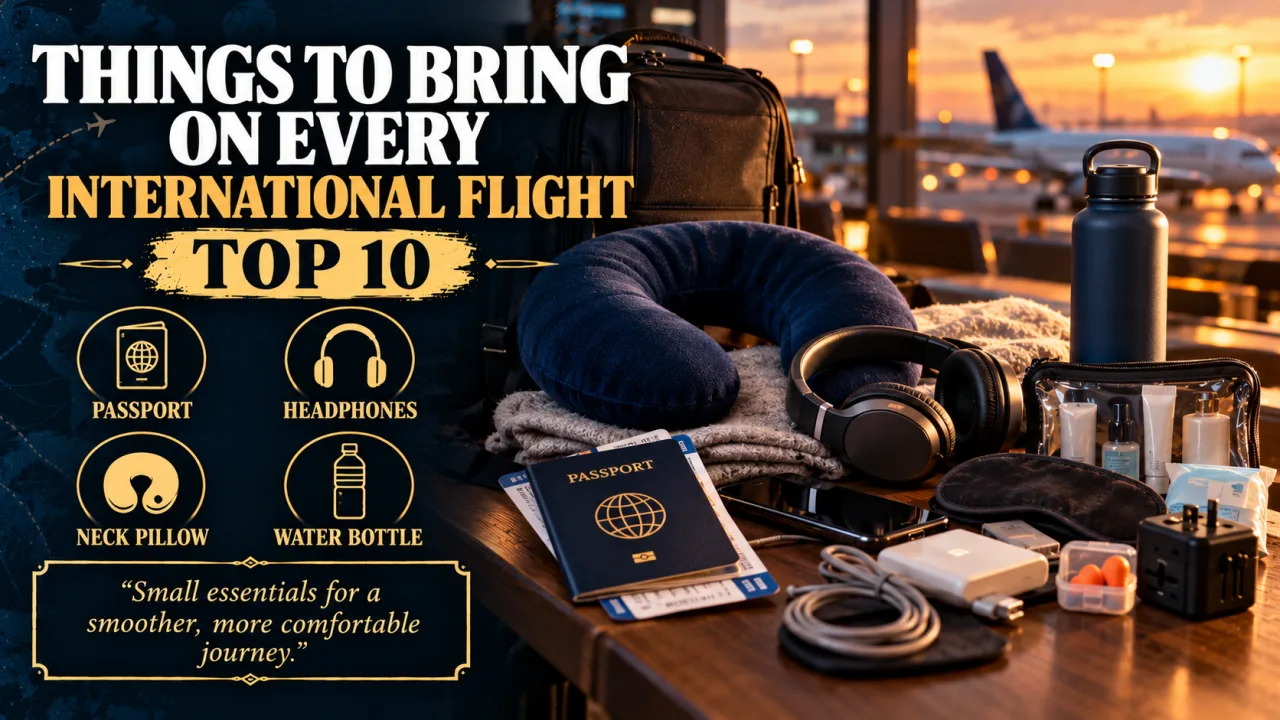
The things to bring on every international flight, as of October 2026, start with a passport and travel permit and end with smart comfort and safety kit. A long trip across borders now involves more checks than ever: biometric entry systems in Europe, digital permissions for the United Kingdom and the United States, new limits on power banks and an uneven patchwork of liquid rules at security. The ten items below are the ones that protect you from the worst outcomes, such as being refused boarding, losing access to medicine or arriving exhausted, and each one is matched with the current rule that explains why it matters.
This guide is written for travellers flying between countries on any airline, whether the journey is a three-hour hop or a sixteen-hour overnight sector. It focuses on the cabin bag, because that is the bag that stays with you when checked luggage is delayed, lost or sent to the wrong continent.
How We Chose These Items
Every item on this list had to pass three tests. First, it had to solve a problem that is specific to crossing a border or spending many hours in a pressurised cabin, rather than a general packing need such as clothes or a toothbrush. Second, it had to be supported by a published rule or official guidance from a government, an aviation regulator, an airline or a health body. Third, it had to be something an ordinary traveller can pack in a carry-on bag without special equipment.
Items were then ranked by the cost of forgetting them. A missing passport or travel authorisation can end a trip at the check-in desk, so documents rank first. Medicines and insurance come next because the consequences of going without them can be serious and expensive. Electronics follow, because 2026 brought genuine new restrictions on how batteries are carried. Comfort items close the list: they will not stop you from flying, but they make a real difference to how you feel when you land.
The rules quoted here were checked against official sources in October 2026. Travel regulations change often, so the final step for any trip is to confirm the latest position with your airline and the government websites of every country on your route.
At a Glance
| Rank | Item | Main reason to pack it | Where to keep it |
|---|---|---|---|
| 1 | Passport and travel authorisations | No valid document, no boarding | Personal item, inner pocket |
| 2 | Copies of key documents | Faster replacement if the original is lost | Separate from the originals and on your phone |
| 3 | Travel insurance details | Overseas medical care can be very costly | Phone and printed card |
| 4 | Essential medicines | Checked bags can go missing for days | Carry-on, original packaging |
| 5 | A rule-compliant power bank | New 2026 limits on number and use | Seat pocket or under the seat in front |
| 6 | Universal adapter and cables | 15 plug types exist worldwide | Small tech pouch |
| 7 | Noise-cancelling headphones or earplugs | Cabin noise is loud for hours | Personal item |
| 8 | Empty refillable water bottle | Cabin air is very dry | Outside pocket, empty at security |
| 9 | Compression socks and a warm layer | Long sitting raises clot risk; cabins get cold | Worn or packed on top |
| 10 | A pen and your arrival details | Forms and border questions on landing | Jacket or passport wallet |
1. Passport, Visas and Travel Authorisations
| Attribute | Details |
|---|---|
| Item type | Identity and entry documents |
| Pack it in | Personal item or a zipped inner pocket, never checked baggage |
| Key rule (October 2026) | The UK requires an ETA for visa-free visitors; the US requires an ESTA for Visa Waiver travellers |
| Main benefit | Lets you board, transit and enter your destination |
| Watch out for | Passport validity rules and digital permits linked to the passport number |
A passport is the one item that no amount of money at the airport can replace in time for departure. What has changed in recent years is that the passport alone is often not enough. Many countries now ask visa-free visitors to obtain an electronic permission before they travel, and airlines are required to check it at check-in. If the permit is missing, the airline can refuse to carry you.
Why You Need It
From 25 February 2026 the United Kingdom began fully enforcing its Electronic Travel Authorisation scheme, meaning airlines and other carriers refuse boarding to passengers who need an ETA and do not have one. Around 85 nationalities, including travellers from the United States, Canada and most of Europe, must apply. British and Irish citizens are exempt. The ETA costs 20 pounds, is usually decided within a day, allows multiple visits of up to six months each, and lasts for two years or until the linked passport expires, whichever comes first.
The United States runs a similar system called ESTA for travellers under the Visa Waiver Program. On 30 September 2025 the fee rose to 40 dollars, up from 21 dollars, under a rule published in the Federal Register.
What the Rules Say
For the Schengen area, the European Union says a non-EU passport must have been issued within the previous 10 years and must remain valid for at least three months after the date you plan to leave. The US State Department notes that some airlines and countries apply stricter expectations, and it suggests that travellers treat six months of remaining validity as a sensible margin.
Europe has also changed how it records visitors. The Entry/Exit System began operating on 12 October 2025 and became fully operational on 10 April 2026 at the external borders of the Schengen countries. On a first visit, non-EU travellers give fingerprints and a facial image, passport stamping has ended, and the digital record is kept for three years. Registration is free. The separate ETIAS travel authorisation, which will cost 20 euros and cover 30 European countries, was still not operating as of October 2026, and the EU says no applications are being accepted yet. Any website taking ETIAS payments before the official launch should be treated with suspicion.
Practical Tips
- Check the passport expiry date the moment you book, not the week you fly.
- Apply for digital permits only through official government websites or apps, because copycat sites charge extra fees.
- Make sure the passport number on your booking, your permit and your passport all match exactly.
- If you renew your passport, apply for a new ETA or ESTA, because the permission is tied to the old document.
Key Figures
- UK ETA fee: 20 pounds, valid for two years or until passport expiry
- US ESTA fee: 40 dollars since 30 September 2025
- Schengen passport rule: issued within 10 years, valid three months beyond departure
- EU Entry/Exit System: fully operational since 10 April 2026
2. Copies of Your Key Documents
| Attribute | Details |
|---|---|
| Item type | Backup paperwork, printed and digital |
| Pack it in | A different pocket or bag from the originals, plus your phone |
| Key rule (October 2026) | The US State Department advises carrying copies and leaving a set with someone at home |
| Main benefit | Speeds up an emergency passport and helps prove your identity |
| Watch out for | Storing scans only on a phone that could be lost with the passport |
Losing a passport abroad is stressful, but it is far less disruptive when you can show a consulate exactly what you lost. A copy of the photo page, the visa or permit approval, your booking confirmations and your insurance policy gives officials the details they need and saves you hours of searching through email on a hotel computer.
Why You Need It
The US State Department recommends that travellers make copies of their passport and other important documents, give one set to a trusted friend or relative, and keep another set apart from the originals. If a passport is lost or stolen overseas, it should be reported straight away; it is then cancelled and can no longer be used, and the traveller must apply for a replacement or an emergency passport at the nearest embassy or consulate. Other governments, including the United Kingdom, offer emergency travel documents through their consular network on similar terms.
What to Include
- The photo page of your passport and any visa or entry permit approval
- Flight, hotel and onward travel confirmations
- Your travel insurance certificate with the emergency phone line
- A list of prescriptions using generic medicine names
- Contact details for your bank card emergency lines
Practical Tips
Keep one paper set in the cabin bag and a second set in a checked bag or with a travel companion. Store digital copies in an encrypted folder or a secure cloud account that you can reach from any device, so a single stolen phone does not wipe out both the original and the backup. A spare passport-style photo can also speed up an emergency application in some countries.
Key Figures
- Two sets of copies are recommended: one with you, one with someone at home
- A lost passport that is reported is cancelled and cannot be used again
- Emergency passports are issued by embassies and consulates
3. Travel Insurance Details
| Attribute | Details |
|---|---|
| Item type | Policy certificate and emergency assistance number |
| Pack it in | Phone, email and a printed card in your wallet |
| Key rule (October 2026) | Schengen visa applicants must hold medical cover of at least 30,000 euros |
| Main benefit | Covers emergency treatment, evacuation and repatriation abroad |
| Watch out for | Exclusions for pre-existing conditions and risky activities |
Travel insurance is not a physical object in the way a passport is, yet the policy number and the 24-hour assistance line are among the most valuable things you can carry. When something goes wrong, the insurer usually wants to be called before treatment starts, and having the details ready can be the difference between a guaranteed payment and an unpaid bill.
Why You Need It
Many travellers assume their home health cover follows them overseas. Often it does not. The US Medicare programme, for example, generally does not pay for health care outside the United States, apart from a few narrow exceptions. The UK government states that a Global Health Insurance Card gives access to necessary state healthcare in eligible countries, but it is not an alternative to travel insurance and does not cover private treatment, mountain rescue or the cost of flying home. The US State Department advises travellers to buy insurance that covers emergency care, existing conditions and medical evacuation.
What the Rules Say
For some trips insurance is not optional. Under the EU Visa Code, people applying for a Schengen short-stay visa must show travel medical insurance valid across the Schengen states with minimum cover of 30,000 euros, including emergency treatment and repatriation for medical reasons.
Choosing the Right One
Read the medical section first. Check the limit for emergency treatment, whether evacuation is included, and how the policy handles any condition you already have. Then look at baggage delay cover, which matters if your checked bag fails to arrive, and trip disruption cover, which can pay for hotels during long delays.
Key Figures
- Schengen visa insurance minimum: 30,000 euros of medical cover
- Medicare: generally no cover outside the United States
- GHIC: state healthcare only, not a substitute for travel insurance
4. Essential Medicines in Original Packaging
| Attribute | Details |
|---|---|
| Item type | Prescription and everyday medicines |
| Pack it in | Carry-on bag, in the original labelled containers |
| Key rule (October 2026) | Medically needed liquids above 100 ml are allowed through US security when declared |
| Main benefit | Keeps treatment going if checked bags are delayed |
| Watch out for | Medicines that are legal at home but banned at your destination |
A delayed suitcase is an inconvenience when it holds clothes, but a real problem when it holds the only supply of a daily prescription. Medicines belong in the cabin bag, along with enough extra doses to cover a missed connection or a few days of delay.
Why You Need It
Keeping medicines in their pharmacy packaging shows border officers what they are and who they were prescribed to. The UK government advises people carrying controlled medicines to keep them in their original packaging in hand luggage and to bring a letter from the prescriber listing the name, destination, travel dates, medicines, doses and total amounts. For trips shorter than three months with no more than three months of supply, a UK personal licence is not normally needed, though the letter is still useful.
What the Rules Say
At US airports, the Transportation Security Administration allows medically necessary liquids, gels and aerosols in amounts larger than 3.4 ounces in reasonable quantities, provided they are declared to the officer for separate screening.
The bigger risk is the destination. Japan is a well-known example: it prohibits stimulant medicines containing amphetamine, such as Adderall, even when a traveller holds a valid prescription from home. The US State Department and the Japanese health ministry both publish guidance on this, and other countries have their own lists of restricted substances.
Practical Tips
- Check the rules of every country on your route, including transit stops, through its embassy or health ministry.
- Carry the generic name of each medicine, since brand names differ between countries.
- Split supplies between two bags if you are travelling with a companion.
- Pack a small kit for travel sickness, pain relief and rehydration salts.
Key Figures
- UK guidance: no personal licence normally needed for under three months of supply on a trip under three months
- TSA: medically necessary liquids over 3.4 ounces permitted when declared
- Japan: amphetamine-based medicines banned for personal import, even with a prescription
5. A Power Bank That Meets the 2026 Rules
| Attribute | Details |
|---|---|
| Item type | Portable lithium battery charger |
| Pack it in | Cabin baggage only, in the seat pocket or under the seat in front |
| Key rule (October 2026) | ICAO limits passengers to two power banks and bans recharging them on board |
| Main benefit | Keeps your phone alive for boarding passes, maps and permits |
| Watch out for | Airline bans on using power banks during the flight |
A phone is now the boarding pass, the e-ticket, the map, the translation tool and often the place where your digital entry permit lives. A power bank keeps that lifeline working through long layovers, but battery rules tightened sharply in 2026 after a series of in-flight fires.
What the Rules Say
The International Civil Aviation Organization adopted updated technical instructions that took effect on 27 March 2026. Under them, each passenger may carry no more than two power banks, they must travel in cabin baggage rather than checked bags, the power banks may not be recharged on board, and ICAO advises against using them to charge devices during flight. Battery terminals must be protected from short circuits. Power banks up to 100 watt-hours can be carried without approval, while those between 100 and 160 watt-hours need the airline's permission.
Many airlines go further. Singapore Airlines, applying the ICAO update from 15 April 2026, bans the use of power banks to charge devices during the flight and asks passengers to keep them in the seat pocket or under the seat rather than in overhead lockers. Emirates has banned power bank use on board since 1 October 2025 and allows one unit under 100 watt-hours with a visible capacity rating. The Lufthansa Group, Japan Airlines and Asiana Airlines introduced their own restrictions during 2026.
Choosing the Right One
Pick a power bank with the capacity clearly printed on the casing, because staff may confiscate any unit they cannot verify. If only milliamp-hours are listed, you can estimate watt-hours by multiplying the mAh figure by the voltage and dividing by 1,000. A 20,000 mAh unit at 3.7 volts works out at 74 Wh, comfortably below the 100 Wh threshold.
Practical Tips
- Charge the power bank fully before leaving home and top up your phone in the lounge or gate area.
- Use the seat power outlet for devices where your airline permits it.
- Never pack a power bank in checked luggage, and remove it if your cabin bag is gate-checked.
Key Figures
- ICAO update effective: 27 March 2026
- Maximum power banks per passenger under ICAO: two
- No approval needed: up to 100 Wh; airline approval: 100 to 160 Wh
6. Universal Travel Adapter and Charging Cables
| Attribute | Details |
|---|---|
| Item type | Plug adapter plus phone and laptop cables |
| Pack it in | A small pouch in the cabin bag |
| Key rule (October 2026) | No special aviation limits; check the voltage of each device |
| Main benefit | Lets you charge at airports, hotels and in-seat outlets |
| Watch out for | Cheap adapters without proper safety certification |
Arriving with a flat phone in a country where you cannot plug in a charger is a small problem that quickly becomes a big one. A universal adapter and a full set of cables in the cabin bag mean you can charge at the gate, on the plane if outlets are fitted, and in your hotel room before the checked bags arrive.
Why You Need It
The International Electrotechnical Commission catalogues 15 plug types in use around the world, lettered A to O. A single trip with a connection can easily involve two or three of them. Mains voltage also differs, with some regions supplying around 100 to 127 volts and many others around 220 to 240 volts. Most modern phone and laptop chargers accept both ranges, but hair dryers and other heating appliances often do not.
Choosing the Right One
Look for an adapter that covers the main plug families used in North America, the United Kingdom, continental Europe, Australia and China, with built-in USB-C ports so that one wall socket can charge several devices. Bring one cable for every device you rely on, plus a spare for the phone, since a damaged cable can be hard to replace in a hurry.
Practical Tips
- Keep cables and adapter together in one clearly marked pouch.
- Download maps, boarding passes and an eSIM data plan before departure, so the phone is useful even before you find a power outlet or Wi-Fi.
- Check whether your seat has a USB port, a mains socket or neither when choosing a seat.
Key Figures
- Plug types listed by the IEC: 15, labelled A to O
- Common mains voltages: about 100 to 127 V and about 220 to 240 V
- Devices to cover: usually phone, earbuds, laptop and watch
7. Noise-Cancelling Headphones or Earplugs
| Attribute | Details |
|---|---|
| Item type | Hearing comfort and sleep aid |
| Pack it in | Personal item, within reach of your seat |
| Key rule (October 2026) | Wireless headphones are generally allowed once the cabin crew permit device use |
| Main benefit | Reduces fatigue from hours of engine and air noise |
| Watch out for | Turning the volume up too high to drown out the cabin |
Aircraft cabins are much louder than most people notice. After a few hours the constant drone contributes to tiredness and makes sleep harder. A pair of noise-cancelling headphones, or simple foam earplugs for travellers on a budget, is one of the most noticeable comfort upgrades for any long journey.
Why You Need It
Researchers at Cornell University who studied how noise affects taste on planes reproduced cabin conditions at roughly 80 to 85 decibels. Active noise cancellation is particularly good at reducing the steady low-frequency rumble of engines and air systems, so you can listen to films or music at a lower, safer volume.
Choosing the Right One
Over-ear models tend to offer the best noise reduction and comfort for overnight flights, while in-ear buds are lighter and easier to sleep in when leaning against a window. Battery life matters: choose a pair that lasts longer than your longest flight, and pack the wired cable in case the in-flight entertainment system does not support wireless audio.
Practical Tips
- Add an eye mask to block cabin lights during overnight sectors.
- Carry a small case so headphones do not get crushed in the seat pocket.
- Remove headphones during safety briefings and announcements.
Key Figures
- Cabin noise used in the Cornell taste study: about 80 to 85 dB
- Best budget alternative: foam earplugs
- Ideal battery life: longer than your longest single flight
8. An Empty Refillable Water Bottle
| Attribute | Details |
|---|---|
| Item type | Reusable drinks bottle |
| Pack it in | Outside pocket of the cabin bag, empty at security |
| Key rule (October 2026) | Bottles must be empty at most security checkpoints, including all US airports |
| Main benefit | Easy hydration in a cabin with very low humidity |
| Watch out for | Insulated and metal bottles that must be empty even at airports with new scanners |
Flying is dehydrating. The cabin is pressurised with outside air that holds very little moisture, so the eyes, skin and throat dry out over a long sector. A refillable bottle lets you drink steadily without waiting for the next drinks service, and it saves money on expensive airside bottled water.
Why You Need It
The World Health Organization notes that cabin humidity typically sits between 10 and 20 percent, far drier than most homes. This dry air can make the eyes, mouth, nose and skin feel uncomfortable, and drinking water regularly helps.
What the Rules Say
In the United States the TSA still applies its 3-1-1 rule as of October 2026, so a water bottle must be empty when it goes through the scanner. The agency has discussed allowing full bottles for some trusted travellers, but that has not replaced the standard rule. In the United Kingdom, liquid limits now depend on the airport. Airports with new scanners, including Heathrow Terminals 2 to 5, Gatwick, Birmingham, Edinburgh and Bristol, accept containers of up to 2 litres, while others such as Manchester, Luton and Stansted still apply the 100 ml limit. Even at upgraded airports such as Heathrow, Gatwick and Birmingham, metal and insulated bottles must still be empty.
Practical Tips
- Empty the bottle before the security queue and fill it at an airside fountain or cafe.
- Ask the cabin crew to refill it during long flights.
- Choose a collapsible bottle if space in your bag is tight.
Key Figures
- Typical cabin humidity: 10 to 20 percent
- TSA rule: 3.4 ounces or 100 ml per container, one quart-size bag
- UK airports with new scanners: up to 2 litres per container
9. Compression Socks and a Warm Layer
| Attribute | Details |
|---|---|
| Item type | Circulation and temperature comfort |
| Pack it in | Wear them on board or pack them on top of the cabin bag |
| Key rule (October 2026) | Health bodies advise movement on long flights; stockings can help those at risk |
| Main benefit | Less leg swelling and lower clot risk; warmth in a chilly cabin |
| Watch out for | Poorly fitting socks; anyone at high risk should seek medical advice |
Sitting still for many hours slows blood flow in the legs. For most travellers the result is simply swollen ankles, but for a minority it can lead to deep vein thrombosis, a clot in a deep vein. Graduated compression socks are a light, inexpensive way to reduce that risk, and a soft layer such as a fleece or scarf deals with the cold air that often blows through cabins at night.
Why You Need It
The World Health Organization's WRIGHT research project found that the risk of venous thromboembolism roughly doubles after a journey of more than four hours, although the absolute risk stays low at about one case for every 6,000 passengers on such flights. The US Centers for Disease Control and Prevention lists factors that raise the risk, including recent surgery, previous clots, pregnancy, obesity and older age, and suggests that people at higher risk may benefit from graduated compression stockings.
What the Evidence Shows
A 2021 Cochrane review pooled nine trials with 2,637 passengers on flights longer than five hours. Among people who wore stockings, 3 developed a symptomless clot, compared with 47 among those who did not. Wearers also had less leg swelling.
Practical Tips
- Flex your ankles and walk the aisle when the seat belt sign is off.
- Choose an aisle seat on long flights to make moving easier.
- Avoid tight clothing at the waist and knees.
- Pack a light jumper or wrap, because blankets are not provided on every airline or in every cabin.
Key Figures
- Clot risk on flights over four hours: roughly doubled, about 1 in 6,000 in absolute terms
- Cochrane review: 3 symptomless clots with stockings versus 47 without
- Simple prevention: regular movement and hydration
10. A Pen and Your Arrival Details
| Attribute | Details |
|---|---|
| Item type | Writing tool plus your first address and contacts |
| Pack it in | Jacket pocket or passport wallet |
| Key rule (October 2026) | Several countries require arrival cards online before you land |
| Main benefit | Fast form filling and clear answers at passport control |
| Watch out for | Assuming paper forms are handed out on board for every destination |
The humble pen is the item travellers most often wish they had packed. Landing cards, customs declarations and lost-baggage forms still appear on many journeys, and borrowing a pen from a busy flight attendant is not always possible. Just as important is the address where you will spend your first night, because border officers routinely ask for it.
Why You Need It
More countries are moving their arrival forms online, which makes the arrival address even more important to have in writing. Thailand replaced its paper TM6 card with the Thailand Digital Arrival Card from 1 May 2025, and foreign visitors must submit it online within the three days before they arrive. Singapore requires all travellers entering the country to complete the SG Arrival Card, which includes a health declaration, within three days before arrival; the official service is free. Both forms ask where you will be staying.
Practical Tips
- Write your first address, phone number and booking reference on a card kept with your passport.
- Complete online arrival cards using official government sites only.
- Keep the pen with your passport so it is ready when the cabin crew hand out forms.
Key Figures
- Thailand Digital Arrival Card: submit within 3 days before arrival, since 1 May 2025
- Singapore SG Arrival Card: submit within 3 days before arrival, free on the official service
- Border question asked almost everywhere: where are you staying?
Useful Extras That Just Missed the List
A few more items are worth considering, depending on the route and your own habits. A travel pillow helps people who sleep sitting up. An eSIM bought before departure gives you data the moment the plane lands. A small toiletry kit with lip balm, moisturiser and a toothbrush freshens you up after an overnight flight. Healthy snacks can bridge long gaps between meals; Finepedia has a separate guide to the best snacks to bring on a plane. And if you are wondering how to fill the hours once everything is packed, see our ideas on things to do on a long-haul flight.
Packing Checklist
| Item | Pack before leaving home | Check at the airport | Use on board |
|---|---|---|---|
| Passport and permits | Check expiry and permit approval | Show at check-in and security | Keep zipped away |
| Document copies | Print and save digitally | Store away from originals | Not needed |
| Insurance details | Save policy and helpline | Keep phone charged | Not needed |
| Medicines | Pack extra days of supply | Declare large liquids | Take doses on schedule |
| Power bank | Charge fully, check Wh rating | Keep in cabin bag | Follow airline rules on use |
| Adapter and cables | Pack in one pouch | Charge at gate | Use seat outlets if allowed |
| Headphones or earplugs | Charge headphones | Keep in personal item | Wear during cruise and sleep |
| Water bottle | Pack empty | Fill airside | Ask crew for refills |
| Compression socks and layer | Put on socks before leaving | Carry the layer | Move legs regularly |
| Pen and arrival details | Write address card | Complete online arrival cards | Fill paper forms |
Carry-On Rules to Know Before You Fly
Security rules for cabin bags vary more in 2026 than they have for many years, so a few minutes of checking can save a long delay at the scanner.
Liquids
In the United States, the TSA 3-1-1 rule still applies: containers of 3.4 ounces or 100 ml, all fitting in one quart-size bag per passenger. In the United Kingdom, the rules now depend on the airport. Where the old limits still apply, liquids must be in containers of up to 100 ml inside a single transparent bag of about 20 cm by 20 cm holding up to a litre, with exemptions for essential medicines, baby food and sealed duty-free purchases. In the European Union, the Commission approved a new scanner set-up in July 2025 that allows liquids of up to 2 litres, but availability differs between airports and even between terminals. Unless you know your departure airport has upgraded, pack liquids as though the 100 ml rule applies.
Batteries and Electronics
Spare lithium batteries and power banks must travel in the cabin, never in checked luggage. Under the ICAO update in force since 27 March 2026, the limit is two power banks per person, and they cannot be recharged on board. Several airlines ban using them at all during the flight.
Food and Customs
Food that is fine to carry through security may still be restricted on arrival. Australia, for example, requires travellers to declare certain foods, plants and animal products, and those who fail to do so can receive an infringement notice. Declaring an item never brings a penalty, even if the item is then taken away. The United States also asks travellers to declare meat, fruit and other agricultural goods.
Plan Your Route
Rules for entry can also depend on your passport, so it helps to know where yours stands. Finepedia's guide to the most powerful passports in the world explains how visa-free access is measured, and our list of ways smart travelers save money abroad covers costs once you land.
Frequently Asked Questions
What is the most important thing to bring on an international flight?
A valid passport is the most important item, followed closely by any digital permit your destination requires, such as a UK ETA or US ESTA. Without both, airlines can refuse to let you board, and no other item on the list can fix that at the airport.
Can I take a power bank on an international flight in 2026?
Yes, in cabin baggage only. Since 27 March 2026, ICAO rules allow up to two power banks per passenger, with no recharging on board. Units up to 100 Wh need no approval. Many airlines, including Emirates and Singapore Airlines, also ban using them during the flight.
Can I bring a water bottle through airport security?
You can bring an empty bottle through security almost everywhere and refill it airside. Some UK and EU airports with new scanners accept liquids of up to 2 litres, but metal and insulated bottles may still need to be empty, and US airports apply the 3.4 ounce limit.
Do I need to print my travel documents?
Printing is not usually mandatory, because most permits are linked to your passport electronically. Still, a printed copy of your passport page, bookings and insurance helps if your phone battery dies or the phone is lost, and the US State Department recommends keeping copies apart from originals.
Are compression socks worth it on a long flight?
For many travellers they are. A 2021 Cochrane review found far fewer symptomless leg clots among passengers who wore stockings on flights longer than five hours. They also reduce ankle swelling. People with higher clot risk should ask a doctor about the right compression level before travelling.
Should medicines go in checked or carry-on luggage?
Medicines should always travel in your carry-on bag, in their original labelled packaging, with a few extra days of supply. Checked bags can be delayed. Carry a prescription or doctor's letter, and check whether any medicine is restricted at your destination, as Japan restricts amphetamine-based drugs.
Conclusion
The best list of things to bring on an international flight is built around two goals: getting through every border check without trouble, and stepping off the plane in good shape. As of October 2026, that means paying close attention to documents and digital permits, carrying medicines and insurance details in the cabin, and respecting the new limits on power banks. Comfort items such as headphones, a water bottle and compression socks then turn a long journey into a manageable one. Check your airline and the official websites of each country on your route a few days before you fly, pack the ten essentials above in your cabin bag, and you will be ready for almost anything the journey brings.
- GOV.UK: UK enforces digital permission to travel - https://www.gov.uk/government/news/uk-enforces-digital-permission-to-travel
- GOV.UK: Apply for an electronic travel authorisation (ETA) - https://www.gov.uk/eta/apply
- Home Office: ETA factsheet - https://homeofficemedia.blog.gov.uk/
- US Customs and Border Protection: ESTA - https://esta.cbp.dhs.gov/
- Federal Register: ESTA fee increase (document 2025-16453) - https://www.federalregister.gov/d/2025-16453
- Your Europe: Travel documents for non-EU nationals - https://europa.eu/youreurope/citizens/travel/entry-exit/non-eu-nationals/index_en.htm
- European Commission: Entry/Exit System fully operational - https://commission.europa.eu/
- Council of the EU: Entry/Exit System - https://www.consilium.europa.eu/
- European Union: ETIAS - https://travel-europe.europa.eu/etias_en
- US State Department: International travel checklist - https://travel.state.gov/en/international-travel/planning/checklist.html
- US State Department: Lost or stolen passport abroad - https://travel.state.gov/en/international-travel/help-abroad/lost-stolen-passport.html
- US State Department: Travel insurance - https://travel.state.gov/en/international-travel/planning/guidance/insurance.html
- Medicare: Travel outside the US - https://www.medicare.gov/coverage/travel-outside-the-u.s.
- GOV.UK: Foreign travel insurance - https://www.gov.uk/guidance/foreign-travel-insurance
- EUR-Lex: EU Visa Code, Regulation (EC) No 810/2009 - https://eur-lex.europa.eu/eli/reg/2009/810/oj
- GOV.UK: Take medicine in or out of the UK - https://www.gov.uk/take-medicine-in-or-out-uk
- GOV.UK: Travelling with medicine containing controlled drugs - https://www.gov.uk/guidance/controlled-drugs-personal-licences
- TSA: Medications (liquids) - https://www.tsa.gov/travel/security-screening/whatcanibring/items/medications-liquid
- TSA: Liquids rule - https://www.tsa.gov/travel/security-screening/liquids-aerosols-gels-rule
- ICAO: Power bank safety update - https://www.icao.int/
- Singapore Airlines: Advisory on the carriage of power banks - https://www.singaporeair.com/en_UK/sg/corporate/newsroom/newsalert-listing/advisory-on-the-carriage-of-power-banks-on-board-sia-flights-/
- Emirates: Power bank rules - https://www.emirates.com/media-centre/
- UK Civil Aviation Authority: Batteries and power banks - https://www.caa.co.uk/
- IEC: World Plugs - https://www.iec.ch/world-plugs
- GOV.UK: Liquids in hand luggage - https://www.gov.uk/hand-luggage-restrictions/liquids
- Heathrow Airport: Liquids at security - https://www.heathrow.com/
- World Health Organization: Travel by air, health considerations - https://www.who.int/
- World Health Organization: WRIGHT project on air travel and blood clots - https://www.who.int/
- CDC: Deep vein thrombosis and pulmonary embolism in travellers - https://www.cdc.gov/
- Cochrane: Compression stockings for preventing DVT in airline passengers - https://www.cochrane.org/evidence/CD004002_compression-stockings-preventing-deep-vein-thrombosis-dvt-airline-passengers
- US Embassy in Thailand: Thailand Digital Arrival Card - https://th.usembassy.gov/
- ICA Singapore: SG Arrival Card - https://www.ica.gov.sg/enter-transit-depart/entering-singapore/sg-arrival-card
- US State Department: Japan country information - https://travel.state.gov/
- Australian Department of Agriculture: What can I bring into Australia - https://www.agriculture.gov.au/
- Cornell Chronicle: Airplane noise and taste study - https://news.cornell.edu/















Log in with