









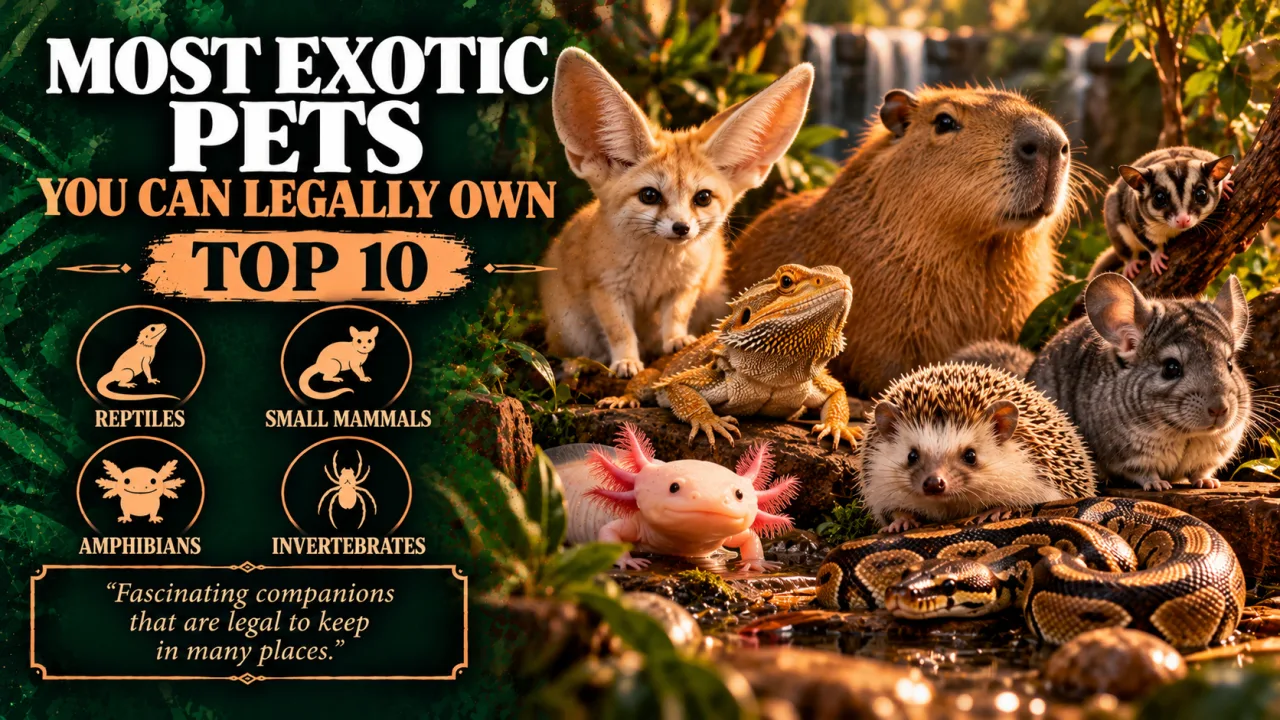
These exotic pets you can legally own, from fennec foxes to axolotls, are allowed in many regions yet still come with permits, local bans and years of care.
An exotic pet is usually defined as any animal kept at home that is not a traditional domestic species such as a dog, cat, rabbit or goldfish. The category is huge. It covers tiny tarantulas that cost less than a takeaway dinner and rainforest mammals that can live longer than a mortgage. It also covers a legal patchwork that changes every time you cross a state line, a county boundary or even a city limit.
This Finepedia guide looks at ten exotic animals that private keepers can legally own in many parts of the world as of October 2026. None of them is legal everywhere. Every entry explains where the animal is commonly allowed, where it is banned or needs a permit, how long it lives, what it costs to buy and how hard it really is to care for. The figures come from veterinary references, zoo fact sheets, wildlife agencies and the published laws themselves, and the sources are listed at the end.
One point matters more than any other on this page: a law that allows an animal is not the same as a recommendation to buy one. Several of these species are threatened in the wild, and some need space, diets and veterinary care that few households can provide. If you want the lighter side of animal ownership, Finepedia's look at the most famous pets on the internet shows how far a charismatic animal can travel online. This page is about the reality behind the photos.
How We Chose These Pets
The ten animals below were selected using four tests, applied together rather than one at a time.
- Legal somewhere real: each animal can be kept legally by private owners in at least some well-documented places, such as particular US states, England or parts of Australia, and the law was checked against official or reputable sources.
- Captive-bred supply: the pet trade for each species can be supplied by captive breeding, so a responsible buyer does not need wild-caught animals.
- Documented care needs: veterinary manuals, zoos or welfare groups have published enough information on diet, housing and lifespan to judge the commitment honestly.
- Genuinely unusual: the animal is clearly outside the everyday dog, cat and hamster group, which is why it attracts attention in the first place.
The order runs roughly from the most eye-catching mammals to the reptiles and invertebrates that most new exotic keepers actually start with. It is not a ranking of which animal makes the best pet. For several entries the honest answer is that very few people should own one at all.
Laws change. Everything here reflects the position as of October 2026, and you should always confirm the current rules with your state or national wildlife agency and your local council before buying any animal.
At a Glance
| No. | Animal | Scientific name | Native range | Main legal catch |
|---|---|---|---|---|
| 1 | Fennec Fox | Vulpes zerda | Sahara and North Africa | Banned or permit-only in many US states and cities |
| 2 | Capybara | Hydrochoerus hydrochaeris | South America | Restricted in some states; needs a pool and a companion |
| 3 | Axolotl | Ambystoma mexicanum | Lake Xochimilco, Mexico | Banned in California, Maine and New Jersey |
| 4 | Sugar Glider | Petaurus breviceps | Australia and New Guinea | Banned in California, Alaska, Hawaii and Pennsylvania |
| 5 | African Pygmy Hedgehog | Atelerix albiventris | Central and East Africa | Banned in several US states and New York City |
| 6 | Kinkajou | Potos flavus | Central and South America | Permit needed in states such as Florida |
| 7 | Chinchilla | Chinchilla lanigera | Andes of Chile | Widely legal; endangered in the wild |
| 8 | Ball Python | Python regius | West and Central Africa | Widely legal, but banned in New York City |
| 9 | Mexican Red-Knee Tarantula | Brachypelma hamorii | Pacific coast of Mexico | Widely legal; CITES-listed in trade |
| 10 | Bearded Dragon | Pogona vitticeps | Inland eastern Australia | Licence needed to keep one in Australia |
1. Fennec Fox
| Attribute | Details |
|---|---|
| Lifespan | About 10 to 14 years in captivity |
| Adult size | The smallest wild canid; females weigh about 1 to 1.9 kg |
| Where it's legal / restricted | Captive-bred fennecs exempt in New York State; no dangerous wild animal licence in England; banned in New York City and many US states |
| Typical cost | Around $1,500 to $3,500 from a reputable breeder (The Spruce Pets) |
| Difficulty | Expert |
The fennec fox is the smallest member of the dog family, a sand-coloured desert fox from the Sahara with ears that look several sizes too big for its head. Those ears help it shed heat and hear prey moving under the sand. It is the animal that most people picture when they hear the phrase exotic pet, and it is also one of the clearest examples of how a legal pet can still be a very demanding one.
Why People Love It
A fennec looks like a living cartoon. It is small, fast, curious and playful, and captive-bred kits that are hand-raised can become comfortable with their owners. The species is bred commercially for the pet trade, which means buyers in legal areas do not need to rely on wild capture.
Legal Status
Fennec laws show the patchwork at its clearest. New York State's dangerous animal rules include a specific exemption for captive-bred fennec foxes, yet New York City lists foxes among the animals that are illegal to keep as pets. In England, the Dangerous Wild Animals Act schedule was rewritten in 2007 and now excludes foxes of the genus Vulpes, which includes the fennec, so no special licence is required. Across the United States, rules range from outright bans to permit systems, and The Spruce Pets warns that most parts of the country regulate fennecs in some way. Internationally, the species is listed in Appendix II of CITES, which controls cross-border trade.
Care Needs
Fennecs are mainly active at night, they dig, they jump and they can be loud. An indoor fennec needs an escape-proof setup, and an outdoor enclosure needs buried mesh to stop tunnelling. They are not cuddly by nature; most prefer to choose when they are handled, and a frightened or annoyed fennec will bite. Finding a veterinarian who treats exotic mammals should happen before the animal arrives, not after it falls ill. Veterinary guidance also notes that fennecs are not covered by a legally recognised rabies vaccine, which can complicate matters if a bite is ever reported.
Costs
The purchase price is only the beginning. The Spruce Pets puts a young fennec from a reputable breeder at roughly $1,500 to $3,500, and secure housing, specialist food and exotic-animal veterinary bills add to that every year for more than a decade.
Key Figures
- Female head-and-body length: about 34.5 to 39.5 cm
- Weight: about 1 to 1.9 kg
- Longest recorded captive lives: about 13 to 14 years
- IUCN Red List status: Least Concern
- CITES listing: Appendix II
2. Capybara
| Attribute | Details |
|---|---|
| Lifespan | About 8 to 12 years in captivity |
| Adult size | The world's largest rodent; typically 35 to 66 kg |
| Where it's legal / restricted | No state permit in Texas; no dangerous wild animal licence in England since 2007; restricted in California and many local areas |
| Typical cost | About $1,000 to $3,000 each, and they should be kept in pairs |
| Difficulty | Expert |
The capybara is the largest rodent alive, a calm, barrel-shaped grazer from the wetlands and grasslands of South America. Its relaxed expression has made it an internet favourite, and capybara cafes and petting experiences have spread the image of an animal that gets along with everybody. Owning one is a very different matter from visiting one.
Why People Love It
Capybaras are social, generally gentle and famously tolerant of other animals. They rarely bite people unless they feel threatened, and they can become tame with patient handling. For people with land and water, they are among the most striking mammals that can be kept legally in some places.
Legal Status
In England, capybaras were among the species taken off the Dangerous Wild Animals Act schedule in 2007, so a licence is no longer required. In the United States, the answer depends on the state and then on the county or city. Texas does not require a state permit for a capybara, while California restricts them and many other states require permits or health certificates. The Spruce Pets advises checking current state and local rules before buying, because they can change.
Care Needs
A capybara is semi-aquatic. It needs a pool deep enough to submerge in, along with shade, shelter and grazing space, which turns its housing into something closer to a small zoo exhibit than a pet enclosure. It is a herd animal, so keeping a single capybara alone is widely discouraged. Like all rodents, its teeth keep growing; without enough grass and hay to wear them down, they can overgrow and make eating painful.
Costs
Pet references put the purchase price at about $1,000 to $3,000 per animal. Because a companion is strongly recommended, the realistic starting figure doubles before a fence, pool or shelter has been built.
Key Figures
- Typical head-and-body length: about 106 to 134 cm
- Typical weight: about 35 to 66 kg
- Lifespan: around 8 to 12 years in captivity
- Social needs: should live with at least one other capybara
- England: removed from the Dangerous Wild Animals Act list in 2007
3. Axolotl
| Attribute | Details |
|---|---|
| Lifespan | About 10 to 15 years in captivity |
| Adult size | Usually 15 to 45 cm long; about 23 cm is most common |
| Where it's legal / restricted | Legal in most US states and the UK; banned in California, Maine and New Jersey |
| Typical cost | About $30 to $80 |
| Difficulty | Moderate |
The axolotl is a salamander that never grows up. It keeps its feathery external gills and stays in the water for its whole life, a condition known as neoteny. In the wild it survives only in the canal remnants of Lake Xochimilco near Mexico City, and it is one of the most threatened amphibians on Earth. In aquariums around the world, it is one of the most common.
Why People Love It
With its permanent smile and frilly pink or dark gills, the axolotl has become a cultural mascot, appearing in games, plush toys and science stories. It is also remarkable biologically: axolotls can regrow lost limbs and parts of other organs, which has made them important laboratory animals. As pets, they are quiet, long-lived and easy to watch.
Legal Status
Axolotls are legal in most US states and in the UK, but a few states ban them outright. California restricts salamanders of the genus Ambystoma, New Jersey lists axolotls among its restricted species, and Maine also prohibits them. Some other places require permits or limit imports, so local checks are essential. In international trade, the species is listed under CITES Appendix II, while all pet axolotls in legal trade should be captive-bred.
Care Needs
Axolotls need cool, clean water. Care guides recommend temperatures around 16 to 18 °C, and water above about 24 °C causes stress and disease. A single adult needs a large aquarium, often given as around 150 litres, with good filtration but gentle flow. Gravel is a hazard because axolotls swallow food along with whatever is beside it, so keepers use bare floors, fine sand or large smooth stones. They should not be handled, since their skin is delicate.
Costs
The animal itself is cheap, about $30 to $80 on average. The real cost is the aquarium, filter, cooling equipment in warm climates and regular water testing.
Key Figures
- IUCN Red List status: Critically Endangered
- Estimated wild population: roughly 50 to 1,000 adults
- Ideal water temperature: about 16 to 18 °C
- Lifespan in captivity: about 10 to 15 years
- CITES listing: Appendix II
4. Sugar Glider
| Attribute | Details |
|---|---|
| Lifespan | Around 10 to 15 years in captivity |
| Adult size | Body 13 to 20 cm, plus a tail of similar length; about 55 to 140 g |
| Where it's legal / restricted | Legal in many US states; banned in California, Alaska, Hawaii and Pennsylvania; permit needed in some states |
| Typical cost | About $100 to $500 each, best kept in pairs |
| Difficulty | Moderate to hard |
The sugar glider is a small marsupial from Australia and New Guinea that glides between trees on a membrane of skin stretched between its front and back legs. It carries its young in a pouch, feeds on sap, nectar and insects, and lives in family groups. Its huge dark eyes and pocket size made it a craze in the American pet trade.
Why People Love It
Sugar gliders bond strongly with their keepers and will happily ride in a shirt pocket or sleeping pouch. They are inquisitive, vocal and acrobatic, and watching one glide across a room is unlike anything a hamster can offer.
Legal Status
Sugar gliders are legal in many US states but are banned in California, Alaska and Hawaii, and Pennsylvania does not allow them as pets either. Hawaii takes the issue especially seriously: the state agriculture department has described sugar gliders as strictly prohibited, with penalties for illegal animals including fines of up to $200,000 and up to three years in jail. Some other states require permits, and cities can add their own bans. In Australia, where the animal is native, each state sets its own rules and several do not allow sugar gliders as pets.
Care Needs
These are social, nocturnal animals. A single glider kept alone is prone to stress, so care guides recommend pairs. They need a tall cage with room to climb and leap, a carefully balanced diet and attention in the evening, when they are awake and the owner may want to sleep. Unneutered males and females kept together will breed.
Costs
The Spruce Pets puts the average price at $100 to $500, and The Vet Desk gives a similar range of about $150 to $500, with young animals costing more. A suitable cage and accessories can cost several hundred dollars more.
Key Figures
- Typical captive lifespan: around 10 to 15 years
- Maximum recorded age: about 17 years
- Recommended group size: at least two
- Hawaii penalty: fines of up to $200,000
- Active period: night
5. African Pygmy Hedgehog
| Attribute | Details |
|---|---|
| Lifespan | Usually 4 to 6 years, sometimes up to 10 |
| Adult size | Small enough to sit in two hands; adults weigh a few hundred grams |
| Where it's legal / restricted | Legal in most US states; banned in California, Georgia, Hawaii, Pennsylvania, Washington DC and New York City |
| Typical cost | About $100 to $300 |
| Difficulty | Moderate |
The pet hedgehog sold in North America and Europe is usually the four-toed hedgehog, often called the African pygmy hedgehog. It is a small, spiny insect-eater from the savannas of Central and East Africa, and it is quite different from the wild European hedgehog of British gardens. For spiky animals that live in the wild rather than in living rooms, see Finepedia's guide to remarkable spiny animals of the world.
Why People Love It
Hedgehogs are small, quiet and odd in the best sense. They huff, roll into a ball when startled and gradually relax with regular, gentle handling. They do not need walks, and a single hedgehog can live happily on its own, which suits people with limited space.
Legal Status
According to the US Department of Agriculture and state wildlife agencies, pet hedgehogs are banned in California, Georgia, Hawaii and Pennsylvania, as well as in Washington DC and all five boroughs of New York City. Some other states require permits. Importing hedgehogs into the United States also has its own federal rules.
Care Needs
Hedgehogs are nocturnal and need a warm, stable room temperature, a solid-floored enclosure with a hide and an exercise wheel, and a diet suited to an insect-eater. They are prone to obesity if fed carelessly. They are also less sociable than some buyers expect, and a nervous hedgehog presents nothing but prickles.
Costs
The Spruce Pets gives an average purchase price of about $100 to $300, with ongoing food and bedding costs of around $20 to $40 a month.
Key Figures
- Common lifespan: about 4 to 6 years
- Longest captive lives: up to about 10 years
- IUCN Red List status: Least Concern
- Monthly running costs: about $20 to $40
- US places with bans: at least four states, plus Washington DC and New York City
6. Kinkajou
| Attribute | Details |
|---|---|
| Lifespan | Usually 20 to 25 years in captivity; some have lived past 40 |
| Adult size | About 79 to 112 cm including the tail; up to about 4.5 kg |
| Where it's legal / restricted | Permit needed in Florida and other states; banned in some states; no dangerous wild animal licence in England since 2007 |
| Typical cost | About $2,500 to $3,500 for a captive-bred baby (Kinkatopia rescue) |
| Difficulty | Expert |
The kinkajou is a tree-dwelling relative of raccoons and coatis from the rainforests of Central and South America. It has a long prehensile tail that grips branches like a fifth hand, and a long tongue for reaching nectar and honey, which earned it the nickname honey bear. It spends the day asleep and the night foraging for fruit.
Why People Love It
Kinkajous are soft, round-eyed and often affectionate with the people they know. Hand-raised animals can be highly interactive, and their acrobatic climbing makes them entertaining to watch. They are also very long-lived, which some owners see as a benefit and others discover too late is a lifelong commitment.
Legal Status
Kinkajou law in the United States falls into four broad groups: outright bans, permit systems, states that allow them without a permit and states with no specific rule. Florida is a well-known permit state. Its wildlife commission sets minimum caging standards for kinkajous, including an enclosure of 6 by 8 feet and 6 feet high for up to two animals. In England, the kinkajou was removed from the Dangerous Wild Animals Act schedule in 2007. Federal law also matters: under the Lacey Act, an animal bought or transported in breach of state law becomes a federal problem once it crosses a state line.
Care Needs
Kinkajous are strictly nocturnal, so they are awake while their owners sleep. They need a large, tall enclosure for climbing, a fruit-heavy diet and an exotic-mammal veterinarian willing to treat them. Their teeth are sharp, and a startled or irritated kinkajou can bite hard. Rescue groups report that many pet kinkajous are surrendered once owners realise how much space, time and patience they need.
Costs
Kinkatopia, a Florida kinkajou rescue, puts the typical purchase price at $2,500 to $3,500 for a captive-bred baby and warns that emergency veterinary visits can easily exceed $1,000.
Key Figures
- Typical captive lifespan: 20 to 25 years
- Oldest recorded: more than 40 years
- Florida minimum enclosure: 6 x 8 feet and 6 feet high for up to two
- CITES listing: Appendix III (listed by Honduras)
- Active period: night
7. Chinchilla
| Attribute | Details |
|---|---|
| Lifespan | About 10 to 20 years |
| Adult size | A compact rodent with very dense fur and a bushy tail |
| Where it's legal / restricted | Legal in most countries and US states, including on New York City's list of allowed pets |
| Typical cost | Varies widely; the cage, dust and hay usually cost more than the animal over time |
| Difficulty | Moderate |
Chinchillas come from the high, dry Andes, where they once lived across parts of Bolivia, Peru and Chile. Their fur is the densest of any living land mammal, with around 20,000 hairs per square centimetre, which made them targets of the fur trade for centuries. Pet chinchillas descend from captive stock, and they are easily the most widely legal animal on this list.
Why People Love It
Chinchillas are lively, clean and nearly odourless, and their soft fur and big ears make them hugely appealing. They are crepuscular, so they are most active at dawn and dusk, which fits better around a working day than a fully nocturnal pet.
Legal Status
Unlike most animals on this page, chinchillas face few legal barriers. They are legal pets in the UK and most of the world, and they appear on New York City's list of animals that may be kept, a city that bans many other exotics. Wild chinchillas are a different story. Both species are listed as Endangered on the IUCN Red List, and wild colonies are now known only in Chile, so no pet should ever come from the wild.
Care Needs
Chinchillas cannot cope with heat. The Merck Veterinary Manual warns that temperatures above about 27 °C (80 °F) can lead to heatstroke, so they need a cool, dry room. They clean their fur with dust baths rather than water, they need unlimited hay to wear down their continuously growing teeth, and they need a tall cage with ledges for jumping. They are social and often do best in compatible pairs.
Costs
The purchase price varies by breeder, colour and region, and rescues regularly rehome adults. Over a lifespan that can reach 20 years, hay, dust, bedding and veterinary care are the larger expense.
Key Figures
- Lifespan: about 10 to 20 years
- Heatstroke risk: above about 27 °C (80 °F)
- IUCN Red List status: Endangered (both species)
- Wild range today: colonies known only in Chile
- Grooming: dust baths, not water
8. Ball Python
| Attribute | Details |
|---|---|
| Lifespan | Up to about 30 years in zoos; around 20 years in the wild |
| Adult size | Usually about 90 to 180 cm; maximum about 182 cm |
| Where it's legal / restricted | Legal in most US states, the UK and much of Europe; banned as a pet in New York City |
| Typical cost | Inexpensive for standard animals; rare colour morphs cost far more |
| Difficulty | Beginner to moderate |
The ball python, called the royal python in Britain, is a West and Central African constrictor and the smallest of the African pythons. Its name comes from its main defence: when threatened, it curls into a tight ball with its head tucked inside rather than biting. That calm temperament has made it one of the most popular pet snakes in the world. For other reptiles kept at home and in the wild, Finepedia's list of extraordinary lizards of the world is a good next read.
Why People Love It
Ball pythons are a manageable size, usually docile and easy to handle. Captive breeders have also produced a huge range of colour and pattern varieties, known as morphs, which has turned ball python keeping into a hobby of its own.
Legal Status
Ball pythons are legal in most US states and are widely kept in the UK and Europe. Big cities can be stricter: New York City bans pythons as pets. Some breeding choices are also controversial. Certain morphs, such as the spider morph, are linked to a neurological wobble, and some reptile events have stopped allowing their sale.
Care Needs
A ball python needs a secure, escape-proof enclosure, a heat gradient, correct humidity and hides at both the warm and cool ends. Many are picky eaters, and some refuse food for weeks, which worries new owners even when the snake is healthy. Because they can live for decades, buying a ball python is a long-term commitment.
Costs
Standard ball pythons are among the more affordable snakes, but prices rise sharply for rare morphs. The enclosure, heating, thermostats and lighting usually cost more than a standard snake.
Key Figures
- Maximum length: about 182 cm
- Lifespan: around 20 years in the wild, up to about 30 years in zoos
- IUCN Red List status: Near Threatened
- Main threat in the wild: heavy collection for the pet trade
- Defence: rolls into a ball rather than biting
9. Mexican Red-Knee Tarantula
| Attribute | Details |
|---|---|
| Lifespan | Females about 25 to 30 years; males about 5 to 10 years |
| Adult size | Leg span of about 13 cm (5 inches) |
| Where it's legal / restricted | Legal in most of the US, UK and Europe; banned as a pet in New York City |
| Typical cost | About $50 to $100 on average |
| Difficulty | Beginner |
The Mexican red-knee tarantula is a large, slow, heavy-bodied spider with black legs banded in orange and red. It comes from the Pacific coast of Mexico, where it lives in burrows, and its bright colours and calm nature made it a favourite in films and with first-time spider keepers.
Why People Love It
It is quiet, needs little space and is famously docile for a tarantula. A female can live for decades, which makes it one of the longest-lived pets of its size. For many people it is the animal that turns a fear of spiders into fascination.
Legal Status
Red-knee tarantulas are legal to keep in most of the United States, the UK and Europe. New York City is a notable exception, since its rules ban tarantulas as pets. In international trade, the species is listed in CITES Appendix II, and researchers have suspected that heavy exports contributed to declines in wild populations. Responsible keepers buy captive-bred spiders.
Care Needs
A red-knee needs a secure, well-ventilated enclosure that is wider than it is tall, with deep substrate for burrowing, a hide and a shallow water dish. It is best treated as an animal to watch, not handle. When stressed, it flicks barbed hairs from its abdomen that irritate skin, eyes and airways, and a fall from even a modest height can injure it.
Costs
The Spruce Pets puts the average price at $50 to $100, and a 2026 price tracker showed a typical US asking price of about $50. Running costs are tiny compared with any mammal.
Key Figures
- Female lifespan: about 25 to 30 years
- Male lifespan: about 5 to 10 years
- Leg span: about 13 cm
- CITES listing: Appendix II
- Defence: flicks irritating barbed hairs
10. Bearded Dragon
| Attribute | Details |
|---|---|
| Lifespan | About 7 to 12 years in captivity |
| Adult size | Up to about 60 cm from head to tail tip |
| Where it's legal / restricted | Legal in most of the US, UK and Europe; native-reptile licence needed in Australian states |
| Typical cost | Usually modest; the heated, UV-lit enclosure is the larger cost |
| Difficulty | Beginner to moderate |
The central bearded dragon is a spiny lizard from the dry woodlands and deserts of inland eastern Australia. When threatened, it puffs out the spiky pouch under its chin and darkens it, which gives the animal its name. It is now one of the most widely kept reptiles anywhere.
Why People Love It
Bearded dragons are active by day, tolerant of handling and full of personality. They wave their arms, bob their heads and bask under a lamp like a tiny sunbather. A 2021 study identified it as the most commonly kept reptile species in the United States and Western Europe.
Legal Status
The odd legal fact about the bearded dragon is that it is easiest to own outside its homeland. Australia banned the export of native wildlife, including bearded dragons, in the 1960s, and the international pet population now comes from captive breeding. Inside Australia, bearded dragons are protected native reptiles, so keepers need the relevant state or territory licence and must buy a captive-bred animal from a licensed keeper. In the United States, the UK and most of Europe, they can usually be kept without a special permit.
Care Needs
Bearded dragons need a large, warm enclosure with a basking spot and proper ultraviolet lighting. RSPCA Australia notes that they rely on ultraviolet light for healthy bones. Their diet shifts from mostly insects when young to mostly plants as adults. Poor lighting and diet are leading causes of illness in pet dragons.
Costs
The lizard itself is usually the cheapest part of the setup. The enclosure, heating, UV lighting and live insects make up most of the cost, along with an annual reptile veterinary check.
Key Figures
- Total length: up to about 60 cm
- Captive lifespan: about 7 to 12 years
- Australian export ban: since the 1960s
- Diet: insects when young, mostly plants as adults
- Activity: active by day
How the Ten Compare
| Animal | Lifespan | Typical cost | Difficulty | Lives alone or in groups? |
|---|---|---|---|---|
| Fennec Fox | 10 to 14 years | $1,500 to $3,500 | Expert | Alone or pairs |
| Capybara | 8 to 12 years | $1,000 to $3,000 each | Expert | Pairs or groups |
| Axolotl | 10 to 15 years | $30 to $80 | Moderate | Alone |
| Sugar Glider | 10 to 15 years | $100 to $500 each | Moderate to hard | Pairs or groups |
| African Pygmy Hedgehog | 4 to 6 years | $100 to $300 | Moderate | Alone |
| Kinkajou | 20 to 25 years | $2,500 to $3,500 | Expert | Alone or pairs |
| Chinchilla | 10 to 20 years | Varies | Moderate | Pairs often best |
| Ball Python | Up to 30 years | Low to very high | Beginner to moderate | Alone |
| Mexican Red-Knee Tarantula | 25 to 30 years (females) | $50 to $100 | Beginner | Alone |
| Bearded Dragon | 7 to 12 years | Low; setup costs more | Beginner to moderate | Alone |
The pattern is clear. The cheapest animals to buy are often the ones with the longest lives, and the mammals with the biggest social media following are the hardest and most expensive to keep well. Lifespan matters as much as price: a tarantula or kinkajou bought today may still be alive in the 2050s. For more animals that outlive expectations, see Finepedia's list of the longest-living animals on Earth.
Honourable Mentions
Hyacinth Macaw
The largest flying parrot is legal to own in many countries when captive-bred, but it is listed in CITES Appendix I and as Vulnerable on the IUCN Red List. Paperwork is strict, the birds are loud and powerful, and they can live for more than 50 years in captivity.
Pet Skunk
Skunks can be kept legally in some US states, usually only when captive-bred. Rules differ sharply on whether the scent glands may be removed, and many states ban skunks completely.
Wallabies
Wallabies are kept privately in a few places with permits, but sources disagree on where licences are needed, and The Spruce Pets notes that they are illegal in most US states. They need large outdoor grazing areas and can live for well over a decade.
Exotic Pets You Usually Cannot Own
Some animals are off the table for private keepers in most places, no matter how much money or space you have.
- Big cats: in the United States, the Big Cat Public Safety Act was enacted on 20 December 2022. It ended new private ownership of lions, tigers, leopards, cheetahs, jaguars, cougars and their hybrids. Owners who already had big cats had to register them with the US Fish and Wildlife Service by 18 June 2023 and may not breed or acquire more.
- Dangerous wild animals in Great Britain: species still on the Dangerous Wild Animals Act schedule, such as large cats, bears and many primates, need a local authority licence, inspections and insurance.
- Any wild-caught protected species: CITES Appendix I species and animals protected under national wildlife laws generally cannot be bought or sold for the pet trade.
- Animals banned by your city: New York City, for example, bans many animals that are legal elsewhere in the state, including ferrets, hedgehogs, tarantulas, pythons and foxes.
- Illegally sourced animals: under the US Lacey Act, buying or moving wildlife that was obtained in breach of state, federal, tribal or foreign law is a federal offence.
Before You Buy: A Checklist
- Check every level of law: national, state or province, county and city. A legal state does not guarantee a legal street.
- Ask about permits, inspections and insurance before you pay a deposit.
- Find an exotic-animal veterinarian near you who will actually treat the species.
- Buy only captive-bred animals from reputable breeders or adopt from a rescue, and ask for paperwork.
- Price the setup, not just the animal: enclosure, heating, lighting, pools, special diets and veterinary bills.
- Match the lifespan to your life: some of these animals will need care for 20 to 30 years.
- Plan for holidays, moving house and emergencies, since few pet sitters can handle exotics.
- Think about the species in the wild, and avoid any trade that puts pressure on threatened populations.
Frequently Asked Questions
What is the easiest exotic pet to own legally?
For most beginners, a captive-bred bearded dragon, ball python or Mexican red-knee tarantula is the simplest option. They are legal in most of the United States, the UK and Europe, cost relatively little to buy and have well-documented care needs. Always check city rules first, because some cities ban snakes and spiders.
Is it legal to own a fennec fox?
It depends on where you live. New York State exempts captive-bred fennec foxes from its dangerous animal rules, and England does not require a dangerous wild animal licence for them. However, New York City bans foxes and many US states ban or restrict them, so check state and local rules first.
Why are axolotls illegal in some states?
California, Maine and New Jersey restrict axolotls as part of wider rules on non-native animals that could harm local wildlife if they escaped or were released. California restricts the whole Ambystoma salamander genus. Elsewhere in the US and in the UK, captive-bred axolotls are generally legal to keep.
Can I keep a sugar glider as a pet?
In many US states, yes, but not everywhere. Sugar gliders are banned in California, Alaska, Hawaii and Pennsylvania, and some other states require permits. Hawaii treats them as strictly prohibited animals. They are social, nocturnal and long-lived, so they should be kept in pairs.
Which exotic pets live the longest?
Among the animals on this list, female Mexican red-knee tarantulas can live 25 to 30 years, ball pythons up to about 30 years in zoos and kinkajous 20 to 25 years, with some passing 40. A hyacinth macaw can live for more than 50 years in captivity.
Do I need a permit to own an exotic pet?
Often, but not always. Some animals, such as chinchillas and bearded dragons outside Australia, need no special permit in most places. Others, such as kinkajous in Florida, need a state permit. Contact your state or national wildlife agency and local council before buying any non-domestic animal.
Conclusion
Exotic pets you can legally own range from a $50 tarantula to a capybara that needs its own pool, and the law is only the first hurdle. Every animal on this list is allowed somewhere and banned somewhere else, and the rules can differ between a state and the city inside it. Long lifespans, specialist diets and the shortage of exotic-animal veterinarians matter just as much as legality.
The best exotic pet is one that is captive-bred, legal at your address and suited to the time, space and money you can give it for its whole life. If any of those three is uncertain, admiring the animal in a zoo or sanctuary is the kinder choice.
- Wikipedia: Fennec fox - https://en.wikipedia.org/wiki/Fennec_fox
- The Spruce Pets: Fennec foxes as pets - https://www.thesprucepets.com/about-fennec-foxes-as-pets-1236778
- Exotic Pet Vet: Fennec foxes - https://www.exoticpetvet.com/fennec-foxes.html
- Cornell Law School LII: 6 NYCRR 180.1 - https://www.law.cornell.edu/regulations/new-york/6-NYCRR-180.1
- New York State DEC: Dangerous animal list - https://extapps.dec.ny.gov/docs/wildlife_pdf/dangerousanimallist.pdf
- NYC Health: Illegal animals as pets - https://on.nyc.gov/IllegalAnimal
- legislation.gov.uk: Dangerous Wild Animals Act 1976 (Modification) Order 2007 - https://www.legislation.gov.uk/uksi/2007/1437/made
- legislation.gov.uk: Dangerous Wild Animals Act 1976 (Modification) (Wales) Order 2007 - https://www.legislation.gov.uk/uksi/2007/2465
- Wikipedia: Capybara - https://en.wikipedia.org/wiki/Capybara
- The Spruce Pets: Capybaras as pets - https://www.thesprucepets.com/capybara-pet-4101211
- WebMD: Capybaras as pets - https://www.webmd.com/pets/capybara-are-they-good-pets
- Wikipedia: Axolotl - https://en.wikipedia.org/wiki/Axolotl
- The Spruce Pets: Axolotls as pets - https://www.thesprucepets.com/axolotls-as-pets-1236714
- New Jersey DEP: Restricted, potentially dangerous and endangered species - https://dep.nj.gov/wp-content/uploads/njfw/restricted-species-potentially-dangerous-species-and-endangered-species.pdf
- California Department of Fish and Wildlife: Exotic pets - https://wildlife.ca.gov/Living-with-Wildlife/Exotic-Pets
- Wikipedia: Sugar glider - https://en.wikipedia.org/wiki/Sugar_glider
- The Spruce Pets: Sugar gliders as pets - https://www.thesprucepets.com/sugar-gliders-as-pets-1237334
- The Vet Desk: Sugar glider cost - https://thevetdesk.com/pet-lifestyle/sugar-gliders/sugar-glider-cost/
- Hawaii Department of Agriculture: Sugar glider news release, 2005 - https://dab.hawaii.gov/blog/news-releases/news-release-november-7-2005/
- Wikipedia: Four-toed hedgehog - https://en.wikipedia.org/wiki/Four-toed_hedgehog
- The Spruce Pets: African pygmy hedgehogs as pets - https://www.thesprucepets.com/african-pygmy-hedgehogs-as-pets-1236866
- USDA APHIS: Bringing hedgehogs and tenrecs into the US - https://www.aphis.usda.gov/pet-travel/another-country-to-us-import/hedgehogs-tenrecs
- Exotic Pet Laws: Hedgehog legal states - https://exoticpetlaws.com/hedgehog-legal-states/
- Wikipedia: Kinkajou - https://en.wikipedia.org/wiki/Kinkajou
- The Spruce Pets: Kinkajous as pets - https://www.thesprucepets.com/kinkajous-as-pets-1237227
- Kinkatopia: Kinkajous as pets - https://www.kinkatopia.org/kinksarenotpets
- Florida Fish and Wildlife Conservation Commission: Captive wildlife rules - https://myfwc.com/license/captive-wildlife/rules-and-regulations/
- LegalClarity: Kinkajou laws by state - https://legalclarity.org/is-it-legal-to-own-a-kinkajou-in-your-state/
- Wikipedia: Chinchilla - https://en.wikipedia.org/wiki/Chinchilla
- Merck Veterinary Manual: Chinchillas - https://www.merckvetmanual.com/exotic-and-laboratory-animals/rodents/chinchillas
- RSPCA: Keeping chinchillas as pets - https://www.rspca.org.uk/adviceandwelfare/pets/rodents/chinchillas
- Wikipedia: Ball python - https://en.wikipedia.org/wiki/Ball_python
- Dublin Zoo: Ball python - https://www.dublinzoo.ie/animals/ball-python/
- Wikipedia: Brachypelma hamorii - https://en.wikipedia.org/wiki/Brachypelma_hamorii
- The Spruce Pets: Mexican red-knee tarantulas as pets - https://www.thesprucepets.com/mexican-red-knee-tarantulas-as-pets-1237353
- Saginaw Children's Zoo: Mexican red-knee tarantula - https://www.saginawzoo.com/mexican-red-knee-tarantula/
- Tarantula List: Brachypelma hamorii price - https://tarantulalist.com/species/brachypelma-hamorii
- Wikipedia: Central bearded dragon - https://en.wikipedia.org/wiki/Central_bearded_dragon
- RSPCA Australia: Bearded dragon care - https://kb.rspca.org.au/categories/companion-animals/other-pets/reptiles/how-should-i-care-for-my-bearded-dragon
- National Geographic: Bearded dragon - https://www.nationalgeographic.com/animals/reptiles/facts/bearded-dragon
- US Fish and Wildlife Service: Big Cat Public Safety Act - https://www.fws.gov/what-you-need-know-about-big-cat-public-safety-act
- Wikipedia: Hyacinth macaw - https://en.wikipedia.org/wiki/Hyacinth_macaw
- Wikipedia: Exotic pet - https://en.wikipedia.org/wiki/Exotic_pet
















Log in with