









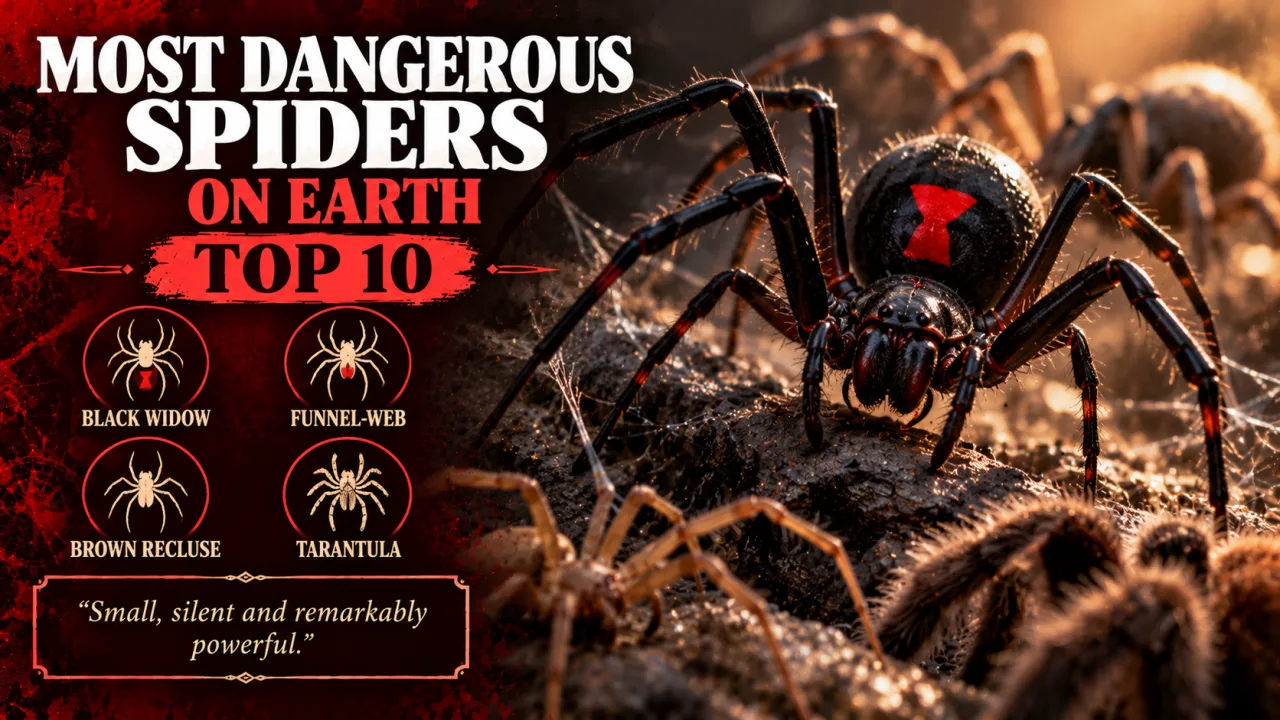
The most dangerous spiders on Earth, as of October 2026, range from Australia's funnel-webs to Brazil's wandering spiders, widows and recluses.
Roughly 52,000 spider species have been named by scientists, and nearly all of them carry venom. That sounds alarming until you look at the medical records. Only a small group of spiders has fangs strong enough to pierce human skin, venom that acts on people, and habits that bring them into our homes, shoes and gardens. A much smaller group still has a documented record of putting people in hospital or, very rarely, killing them.
This Finepedia guide is about that small group. It ranks ten spiders and spider groups by real medical significance as of October 2026, using clinical case series, poison-centre data and museum research rather than horror stories. Each entry has a Quick Facts table, a look at where the spider lives, what its venom does, how it behaves around people and how bites are treated today. Later sections deal with famous spiders that do not deserve their reputation, and with sensible first steps after a bite.
Spiders are not the only animals with a fearsome reputation. Finepedia's guide to the most venomous snakes in the world covers the reptiles that cause far more deaths, while fascinating spiders of the world celebrates the record-breaking and harmless side of the spider family.
How We Ranked These Spiders
There is no single number that tells you how dangerous a spider is. Laboratory potency tests on mice are useful, but a mouse is not a person, and some spider toxins hit primates far harder than rodents. This list weighs four factors together:
- Venom potency in people: whether the venom has been shown to cause serious effects in humans, not only in laboratory animals.
- Documented severe cases and deaths: published case series, hospital reviews and poison-centre reports.
- Antivenom and treatment: whether a specific antivenom exists, how widely it is available, and how much it has changed outcomes.
- Contact with humans: how often the spider lives in or near houses, gardens, clothing and footwear, and how often bites happen.
A spider that can kill but almost never meets people ranks below one that bites thousands of people a year with a small but real risk of serious illness. Spiders with frightening venom chemistry but very few confirmed human cases sit at the lower end. Where the evidence is thin, the entry says so.
One rule applied throughout: a bite only counts as evidence if the spider was actually seen biting and identified. Many reports of so-called spider bites turn out to be skin infections, insect bites or other conditions, a problem discussed in detail under the brown recluse.
At a Glance
| Rank | Spider | Scientific name | Main region | Why it ranks here |
|---|---|---|---|---|
| 1 | Sydney Funnel-Web Spider | Atrax robustus | Sydney region, Australia | 13 recorded deaths before antivenom; fast, severe envenoming |
| 2 | Brazilian Wandering Spiders | Phoneutria species | Central and South America | Thousands of bites a year; rare deaths in young children |
| 3 | Northern Tree-Dwelling Funnel-Web | Hadronyche formidabilis | New South Wales and Queensland | Very high rate of severe envenoming per bite |
| 4 | Chilean Recluse Spider | Loxosceles laeta | South America, introduced elsewhere | Can cause kidney failure and death |
| 5 | Redback Spider | Latrodectus hasselti | Australia | Hundreds treated with antivenom each year |
| 6 | Black Widow Spiders | Latrodectus mactans and relatives | North America | Thousands of bites, painful but rarely severe |
| 7 | Brown Recluse Spider | Loxosceles reclusa | Central and southern United States | Occasional skin necrosis and rare systemic illness |
| 8 | Mouse Spiders | Missulena species | Australia | Capable of severe envenoming, though rarely |
| 9 | Indian Ornamental Tarantulas | Poecilotheria species | India and Sri Lanka | Bites cause severe, delayed muscle cramps |
| 10 | Six-Eyed Sand Spiders | Hexophthalma species | Southern Africa | Potent tissue-damaging venom, almost no human cases |
1. Sydney Funnel-Web Spider
| Attribute | Details |
|---|---|
| Scientific name | Atrax robustus |
| Range | Central Coast of New South Wales south to the Georges River and west to Baulkham Hills |
| Size | Body about 2 to 4 cm long |
| Venom type | Neurotoxic, driven by delta-atracotoxin (robustoxin) in males |
| Antivenom | Funnel-web antivenom, in use since 1981 |
Where It Lives
The Sydney funnel-web is a ground-dwelling spider of the bush, suburbs and gardens around Australia's largest city. It builds a silk-lined burrow in cool, damp places such as under rocks, logs, rockeries and the foundations of houses. Silk trip-lines spread out from the entrance and tell the spider when an insect, snail or small lizard walks past.
In January 2025, researchers led by the Australian Museum and the Australian Reptile Park published a study in BMC Ecology and Evolution showing that the animal long called the Sydney funnel-web is actually three species. Atrax robustus keeps the name and lives around central Sydney. The southern form was named Atrax montanus, and a much larger form found around Newcastle, about 150 km to the north, was named Atrax christenseni, nicknamed Big Boy. The funnel-web antivenom works against all three.
Venom and Bite Effects
The danger comes mainly from adult males. Their venom contains a toxin called delta-atracotoxin, also known as robustoxin, which keeps nerve channels firing when they should switch off. According to the Australian Museum, this toxin hits humans and other primates hard but has little effect on many other mammals, including cats and dogs.
Signs of severe envenoming can begin within minutes. They include tingling around the mouth, twitching muscles, heavy sweating and drooling, a racing heart, rising blood pressure and, in the worst cases, fluid in the lungs and loss of consciousness. A 2005 review of 138 definite funnel-web bites in the Medical Journal of Australia found that the 13 recorded deaths all happened before antivenom existed, and that seven of those who died were children.
Behaviour Around People
Most encounters happen in summer and autumn, when males leave their burrows to search for mates. Between November and April they wander at night, and they often end up in garages, shoes left outside, laundry on the floor or backyard swimming pools. A male that falls into a pool can survive for at least 30 hours underwater, so a spider that looks drowned may still bite. Funnel-webs cannot jump, but when threatened they rear up and show their fangs.
The 2005 MJA review found that only about 17 percent of bites by this species caused severe envenoming. That is lower than for some of its relatives, but the Sydney funnel-web lives among millions of people, which is why it tops this list.
Treatment
Funnel-web antivenom was developed by Dr Struan Sutherland's team at the Commonwealth Serum Laboratories and introduced in 1981. The same team popularised pressure-immobilisation first aid, which slows the spread of venom while the patient gets to hospital. No deaths have been recorded since the antivenom became available. In the 2005 review, 97 percent of the 75 patients who received it had a complete response.
The Australian Reptile Park has run a public venom-milking program since 1981, and it relies on people bringing in spiders caught safely in jars. That venom goes to CSL Seqirus for antivenom production.
Key Figures
- 13 recorded deaths, all before 1981.
- The first recorded death was a toddler in Thornleigh, Sydney, in February 1927.
- Severe envenoming in about 17 percent of identified bites.
- Three species now recognised in the former single species, as of the 2025 revision.
2. Brazilian Wandering Spiders
| Attribute | Details |
|---|---|
| Scientific name | Phoneutria species, mainly Phoneutria nigriventer in Brazil |
| Range | Forests, plantations and towns from Central America to northern Argentina |
| Size | Body about 17 to 48 mm; leg span up to about 18 cm |
| Venom type | Neurotoxic, acting on sodium, calcium and potassium channels |
| Antivenom | Equine antivenom produced in Brazil |
Where It Lives
Wandering spiders are large, fast hunters that do not build webs to catch prey. They roam at night and shelter by day in dark crevices, banana plants, piles of timber and building materials. In south-eastern Brazil, the most medically important species, Phoneutria nigriventer, is common in towns and cities, which is why bites are so frequent there. Fewer than ten species are recognised, and the exact count changes as taxonomists review the genus.
These spiders are famous for turning up in fruit shipments. The University of Florida notes that wandering spiders have been found in bananas exported from South and Central America, although many spiders found in fruit turn out to be harmless look-alikes.
Venom and Bite Effects
The venom is a complex cocktail of small proteins that disrupt nerve signalling. Most bites cause intense local pain that may spread up the limb, along with swelling, redness and sweating near the bite. In a small minority of cases, mostly in young children, the venom causes profuse sweating, vomiting, a fast heart rate, high blood pressure, fluid in the lungs and shock. Painful, prolonged erections are a known sign of systemic envenoming in boys and men, and one of the toxins behind this effect has been studied by researchers as a possible lead for new drugs.
A study of 422 bites treated at a poison centre in Campinas, Brazil, between 1984 and 1996 gives a clear picture of the real risk. About 90 percent of cases were mild, 8.5 percent were moderate, and 0.5 percent, two children, were severe. One of those children, a three-year-old, died nine hours after being bitten.
Behaviour Around People
When disturbed, a wandering spider raises its front legs and shows its fangs in a distinctive defensive pose, which gives the group the nickname armed spiders. Bites almost always happen by accident. In the Campinas study, more than half of all bites happened inside homes, and about 41 percent were on the feet, often when people put on shoes or handled stored items.
Brazil records thousands of Phoneutria bites each year, which makes this group one of the busiest spider problems in the world for poison centres.
Treatment
Most patients need only pain relief, usually a local anaesthetic injected around the bite, and a period of observation. Antivenom is kept for moderate and severe cases, especially in children. In the Campinas series, it was used in only 2.3 percent of patients. Brazil's antivenom against Phoneutria is made from horse antibodies by public institutes such as Instituto Butantan, and a review in Clinical Toxicology notes that serum therapy for these bites has been used in Brazil since 1925.
Key Figures
- Severe envenoming in roughly 0.5 to 1 percent of bites, mostly in children.
- Leg span of the largest individuals up to about 18 cm.
- Defensive pose: front legs raised high, fangs displayed.
- Most bites happen in or around houses.
3. Northern Tree-Dwelling Funnel-Web Spider
| Attribute | Details |
|---|---|
| Scientific name | Hadronyche formidabilis |
| Range | Wet forests of New South Wales north from the Watagan Mountains into southern Queensland |
| Size | Body about 4 to 5 cm, the largest funnel-web |
| Venom type | Neurotoxic, similar to the Sydney funnel-web |
| Antivenom | The same funnel-web antivenom |
Where It Lives
Unlike its ground-dwelling cousin, this funnel-web lives in trees. It makes its silk-lined retreat in rot-holes, cracks and crevices of rough-barked trees in moist forests, and has been recorded more than 30 metres above the ground. It is the largest member of the Australian funnel-web group, which includes around 40 species in the genera Atrax, Hadronyche and Illawarra.
Venom and Bite Effects
The venom produces the same dangerous pattern as the Sydney species: muscle twitching, sweating, drooling, high blood pressure and possible fluid in the lungs. What sets it apart is the rate of serious outcomes. In the 2005 MJA review of funnel-web bites in which the spider was identified to species, 63 percent of bites by this spider caused severe envenoming. Only the southern tree-dwelling funnel-web, Hadronyche cerberea, had a higher rate in that review, at 75 percent.
Behaviour Around People
Because it lives in forest trees, this spider meets people far less often than the Sydney funnel-web. Bites usually involve people working or camping in forests, handling timber, or finding a spider that has dropped from a branch or wandered after heavy rain. That lower contact rate is the only reason it ranks below the Sydney species despite a more alarming record per bite.
Treatment
Funnel-web antivenom works against the venom of this species, and the same first-aid approach applies: pressure-immobilisation bandaging, keeping the patient still and calling an ambulance. Rapid access to hospital matters, since severe signs can appear quickly.
Key Figures
- Severe envenoming in 63 percent of identified bites in the 2005 review.
- Recorded living more than 30 metres up in trees.
- Largest of the roughly 40 Australian funnel-web species.
4. Chilean Recluse Spider
| Attribute | Details |
|---|---|
| Scientific name | Loxosceles laeta |
| Range | Chile, Peru, Argentina and neighbouring countries; introduced populations elsewhere |
| Size | Body about 8 to 15 mm |
| Venom type | Cytotoxic and haemolytic (sphingomyelinase D) |
| Antivenom | Anti-Loxosceles antivenoms made in some South American countries; benefit debated |
Where It Lives
The Chilean recluse is the largest and most medically important member of the recluse family in South America. In Chile it is a true house spider, hiding behind pictures and furniture, in wardrobes and among clothes and bedding. Human trade has carried it far from home. A colony has lived in the basement of the Natural History Museum in Helsinki, Finland, since around the 1960s, and populations have been reported in the Los Angeles area of California.
Venom and Bite Effects
The key toxin is an enzyme called sphingomyelinase D, which damages cell membranes and triggers inflammation. Most bites cause a painful skin lesion that can turn into a dark area of dead tissue, a condition doctors call cutaneous loxoscelism. In a minority of cases the venom spreads through the body, destroying red blood cells and damaging the kidneys. This viscerocutaneous form can cause dark urine, jaundice, kidney failure and death.
A study of 216 cases from Santiago covering 1955 to 1988 found that 84 percent were cutaneous only and 16 percent were viscerocutaneous. About 3.7 percent of all patients died, and every death occurred in the viscerocutaneous group. Another Chilean report described 47 viscerocutaneous cases, with 9 deaths.
Behaviour Around People
The Chilean recluse is shy and does not attack. Bites happen when the spider is pressed against the skin. In the Santiago series, 86.6 percent of bites occurred at home, many while people were asleep or getting dressed. Shaking out clothes and bedding, moving beds away from walls and keeping storage areas tidy are standard advice in Chile.
Treatment
Treatment focuses on pain control, wound care and close monitoring of blood and kidney tests during the first days, when the dangerous systemic form usually declares itself. Some South American producers, such as Instituto Butantan in Brazil, make antivenoms that include antibodies against Loxosceles venom, but experts still debate how much they help once skin damage is visible. A more recent Chilean cohort of 200 patients treated between 2013 and 2017 recorded no deaths and only 5.5 percent viscerocutaneous cases, suggesting that earlier diagnosis and better supportive care have improved outcomes.
Key Figures
- Deaths in the 1955 to 1988 Santiago series occurred only in the systemic form.
- 86.6 percent of bites happened inside homes.
- A colony has lived in a Helsinki museum basement for decades.
5. Redback Spider
| Attribute | Details |
|---|---|
| Scientific name | Latrodectus hasselti |
| Range | Throughout Australia, especially around buildings and gardens |
| Size | Female body about 10 mm; male about 4 mm |
| Venom type | Neurotoxic (alpha-latrotoxin) |
| Antivenom | Redback antivenom, available since 1956 |
Where It Lives
The redback is a close relative of the black widow and one of the most familiar spiders in Australia. Females are glossy black with a red or orange stripe on the top of the abdomen and an hourglass mark underneath. They build messy, tangled webs in dry, sheltered spots such as letterboxes, sheds, outdoor furniture, pot plants, under barbecue lids and beneath toilet seats in old outdoor toilets.
Venom and Bite Effects
Only the female's bite is medically important; the tiny male rarely manages to bite people. The venom's main toxin, alpha-latrotoxin, causes nerve endings to release a flood of chemical messengers. The result is a syndrome called latrodectism. Pain at the bite site grows over an hour or so and can spread to the limbs, chest, abdomen or back. Local and generalised sweating, nausea, vomiting, headache and a general feeling of being unwell are common, and symptoms can last for days.
The Australian Venom Research Unit records at least 14 deaths from redback bites before antivenom was introduced. No deaths have been recorded since its introduction in 1956.
Behaviour Around People
Redbacks are not aggressive, but they live wherever people do, so bites are common. A 1998 estimate in the journal Toxicon put the number of redback bites at somewhere between 2,000 and 10,000 a year. The Australian Museum notes that more than 250 people a year receive antivenom. Many bites happen when people put their hands into gloves, shoes or hidden corners without looking.
Treatment
First aid differs from funnel-web bites. Health authorities advise applying an ice pack to ease pain and not using a pressure bandage, because the venom moves slowly and pressure only adds to the pain. People with severe or spreading pain, sweating or other symptoms should get medical help. The use of antivenom has been studied and debated by Australian doctors in recent years, and decisions are now made case by case in hospital.
Key Figures
- At least 14 deaths before antivenom, none since 1956.
- More than 250 cases treated with antivenom each year.
- Possibly up to 10,000 bites a year across Australia.
6. Black Widow Spiders
| Attribute | Details |
|---|---|
| Scientific name | Latrodectus mactans, with Latrodectus hesperus and Latrodectus variolus |
| Range | Most of North America, especially the southern and western United States |
| Size | Female body about 1 to 1.5 cm; males much smaller |
| Venom type | Neurotoxic (alpha-latrotoxin) |
| Antivenom | Equine black widow antivenin, approved by the US FDA |
Where It Lives
The name black widow covers several closely related North American species. The southern black widow is the best known, with the western and northern black widows filling much of the rest of the continent. The adult female is shiny black with a red hourglass shape on the underside of the abdomen. The US National Institute for Occupational Safety and Health warns that they are common in woodpiles, sheds, outhouses and other undisturbed outdoor spaces, which puts gardeners, farm workers and builders at particular risk.
Venom and Bite Effects
Like the redback, the black widow causes latrodectism. The bite itself can feel like a pinprick, but within an hour pain and cramping can spread from the bite to the abdomen, back and chest. Abdominal muscle rigidity can be severe enough to be mistaken for appendicitis. Sweating, nausea, raised blood pressure and restlessness may follow.
The real-world record is far less frightening than the reputation. A review of US poison-centre data from 2012 to 2022, published in 2025, found 15,299 black widow exposures, roughly 1,400 a year. Only 0.8 percent had major effects, about 10 percent of patients were admitted to hospital, and no deaths were recorded. An earlier review of data from 2000 to 2008, covering more than 23,000 exposures, also found no deaths.
Behaviour Around People
Black widows are reclusive and usually bite only when pressed, for example when someone reaches into a dark space or puts on a glove or boot where a female is hiding. The idea that the female always eats the male after mating is an exaggeration; it can happen, but many males survive.
Treatment
Most patients are treated with pain relief, muscle relaxants and observation. An antivenom made from horse antibodies is approved in the United States, but because it carries a risk of allergic reactions, it is used in only a small share of cases. In the 2012 to 2022 data, antivenom was given in 3.4 percent of exposures. The CDC's advice for workers is to wash the bite with soap and water, apply a cool compress, elevate the limb and seek medical attention, and it notes that tetanus protection should be checked.
Key Figures
- About 1,400 reported exposures a year in US poison-centre data.
- No deaths recorded in the 2012 to 2022 review.
- Major effects in fewer than 1 in 100 exposures.
7. Brown Recluse Spider
| Attribute | Details |
|---|---|
| Scientific name | Loxosceles reclusa |
| Range | Central and southern United States, from Nebraska and Ohio south to Texas and Georgia |
| Size | Body about 1 cm; leg span roughly the size of a large coin |
| Venom type | Cytotoxic and haemolytic (sphingomyelinase D) |
| Antivenom | No antivenom approved in the United States |
Where It Lives
The brown recluse is established in 16 US states, according to Penn State Extension, with its heartland in Missouri, Kansas, Oklahoma, Arkansas, Tennessee and Kentucky. Inside its range it can be extremely common indoors. It shelters in closets, attics, basements, boxes and behind furniture. Identification relies on two features: six eyes arranged in three pairs, instead of the usual eight, and a dark violin-shaped mark on the front body section, with the neck of the violin pointing towards the rear.
Venom and Bite Effects
The venom uses the same main enzyme as the Chilean recluse. Penn State Extension summarises the evidence like this: about 90 percent of bites cause no reaction or only a small red bump, about 10 percent produce a patch of dead skin that can take two to four months to heal, and fewer than 1 percent lead to systemic illness, such as the destruction of red blood cells and kidney injury. Severe systemic cases are most often reported in children.
Behaviour Around People
The brown recluse lives up to its name. Researchers collected more than 2,000 recluses from a single Kansas home over six months, yet the family living there had reported no bites in six years. Bites tend to occur when a spider is trapped against skin in bedding or clothing.
The bigger problem is over-diagnosis. In a national study published in 2005, people from 49 states mailed in spiders they believed were brown recluses. Almost none of the recluses came from outside the spider's known range. The University of California's pest-management program reports that a large share of recluse bite diagnoses referred to a California toxicologist came from areas where no recluses live. Bacterial infections such as MRSA, chemical burns, diabetic ulcers and other conditions are often wrongly blamed on spiders.
Treatment
There is no recluse antivenom approved in the United States. Treatment for most bites is simple wound care, rest, elevation, cold compresses and pain relief. Patients who develop fever, dark urine, jaundice or feel generally unwell need urgent medical assessment, because these can be signs of systemic loxoscelism.
Key Figures
- Established in 16 US states.
- About 90 percent of bites heal without significant damage.
- Fewer than 1 percent of bites cause systemic illness.
8. Mouse Spiders
| Attribute | Details |
|---|---|
| Scientific name | Missulena species, including Missulena bradleyi and Missulena occatoria |
| Range | Most of mainland Australia |
| Size | Medium-sized, stocky spiders; males smaller than females |
| Venom type | Neurotoxic, related in action to funnel-web venom |
| Antivenom | Funnel-web antivenom has been used successfully |
Where It Lives
Mouse spiders are burrowing spiders found across most of mainland Australia. Females live in deep burrows, often closed with a trapdoor, and rarely leave them. Males wander in search of mates and, unusually for big burrowing spiders, they often do so in daylight, especially after rain. The male red-headed mouse spider, with its bright red jaws and blue-black body, is one of the most striking spiders in the country.
Venom and Bite Effects
Laboratory research has shown that the venom of the eastern mouse spider acts in a similar way to funnel-web venom. In real life, though, mouse spider bites are usually mild. A 2004 study in the Medical Journal of Australia reviewed 40 definite bites and found only one severe case, a 2.5 percent rate. That case involved a 19-month-old child bitten by a male eastern mouse spider in Queensland in 1985. The child became seriously ill and recovered after being given funnel-web antivenom. No deaths from mouse spiders have been recorded.
Behaviour Around People
Mouse spiders are often confused with funnel-webs because both are large, dark and stocky with powerful fangs. Since males wander by day and are sometimes found in swimming pools and gardens, people may be bitten when handling them. Because the two groups are hard for non-experts to tell apart, health authorities advise treating any bite by a large, dark ground spider in eastern Australia as a possible funnel-web bite.
Treatment
First aid is the same as for funnel-web bites: a pressure-immobilisation bandage, keeping still, and calling an ambulance. The Australian Museum notes that funnel-web antivenom has been used successfully to treat severe mouse spider envenoming.
Key Figures
- 1 severe case in 40 definite bites in the 2004 MJA review.
- No recorded deaths.
- Males often wander in daylight after rain.
9. Indian Ornamental Tarantulas
| Attribute | Details |
|---|---|
| Scientific name | Poecilotheria species, including Poecilotheria regalis and Poecilotheria metallica |
| Range | Forests of India and Sri Lanka |
| Size | Leg span roughly 15 to 20 cm in larger species |
| Venom type | Neurotoxic effects causing severe muscle cramps |
| Antivenom | None |
Where It Lives
The ornamental tarantulas are tree-dwelling spiders found only in India and Sri Lanka. They hide in tree holes and under bark during the day and come out at night to hunt insects. Their bold black, white, grey and yellow patterns make them some of the most beautiful tarantulas in the world. The gooty sapphire ornamental tree spider, Poecilotheria metallica, a vivid blue species known from a small area of southern India, is listed as Critically Endangered by the IUCN.
Venom and Bite Effects
Most tarantula bites cause only local pain, but this genus is the clear exception. A 2014 study in Toxicon described a verified bite by Poecilotheria regalis that produced severe muscle cramps which began hours after the bite and kept coming back in waves. Reviews of reported bites describe a similar pattern of delayed, intense cramping, sometimes with sweating, a fast heart rate and difficulty moving. A 2023 case report from Sri Lanka described a man bitten by a local ornamental tarantula, Poecilotheria fasciata, who developed hand swelling, painful generalised muscle spasms and palpitations, and recovered after intravenous calcium gluconate.
Behaviour Around People
These spiders are fast and nervous rather than aggressive. The 2023 Sri Lankan case shows that bites do occur within the spiders' native range, although few are reported. Many other documented bites involve captive spiders, since ornamental tarantulas are popular with hobby keepers worldwide. That is why this group appears on the list: it shows how the exotic pet trade can create new kinds of spider bite cases far from the animal's natural home.
Treatment
There is no antivenom. Care is supportive, with pain relief, muscle relaxants or other medicines to control spasms, and observation until the cramps settle. No deaths are documented in the medical literature reviewed for this article.
Key Figures
- Delayed muscle cramps can continue for days or longer after a bite.
- Poecilotheria metallica is listed as Critically Endangered.
- Native only to India and Sri Lanka.
10. Six-Eyed Sand Spiders
| Attribute | Details |
|---|---|
| Scientific name | Hexophthalma species, including Hexophthalma hahni |
| Range | Deserts and dry scrub of Namibia, South Africa and Zimbabwe |
| Size | Body about 8 to 11 mm |
| Venom type | Cytotoxic (sphingomyelinase D), related to recluse venom |
| Antivenom | None |
Where It Lives
Six-eyed sand spiders are flat, crab-like relatives of the recluses. They live in sandy, dry habitats in southern Africa and bury themselves just below the surface, where sand grains stick to hairs on their bodies and make them almost invisible. They wait there for passing prey. Until 2017 they were placed in the genus Sicarius, but a revision by Magalhães and colleagues moved the African species into Hexophthalma, a genus now home to several described species.
Venom and Bite Effects
On paper, these spiders have some of the most potent venom of any recluse relative. Their venom contains the same tissue-destroying enzyme family found in Loxosceles, and laboratory studies on rabbits have shown severe skin damage. That is the source of their fearsome reputation.
The human record, however, is almost empty. Medical reviews of southern African spider bites describe very few suspected cases, and none in which a sand spider was clearly identified as the culprit. The spider's remote desert home and secretive habits mean that people almost never encounter it.
Behaviour Around People
Sand spiders are slow to bite and prefer to stay buried. They are mostly found by researchers, photographers and hikers who deliberately sift through sand or turn over rocks. They earn a place on this list for their venom chemistry, not for any record of harm, and they show how a spider can be dangerous in theory but barely matter to public health in practice.
Treatment
There is no antivenom. Any suspected bite would be managed like a recluse bite, with wound care, monitoring for signs of systemic illness and medical follow-up.
Key Figures
- Buried under sand, often fully hidden.
- The genus Hexophthalma was revived for the African species in 2017.
- Venom enzyme related to that of recluse spiders.
How the Ten Compare
| Rank | Spider | Main venom effect | Deaths on record | Specific antivenom | Contact with people |
|---|---|---|---|---|---|
| 1 | Sydney Funnel-Web | Nervous system | 13, all before 1981 | Yes | High in Sydney |
| 2 | Brazilian Wandering Spiders | Nervous system | Rare, mostly young children | Yes, in Brazil | High in Brazilian towns |
| 3 | Northern Tree-Dwelling Funnel-Web | Nervous system | None reported in the 2005 review | Yes | Low to moderate |
| 4 | Chilean Recluse | Skin and blood | Yes, in the systemic form | Limited, debated | High in Chilean homes |
| 5 | Redback | Nervous system | At least 14, all before 1956 | Yes | Very high |
| 6 | Black Widows | Nervous system | None in recent US data | Yes | High |
| 7 | Brown Recluse | Skin and blood | Very rare | No | High within range |
| 8 | Mouse Spiders | Nervous system | None recorded | Funnel-web antivenom used | Moderate |
| 9 | Indian Ornamental Tarantulas | Muscle cramps | None documented | No | Low, mostly pets |
| 10 | Six-Eyed Sand Spiders | Skin damage | None confirmed | No | Very low |
The table makes one point clear. The spiders that once killed people most often, the funnel-webs and the redback, now cause no deaths at all in places where antivenom and good first aid are available. Today, the main risks are delayed treatment, young age and the systemic forms of recluse envenoming.
Spider Myths and Near Misses
Several spiders and spider-like animals have a reputation that the evidence does not support. They are left off the main list on purpose.
Hobo Spider
For years, the hobo spider, Eratigena agrestis, was blamed for flesh-damaging bites in the north-western United States, and a 1996 CDC report reflected that belief. Later research overturned it. A 2004 review in Annals of Emergency Medicine concluded that the evidence for necrotic hobo spider bites was weak, and a 2011 study in the Journal of Medical Entomology found no significant tissue-damaging activity in its venom. The spider has also never been linked to necrotic bites in its native Europe.
Camel Spiders
The so-called camel spiders of desert war stories are not spiders at all. They belong to a separate group of arachnids called solifuges, or wind scorpions. They have no venom glands. A large one can give a painful pinch with its huge jaws, and the wound can become infected, but tales of camel spiders eating flesh or chasing people are myths.
Yellow Sac Spiders
Yellow sac spiders, genus Cheiracanthium, are often blamed for skin wounds. A 2006 study in the American Journal of Tropical Medicine and Hygiene reviewed 20 verified bites in the United States and Australia and found no necrosis. Typical effects were short-lived pain, redness and itching.
White-Tailed Spiders
In Australia, the white-tailed spider was long accused of causing necrotic ulcers. A prospective study of 130 definite bites, published in the Medical Journal of Australia in 2003, found no ulcers and no confirmed infections. Most bites caused only local pain, redness and itching that faded within a day or so.
Giant Tarantulas and Huntsman Spiders
The Goliath birdeater of South America and the large huntsman spiders of Australia and Asia look terrifying because of their size. Their bites can be painful, and some tarantulas flick irritating hairs from their abdomen, but neither group has a record of serious envenoming in people. Size is not a reliable guide to danger.
What to Do If Bitten
This section summarises public guidance from health agencies and museums. It is general information, not medical advice. Anyone with severe or spreading symptoms should contact local emergency services or a poison information centre straight away.
- Stay calm and move away from the spider. If it is safe, take a photo or keep the spider in a sealed jar for identification, but do not risk another bite.
- For a possible funnel-web or mouse spider bite in Australia, or any bite by a large, dark ground spider there, Australian health authorities advise a firm pressure-immobilisation bandage over the whole limb, keeping the person still and calling an ambulance.
- For redback bites, the Australian Museum advises an ice pack for pain and no pressure bandage. Seek medical help if pain is severe or spreading, or if sweating or other symptoms develop.
- For other spider bites, the CDC recommends washing the bite with soap and water, applying a cool cloth, raising the affected limb and seeking medical attention if symptoms worsen. Check that tetanus protection is up to date.
- Seek urgent care for breathing difficulty, muscle twitching, heavy sweating, severe abdominal pain, dark urine, fever or a rapidly spreading wound, and for any significant bite in a young child.
- A wound that appears without a spider being seen is often something else, such as a bacterial skin infection, and should be checked by a doctor.
Frequently Asked Questions
What is the most dangerous spider in the world?
Most experts point to the Sydney funnel-web spider because its venom acts quickly, it lives close to millions of people, and it caused 13 recorded deaths before antivenom was introduced in 1981. Brazilian wandering spiders cause far more bites each year, but only a small share lead to severe illness, and deaths are rare and mostly in young children.
How many people die from spider bites each year?
Very few. In countries with modern medical care, deaths from spider bites are extremely rare. Australia has recorded no deaths from funnel-web or redback bites since their antivenoms were introduced, and US poison-centre data from 2012 to 2022 recorded no black widow deaths. Rare fatal cases still occur in places where treatment is delayed or far away.
Are spiders in Australia the most dangerous?
Australia has two of the most medically significant spider groups, the funnel-webs and the redback, but it also has excellent antivenoms and first-aid systems. South America's wandering spiders and recluses are also significant, and in some areas cause more serious cases, so the answer depends on where you live and how quickly care can be reached.
Can a brown recluse bite kill you?
Deaths are extremely rare. About 90 percent of brown recluse bites cause little or no damage, and fewer than 1 percent cause systemic illness. The rare serious cases mostly involve children, show up as fever, dark urine or jaundice, and require hospital care with blood and kidney monitoring.
Do spiders bite people on purpose?
No. Nearly all bites are defensive, happening when a spider is pressed against skin in clothing, shoes, bedding or gloves, or when someone handles it. Spiders do not hunt people, and most will run or hide if given the chance, which is why shaking out clothes and shoes prevents many bites.
Is the camel spider venomous?
No. Camel spiders are solifuges, not true spiders, and they have no venom glands. Their large jaws can give a painful bite that may become infected, but they cannot inject venom, and stories about them chasing or eating people are myths.
What does a spider bite look like?
Most bites look like a small red bump and may not be noticed at all. Because many skin conditions look similar, a wound should not be blamed on a spider unless a spider was seen biting. Spreading redness, pus or fever point more often to infection and need a doctor's check.
Conclusion
The most dangerous spiders on Earth are a small, well-studied group. As of October 2026, the Sydney funnel-web still heads the list for the speed and severity of its venom, while Brazil's wandering spiders and South America's Chilean recluse remain serious public-health concerns. The redback and black widow bite thousands of people but almost never kill, and the brown recluse is far more often blamed than guilty.
The wider lesson is reassuring. Antivenoms, pressure-immobilisation first aid and better hospital care have turned spiders that once killed children into treatable emergencies. For anyone who shares a home, garden or country with these animals, simple habits such as shaking out shoes, wearing gloves in sheds and leaving spiders alone do more to prevent harm than fear ever will. Readers interested in other risky wildlife can explore Finepedia's lists of the most dangerous sea creatures and the most dangerous wild animals in Canada.
- Australian Museum: Sydney Funnel-web Spider - https://australian.museum/learn/animals/spiders/sydney-funnel-web-spider/
- Australian Museum: Funnel-web Spiders group - https://australian.museum/learn/animals/spiders/funnel-web-spiders-group/
- Australian Museum: Sydney Funnel-web Spider reclassified (2025) - https://australian.museum/about/organisation/media-centre/sydney-funnel-web-spider-reclassified/
- Loria et al. 2025, BMC Ecology and Evolution - https://link.springer.com/article/10.1186/s12862-024-02332-0
- Isbister et al. 2005, Funnel-web spider bite: a systematic review, Medical Journal of Australia - https://www.mja.com.au/journal/2005/182/8/funnel-web-spider-bite-systematic-review-recorded-clinical-cases
- Isbister et al. 2004, Mouse spider bites, Medical Journal of Australia - https://www.mja.com.au/journal/2004/180/5/mouse-spider-bites-missulena-spp-and-their-medical-importance
- Australian Museum: Redback Spider - https://australian.museum/learn/animals/spiders/redback-spider/
- Australian Venom Research Unit: Redback spider - https://www.avru.org/q-general/general_redback.html
- Victoria Department of Health: Spiders - https://www.health.vic.gov.au/environmental-health/spiders-pest-control
- Bucaretchi et al. 2000, Phoneutria bites in Campinas, Revista do Instituto de Medicina Tropical de Sao Paulo - https://www.scielo.br/j/rimtsp/a/YjV9rzJH4jPBGt8ZhghtNGg/?lang=en
- Bucaretchi et al. 2008, Clinical Toxicology - https://www.tandfonline.com/doi/full/10.1080/15563650802258524
- University of Florida IFAS: Armed spiders - https://ask.ifas.ufl.edu/publication/IN1207
- Schenone et al. 1989, Loxoscelism in Chile - https://pubmed.ncbi.nlm.nih.gov/2577020/
- University of California IPM: Brown recluse and other recluse spiders - https://ipm.ucanr.edu/home-and-landscape/brown-recluse-and-other-recluse-spiders/
- Penn State Extension: Brown Recluse Spiders - https://extension.psu.edu/brown-recluse-spiders
- Vetter 2005, Journal of Medical Entomology - https://academic.oup.com/jme/article/42/4/512/910901
- CDC NIOSH: Venomous Spiders - https://www.cdc.gov/niosh/outdoor-workers/about/venomous-spiders.html
- Kerns et al. 2025, black widow exposures 2012 to 2022, Wilderness and Environmental Medicine - https://pubmed.ncbi.nlm.nih.gov/39670790/
- US FDA: Black Widow Spider Antivenin (Equine) - https://www.fda.gov/vaccines-blood-biologics/approved-blood-products/black-widow-spider-antivenin-equine
- Poison Control: Black widow spiders - https://www.poison.org/articles/black-widow-spiders
- Fuchs et al. 2014, Poecilotheria bites, Toxicon - https://pubmed.ncbi.nlm.nih.gov/24215987/
- Case report of Poecilotheria envenomation, 2023 - https://pmc.ncbi.nlm.nih.gov/articles/PMC10483889/
- Gaver-Wainwright et al. 2011, hobo spider venom, Journal of Medical Entomology - https://academic.oup.com/jme/article/48/2/382/893951
- Isbister and Gray 2003, white-tail spider bite, Medical Journal of Australia - https://www.mja.com.au/journal/2003/179/4/white-tail-spider-bite-prospective-study-130-definite-bites-lampona-species
- Vetter et al. 2006, yellow sac spider bites, American Journal of Tropical Medicine and Hygiene - https://www.ajtmh.org/view/journals/tpmd/74/6/article-p1043.xml
- UC IPM: Windscorpion - https://ipm.ucanr.edu/home-and-landscape/windscorpion/
- Burke Museum: Camel spider myth - https://www.burkemuseum.org/collections-and-research/biology/arachnology-and-entomology/spider-myths/myth-near-east-camel
- World Spider Catalog - https://wsc.nmbe.ch/
















Log in with