






 By
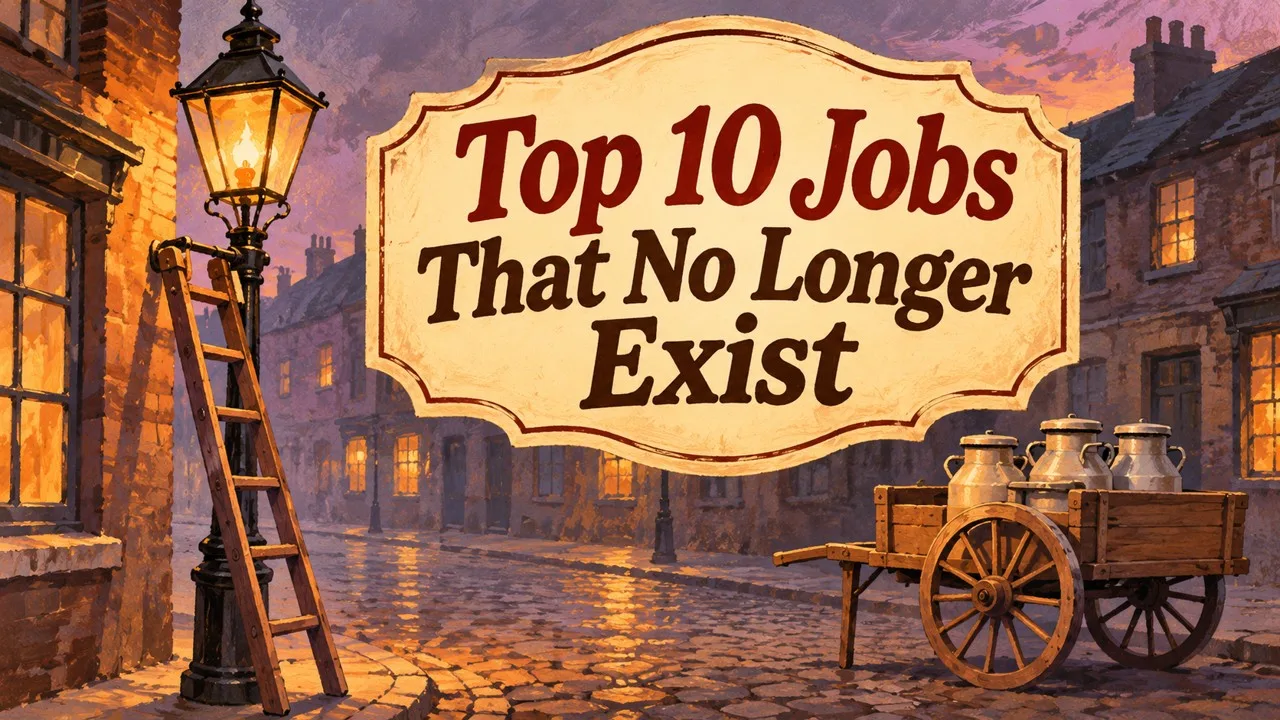
Knocker-uppers, lamplighters, human computers and pinsetters once filled ordinary working lives, until clocks, electricity and machines made them unnecessary. Every generation has jobs that seem permanent until they disappear. In the nineteenth and twentieth centuries, technology removed many kinds of work that had employed thousands of people. Some of those jobs were dangerous, but many were simply routine tasks that machines, networks or new habits eventually took over.
The ten jobs below are the knocker-up, the lamplighter, the cigar-factory reader, the human computer, the switchboard operator, the pinsetter, the ice harvester, the elevator operator, the Linotype operator and the telegraph messenger. A few survive in small numbers or as tourist attractions, but none is the ordinary job it once was. The focus here is on what the work involved and why it ended.
Key Facts
| # | Job | What the worker did | What replaced it |
|---|---|---|---|
| 1 | Knocker-up | Tapped on bedroom windows to wake workers for early shifts | Affordable alarm clocks |
| 2 | Lamplighter | Lit and extinguished gas or oil street lamps every evening and morning | Electric street lighting with automatic controls |
| 3 | Cigar-factory lector | Read newspapers and novels aloud to workers rolling cigars | Radio, and changes in the industry |
| 4 | Human computer | Performed complex calculations by hand for scientists and engineers | Electronic computers |
| 5 | Switchboard operator | Connected telephone calls by plugging cords into a switchboard | Automatic telephone exchanges |
| 6 | Pinsetter | Reset bowling pins and returned balls in bowling alleys | Automatic pinsetting machines |
| 7 | Ice harvester | Cut blocks of ice from frozen lakes and rivers in winter | Mechanical refrigeration |
| 8 | Elevator operator | Controlled elevator movement and doors and helped passengers | Automatic elevators with push buttons |
| 9 | Linotype operator | Typed text on a machine that cast lines of metal type | Phototypesetting and computers |
| 10 | Telegraph messenger | Carried telegrams from telegraph offices to recipients | The telephone, and later electronic messaging |
1. A Human Alarm Clock
In industrial towns of Britain and Ireland, especially from the nineteenth century into the early twentieth, factory and mill workers needed to wake before dawn. Many could not afford reliable clocks. A knocker-up walked the streets in the early morning, tapping on bedroom windows with a long pole or, in some accounts, shooting dried peas through a tube [1].
Clients paid a small weekly fee. The knocker-up usually stayed until the sleeper showed a sign of being awake. Photographs from the early twentieth century show knocker-ups at work in places such as London and the industrial north of England [1].
The job declined as alarm clocks became cheap and reliable, and it had largely disappeared by the mid-twentieth century, though a few continued in some towns into the 1970s. The knocker-up is often remembered in local history and in a popular children's picture book. It shows how a whole occupation could depend on a single missing technology.
2. Keepers of the Street Lights
Before electric lighting, many cities relied on gas or oil street lamps. Lamplighters walked set routes at dusk, lighting each lamp with a long pole carrying a flame or a hook to open the gas valve. At dawn, they returned to put them out, and they also cleaned and repaired the lamps [2].
The job was common in European and American cities in the nineteenth century. As electric street lighting spread in the early twentieth century, with lamps controlled from central switches and later by automatic timers and light sensors, the need for lamplighters faded [2].
A few places still employ lamplighters to maintain historic gas lamps. In London, a small team looks after the remaining gas street lamps, and some other cities keep the role for heritage reasons. The lamplighter has also become a familiar figure in literature, including Antoine de Saint-Exupéry's The Little Prince.
3. A Reader on the Factory Floor
In the cigar factories of Cuba, and later in Florida, especially in Tampa's Ybor City, workers rolled cigars by hand at long tables. From the 1860s, they paid lectores, or readers, out of their own wages to read aloud to them while they worked [3].
Related: Top 10 Historic Jobs Transformed by Technology
The lector sat on a raised platform and read newspapers, political writing and novels. Workers chose the reading material. Some cigar brands are said to take their names from novels read in factories, including Romeo y Julieta and Montecristo, after The Count of Monte Cristo [3].
In the United States, the role declined after the 1930s, partly because of labor disputes and the arrival of radio, and as the cigar industry mechanized. In Cuba, lectores still work in some factories, and the tradition was recognized as part of Cuba's cultural heritage in 2012. The lector is a rare example of a job created by workers themselves.
4. Computing by Hand
Before electronic computers, the word computer meant a person who did calculations. Observatories, government agencies and engineering firms employed teams of human computers, often women, to carry out long numerical work [4].
At Harvard College Observatory in the late nineteenth century, a group of women known as the Harvard Computers classified stars from photographic plates, and some, such as Henrietta Swan Leavitt and Annie Jump Cannon, made major scientific discoveries. In the twentieth century, NASA and its predecessor employed human computers, including the African American mathematicians Katherine Johnson, Dorothy Vaughan and Mary Jackson [4].
The arrival of electronic computers in the 1940s and 1950s gradually replaced this work. Some human computers became programmers, learning to operate the new machines. The role is now remembered partly through the film Hidden Figures, released in 2016, and through renewed historical attention to the contributions of these workers.
5. Connecting Calls by Hand
In the early days of the telephone, every call had to be connected by hand. Switchboard operators, mostly young women after the earliest years, sat in front of large boards and plugged cords into jacks to link callers. They answered with phrases like number, please [5].
The job employed large numbers of women in the late nineteenth and early twentieth centuries and became one of the most common jobs open to them. The work was demanding, closely supervised and fast-paced. Operators also had to handle emergencies and long-distance connections [5].
Related: Top 10 Dangerous Jobs That Have Disappeared
Automatic exchanges began to replace manual switchboards from the early twentieth century, using electromechanical switching systems. The transition took decades, and some rural areas used manual exchanges into the mid-twentieth century or later. Today, operators still exist in some forms, such as in hotels and emergency services, but the classic switchboard job has gone.
6. Resetting Pins by Hand
In bowling alleys of the late nineteenth and early twentieth centuries, pins were reset by hand. Pinsetters, often called pin boys, sat behind the lanes, cleared fallen pins, placed them back in position and returned the balls to the players [6].
The job was usually done by teenage boys and was poorly paid. It could also be risky, because flying pins and balls could injure workers. Labor laws and changing attitudes toward child labor made it harder to employ young workers in this way [6].
The automatic pinsetter, developed by the American Machine and Foundry Company and introduced commercially in the late 1940s and early 1950s, quickly replaced pin boys. The machines helped bowling become a popular mass leisure activity in the United States in the 1950s. The term pinsetter now usually refers to the machine rather than the person.
7. Harvesting Ice From Lakes
Before refrigerators, ice was cut from frozen lakes and rivers in winter and stored in insulated ice houses for use in summer. Ice harvesters used saws, horses and special tools to cut large blocks, which were stored under sawdust or straw [7].
The ice trade became a big business in the nineteenth century. The Boston merchant Frederic Tudor, sometimes called the Ice King, shipped New England ice to the Caribbean and as far as India from the early 1800s. Icemen delivered blocks to homes and businesses for iceboxes [7].
Related: Top 25 Interesting Facts About the Solar System
Mechanical refrigeration and electric home refrigerators, which became common in the 1920s to 1950s in wealthier countries, ended the natural ice trade. The ice harvester and the iceman disappeared from most places. Some communities still hold ice harvesting festivals to demonstrate the old techniques.
8. Running the Lift
Early elevators needed an operator to control speed, stop at the correct floor and open the doors. Operators worked in office buildings, department stores, hotels and apartment blocks, often in uniform, and also acted as greeters and helpers [8].
Automatic elevators with push-button controls existed by the early twentieth century, but many people were nervous about riding without an operator. A strike by elevator operators in New York City in 1945, which disrupted the city, helped encourage building owners to switch to automatic systems [8].
Over the following decades, automatic elevators became standard, with safety features such as emergency phones and automatic doors reassuring passengers. A few elevator operators still work, mainly in historic buildings, luxury hotels or as a deliberate service. The job's decline is often cited in discussions of automation and its effect on employment.
9. Setting Type at a Keyboard
The Linotype machine, invented by Ottmar Mergenthaler and first used at the New York Tribune in 1886, transformed printing. Instead of setting type by hand, letter by letter, an operator typed on a keyboard, and the machine cast a complete line of type in hot metal [9].
Linotype operators were skilled workers, and the machines became central to newspaper production around the world for nearly a century. The job was demanding, as operators worked quickly with hot metal and complex machinery [9].
Related: Top 25 Interesting Facts About the Universe
From the 1960s and 1970s, phototypesetting and then computer typesetting replaced hot metal. Newspaper strikes and disputes, such as those in Britain in the 1980s, were partly about the move to new technology. The Linotype operator's skills became obsolete. A documentary film, Linotype: The Film, released in 2012, recorded the memories of former operators.
10. Delivering Telegrams on Foot or Bicycle
Telegrams were sent by electric telegraph between offices, but someone had to carry the message to its final address. Telegraph messengers, usually boys or young men, delivered telegrams on foot or by bicycle in cities around the world [10].
The job was common in the late nineteenth and early twentieth centuries. Messengers delivered business messages, greetings and sometimes bad news, including wartime notices of deaths. Several notable people worked as telegraph messengers in their youth, including the industrialist Andrew Carnegie [10].
As telephones became common, demand for telegrams fell. Many telegraph services ended in the second half of the twentieth century, and Western Union ended its telegram service in the United States in 2006. The messenger's role now survives mainly in courier and delivery jobs that use very different technology.
Conclusion
The ten jobs above disappeared for similar reasons. A new technology, such as the alarm clock, electric light, the automatic exchange, the refrigerator or the computer, made a human task unnecessary or less economical. In some cases, such as the elevator operator, public trust in the new technology took time to build.
These jobs are not just curiosities. They were sources of income and identity for large numbers of people, and their disappearance affected families and communities. Remembering them is a way to think about current debates over automation, and about how work changes when machines learn to do it.
- ^ [1] Accounts of knocker-ups in industrial Britain. Wikipedia: knocker-up Wikipedia: alarm clock
- ^ [2] Accounts of lamplighters and gas street lighting. Wikipedia: lamplighter Wikipedia: gas lighting
- ^ [3] Accounts of lectores in Cuban and Florida cigar factories. Wikipedia: Ybor City Wikipedia: cigar
- ^ [4] Accounts of human computers, the Harvard Computers and NASA's computers. Wikipedia: human computer Wikipedia: Harvard Computers
- ^ [5] Accounts of switchboard operators and automatic exchanges. Wikipedia: switchboard operator Wikipedia: telephone exchange
- ^ [6] Accounts of pin boys and the automatic pinsetter. Wikipedia: pinsetter Wikipedia: ten-pin bowling
- ^ [7] Accounts of the natural ice trade and Frederic Tudor. Wikipedia: ice trade Wikipedia: ice cutting
- ^ [8] Accounts of elevator operators and the 1945 New York strike. Wikipedia: elevator operator Wikipedia: elevator
- ^ [9] Accounts of the Linotype machine and hot-metal typesetting. Wikipedia: Linotype machine Wikipedia: Ottmar Mergenthaler
- ^ [10] Accounts of telegraph messengers and the end of telegram services. Wikipedia: telegraph messenger Wikipedia: telegram





















Discussion
Log in with