




Top 10 Cases Where Evolution Seemed to Run Backward
 By Dhiraj Sharma · Published
Share Post
Loading…
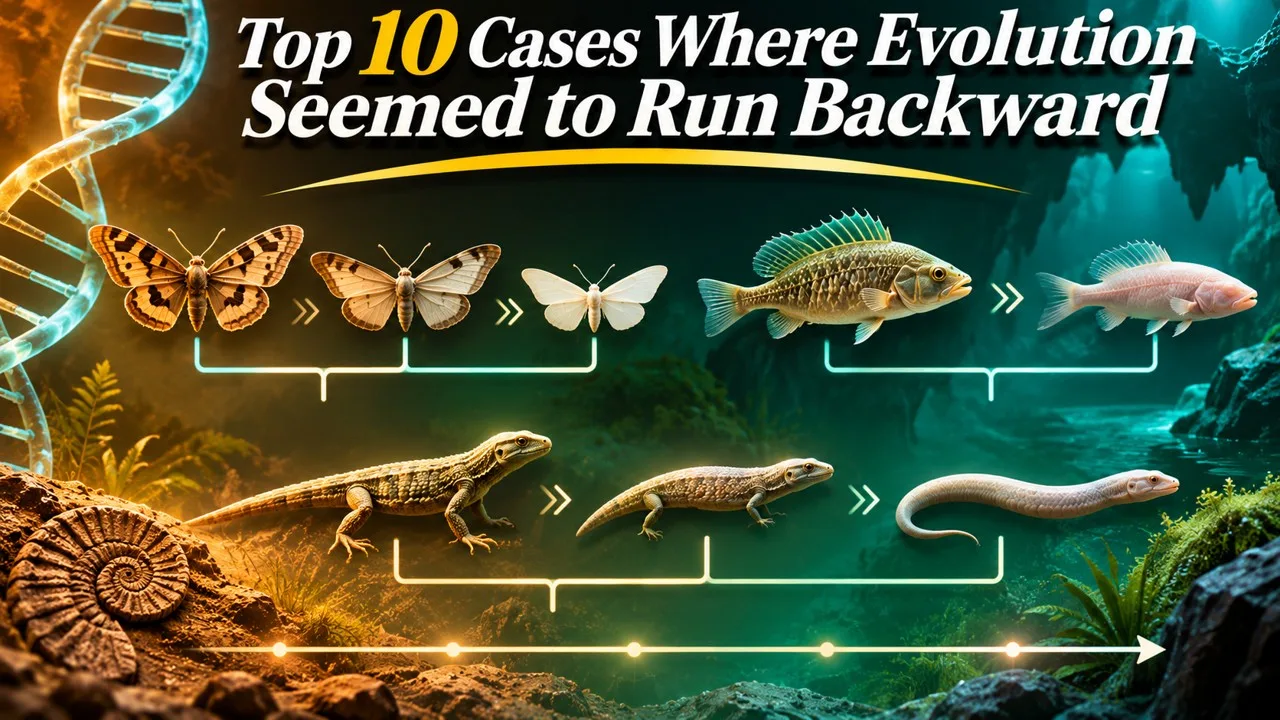
Peppered moths, sticklebacks and an island rail show traits returning when conditions change; that is selection, not evolution running in reverse. "Backward evolution" is a vivid caption and a poor mechanism [2][3]. Time does not rewind a lineage to an ancestor. What can happen is that a trait is reduced, then favored again, or that a similar solution, such as flightlessness on an island, evolves more than once [3][10]. Dollo's law, an old generalization that complex traits never return, is a tendency with a long list of proposed exceptions, not a physical barrier [3][8]. The ten cases below are those kinds of stories, told with the arguments left in [6][8][9].
A beak that changes twice in five years may even be plasticity as much as genes, until that is sorted out [1]. The list starts there, on purpose.
Key Facts
These are documented or seriously argued cases of trait reversal, changing selection, or a repeated evolutionary outcome. None of them is a film run backward.
Ten Cases at a Glance
| Rank | Example | Careful version |
|---|---|---|
| 1 | Dark-eyed juncos | Researchers have reported a rapid change and later reversal in beak measurements in a Los Angeles population; cause and genetic status are still being tested |
| 2 | Peppered moths | Melanic moths rose under soot and fell when the air and the trees lightened; selection changed direction |
| 3 | Sticklebacks | Freshwater fish often lose armor and can regain it when conditions favor plates again, often from standing variation |
| 4 | Ichthyosaurs | A late species has been argued to have returned to a large-prey diet after a long period of feeding on smaller animals |
| 5 | Chain ferns | Some ferns appear to move back and forth between more and less specialized fronds, not along a one-way march |
| 6 | Liolaemus lizards | Some Andean lineages may have returned to egg-laying after live birth; the phylogenetic inference is still discussed |
| 7 | Skinks and legs | Some papers argue that certain skinks re-evolved limbs after a loss; proving a complete loss and a true return is hard |
| 8 | Stick insects | A phylogenetic study concluded that wings returned after a long wingless period; the conclusion has been debated |
| 9 | Guenther's marsupial frog | This frog has lower teeth that most frogs lost long ago, a proposed re-evolution; the species has not been confirmed for many years |
| 10 | Aldabra rail | A flightless rail was lost when the atoll drowned; flying relatives recolonized, and flightlessness evolved again |
1. A Beak that Changed, then Changed Again
Dark-eyed juncos are common sparrows, including in cities. In 2025, researchers reported that a Los Angeles population had shifted in beak measurements over a few years, then shifted back, a pace that made headlines because ordinary evolutionary change is usually slower to see [1]. One proposed explanation tied the first change to a different urban diet, and the later reversal to a return toward insects and seeds when the city's discarded food pattern changed during and after pandemic lockdowns [1]. That ecological story is a hypothesis, not a finished proof, and a change this fast always raises the question of plasticity, of which birds were sampled, and of whether genes were involved at all. The unexpected fact, if the measurements hold, is speed. The careful fact is that a city bird can be a natural experiment, and that five years of data should not yet be carved into a law.
A reversal in a dataset is not a time machine. It is a reason to keep measuring.
2. Soot, then Cleaner Bark
The peppered moth is the classroom example, and it has earned the job. In parts of industrial Britain, dark, melanic moths became common on darkened trees, and later, as air quality improved and lichens and paler bark returned, the paler form rose again [2]. The mechanism is natural selection by predators in a changing background, with a known genetic basis for the dark form, even if some early experimental methods were later argued over [2]. Nothing here ran backward. The moths did not become their ancestors. The environment changed, and the frequencies changed with it, twice. The unexpected fact, for anyone who met the story only as a one-way darkening, is the second chapter: a famous "forward" shift can go the other way when the soot does.
A textbook can be true and still be incomplete if it stops at the factory and never reaches the cleanup.
Related: Top 10 Turning Points in the History of Biology
3. Armor that Can Be Lost and Recruited Again
Three-spined sticklebacks in the sea are typically well plated and spined. Populations that colonized fresh water have, many times, reduced that armor, a change that is now mapped to a small number of well-studied genes, including regulatory changes that are famous in evolutionary biology [3]. When the ecological pressure changes again, plates can increase, sometimes quickly, because the older alleles are not always gone from the population [3]. That is one reason the fish are so often cited against a strict reading of Dollo's law: the "lost" trait may still be sitting in the gene pool, ready to be favored. The unexpected fact is practical. A reversal is easier when the parts were stored, not when they have to be invented from nothing.
A lake is not the past. It is a new place that sometimes favors an old kit.
4. A Marine Reptile's Diet, Inferred Twice
Ichthyosaurs were marine reptiles, not fish, that evolved a fish-like outline, itself a reminder that a body plan can converge without a lineage walking backward [4]. Within that group, paleontologists have argued that feeding ecology also shifted: some early forms appear suited to large prey, a long later period favored smaller fish and invertebrates, and at least one late species, Kyhytysuka sachicarum, has been interpreted as returning to a more robust, large-prey way of eating [4]. Those are inferences from skulls and teeth, not filmed meals, and the timing should be treated as approximate. The unexpected fact is the second swing. A diet is a trait that can move more than once in a long-lived clade, if the food web and the jaw allow it, and that is still not a reversal of the whole animal into an ancestor.
A fossil can surprise you about lunch. It cannot put the clock in reverse.
5. Fronds that Do Not March One Way
Ferns are an old group, and they have had time to try more than one way of arranging work on a frond [5]. In chain ferns, some species separate a more obviously reproductive frond from a more photosynthetic one, a specialization that looks, to a casual eye, like a "later" or "higher" form [5]. Comparative work has suggested that lineages can move between that specialized condition and a more generalized one more than once, rather than climbing a single ladder toward complexity. The unexpected fact is the lack of a ladder. An old plant group can shuffle a trait without illustrating a morality play about progress. "Backward," here, is only a word for "toward the less specialized state," which was never a sin in the first place.
A spore is not a failure to invent a flower. It is a working method, and it can be packaged in more than one kind of leaf.
Related: Top 10 Most Bizarre Phobias: Strange Fears That Exist
6. Live Birth, then, perhaps, Eggs Again
In the Andes, many lizards in the large genus Liolaemus live at elevations and temperatures where carrying young can be an advantage, and live birth has evolved in the group [6]. Some phylogenetic studies have inferred that certain populations or species, after a later move into warmer, lower country, returned to egg-laying [6]. Reversals of viviparity are not supposed to be common, because the anatomy and the timing of development are complicated, and that is why the claim is still a specialist argument rather than a closed case. The unexpected fact, if the trees are right, is a rare U-turn in reproductive mode, explained by climate and elevation, not by a wish to be "primitive" again.
An egg is not an ancestor. It is a strategy that can, perhaps, be reassembled when the mountain no longer requires the other one.
7. Legs, Burrows, and a Hard Proof
Some skinks are almost limbless and live by moving through soil or litter. Papers on certain Southeast Asian groups have argued that ancestors lost their legs, in a climate and a substrate that favored burrowing, and that later descendants re-evolved more usable limbs when the ground and the hunting style changed [7]. The dates sometimes attached to those steps should be read as estimates. The deeper problem is evidence. A complete loss followed by a true return is hard to distinguish, in a fossil-poor, soft-tissue-poor record, from a partial reduction that never quite went to zero, or from a developmental pathway that stayed available [7]. The unexpected fact is the argument itself. Limbs are a classic "complex trait," and any claim that they came back deserves, and has received, a high bar.
A lizard with legs is not automatically a Lazarus. It may be a cousin that never fully packed the legs away.
Related: Top 10 Oldest Buildings in the World
8. Wings after a Long Pause, perhaps
Stick insects include flying species and wingless ones, and a well-known phylogenetic study concluded that wings were lost, stayed gone for a long interval, and then returned in some lineages [8]. The paper was received as a challenge to Dollo's law and then as a target, because hidden wing discs, poorly resolved trees, or incomplete loss can mimic a resurrection [8]. The unexpected fact is how much of the drama lives in the method. If the tree is right, a complex flight apparatus can be rebuilt, perhaps because the developmental genes were not deleted. If the tree is wrong, the wings never fully left. Either way, the insects are not traveling backward in time. They are either revealing a stored toolkit or revealing a harder genealogy.
A wing is a costly organ. Evolution can tax it, shelve it, and, perhaps, unshelve it. That is already a strange enough story.
9. Teeth that Should Not, perhaps, Be There
Guenther's marsupial frog, Gastrotheca guentheri, is unusual among frogs for having a full set of teeth on the lower jaw as well as the upper, a condition most frogs lost deep in their history [9]. Phylogenetic work has treated those lower teeth as a re-evolution after a very long absence, one of the stranger proposed exceptions to a one-way dental loss [9]. The species is also vanishingly rare and has not been securely confirmed for many years; some accounts fear it is already gone. This article will not turn that absence into a hunt. The unexpected fact is morphological, and it is still a hypothesis about a tree: a frog that looks, in the mouth, as if a trait had been called back. Calling it back is not the same as winding the whole animal to the Triassic.
A proposed resurrection of teeth is a research conclusion. It should be allowed to remain one, especially when the animal itself may no longer be available to study.
Related: 10 Sikh Gurus: The Pillars of Sikhism Who Shaped Faith, Equality, Courage, and Humanity
10. An Atoll, a Flood, and Flightlessness Again
The Aldabra rail is a flightless bird of Aldabra Atoll in the Seychelles. Fossils show a flightless rail on the atoll before a sea-level high that drowned the land, an event that would have erased a bird that could not fly away [10]. When the atoll re-emerged, flying white-throated rails could colonize again, and their descendants became flightless once more, a repeated island syndrome rather than a resurrection of the drowned population [10]. The unexpected fact is the repeat. "Came back from extinction" is true only in the loose sense that a similar bird, from a flying ancestor, occupies the same rock and has again lost the habit of flight. The individuals did not return. The outcome did, because the island and the ancestor made the same kind of life likely a second time.
That is evolution doing a familiar thing twice. It is the opposite of a reel run backward, and it is wonderful enough.
Conclusion
The ten cases above can be told as a list of U-turns, and they will be misunderstood if the metaphor is allowed to drive. Selection can change direction, as it did for moths and can do for sticklebacks. A diet, a frond, or, perhaps, a reproductive mode can swing more than once in a clade. Wings, legs, and teeth, if they truly returned, would say more about stored development than about a reversing clock. An island rail can lose flight twice, after a flood wipes the first experiment away. A city junco can change a beak measurement and change it again, maybe even without a genetic rewrite. In every case the lineage moves forward in time. The traits are what double back, when the world and the leftover toolkit allow it.
"Backward" is a caption. The science is reversible selection, repeated outcomes, and a few hard, unfinished phylogenetic fights. That is a better list.
- ^ [1] Recent research reporting rapid change and reversal in beak measurements of dark-eyed juncos in Los Angeles, including proposed urban-diet explanations, treated here as early and still under test. Britannica: Dark-eyed junco
- ^ [2] The rise and later decline of melanism in the peppered moth as a case of selection changing with pollution and cleanup. Britannica: Peppered moth
- ^ [3] Studies of armor loss and regain in three-spined sticklebacks, including the role of standing genetic variation. Britannica: Stickleback
- ^ [4] Paleontological work on ichthyosaur feeding ecology, including interpretations of Kyhytysuka as a return to large-prey habits. Britannica: Ichthyosaur
- ^ [5] Comparative botanical work on specialized versus generalized fronds in chain ferns and related groups. Britannica: Fern
- ^ [6] Phylogenetic studies of live birth and possible returns to egg-laying in Liolaemus lizards, treated as an ongoing inference. Britannica: Lizard
- ^ [7] Papers arguing for limb re-evolution in some skinks, with the difficulty of proving complete prior loss noted. Britannica: Skink
- ^ [8] Phylogenetic claims of wing re-evolution in stick insects, and subsequent debate. Britannica: related orthopteroid accounts, and the stick-insect literature
- ^ [9] Research on lower-jaw teeth in Gastrotheca guentheri as a proposed re-evolution, and the species' long absence from confirmed sightings. Britannica: Frog
- ^ [10] Fossil and modern evidence that flightlessness evolved more than once in rails on Aldabra after the atoll's submergence and re-emergence. Britannica: Aldabra Islands






















Discussion
Log in with