



 By
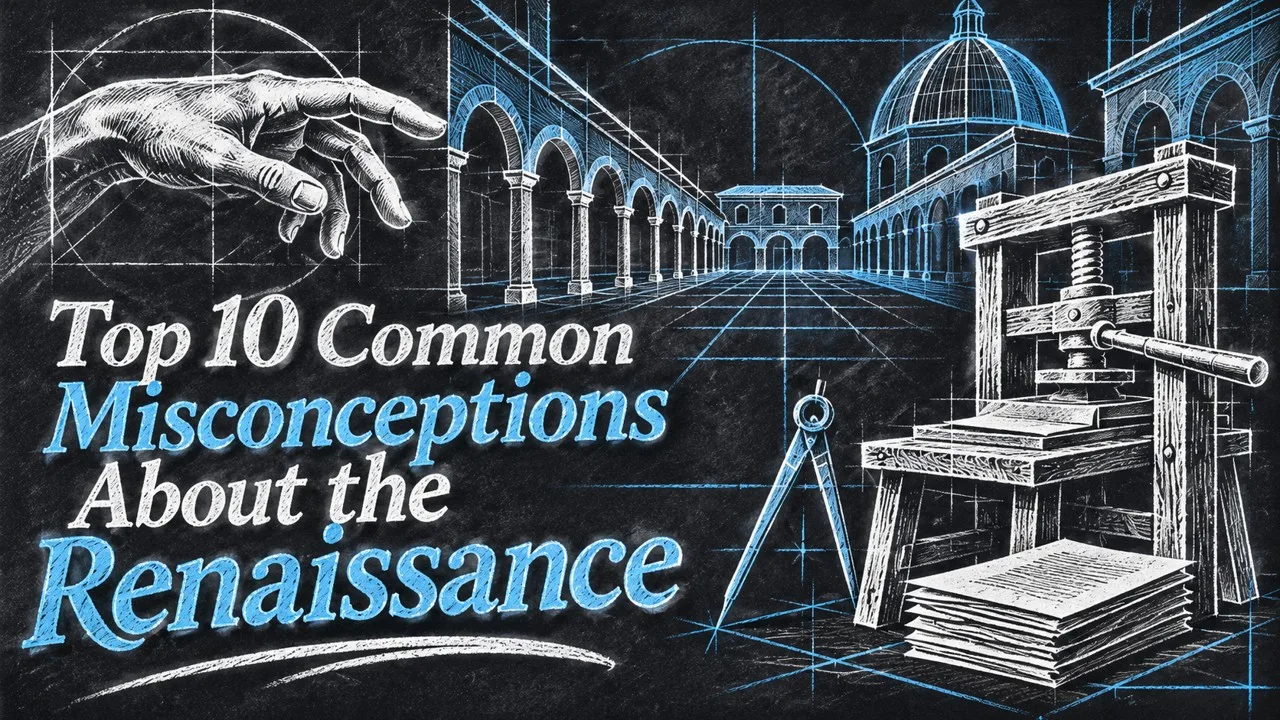
The Renaissance did not rescue Europe from a dark age, its statues copied a mistake and Michelangelo did not paint lying down. Ten common myths corrected. The Renaissance is often imagined as a sudden burst of light after a thousand years of darkness, when geniuses rediscovered ancient learning and invented the modern world. That picture is memorable, but much of it is misleading.
Historians today see the period, roughly from the fourteenth to the seventeenth century, as a time of real cultural change rooted in earlier developments. Medieval scholars, Byzantine libraries, Islamic science and northern European craftsmen all contributed to it.
Many popular beliefs about the Renaissance come from writers of later centuries who had their own reasons for celebrating it, or from films and novels that simplified its history.
The ten misconceptions below are among the most common. Each entry explains what historians have found and the evidence behind their views.
Key Facts
| # | Misconception | What historians say | Key evidence |
|---|---|---|---|
| 1 | The name was given later | Coined by later historians | Nineteenth-century books |
| 2 | Medieval culture was not dark | Earlier revivals existed | Universities, cathedrals and translations |
| 3 | Classical works were preserved | Monks, Byzantines and Islamic scholars | Manuscripts copied for centuries |
| 4 | A wider European movement | The Northern Renaissance | Flemish painting and northern humanists |
| 5 | A misunderstanding of antiquity | Painted originals | Traces of pigment |
| 6 | Fame came much later | A theft made it a global icon | The 1911 theft |
| 7 | Magic and astrology flourished | Hermetic texts and court astrologers | Ficino and the Corpus Hermeticum |
| 8 | He painted standing up | Custom scaffolding | His own poem |
| 9 | Most designs stayed on paper | Notebooks largely unpublished | Thousands of manuscript pages |
| 10 | Movable type existed earlier | China and Korea | Bi Sheng and the Jikji |
1. People Called It the Renaissance
People living in fifteenth-century Florence did not say that they lived in the Renaissance. Some writers did describe a revival of arts and learning; the artist and biographer Giorgio Vasari wrote of a rinascita, or rebirth, of art in 1550 [1].
But the term Renaissance as the name of a historical period became popular in the nineteenth century. The French historian Jules Michelet used it in 1855, and the Swiss historian Jacob Burckhardt's influential book The Civilization of the Renaissance in Italy, published in 1860, fixed the idea in the public mind [1].
Burckhardt's view of the period as the birth of modern individualism shaped how generations of readers saw it, though many historians have since questioned it. Some scholars now prefer the term early modern period for the centuries after about 1500, partly to avoid the assumption that everything before the Renaissance was backward.
2. It Ended the Dark Ages
The idea of a dark age before the Renaissance goes back to the Italian poet Petrarch in the fourteenth century, who saw the centuries after the fall of Rome as a time of decline [2].
Historians now reject the label for the Middle Ages as a whole. The court of Charlemagne promoted learning around 800, in what is called the Carolingian Renaissance, and introduced a clear handwriting style that influenced modern lowercase letters [2].
The twelfth century saw another revival, with the founding of universities such as Bologna, Paris and Oxford, the building of Gothic cathedrals and the translation of Greek and Arabic works into Latin. Medieval engineers developed mechanical clocks, eyeglasses and improved windmills, and medieval thinkers debated logic, natural philosophy and law in ways that laid foundations for later science.
Related: History of Human Civilization: From Ancient Times to the Modern Age
3. Ancient Texts Were Lost Until Then
It is often said that Renaissance scholars rediscovered ancient learning that had been lost. In fact, many classical texts survived because they were copied by medieval monks or preserved in Byzantine and Islamic libraries [3].
When the scholar Poggio Bracciolini found a copy of the Roman poet Lucretius's On the Nature of Things in 1417, it was in a German monastery, where monks had preserved it [3].
Greek works were taught in Italy partly by Byzantine scholars, such as Manuel Chrysoloras, who began teaching Greek in Florence in 1397. Arabic translations and commentaries, especially of Aristotle, had already influenced European thought for centuries. After the fall of Constantinople in 1453, more Greek scholars and manuscripts arrived in Italy, but the movement of Greek learning westward had begun decades earlier. Bracciolini's find of Lucretius later influenced debates about atoms and the nature of the universe.
4. It Happened Only in Italy
The Renaissance is often associated with Florence and Rome, but similar developments took place across Europe. Historians speak of a Northern Renaissance in the Low Countries, Germany, France and England [4].
Flemish painters such as Jan van Eyck were masters of oil painting, admired by Italian artists. The German artist Albrecht Durer traveled to Italy and combined Italian ideas with northern traditions, while the Dutch scholar Erasmus became one of the most influential humanist thinkers [4].
Ideas and artworks moved in both directions, carried by merchants, scholars and printed books. Northern humanists often focused on religious texts, and their work fed into the debates of the Protestant Reformation. Erasmus published a new Greek edition of the New Testament in 1516, which became an important source for later translations.
5. Ancient Statues Were Pure White
Renaissance artists admired ancient Greek and Roman sculptures, which by their time had mostly lost their paint. As a result, they believed that classical statues had been pure white marble, and much Renaissance sculpture followed that ideal [5].
Research has shown that ancient statues were often brightly painted, with colored skin, clothing and eyes. Scientists have detected traces of pigments on many surviving works [5].
Related: Top 10 Most Bizarre Phobias: Strange Fears That Exist
The belief in white classical sculpture was reinforced in the eighteenth century by scholars such as Johann Joachim Winckelmann. Modern reconstructions showing statues in their original colors often surprise visitors. Traveling exhibitions such as Gods in Color, organized by the archaeologists Vinzenz Brinkmann and Ulrike Koch-Brinkmann, have presented painted replicas of ancient works based on scientific analysis of pigment traces.
6. The Mona Lisa Was Always Famous
Leonardo da Vinci's Mona Lisa, painted in the early sixteenth century, was admired by artists and kept in the French royal collection. But for centuries it was not the world's most famous painting [6].
Its reputation grew in the nineteenth century, but its global fame came after it was stolen from the Louvre in 1911 by Vincenzo Peruggia, an Italian worker. The theft made headlines around the world, and crowds came to see the empty space on the wall [6].
The painting was recovered in Florence in 1913. By then, it had become a worldwide celebrity, a status it has kept ever since. Peruggia had worked at the Louvre and hid in the museum before walking out with the painting under his clothes. He claimed he wanted to return it to Italy, and he served only a short prison sentence. During the investigation, police questioned the poet Guillaume Apollinaire, and the young Pablo Picasso was also brought in for questioning, though neither had any role in the theft.
7. Reason Replaced Magic
The Renaissance is sometimes seen as a time when reason replaced superstition. In reality, interest in magic, astrology and alchemy grew during the period [7].
The Florentine scholar Marsilio Ficino translated a collection of mystical texts attributed to Hermes Trismegistus, the Corpus Hermeticum, at the request of Cosimo de' Medici. He prioritized it over finishing his translation of Plato [7].
Rulers and even popes consulted astrologers. The witch hunts in Europe reached their peak in the late sixteenth and early seventeenth centuries, after many of the period's famous artistic achievements. Even scientists of the period mixed what would now be called science and mysticism. The astronomer Johannes Kepler cast horoscopes, and Isaac Newton later spent years studying alchemy.
Related: Top 10 Oldest Buildings in the World
8. Michelangelo Painted Lying on His Back
A popular image shows Michelangelo lying on his back on a scaffold to paint the ceiling of the Sistine Chapel between 1508 and 1512. In fact, he designed a scaffold that let him stand while reaching up to paint [8].
Painting in this position was physically exhausting. Michelangelo wrote a humorous poem complaining that his beard pointed toward heaven, his neck was bent back and paint dripped onto his face [8].
The image of him lying down was popularized by the 1965 film The Agony and the Ecstasy, starring Charlton Heston as the artist. Michelangelo considered himself mainly a sculptor and was reluctant to accept the commission from Pope Julius II. The ceiling contains more than three hundred figures, including the famous Creation of Adam.
9. Leonardo Built Working Machines
Leonardo da Vinci filled notebooks with designs for flying machines, armored vehicles and other devices. He is often credited with inventing the helicopter and tank [9].
Most of these designs were never built, and many would not have worked as drawn. His notebooks were largely unknown to the public for centuries, so they had little influence on later engineers [9].
Leonardo's notebooks are nonetheless remarkable for their observations of anatomy, water and nature. One notebook, the Codex Leicester, was bought by Bill Gates in 1994 for about 30.8 million dollars. Around seven thousand pages of Leonardo's notes survive, written in mirror writing from right to left. In 2000, the British skydiver Adrian Nicholas made a safe descent using a parachute built to one of Leonardo's designs, with materials available in his time.
10. Printing Was First Invented Then
Johannes Gutenberg's printing press, developed in Mainz around 1440, transformed European culture. But movable type had been invented much earlier in East Asia [10].
Related: 10 Sikh Gurus: The Pillars of Sikhism Who Shaped Faith, Equality, Courage, and Humanity
The Chinese inventor Bi Sheng created movable type made of baked clay around 1040, and Korean printers used metal movable type in the following centuries. The Jikji, a Buddhist text printed in Korea in 1377, is the oldest surviving book printed with metal movable type [10].
Gutenberg's contribution was a complete system, including a press, oil-based ink and a method for casting type, which made printing faster and cheaper for alphabetic scripts. East Asian scripts with thousands of characters made movable type less practical than woodblock printing, which remained dominant in China for centuries. In Europe, by contrast, printing spread so fast that millions of books had been printed by 1500.
Conclusion
The Renaissance was a remarkable period in European history, but it was not a sudden break from the past. It built on medieval learning, Byzantine and Islamic scholarship and developments across Europe.
Many popular ideas about it, from dark ages to white statues, come from later writers or modern popular culture.
Understanding the Renaissance more accurately does not diminish its achievements. Instead, it shows how ideas develop through exchange and continuity.
The period's art and thought remain influential, but they are best appreciated in their full historical context.
- ^ [1] Accounts of the term Renaissance. Wikipedia: Renaissance Wikipedia: Jacob Burckhardt
- ^ [2] Accounts of the Dark Ages. Wikipedia: Dark Ages Wikipedia: Renaissance of the 12th century
- ^ [3] Accounts of classical texts. Wikipedia: Transmission of the Greek Classics Wikipedia: Poggio Bracciolini
- ^ [4] Accounts of the Northern Renaissance. Wikipedia: Northern Renaissance Wikipedia: Jan van Eyck
- ^ [5] Accounts of painted statues. Wikipedia: Polychrome sculpture Wikipedia: Johann Joachim Winckelmann
- ^ [6] Accounts of the Mona Lisa. Wikipedia: Mona Lisa Wikipedia: Vincenzo Peruggia
- ^ [7] Accounts of Renaissance magic. Wikipedia: Marsilio Ficino Wikipedia: Corpus Hermeticum
- ^ [8] Accounts of the Sistine ceiling. Wikipedia: Sistine Chapel ceiling Wikipedia: The Agony and the Ecstasy
- ^ [9] Accounts of Leonardo's inventions. Wikipedia: Science and inventions of Leonardo da Vinci Wikipedia: Codex Leicester
- ^ [10] Accounts of movable type. Wikipedia: Movable type Wikipedia: Jikji























Discussion
Log in with