


Top 10 Legendary Characters Inspired by Real People
 By Dhiraj Sharma · Published
Share Post
Loading…
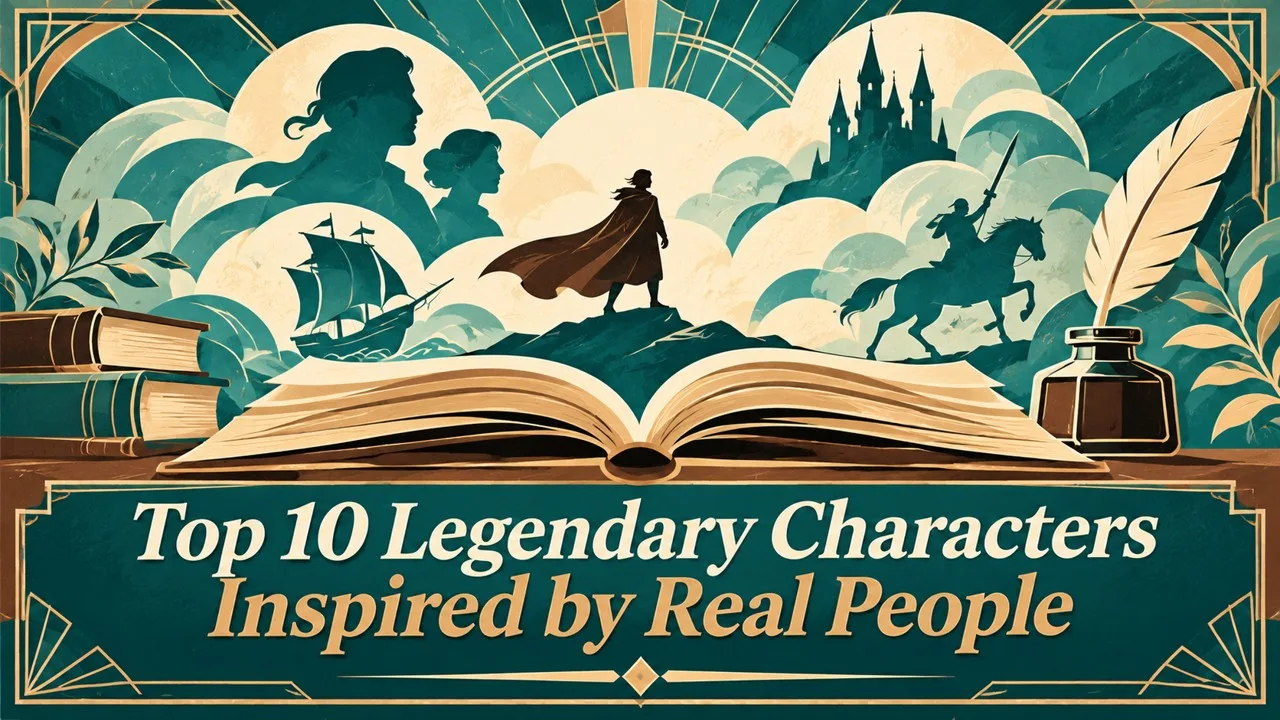
Famous fictional characters often had real models, from the Edinburgh doctor behind Sherlock Holmes to the marooned sailor who inspired Robinson Crusoe. Some fictional characters feel so alive that it is easy to forget they were invented. Sherlock Holmes receives letters addressed to Baker Street, children write to Santa Claus, and visitors travel to islands and towns linked to famous stories. Part of the reason these characters feel real is that many of them were built from real people.
Writers have always borrowed from life. A teacher's habits, a friend's personality, a sailor's ordeal or a child's name can become the seed of a character that outlives everyone involved. Sometimes the author openly acknowledged the debt. In other cases, the link was made later by readers and historians, and it remains a matter of debate.
The ten characters below are Sherlock Holmes, Robinson Crusoe, Count Dracula, Peter Pan, Alice, Long John Silver, Uncle Sam, Santa Claus, Winnie-the-Pooh and Moby Dick. Their real-life models range from a Scottish surgeon and a stranded sailor to a Canadian bear and an albino whale.
Where the connection is well documented, such as in an author's own letters, that is noted. Where it rests on later claims or local tradition, the uncertainty is noted too, since many popular stories about literary inspiration have grown in the telling.
Knowing the real people behind these characters does not diminish the writers' achievements. If anything, it shows how imagination works, transforming ordinary details into figures that become part of a shared culture and live on far beyond their creators.
Key Facts
| # | Character | Real-life inspiration | Creator and date |
|---|---|---|---|
| 1 | Sherlock Holmes | Dr. Joseph Bell, Edinburgh surgeon | Arthur Conan Doyle, 1887 |
| 2 | Robinson Crusoe | Alexander Selkirk, Scottish sailor | Daniel Defoe, 1719 |
| 3 | Count Dracula | Vlad III of Wallachia, a fifteenth-century prince | Bram Stoker, 1897 |
| 4 | Peter Pan | The Llewelyn Davies boys | J. M. Barrie, 1904 |
| 5 | Alice | Alice Liddell | Lewis Carroll, 1865 |
| 6 | Long John Silver | William Ernest Henley, poet and editor | Robert Louis Stevenson, 1883 |
| 7 | Uncle Sam | Samuel Wilson, a meat supplier from Troy, New York | Popular use from the War of 1812 |
| 8 | Santa Claus | Saint Nicholas of Myra, a fourth-century bishop | Developed over centuries |
| 9 | Winnie-the-Pooh | Winnipeg, a black bear at London Zoo, and Christopher Robin Milne | A. A. Milne, 1926 |
| 10 | Moby Dick | Mocha Dick, a white sperm whale | Herman Melville, 1851 |
1. The Doctor Who Read People
Arthur Conan Doyle studied medicine at the University of Edinburgh in the 1870s, where one of his teachers was the surgeon Joseph Bell. Bell was famous for his powers of observation. He could look at a patient and deduce their job, recent travels and habits from small details such as their hands, clothes and accent, often astonishing students [1].
Conan Doyle worked as Bell's clerk at the Royal Infirmary, watching his methods up close. When he created Sherlock Holmes in the novel A Study in Scarlet, published in 1887, he gave the detective the same ability to reason from tiny clues [1].
Conan Doyle openly acknowledged the debt. In a letter to Bell in 1892, he wrote that it was most certainly to him that he owed Sherlock Holmes. Bell himself took a modest view and suggested that Conan Doyle's own imagination deserved more credit.
2. The Sailor Who Lived Alone
Alexander Selkirk was a Scottish sailor serving on a privateering voyage in the Pacific. In 1704, after quarreling with his captain over the ship's seaworthiness, he asked to be left on an uninhabited island off the coast of Chile. He soon regretted it, but the ship had gone [2].
Selkirk survived alone for more than four years, hunting goats, eating wild plants and reading the Bible. In 1709, he was rescued by a British expedition led by Woodes Rogers. His story was published and widely discussed in Britain [2].
Related: Top 10 Famous Figures Who Turned Out to Be Legendary
Daniel Defoe's novel Robinson Crusoe, published in 1719, is often said to be inspired by Selkirk, though Defoe moved the setting to the Caribbean and greatly expanded the story, and he may have drawn on other castaway accounts too. In 1966, Chile renamed Selkirk's island Robinson Crusoe Island.
3. A Name From Romanian History
Bram Stoker's novel Dracula, published in 1897, introduced one of the most famous characters in fiction. The name came from Vlad III, a prince of Wallachia in the fifteenth century, who was known as Dracula, meaning son of the dragon, because his father belonged to a knightly order called the Order of the Dragon [3].
Vlad III is remembered for his harsh rule and for impaling enemies, which earned him the nickname Vlad the Impaler. Stoker's working notes show that he came across the name in a book about Wallachia and Moldavia, and that he liked it because the book said it meant devil [3].
How much more Stoker borrowed from Vlad's life is debated. Some scholars argue that he took little beyond the name and a few historical references. In Romania, Vlad is often remembered as a defender against Ottoman invasion rather than a monster.
4. The Boys in Kensington Gardens
In 1897, the Scottish writer J. M. Barrie met the young sons of Arthur and Sylvia Llewelyn Davies while walking his dog in Kensington Gardens in London. He became close to the family and entertained the boys with stories about pirates, fairies and a boy who never grew up [4].
The character of Peter Pan first appeared in a novel in 1902, and the famous play Peter Pan premiered in London in 1904. Peter was named after one of the boys, Peter Llewelyn Davies. Barrie later wrote that he had made Peter by rubbing the five boys together, as savages do with sticks to produce a flame [4].
After both parents died, Barrie became the boys' guardian. Their later lives included tragedy, and Peter Llewelyn Davies reportedly disliked being associated with the famous character for the rest of his life.
5. The Girl on a Boat Trip
Alice Liddell was one of the daughters of Henry Liddell, dean of Christ Church at Oxford. Charles Dodgson, a mathematics lecturer at the college who wrote under the name Lewis Carroll, befriended the family and often took the children on outings [5].
Related: Top 10 Most Bizarre Phobias: Strange Fears That Exist
On July 4, 1862, during a boat trip on the River Thames with Alice and her sisters, Dodgson told a story about a girl named Alice who fell down a rabbit hole. Alice asked him to write it down. He gave her a handwritten version, Alice's Adventures Under Ground, and later expanded it into Alice's Adventures in Wonderland, published in 1865 [5].
The illustrations by John Tenniel did not portray the real Alice, who had dark, short hair. In 1928, Alice sold the original manuscript at auction, and it is now held by the British Library.
6. A Poet With One Leg
Robert Louis Stevenson's novel Treasure Island, published as a book in 1883, features the one-legged pirate Long John Silver, one of the most memorable villains in fiction. He is charming, clever and dangerous all at once [6].
Stevenson's friend William Ernest Henley, a poet and editor, had lost part of his leg as a young man because of tuberculosis of the bone. Henley was a powerful, energetic personality, known for his loud laugh and strong opinions. He also wrote the poem Invictus while in hospital [6].
In a letter to Henley, Stevenson admitted that the sight of Henley's maimed strength and masterfulness had inspired John Silver. Henley was not a villain, of course; Stevenson took his vitality and presence and gave them to a pirate.
7. A Meat Packer in Troy
Uncle Sam, the bearded figure in a star-spangled top hat, is a national personification of the United States. His origin is usually traced to Samuel Wilson, a meat packer in Troy, New York, who supplied barrels of beef to the United States Army during the War of 1812 [7].
According to the story, the barrels were stamped with the letters U.S. When someone asked what the letters meant, a worker reportedly joked that they stood for Uncle Sam Wilson. The joke spread among soldiers, and Uncle Sam became a nickname for the federal government [7].
Related: Top 10 Oldest Buildings in the World
The story is supported by local tradition, though historians note that the evidence is limited. In 1961, the United States Congress passed a resolution recognizing Samuel Wilson of Troy as the progenitor of America's national symbol.
8. A Generous Bishop
Saint Nicholas was a Christian bishop of Myra, in what is now Turkey, in the fourth century. Few facts about his life are certain, but many legends describe his generosity, including a story that he secretly gave gold to three poor sisters so they could marry [8].
He became one of the most popular saints in Europe, the patron of children and sailors. In the Netherlands, he was celebrated as Sinterklaas, who brought gifts to children. Dutch settlers carried the tradition to New York, where it blended with other customs [8].
In the nineteenth century, American writers and artists shaped the modern Santa Claus. A poem published in 1823 described his sleigh and reindeer, and the cartoonist Thomas Nast helped fix his image as a jolly, bearded figure who lived at the North Pole.
9. A Bear From Canada
In 1914, Harry Colebourn, a Canadian army veterinarian, bought a young black bear cub at a railway station in Ontario. He named her Winnipeg after his hometown, and she became the mascot of his unit. When the unit went to France, he left her at the London Zoo, where she became a popular attraction [9].
Among her young visitors was Christopher Robin Milne, the son of the writer A. A. Milne. Christopher named his own teddy bear Winnie after her. His other toys, including a donkey and a piglet, also became characters [9].
Milne's book Winnie-the-Pooh, published in 1926, featured Christopher Robin and his toys in a forest based on Ashdown Forest in Sussex. Christopher Robin Milne later wrote about the mixed feelings of growing up as a famous fictional character.
Related: The Evolution of Stranger Things: Seasons, Themes, and Characters
10. An Albino Whale
Mocha Dick was a sperm whale said to live in the Pacific near Mocha Island, off the coast of Chile, in the early nineteenth century. He was described as unusually pale, almost white, and was reported to have survived many encounters with whalers [10].
In 1839, the explorer and writer Jeremiah Reynolds published an account of Mocha Dick in The Knickerbocker magazine. Herman Melville, who had worked on whaling ships, is believed to have known the story. He also drew heavily on the sinking of the whaleship Essex by a sperm whale in 1820 [10].
Melville's Moby-Dick, published in 1851, turned these real events into a vast novel about obsession and nature. It sold poorly at first but is now considered one of the greatest American novels.
Conclusion
These characters show how fiction draws from real life. A teacher, a castaway, a child or a bear can provide the spark for a story that becomes part of world culture, long after the real person is forgotten.
They also show how stories about inspiration can grow over time. Some links are clearly documented in letters and notes, while others rest on tradition and later claims. Separating fact from legend is part of the fun of literary history.
Next time you meet a memorable character in a book, it may be worth asking who the author knew, met or read about. Behind many great inventions of fiction, there is a real person waiting to be discovered.
- ^ [1] Accounts of Joseph Bell and Sherlock Holmes. Wikipedia: Joseph Bell Wikipedia: Sherlock Holmes
- ^ [2] Accounts of Alexander Selkirk. Wikipedia: Alexander Selkirk Wikipedia: Robinson Crusoe Island
- ^ [3] Accounts of Vlad III and Dracula. Wikipedia: Vlad the Impaler Wikipedia: Count Dracula
- ^ [4] Accounts of the Llewelyn Davies boys and Peter Pan. Wikipedia: Llewelyn Davies boys Wikipedia: Peter Pan
- ^ [5] Accounts of Alice Liddell. Wikipedia: Alice Liddell Wikipedia: Alice's Adventures in Wonderland
- ^ [6] Accounts of William Ernest Henley and Long John Silver. Wikipedia: William Ernest Henley Wikipedia: Long John Silver
- ^ [7] Accounts of Uncle Sam and Samuel Wilson. Wikipedia: Uncle Sam Wikipedia: Samuel Wilson
- ^ [8] Accounts of Saint Nicholas and Santa Claus. Wikipedia: Saint Nicholas Wikipedia: Santa Claus
- ^ [9] Accounts of Winnipeg the bear and Winnie-the-Pooh. Wikipedia: Winnipeg (bear) Wikipedia: Christopher Robin Milne
- ^ [10] Accounts of Mocha Dick and the Essex. Wikipedia: Mocha Dick Wikipedia: Essex (ship)




















Discussion
Log in with