




 By
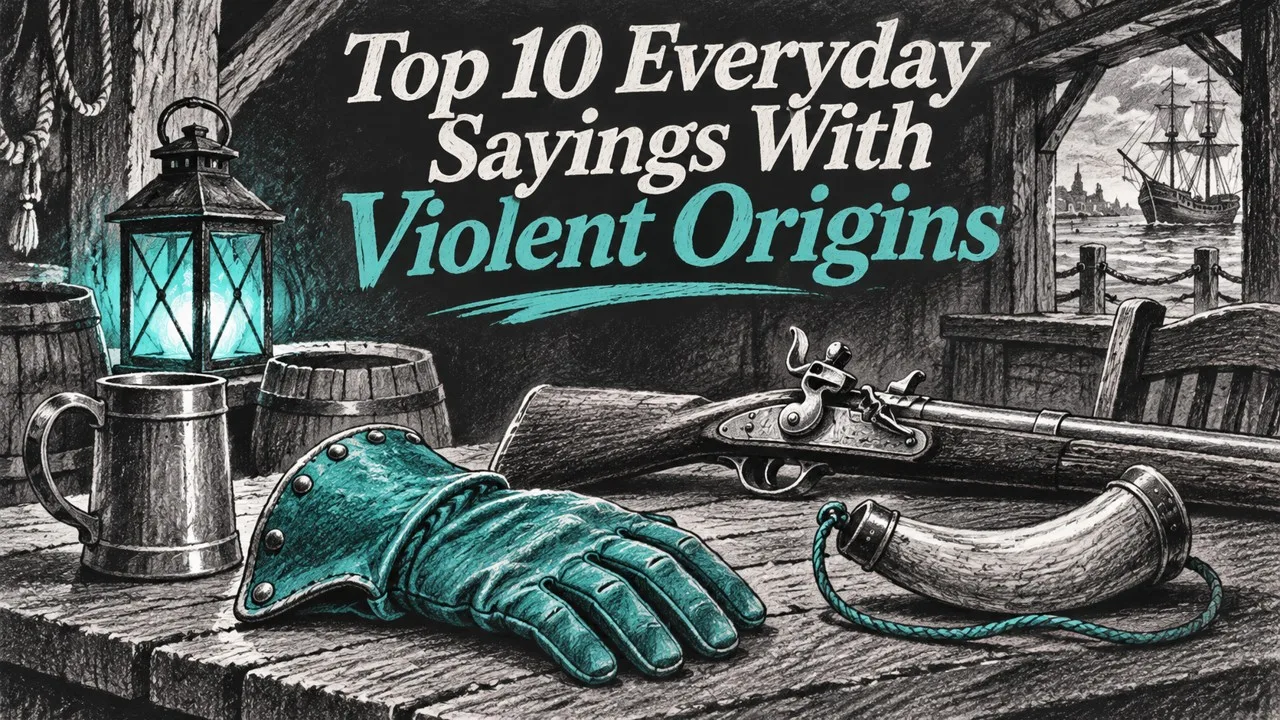
Caught red-handed, bury the hatchet, run amok and read the riot act all began with blood, weapons or punishment. Ten sayings and their violent pasts. Many everyday expressions sound harmless today. People say a friend went berserk at a sale or that a boss read them the riot act over a late report. But some of these phrases began in battles, executions, punishments and laws designed to control crowds.
Language often keeps vivid images long after the original practices have disappeared. Over time, words that once described bloodshed have become mild metaphors for anger, conflict or trouble.
Word historians, who study the origins of phrases, rely on early printed sources to trace their development. In some cases, the origin is well documented. In others, competing theories exist, and some popular stories have been shown to be false.
The ten sayings below have origins that historians generally link to violence. Where an origin is uncertain, the entry explains the main theories.
Key Facts
| # | Saying | Original setting | Earliest known use |
|---|---|---|---|
| 1 | Caught red-handed | Scottish law | Fifteenth century |
| 2 | Bury the hatchet | Indigenous peacemaking in North America | Seventeenth century |
| 3 | Give no quarter | Battlefield surrender | Seventeenth century |
| 4 | Run amok | Malay world | Sixteenth century |
| 5 | Go berserk | Norse warriors | Medieval sagas |
| 6 | Bite the dust | Ancient epic poetry | Eighteenth century in English |
| 7 | Whipping boy | Royal courts | Sixteenth and seventeenth centuries |
| 8 | Read the riot act | British law | 1714 |
| 9 | Run the gauntlet | Military punishment | Seventeenth century |
| 10 | Kick the bucket | Uncertain, possibly slaughterhouses | Eighteenth century |
1. Caught Red-Handed
To catch someone red-handed means to discover them in the act of doing something wrong. The phrase comes from Scottish legal language, in which a person caught with blood still on their hands, for example after a killing or poaching, was said to have been taken with red hand [1].
The expression appears in Scottish legal records from the fifteenth century. Being caught in this way meant there was little doubt about guilt [1].
The form red-handed became widespread after the novelist Walter Scott used it in his novel Ivanhoe, published in 1819. Today it is used for any wrongdoing, from stealing cookies to fraud. The heraldic red hand, a symbol of the Irish province of Ulster, is unrelated, though legends about it also involve blood. In older English, the phrase with the mainour, meaning with stolen goods in hand, served a similar purpose in legal cases.
2. Bury the Hatchet
To bury the hatchet means to make peace and set aside a quarrel. The phrase comes from the practices of Indigenous peoples in northeastern North America, who sometimes buried weapons to mark the end of a conflict [2].
The tradition of the Haudenosaunee, or Iroquois, Confederacy tells of the burying of weapons under a great tree of peace when the confederacy was formed. English colonists recorded references to burying hatchets in peace negotiations from the late seventeenth century [2].
In 1761, a ceremony in Nova Scotia marked a peace between the Mi'kmaq and the British, with participants burying hatchets. The phrase entered English as a metaphor for reconciliation in any context. The opposite idea also existed: taking up the hatchet meant going to war. The phrase appears in the writings of colonial officials and later in American literature, including works by James Fenimore Cooper.
Related: Top 10 Everyday Words That Began as Names of People and Places
3. Give No Quarter
To give no quarter means to show no mercy. In warfare, granting quarter meant sparing the life of a defeated enemy who surrendered. Refusing quarter meant killing them even when they tried to give up [3].
Armies sometimes declared in advance that no quarter would be given, for example by flying a red flag, to intimidate opponents. Such declarations were often linked to sieges and particularly bitter conflicts [3].
Today, the Hague Convention of 1907 forbids declaring that no quarter will be given, and killing enemies who have surrendered is a war crime. The phrase survives in sports and business to describe ruthless competition. The origin of the word quarter in this sense is uncertain. One suggestion is that it referred to quarters, or lodgings, given to prisoners, while another links it to the idea of mercy or good relations between opponents. Pirates in the eighteenth century were also said to fly red flags to warn that no quarter would be given.
4. Run Amok
To run amok means to behave in a wild and uncontrolled way. The word comes from the Malay word amuk, which describes a sudden, frenzied attack, often by a lone individual [4].
European travelers to Southeast Asia in the sixteenth century, including the Portuguese, wrote about men who suddenly attacked people around them with weapons. Captain James Cook also described the phenomenon in the eighteenth century [4].
Psychiatrists later considered amok to be a culture-bound syndrome, a pattern of behavior linked to particular societies. In everyday English, the phrase now describes anything from rampaging children to malfunctioning computers. Colonial authorities in some regions of Southeast Asia took harsh measures against people who ran amok, and the warriors of some Malay rulers were said to use amuk as a tactic in battle. The spelling amuck is also found in older English texts.
5. Go Berserk
To go berserk means to become wildly angry or out of control. The word comes from the berserkers, Norse warriors described in medieval sagas and poems as fighting in a trancelike fury [5].
The name is generally thought to mean bear shirt, possibly referring to warriors who wore bearskins or took on the spirit of bears. Some sagas describe berserkers biting their shields and feeling no pain in battle [5].
Related: Top 10 Everyday English Words With Surprising Histories
Historians debate how much of this description is literal. The word became popular in English in the nineteenth century, partly through the novels of Walter Scott, and was later used for any uncontrolled rage. A Christian law code in medieval Iceland included penalties for going berserk, suggesting that the behavior was considered a real danger. Some researchers have proposed that the fury was linked to intoxicating substances, but there is no firm evidence for any particular explanation.
6. Bite the Dust
To bite the dust means to die or fail. The image goes back to ancient epic poetry, especially Homer's Iliad, in which warriors falling in battle are described as biting the earth [6].
Biblical passages speak of enemies licking the dust, a similar image of defeat. The exact English wording bite the dust appears in the eighteenth century, including in a translation by the Scottish novelist Tobias Smollett [6].
In the twentieth century, the phrase became popular in Western films, where outlaws and soldiers bit the dust in gunfights. The band Queen gave it a further boost with its 1980 hit Another One Bites the Dust. The song, written by the band's bassist John Deacon, reached number one in the United States and became one of the band's best-selling singles. The phrase's link to ancient poetry remains largely unknown to most people who use it.
7. Whipping Boy
A whipping boy is someone who takes the blame for others. According to tradition, boys were educated alongside young princes in some European courts and were punished in place of the royal child when the prince misbehaved, since a tutor could not strike a future king [7].
Barnaby Fitzpatrick, a companion of the young King Edward VI of England, is often described as his whipping boy, as is William Murray, a companion of the future Charles I. Historians debate how often such punishments actually took place [7].
The idea appears in Mark Twain's novel The Prince and the Pauper. Today, whipping boy refers to a person or group blamed for problems they did not cause. A children's novel titled The Whipping Boy, by Sid Fleischman, won the Newbery Medal in 1987. Historians note that the earliest accounts of whipping boys were written some time after the events, which makes them hard to confirm.
Related: Top 10 Everyday Phrases with Military Origins
8. Read the Riot Act
To read someone the riot act means to scold them severely. The phrase refers to a British law, the Riot Act, passed in 1714. It allowed local authorities to order groups of twelve or more people to disperse [8].
A magistrate had to read out a proclamation from the act. If the crowd did not leave within an hour, those who remained could face severe punishment, and force could be used against them. The act was read during the Peterloo Massacre in Manchester in 1819, when cavalry charged a crowd, killing at least fifteen people [8].
The Riot Act was repealed in England and Wales in 1973. The phrase now describes a stern warning rather than a legal order. The act also made it a serious crime to damage churches, houses and other buildings during a riot. Similar laws were adopted in other parts of the British Empire and in some American states.
9. Run the Gauntlet
To run the gauntlet means to face a series of attacks or criticisms. The phrase comes from a military punishment in which an offender was forced to run between two lines of soldiers who struck him with sticks, whips or other weapons [9].
The word comes from the Swedish gatlopp, meaning a passage run, and the punishment was used in European armies during the Thirty Years' War in the seventeenth century. The English word was originally gantlope [9].
Over time, gantlope was confused with gauntlet, the word for an armored glove, which produced the modern form. Similar ordeals were also recorded among some Indigenous peoples of North America for captives. The punishment was used in the British and other navies, as well as armies, before being phased out in the nineteenth century. The phrase was used figuratively in English by the late seventeenth century.
10. Kick the Bucket
To kick the bucket is a casual way of saying to die. Its origin is uncertain, but the main theories are both grim [10].
Related: Top 10 Words That Used to Mean Something Else
One theory links it to an old meaning of bucket as a beam or yoke from which slaughtered animals were hung by their feet, where they might kick as they died. Another suggests it referred to a person a bucket kicked away from beneath someone during a hanging [10].
The phrase was recorded in 1785 in Francis Grose's Classical Dictionary of the Vulgar Tongue, a guide to slang. It later gave rise to the term bucket list, popularized by a 2007 film. Grose's dictionary, which recorded the slang of criminals, soldiers and ordinary Londoners, is still a valuable source for historians of the English language. Many common phrases have equally murky origins, and word historians caution against stories that seem too neat.
Conclusion
These sayings show how violence has left a mark on everyday language. Words born in battles, laws and punishments now describe ordinary disagreements and frustrations.
As the original practices have faded, the phrases have lost much of their force. Few people who say they will bury the hatchet are thinking of weapons in the ground.
Tracing their origins can reveal surprising connections between history and modern speech.
Language keeps changing, and the phrases people use today may carry origins that future generations will find just as surprising.
- ^ [1] Accounts of red-handed. Wikipedia: Red-handed Wikipedia: Ivanhoe
- ^ [2] Accounts of burying the hatchet. Wikipedia: Burying the hatchet Wikipedia: Iroquois Confederacy
- ^ [3] Accounts of quarter. Wikipedia: Hague Conventions Wikipedia: law of war
- ^ [4] Accounts of amok. Wikipedia: Running amok Wikipedia: culture-bound syndrome
- ^ [5] Accounts of berserkers. Wikipedia: Berserker Wikipedia: saga
- ^ [6] Accounts of biting the dust. Wikipedia: Iliad Wikipedia: Another One Bites the Dust
- ^ [7] Accounts of whipping boys. Wikipedia: Whipping boy Wikipedia: Barnaby Fitzpatrick
- ^ [8] Accounts of the Riot Act. Wikipedia: Riot Act Wikipedia: Peterloo Massacre
- ^ [9] Accounts of running the gauntlet. Wikipedia: Running the gauntlet Wikipedia: Thirty Years' War
- ^ [10] Accounts of kick the bucket. Wikipedia: Kick the bucket Wikipedia: bucket list




















Discussion
Log in with