





Top 10 Surprising Discoveries Made During Home Renovations
 By Dhiraj Sharma · Published
Share Post
Loading…
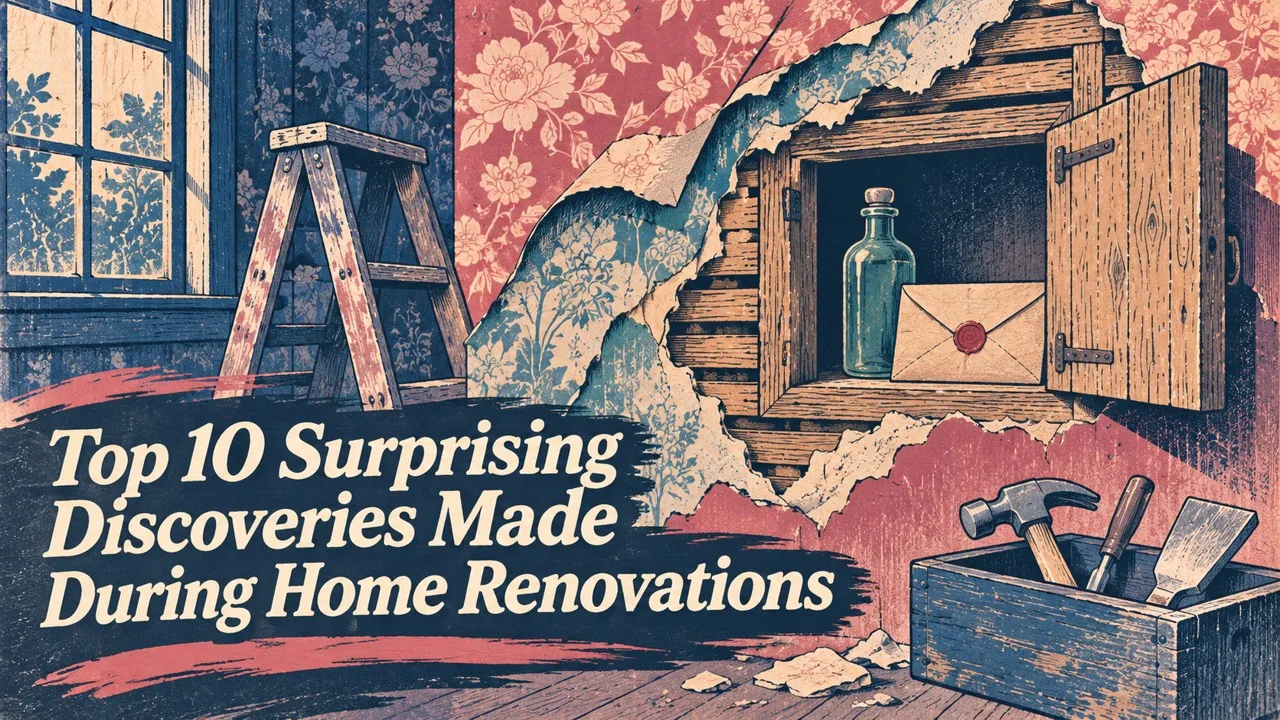
An underground city, a buried hoard of gold coins, a possible Caravaggio and a stash of human bones: ten real discoveries made while fixing up buildings. Most renovation projects turn up nothing more exciting than old wiring, layers of wallpaper or a forgotten coin under the floorboards. Occasionally, though, knocking through a wall or digging out a drain reveals something that changes the history of a building, a town or even a whole field of study.
Old buildings sit on top of earlier ones, and their owners have long hidden valuables, protective charms and unwanted things in walls, floors and roofs. Because these spaces are rarely disturbed, objects can survive there for centuries.
Some of the finds below were made by homeowners. Others were uncovered by workers repairing synagogues, offices and historic houses. In several cases, the people who made them had no idea at first of what they had found.
These ten discoveries range from ancient tunnels to Renaissance art and from household magic to the remains of an eighteenth-century anatomy school.
Key Facts
| # | Find | Where | Year found |
|---|---|---|---|
| 1 | Derinkuyu underground city | Cappadocia, Turkey | 1963 |
| 2 | Faggiano family home | Lecce, Italy | 2000 |
| 3 | Judith and Holofernes painting | Near Toulouse, France | 2014 |
| 4 | Concealed shoes | Britain and beyond | Many centuries |
| 5 | Witch bottles | England | Sixteenth and seventeenth centuries |
| 6 | Ellerby Hoard | North Yorkshire, England | 2019 |
| 7 | Cairo Geniza | Fustat, Egypt | 1890s |
| 8 | Heads of the Kings of Judah | Paris, France | 1977 |
| 9 | Benjamin Franklin House | London, England | 1998 |
| 10 | Dried cats | Europe | Many centuries |
1. A City Beneath the Basement
In 1963, a resident of Derinkuyu in central Turkey knocked through a wall in his home during renovations and found a passage behind it. The tunnel led into an enormous underground city carved out of soft volcanic rock [1].
The complex extends many levels below the surface and contains living areas, stables, wells, chapels and ventilation shafts. Heavy rolling stone doors could seal passages from the inside. Researchers estimate that it may have sheltered thousands of people along with their animals [1].
Its earliest phases may date back to the first millennium BC, and it was later expanded and used in the Byzantine era as a refuge during raids. Derinkuyu opened to visitors in 1969 and is part of a World Heritage Site. It is the deepest of the many underground settlements in the region, and a tunnel several kilometers long is believed to connect it with the nearby underground city of Kaymakli. Only part of the complex is open to visitors today.
2. History Under a Blocked Toilet
In 2000, Luciano Faggiano bought a building in the southern Italian city of Lecce, planning to open a restaurant. When he and his sons began digging to find a leaking sewage pipe, they kept uncovering older layers [2].
Over years of excavation, they found a Messapian tomb, a Roman-era chamber, traces of a medieval convent and many artifacts, including pottery, coins and lamps. The family reportedly worked on the site for years before archaeologists from the authorities became involved [2].
The building opened as a private museum, the Museo Faggiano, allowing visitors to walk down through more than two thousand years of the city's history. Lecce sits on a site that has been inhabited since ancient times. The city is famous for its Baroque churches and palaces, built from a soft local limestone, which have earned it the nickname of the Florence of the South.
Related: Top 10 Overlooked Ancient Mysteries
3. A Possible Caravaggio in the Attic
In 2014, homeowners near Toulouse in France went into their attic to investigate a leak in the roof. Behind a door, they found a large dusty painting showing Judith beheading the Assyrian general Holofernes [3].
Some experts concluded that it was a lost work by the Italian master Caravaggio, painted in the early seventeenth century. Others argued that it was by the Flemish painter Louis Finson, who copied Caravaggio and owned works by him. The debate has not been settled [3].
The French government temporarily barred the painting from leaving the country while it was studied. In 2019, shortly before a planned public auction, it was sold privately to an international buyer for an undisclosed sum. The painting had been valued by its promoters at between 100 and 150 million euros, which would have made it one of the most expensive old master paintings ever sold. The owners of the house said they had no idea how it came to be in the attic.
4. Shoes Hidden in the Walls
Builders and homeowners regularly find old shoes hidden inside walls, around chimneys, under floors and in roofs. The practice appears to have been especially common in Britain between the sixteenth and nineteenth centuries [4].
Most of the shoes are worn, and many belonged to children. Because they were deliberately placed near openings such as chimneys and doors, many historians think they were meant to protect the household from evil spirits or witches [4].
The Northampton Museum and Art Gallery in England, which has one of the world's largest shoe collections, keeps an index of concealed shoe finds. It has recorded around two thousand examples, mainly from Britain but also from other countries. The oldest recorded examples date from the medieval period, and reports of new finds continue to arrive as old houses are renovated. Shoes are thought to have been chosen because they hold the shape of the wearer.
5. A Bottle Against Witches
Witch bottles were countermagic devices used in England, especially in the sixteenth and seventeenth centuries. They were often buried under hearths or thresholds or hidden in walls during building work [5].
Many were stoneware jugs and contained items such as bent pins, nails, hair and human urine. The idea was that a witch's spell would be drawn into the bottle and trapped there or turned back on the witch [5].
Related: Top 10 Archaeological Sites Hidden in Deserts
In 2004, a sealed witch bottle was discovered during excavation work in Greenwich, London. Analysis showed that it still contained urine, bent nails and pins, hair, navel fluff and a small leather heart pierced by a nail. Researchers said that the urine suggested a living person had prepared the bottle, and that sulfur traces might indicate it was also meant to be heated. The jugs used for many witch bottles were stoneware vessels made in the Rhineland, decorated with the face of a bearded man.
6. Gold Under the Kitchen Floor
In 2019, a couple renovating the kitchen of their eighteenth-century home in the village of Ellerby in North Yorkshire lifted the floorboards and found a salt-glazed cup the size of a drinks can. Inside were more than 260 gold coins [6].
The coins dated from 1610 to 1727 and were linked by researchers to a wealthy family of merchants from Hull. Why the hoard was hidden and never recovered remains unclear, as there was no bank in the region at the time [6].
When the coins were auctioned in London in 2022, they sold for a total of more than 750,000 pounds, far above the original estimate. The coins spanned the reigns of monarchs from James I to George I, and the couple asked to remain anonymous.
7. A Storeroom of Sacred Texts
Jewish tradition forbids destroying writings that may contain the name of God, so worn texts were stored in a room called a geniza until they could be buried. The Ben Ezra Synagogue in old Cairo kept its geniza for centuries without clearing it [7].
When the synagogue was rebuilt and repaired in the late nineteenth century, scholars became aware of the huge cache of papers it held. In 1896 and 1897, the scholar Solomon Schechter took a large part of it to Cambridge [7].
The collection contains around 400,000 fragments, including letters, contracts, poetry and religious texts, mostly from the medieval period. It has transformed knowledge of Jewish life and Mediterranean trade in the Middle Ages. Most of the fragments are now held at Cambridge University Library, with others in libraries in Oxford, New York, Saint Petersburg and elsewhere. Scholars are still cataloguing and digitizing them.
Related: Top 10 Lost Cities That Were Rediscovered
8. The Lost Kings of Notre-Dame
During the French Revolution, crowds attacked the statues of the kings of Judah on the facade of Notre-Dame Cathedral, believing that they represented kings of France. In 1793, the statues were beheaded, and the heads disappeared [8].
In 1977, workers renovating a bank's building in Paris discovered 21 of the heads buried in the courtyard. They had apparently been collected and buried by a former owner of the house in the late eighteenth century [8].
The heads, which still carry traces of their original paint, are now displayed at the Musee de Cluny, the national museum of the Middle Ages in Paris. The owner who buried them is believed to have been a royalist who wanted to protect the statues from further damage. The statues now on the cathedral's facade are nineteenth-century replacements created during the restoration led by Eugene Viollet-le-Duc.
9. Bones in Benjamin Franklin's House
Benjamin Franklin lived at 36 Craven Street in London for many years between 1757 and 1775. In 1998, conservation work at the house uncovered a pit in the basement filled with human and animal bones [9].
Researchers found more than 1,200 pieces of bone, from at least ten people. Some showed signs of dissection, such as saw marks. The finds were linked to an anatomy school run at the house by William Hewson, who lived there and was married to the daughter of Franklin's landlady [9].
In that era, bodies for anatomical study were in short supply and were often obtained illegally. There is no evidence that Franklin took part in the dissections. Hewson was a respected surgeon who made important studies of the blood and lymphatic system. He died in 1774 after cutting himself while dissecting a corpse. The house is now a museum and educational center.
10. Cats Inside the Walls
Mummified cats have been found inside the walls, floors and roofs of old buildings in Britain, Ireland and other parts of Europe. Some animals were probably trapped by accident, but others appear to have been placed there deliberately [10].
Related: Top 10 'Ancient Alien' Artifacts with Ordinary Explanations
Many scholars think that, like concealed shoes, the cats were intended to protect buildings from evil or bad luck. Some may also have been meant to scare away rats and mice [10].
Because the cats dried out in enclosed spaces, they can be remarkably well preserved. Many have been returned to their hiding places by homeowners after discovery, while others are displayed in museums. Examples have been reported from churches, mills and houses as well as from public buildings. Some families believe it is unlucky to remove a cat once it has been found.
Conclusion
These discoveries show how much history can be hidden inside ordinary buildings. Walls and floors hold not only lost valuables but also evidence of beliefs, fears and daily routines that rarely appear in written records.
Some finds, like the Cairo Geniza and the heads of Notre-Dame, have reshaped scholarship. Others, like concealed shoes and witch bottles, have revealed the folk magic of ordinary people.
In many countries, finds of treasure or archaeological material must be reported to the authorities, and experts recommend doing so if something unusual turns up.
The next renovation may simply uncover old wiring, but it may also add a new chapter to history.
- ^ [1] Accounts of Derinkuyu. Wikipedia: Derinkuyu underground city Wikipedia: Cappadocia
- ^ [2] Accounts of Lecce. Wikipedia: Lecce Wikipedia: Messapians
- ^ [3] Accounts of the Toulouse painting. Wikipedia: Caravaggio Wikipedia: Louis Finson
- ^ [4] Accounts of concealed shoes. Wikipedia: Concealed shoes Wikipedia: apotropaic magic
- ^ [5] Accounts of witch bottles. Wikipedia: Witch bottle Wikipedia: Bellarmine jug
- ^ [6] Accounts of the Ellerby Hoard. Wikipedia: Ellerby Hoard Wikipedia: hoard
- ^ [7] Accounts of the Cairo Geniza. Wikipedia: Cairo Geniza Wikipedia: Solomon Schechter
- ^ [8] Accounts of the kings of Judah. Wikipedia: Musee de Cluny Wikipedia: Notre-Dame de Paris
- ^ [9] Accounts of Benjamin Franklin House. Wikipedia: Benjamin Franklin House Wikipedia: William Hewson
- ^ [10] Accounts of dried cats. Wikipedia: Dried cat Wikipedia: folk magic






















Discussion
Log in with