






 By
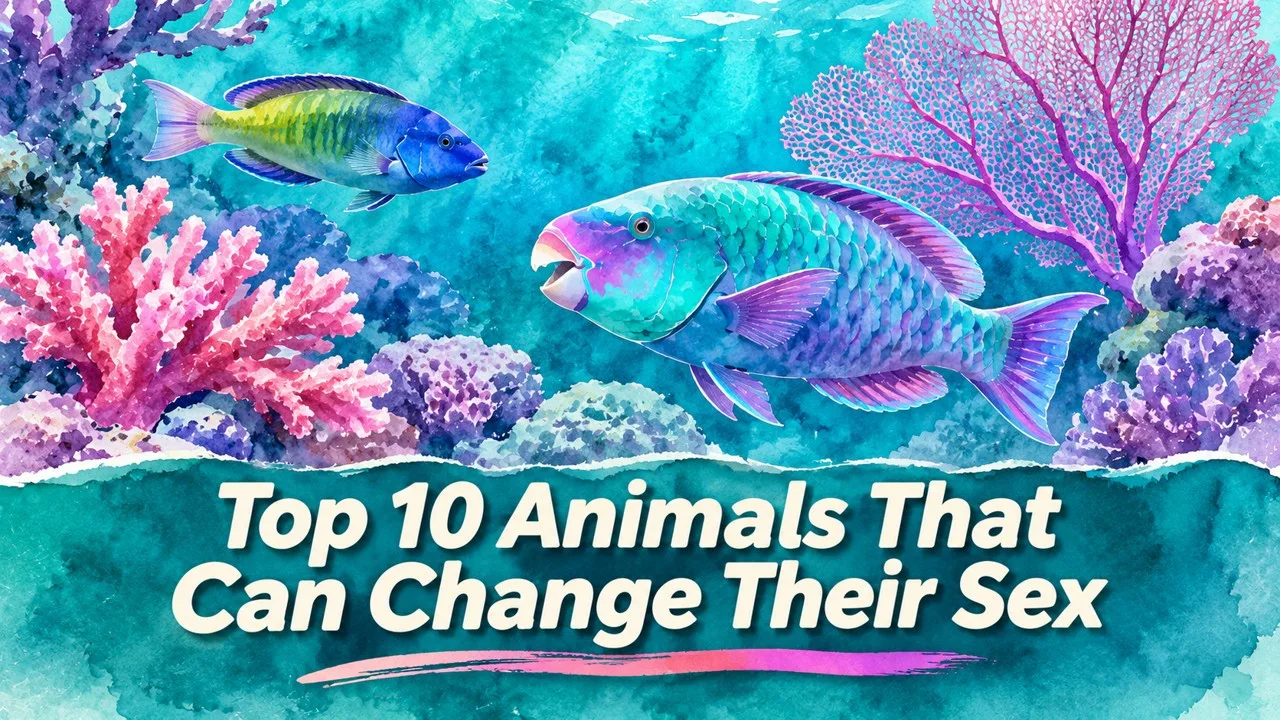
Clownfish, wrasses, parrotfish, oysters and even lizards can switch sex or override their genes. Ten animals that show how flexible sex can be in nature. In humans and most other mammals, sex is set early in development and does not change. But across the animal kingdom, especially among fish and mollusks, many species can change their sex during adulthood.
Biologists call this sequential hermaphroditism. In protandrous species, individuals begin as males and later become females. In protogynous species, they begin as females and later become males. A few species can change in either direction, sometimes more than once.
The trigger is often social. When the dominant male or female in a group dies or disappears, another individual changes to take its place. In other species, size, age or temperature plays the decisive role.
The ten animals below show the variety of ways that sex can change in nature and why such flexibility can help animals reproduce successfully.
Key Facts
| # | Animal | Direction of change | Trigger |
|---|---|---|---|
| 1 | Clownfish | Male to female | Death of the dominant female |
| 2 | Bluehead wrasse | Female to male | Loss of the dominant male |
| 3 | Asian sheepshead wrasse | Female to male | Age and size |
| 4 | Parrotfish | Female to male | Social structure |
| 5 | Cleaner wrasse | Female to male | Loss of the harem male |
| 6 | Coral gobies | Either direction | Finding a partner |
| 7 | Barramundi | Male to female | Age and size |
| 8 | Slipper limpet | Male to female | Position in the stack |
| 9 | Oysters | Both directions | Season, age and conditions |
| 10 | Bearded dragon | Genetic male to functional female | Egg incubation temperature |
1. The Real Story Behind Nemo
Clownfish live among the stinging tentacles of sea anemones in the Indian and Pacific Oceans. Each anemone typically hosts a small group with a strict size hierarchy. The largest fish is the breeding female, the second largest is the breeding male and the rest are smaller, nonbreeding males [1].
If the female dies, the breeding male changes into a female, and the largest of the nonbreeding males grows and becomes the new breeding male. All clownfish begin life as males [1].
Biologists have often pointed out that in real life, Marlin, the father in the film Finding Nemo, would likely have become female after Nemo's mother died. Clownfish are protected from their anemone's stings by a layer of mucus on their skin. There are around thirty species of clownfish, and they are among the few marine ornamental fish that are bred in captivity on a large scale. Each fish in an anemone group generally waits its turn, and smaller males may limit their own growth to avoid being expelled by those above them.
2. A Change Within Days
The bluehead wrasse is a small reef fish found in the Caribbean and western Atlantic. Most begin life as yellow females. Large dominant males have a striking blue head, black and white bands and a green body [2].
When a dominant male is removed from a reef, the largest female often begins acting like a male within minutes or hours. Within about a week or two, her ovaries transform into testes, and she can produce sperm. Her colors change as well [2].
The species has become a model for studying how social cues trigger changes in the brain and body. Research has shown that the transformation involves widespread changes in gene activity, including the shutting down of genes needed for female reproduction. Smaller males in the initial phase have the same yellow coloring as females and sometimes sneak into spawning events. Bluehead wrasses are also notable as cleaners when young, picking parasites off larger fish.
Related: Top 10 Longest-Living Animals on Earth
3. A Fish That Changes Its Face
The Asian sheepshead wrasse lives in rocky reefs off Japan, Korea and China. Females are relatively slender, but when they change into males, they develop a large bulging forehead and a protruding chin [3].
The transformation can take place over a period of months and gives males a dramatically different appearance. Males defend territories and mate with females in their area [3].
The species attracted worldwide attention when its transformation was featured in the BBC series Blue Planet II in 2017. Scientists think the change may be influenced by age, size and social conditions. The fish can grow to around a meter in length and is thought to live for more than twenty years. Its distinctive head lump, which is made of soft tissue rather than bone, is thought to help males display dominance.
4. Colorful Males That Began as Females
Many species of parrotfish, found on coral reefs worldwide, can change from female to male. In these species, the most brightly colored fish are usually terminal-phase males that were once females [4].
Parrotfish have beaklike teeth that they use to scrape algae from coral and rocks. They swallow fragments of coral, grind them up and excrete them as fine sand, contributing significantly to the white sand beaches of some tropical islands [4].
Some parrotfish surround themselves with a cocoon of mucus at night, which may help protect them from parasites and predators. Their color patterns change so much that scientists once classified different phases of the same species as separate species. Studies of parrotfish sex change have shown that in some species, a small proportion of individuals are born male and never change, while others become males only after starting life as females. Scientists recognize around ninety-five species of parrotfish.
5. Harems and Swift Takeovers
Cleaner wrasses run cleaning stations on coral reefs, where larger fish visit to have parasites removed. A typical group consists of one male and a harem of several females [5].
If the male dies or is removed, the largest female usually takes over his role. She starts behaving like a male within hours, and her body becomes able to produce sperm within a few weeks [5].
Related: Top 10 Most Dangerous Sea Creatures
Cleaner wrasses have also attracted attention for their intelligence. In some experiments, they appeared to pass a version of the mirror test, which is used to study self-recognition in animals, although the interpretation is debated. Some smaller fish, known as false cleaner fish, mimic the appearance of cleaner wrasses so they can approach larger fish and bite off pieces of their fins. The cleaner wrasse is one of the most studied reef fish in behavioral research.
6. Switching Back and Forth
Coral gobies of the genus Gobiodon are small fish that live among branches of corals in the Indian and Pacific Oceans. They tend to live in pairs, rarely leaving the safety of their host coral [6].
Because moving between corals is dangerous, finding a partner of the opposite sex can be difficult. Researchers have found that when two gobies of the same sex pair up, one of them can change sex, and the change can go in either direction [6].
This ability to switch both ways allows the fish to reproduce with whatever partner they find. Scientists consider it an adaptation to their small, isolated habitats. Gobiodon species often have toxic mucus on their skin, which may deter predators. Some species have been observed helping their host coral by removing harmful seaweed, which benefits both the goby and the coral.
7. A Popular Fish That Begins Male
Barramundi are large fish found from the Persian Gulf to northern Australia and are prized for sport fishing and as food. Most begin life as males and later become females [7].
Many barramundi mature as males at about three or four years of age and change into females a few years later. As a result, the largest barramundi caught are usually female [7].
The name barramundi comes from an Aboriginal Australian language. The species is widely farmed in Australia and Southeast Asia, and its sex change is a factor that fish farmers must consider when managing breeding stock. In the wild, barramundi often migrate between rivers and coastal waters, spawning in estuaries at the start of the wet season. The species can grow to more than a meter long, and the largest specimens can weigh tens of kilograms.
Related: Top 10 Strangest Deep-Sea Creatures
8. Stacks of Changing Snails
The slipper limpet, a marine snail native to the Atlantic coast of North America, lives in stacks, with individuals attached one on top of another. The largest and oldest at the bottom are female, and the smaller ones near the top are male [8].
As the snails grow and new males settle on top, males lower in the stack change into females. The sex of an individual is influenced by its position and contacts with others [8].
The species has spread to Europe and other regions, probably carried accidentally with imported oysters. In some areas, it competes with native shellfish for food and space. Slipper limpets get their name from their shell, which has a shelf on its underside resembling the inside of a slipper. They feed by filtering tiny particles from the water and can remain attached in the same stack for years.
9. Shellfish That Change Repeatedly
Many oyster species can change sex, sometimes several times during their lives. The Pacific oyster, a widely farmed species, often matures first as a male and may later become female [9].
The European flat oyster alternates between male and female phases in a regular cycle, sometimes within the same breeding season. Environmental conditions such as temperature and food supply can influence the change [9].
Oysters are also important for coastal ecosystems. They filter large amounts of water and form reefs that provide habitat for other species. Oyster farming is a major industry in many countries. Because a single oyster can release millions of eggs in a spawning season, changing to female as it grows larger allows it to make the most of its increased size.
10. Lizards Reversed by Heat
In the central bearded dragon, a lizard native to Australia and popular as a pet, sex is normally determined by chromosomes. But temperature can override the genetic signal [10].
Related: Top 10 Most Dangerous Fish in the World
In a study published in 2015, researchers found that embryos with male chromosomes that were incubated at high temperatures developed as females. Such sex-reversed females have also been found in the wild [10].
The researchers suggested that rising temperatures could affect the balance of males and females in some reptile populations. Unlike the fish in this list, bearded dragons do not change sex as adults; the reversal happens during development. Temperature controls sex in many other reptiles, including all crocodilians and many turtles. In some sea turtle populations, warmer beaches are already producing a large majority of female hatchlings.
Conclusion
These examples show that sex in the animal world can be more flexible than it is in humans. Social structure, size, age and temperature can all influence whether an animal is male or female.
Biologists think sex change evolves when one sex benefits more from being large. In many fish, large males can defend territories and mate with many females, while in others, large females can produce more eggs.
Studying these animals also helps scientists understand how hormones, genes and the brain control sexual development.
Climate change, overfishing and habitat loss may disrupt some of these systems, which is one reason researchers continue to study them closely.
- ^ [1] Accounts of sequential hermaphroditism. Wikipedia: Sequential hermaphroditism Wikipedia: Ocellaris clownfish
- ^ [2] Accounts of the bluehead wrasse. Wikipedia: Bluehead wrasse Wikipedia: wrasse
- ^ [3] Accounts of the Asian sheepshead wrasse. Wikipedia: Asian sheephead wrasse Wikipedia: Blue Planet II
- ^ [4] Accounts of parrotfish. Wikipedia: Parrotfish Wikipedia: coral reef
- ^ [5] Accounts of cleaner wrasses. Wikipedia: Cleaner wrasse Wikipedia: mirror test
- ^ [6] Accounts of coral gobies. Wikipedia: Gobiodon Wikipedia: goby
- ^ [7] Accounts of barramundi. Wikipedia: Barramundi Wikipedia: aquaculture
- ^ [8] Accounts of slipper limpets. Wikipedia: Slipper limpet Wikipedia: invasive species
- ^ [9] Accounts of oysters. Wikipedia: Oyster Wikipedia: Pacific oyster
- ^ [10] Accounts of bearded dragons. Wikipedia: Bearded dragon Wikipedia: Temperature-dependent sex determination




















Discussion
Log in with