




 By
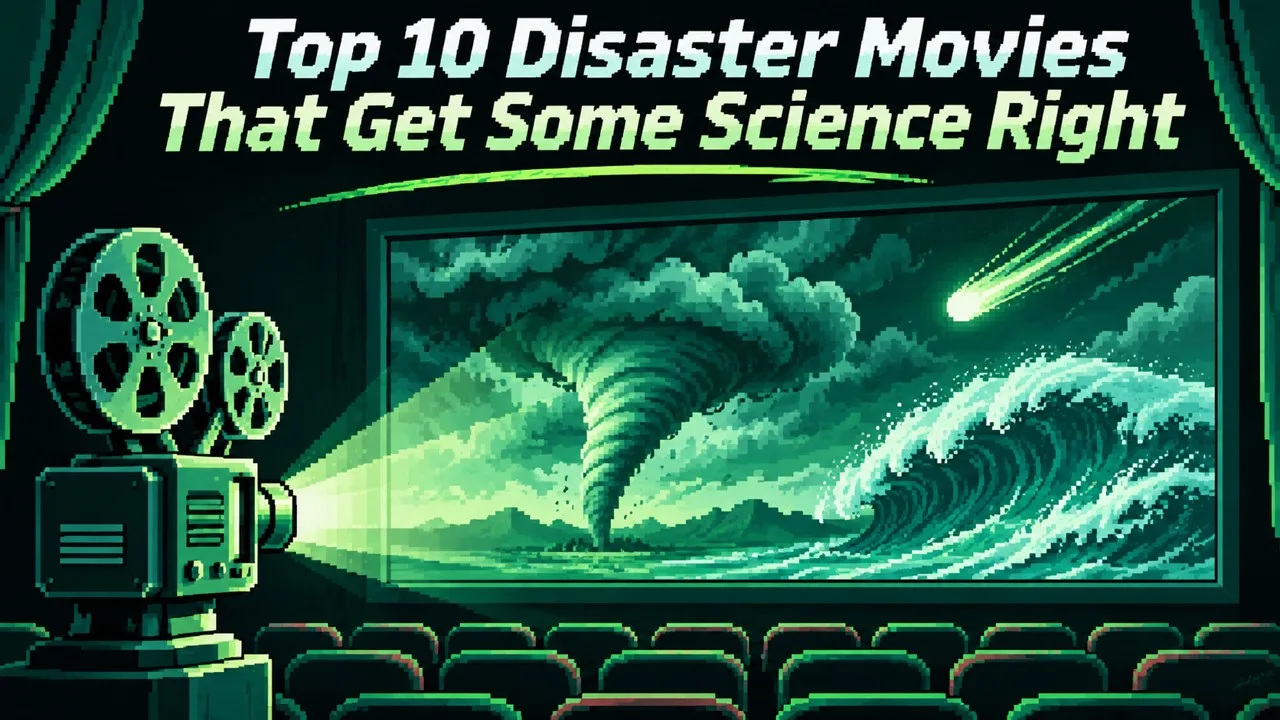
Contagion, Twister, Apollo 13 and The Wave drew on real research. Ten disaster films that got at least some of the science right, and where they slipped. Disaster movies are famous for scientific blunders: cities frozen in an afternoon, lava that behaves like water and asteroids destroyed by drilling crews. Yet a handful of films in the genre have taken real research seriously, often by hiring scientists as consultants or basing their stories on documented events.
None of these films is a documentary. Each compresses time, adds personal drama or bends physics for spectacle. But each also portrays at least one real process or risk with enough care that scientists have praised parts of it.
The films below cover pandemics, tornadoes, volcanoes, tsunamis, nuclear war, rockslides, spaceflight and threats from space. Several helped audiences understand hazards that were later discussed in news headlines.
For each film, the entry notes what it got right and, where relevant, what it exaggerated.
Key Facts
| # | Film | Year | Science it handled well |
|---|---|---|---|
| 1 | Contagion | 2011 | Spread and response to a new virus |
| 2 | Twister | 1996 | Tornado research in the field |
| 3 | Dante's Peak | 1997 | Volcano monitoring and warning signs |
| 4 | The Day After Tomorrow | 2004 | The Atlantic overturning circulation |
| 5 | The Impossible | 2012 | The 2004 Indian Ocean tsunami |
| 6 | Threads | 1984 | Fallout and nuclear winter |
| 7 | The Wave | 2015 | Rockslide-generated tsunamis |
| 8 | Apollo 13 | 1995 | Spacecraft systems and improvised fixes |
| 9 | Gravity | 2013 | Space debris and collisions |
| 10 | Don't Look Up | 2021 | Comet detection and response |
1. A Pandemic Built on Real Biology
Steven Soderbergh's Contagion follows the spread of a fictional virus, MEV-1, from its emergence in Asia to a global pandemic. The filmmakers worked with scientists, including the virologist W. Ian Lipkin of Columbia University, who served as a technical adviser [1].
The fictional virus was modeled partly on the Nipah virus, which jumps from bats to pigs and people. The film shows contact tracing, transmission through touched surfaces, the basic reproduction number and the long process of developing and distributing a vaccine [1].
Contagion attracted a large new audience in 2020 during the COVID-19 pandemic, when many viewers noted parallels with real public health measures. Some details, such as the speed of vaccine development, were simplified for the story. The screenplay was written by Scott Z. Burns, who consulted public health officials while researching it. The final scene reveals how the virus first passed from a bat to a pig and then to a human, a chain that mirrors how some real viruses emerge.
2. Storm Chasers and Their Instruments
Twister follows a team of storm chasers trying to place sensors inside a tornado using a device called Dorothy. The idea was inspired by a real instrument called TOTO, a barrel-shaped package tested by government scientists in the 1980s [2].
Like the fictional team, real researchers struggled to deploy instruments in a tornado's path. In the mid-1990s, the VORTEX project used vehicles and mobile Doppler radar to study how tornadoes form, and storm chasers' work contributed to better warnings [2].
The film exaggerates many details, such as people surviving very close to violent tornadoes. Still, it inspired many viewers to study meteorology, and a sequel, Twisters, was released in 2024. The real TOTO was named after the dog in The Wizard of Oz, and it never managed to record data from inside a tornado. The film's lead characters were loosely modeled on the kind of researchers working at the National Severe Storms Laboratory in Norman, Oklahoma.
Related: Top 10 Most Bizarre Phobias: Strange Fears That Exist
3. Watching a Volcano Wake Up
In Dante's Peak, a volcanologist from the United States Geological Survey arrives in a small town and finds signs that a nearby volcano is waking. The film depicts real monitoring methods, including seismometers, measurements of volcanic gases and ground deformation [3].
It also shows a pyroclastic flow, a fast-moving avalanche of hot ash and gas, which is among the deadliest volcanic hazards. The filmmakers drew on footage and lessons from the 1980 eruption of Mount St. Helens and the 1991 eruption of Mount Pinatubo [3].
Some scenes, such as driving a truck over flowing lava, are unrealistic. But the film's portrayal of scientists debating when to issue warnings reflects a genuine dilemma in volcano monitoring. Before the 1991 eruption of Pinatubo, scientists from the Philippines and the United States issued warnings that allowed tens of thousands of people to evacuate, saving many lives. False alarms, by contrast, can damage public trust.
4. A Real Ocean Current, Wildly Accelerated
The Day After Tomorrow imagines that melting ice disrupts the ocean currents carrying warm water northward in the Atlantic, plunging the Northern Hemisphere into an ice age within days. That timeline is impossible [4].
The underlying system is real, however. The Atlantic meridional overturning circulation, which includes the Gulf Stream, carries heat toward Europe. Studies of past climate suggest that its disruption contributed to abrupt cold periods, such as the Younger Dryas, roughly 12,900 years ago [4].
Scientists continue to study whether global warming could weaken or even collapse the circulation in the future. A collapse would change weather patterns over decades, not freeze cities overnight. The film also shows giant tornadoes striking Los Angeles and a storm system with a frozen eye pulling cold air from the upper atmosphere, both of which are far beyond real weather. Some climate scientists welcomed the film for drawing attention to climate change while criticizing its science.
5. The Force of a Tsunami
The Impossible is based on the experiences of a Spanish family who survived the 2004 Indian Ocean tsunami while on holiday in Thailand. Naomi Watts was nominated for an Academy Award for her role [5].
The film was praised for showing the tsunami not as a neatly curling surfing wave but as a surging flood of water filled with debris, which caused many of the injuries. It also depicts the danger of wounds and infections in the days after the disaster [5].
Related: Top 10 Oldest Buildings in the World
The tsunami was triggered by a magnitude 9.1 earthquake off Sumatra and killed more than 225,000 people in over a dozen countries, making it one of the deadliest natural disasters in recorded history. The real family's story was told by Maria Belon, who served as a consultant on the film. The filmmakers recreated the wave using water tanks and miniature sets rather than relying entirely on computer graphics.
6. Life After a Nuclear War
Threads is a British television film that depicts a nuclear attack on Britain and its aftermath, focusing on the city of Sheffield. It was written by Barry Hines and directed by Mick Jackson [6].
The film shows not only the blasts but also radioactive fallout, the collapse of medical care and food supplies, and a drop in temperatures caused by smoke blocking sunlight. That idea, known as nuclear winter, had been described in a widely discussed scientific study published in 1983 [6].
Threads is often described as one of the most harrowing films ever made. Its grim portrayal of long-term consequences contrasts sharply with films that end shortly after the explosions. The production drew on expert advice and published studies about the likely effects of nuclear war, and the film was first broadcast by the BBC in September 1984, during a period of high Cold War tension.
7. A Fjord Waiting for a Rockslide
The Norwegian film The Wave, or Bolgen in Norwegian, imagines a mountainside collapsing into a fjord and sending a tsunami toward the village of Geiranger. The scenario is based on a genuine risk [7].
The unstable rock face of Akneset, above the Sunnylvsfjorden near Geiranger, is constantly monitored by sensors. Experts have warned that a large collapse could produce a wave reaching nearby villages within minutes, which is why warning systems and evacuation plans exist [7].
Norway has experienced real disasters of this kind. In 1934, a rockslide into the Tafjord produced waves that killed 40 people, and earlier rockslides at Loen killed dozens in 1905 and 1936. The Wave became one of the most successful Norwegian films and led to a sequel, The Quake, released in 2018, which depicts an earthquake striking Oslo.
Related: The Evolution of Stranger Things: Seasons, Themes, and Characters
8. An Accurate Space Emergency
Ron Howard's Apollo 13 recounts the 1970 mission in which an oxygen tank exploded on the way to the Moon. Astronauts and flight controllers had to improvise to bring the crew home safely [8].
The film was praised for its accurate portrayal of spacecraft systems, including the problem of rising carbon dioxide in the lunar module. Engineers on the ground designed a way to fit square filter cartridges into a system built for round ones, using materials available on board [8].
To create weightlessness, scenes were filmed aboard a NASA aircraft flying parabolic arcs, giving actors about 25 seconds of free fall at a time. Some dialogue and conflicts were dramatized. Jim Lovell, the mission's commander, was played by Tom Hanks and appeared briefly in the film as the captain of the recovery ship. The famous line about having a problem was slightly altered from the real transmission, which was, Houston, we've had a problem.
9. A Chain Reaction in Orbit
Alfonso Cuaron's Gravity begins when debris from a destroyed satellite triggers a chain of collisions in orbit. The idea reflects a real concern known as the Kessler syndrome, described by the NASA scientist Donald Kessler in 1978 [9].
Collisions in low Earth orbit create fragments that can strike other satellites, potentially producing more debris. In 2009, an active American communications satellite collided with a defunct Russian satellite, creating thousands of fragments [9].
The film takes liberties, such as moving easily between spacecraft in very different orbits. But astronauts and scientists praised its visual portrayal of the danger posed by orbital debris. In 2007, China destroyed one of its own weather satellites with a missile, creating one of the largest debris clouds ever recorded. Space agencies now track tens of thousands of objects in orbit, and the International Space Station sometimes has to move to avoid debris.
10. Planetary Defense on Screen
Don't Look Up is a satirical comedy about scientists who discover a comet on course to hit Earth. Its scientific adviser was Amy Mainzer, a planetary scientist who led NASA's NEOWISE mission, which searches for asteroids and comets [10].
Related: Chernobyl Miniseries: Stories of Tragedy of a Nuclear Catastrophe, Heroism and Sacrifice
The film's depiction of how astronomers detect, track and calculate the orbits of comets is broadly accurate. Long-period comets can arrive from the outer solar system with relatively little warning [10].
In 2022, NASA's DART spacecraft deliberately crashed into the small asteroid Dimorphos and changed its orbit, the first test of a technique that could one day deflect a threatening object. The impact shortened the time Dimorphos took to orbit its larger companion asteroid by about 32 minutes, far more than the minimum mission goal. NASA has an office dedicated to planetary defense, which coordinates efforts to find and track potentially hazardous objects.
Conclusion
These films show that scientific accuracy and drama can coexist. Even when they exaggerate for effect, they can introduce audiences to real hazards and the work of scientists who study them.
In several cases, consultants and real events shaped the stories. Some films have even been used in classrooms to start discussions about science and risk.
They also show the difficulty of portraying slow or complex processes on screen, which is why filmmakers compress time and simplify events.
Watching critically means enjoying the story while asking which parts are grounded in reality and which are pure invention.
- ^ [1] Accounts of Contagion. Wikipedia: Contagion Wikipedia: Nipah virus
- ^ [2] Accounts of Twister. Wikipedia: Twister Wikipedia: storm chasing
- ^ [3] Accounts of Dante's Peak. Wikipedia: Dante's Peak Wikipedia: pyroclastic flow
- ^ [4] Accounts of The Day After Tomorrow. Wikipedia: The Day After Tomorrow Wikipedia: AMOC
- ^ [5] Accounts of The Impossible. Wikipedia: The Impossible Wikipedia: 2004 Indian Ocean tsunami
- ^ [6] Accounts of Threads. Wikipedia: Threads Wikipedia: nuclear winter
- ^ [7] Accounts of The Wave. Wikipedia: The Wave Wikipedia: Tafjord
- ^ [8] Accounts of Apollo 13. Wikipedia: Apollo 13 (film) Wikipedia: Apollo 13
- ^ [9] Accounts of Gravity. Wikipedia: Gravity Wikipedia: Kessler syndrome
- ^ [10] Accounts of Don't Look Up. Wikipedia: Don't Look Up Wikipedia: DART






















Discussion
Log in with