





 By
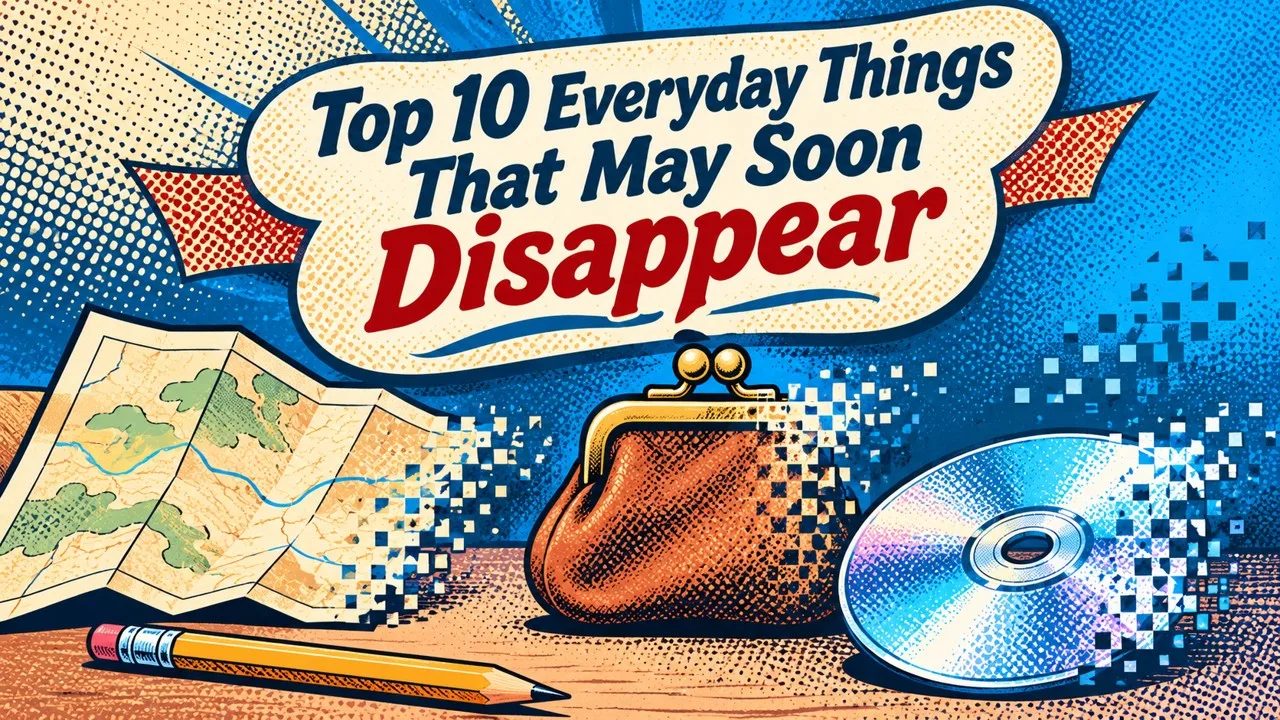
From pennies and paper checks to landlines and passwords, these ten everyday things are fading fast and may soon disappear from daily life. Some things are so ordinary that we rarely notice them. Coins rattle in our pockets, a landline phone sits in the hallway and a password guards every online account. Yet many of these familiar objects and habits are quietly disappearing.
Technology is the main driver. Smartphones, digital payments, fast internet connections and new security methods have made many older tools less necessary. At the same time, governments have introduced rules to phase out products that waste energy or cost more to make than they are worth.
Change rarely happens overnight. Old technologies often linger for years after newer ones arrive, especially among people who prefer them, cannot afford alternatives or live in places where new systems are not yet available. But the direction of travel is often clear.
The disappearance of everyday things can raise real concerns. Older people, those on low incomes and people in rural areas may struggle when familiar services vanish, and some critics warn that moving everything online creates new risks from outages, fraud and surveillance.
The ten items below are all still in use today, but each is declining fast in at least some parts of the world. Some may disappear entirely within a generation, while others may survive only as niche products for enthusiasts.
Where change is planned or announced, that is noted. Predicting the future is always uncertain, and some of these items may prove more durable than expected.
Looking at what may vanish also helps us appreciate how quickly daily life changes. Many of the things our grandparents took for granted have already gone, and our grandchildren may find some of today's habits just as strange.
History is full of everyday objects that vanished. Telegrams, typewriters, slide rules, public phone boxes and film cameras were once part of ordinary life, and most of them faded within a few decades of being replaced. In almost every case, people at the time found it hard to believe that such familiar tools could disappear so quickly. The items on this list may follow the same path, and some are already well along it.
Key Facts
| # | Thing | What is replacing it | Where it is fading |
|---|---|---|---|
| 1 | Pennies and cents | Card and phone payments | Canada, the United States and elsewhere |
| 2 | Cash | Digital and mobile payments | Sweden, Norway and many others |
| 3 | Traditional phone lines | Internet-based calling | United Kingdom and other countries |
| 4 | Cheques and checks | Bank transfers and online payments | United States, United Kingdom and others |
| 5 | Passwords | Passkeys and biometrics | Worldwide |
| 6 | Incandescent bulbs | LED lighting | European Union, United States and many others |
| 7 | Telephone directories | Search engines and smartphones | Worldwide |
| 8 | Analog broadcasting | Digital radio and streaming | Norway and other countries |
| 9 | Fax | Email and digital documents | Japan and elsewhere |
| 10 | One-dimensional barcodes | Two-dimensional codes such as QR codes | Worldwide |
1. The Smallest Coins
Low-value coins cost money to produce and are increasingly rarely used. In many countries, the cost of making a one-cent coin has risen above its face value, while shoppers often leave them in jars or drawers rather than spending them [1].
Canada stopped distributing its penny in 2013, and stores began rounding cash prices to the nearest five cents. Several other countries, including Australia and New Zealand, withdrew their smallest coins decades earlier [1].
In 2025, the United States government also moved to stop producing new pennies for circulation. Existing coins remain legal tender, but the decision reflects a broader trend toward fewer coins in daily life.
Related: Top 10 Everyday Things That May Soon Disappear
2. Banknotes and Coins
In some countries, cash is rapidly losing ground to cards and mobile payment apps. Sweden is often cited as one of the most cashless societies in the world, where many shops and even some banks no longer handle cash [2].
The rise of contactless cards and smartphone payments sped up during the COVID-19 pandemic, when many people avoided handling money. In many cities, it is now possible to go weeks without touching a banknote [2].
The shift has raised concerns about people who rely on cash, such as older people and those without bank accounts. Some governments have introduced rules to protect access to cash, even as its use declines.
3. The Landline Telephone
For most of the twentieth century, the landline phone was the main way people communicated over distance. Today, many households have abandoned their landlines in favor of mobile phones [3].
Telephone companies are also replacing the old copper networks that carried analog calls. In the United Kingdom, the traditional public telephone network is being switched off and replaced with digital lines that carry calls over the internet, a process planned to be completed in the late 2020s [3].
The change affects devices that depend on old phone lines, such as some alarm systems and telecare devices for older people. Providers have been asked to make sure vulnerable customers are protected during the switch.
4. The Paper Check
Paper checks were once a standard way to pay bills, rent and wages. Today, their use has fallen sharply as people pay online, by card or through instant bank transfers [4].
Several countries have taken steps to reduce check use further. In 2025, the United States government announced plans to phase out paper checks for most federal payments, such as benefit payments and tax refunds, in favor of electronic transfers [4].
Some businesses and banks have stopped accepting checks or charge fees to process them. While checks have not vanished, they are becoming a rare sight for many younger people.
Related: Top 10 Most Bizarre Phobias: Strange Fears That Exist
5. Typing a Password
Passwords have protected computer systems for decades, but they have serious weaknesses. People often reuse simple passwords, which can be guessed or stolen in data breaches and phishing attacks [5].
Technology companies have been developing alternatives called passkeys, which use cryptographic keys stored on a device and unlocked with a fingerprint, face scan or PIN. Because there is no password to steal, passkeys are much harder to phish [5].
Major companies such as Apple, Google and Microsoft have added support for passkeys, and many websites now offer them. Passwords are unlikely to disappear immediately, but they may gradually become a backup rather than the main way to log in.
6. The Old Light Bulb
The incandescent light bulb lit homes for more than a century, but it wastes most of its energy as heat. Newer technologies, especially LED bulbs, use far less electricity and last much longer [6].
Many governments have phased out the sale of most incandescent bulbs. The European Union began restricting them in 2009, and the United States introduced rules that took effect in 2023, effectively ending sales of most traditional bulbs for general use [6].
Some specialty incandescent bulbs remain available, for example in ovens. But for ordinary lighting, the classic glowing filament is becoming a historical curiosity.
7. The Printed Phone Book
For generations, thick printed phone books were delivered to homes every year, listing the names, addresses and phone numbers of local residents and businesses. The yellow pages section was the main way to find a plumber or a restaurant [7].
The internet made these directories much less useful. People turned to search engines, online maps and smartphone apps to find businesses, and many households stopped using printed directories [7].
Related: Top 10 Oldest Buildings in the World
Publishers reduced the size and distribution of phone books, and in many places they have stopped printing them altogether. In the United Kingdom, the final printed edition of the yellow pages was delivered in 2019.
8. FM Radio
FM radio has been a familiar part of daily life for decades, but it is facing competition from digital radio and internet streaming. Digital systems can carry more stations and better sound quality [8].
In 2017, Norway became the first country to begin switching off its national FM radio networks in favor of digital audio broadcasting. Some local stations continued to broadcast on FM [8].
Other countries have discussed similar changes, although many have chosen to keep FM running for now. Meanwhile, more and more people listen to radio through apps and smart speakers.
9. The Fax Machine
The fax machine was once essential in offices, sending documents over telephone lines within minutes. Email and digital file sharing have largely replaced it in most workplaces [9].
Faxes have lingered in certain sectors, such as healthcare and government, partly because of legal requirements and long-standing habits. Japan has been known for its continued use of fax machines in offices and government agencies [9].
In the early 2020s, the Japanese government launched efforts to reduce its reliance on faxes and other paper-based processes. Similar efforts are under way elsewhere, and the fax machine is gradually fading from everyday use.
10. The Classic Barcode
The familiar striped barcode on product packaging has been scanned at checkouts since the 1970s. It stores only a short product number, which links to information in the store's computer system [10].
Related: 10 Sikh Gurus: The Pillars of Sikhism Who Shaped Faith, Equality, Courage, and Humanity
The organization that manages barcode standards, GS1, has been working with retailers to move toward two-dimensional codes, such as QR codes, which can store much more information, including batch numbers and expiry dates. The industry has set a goal for retailers to be able to scan these codes by 2027 [10].
The old barcode will not disappear overnight, and both kinds of codes may be printed side by side for years. But the shift could eventually make the classic stripes a thing of the past.
Conclusion
These everyday things show how quickly technology and society can change. Items that seemed permanent a few decades ago are now fading, replaced by digital alternatives that are often faster, cheaper or more secure.
The changes bring benefits, but they also create challenges. People who rely on older technologies can be left behind, and new systems bring their own risks, from cyberattacks to dependence on electricity and internet connections.
Some of these items may survive longer than expected, sustained by enthusiasts, regulations or practical needs. Others may vanish quickly once a tipping point is reached.
Either way, it is worth noticing the ordinary objects around us. Today's everyday tools may be tomorrow's museum pieces.
Future generations may find it hard to imagine paying for groceries with paper notes or remembering dozens of passwords, just as many people today struggle to imagine life without the internet.
Not every change is inevitable. In several countries, campaigns have pushed back against the loss of cash, local bank branches and postal services, arguing that they remain essential for many people. Governments, businesses and communities face difficult choices about how fast to move, and how to make sure that nobody is left without the services they need while new systems take over.
- ^ [1] Accounts of the penny. Wikipedia: Penny (Canadian coin) Wikipedia: Penny (United States coin)
- ^ [2] Accounts of cashless societies. Wikipedia: cashless society Wikipedia: Swish (payment)
- ^ [3] Accounts of landline networks. Wikipedia: public switched telephone network Wikipedia: plain old telephone service
- ^ [4] Accounts of checks. Wikipedia: cheque Wikipedia: electronic funds transfer
- ^ [5] Accounts of passkeys. Wikipedia: passkey Wikipedia: phishing
- ^ [6] Accounts of light bulbs. Wikipedia: phase-out of incandescent light bulbs Wikipedia: LED lamp
- ^ [7] Accounts of phone books. Wikipedia: telephone directory Wikipedia: yellow pages
- ^ [8] Accounts of FM radio. Wikipedia: FM broadcasting Wikipedia: Digital Audio Broadcasting
- ^ [9] Accounts of the fax machine. Wikipedia: fax Wikipedia: email
- ^ [10] Accounts of barcodes. Wikipedia: barcode Wikipedia: QR code




















Discussion
Log in with