





 By
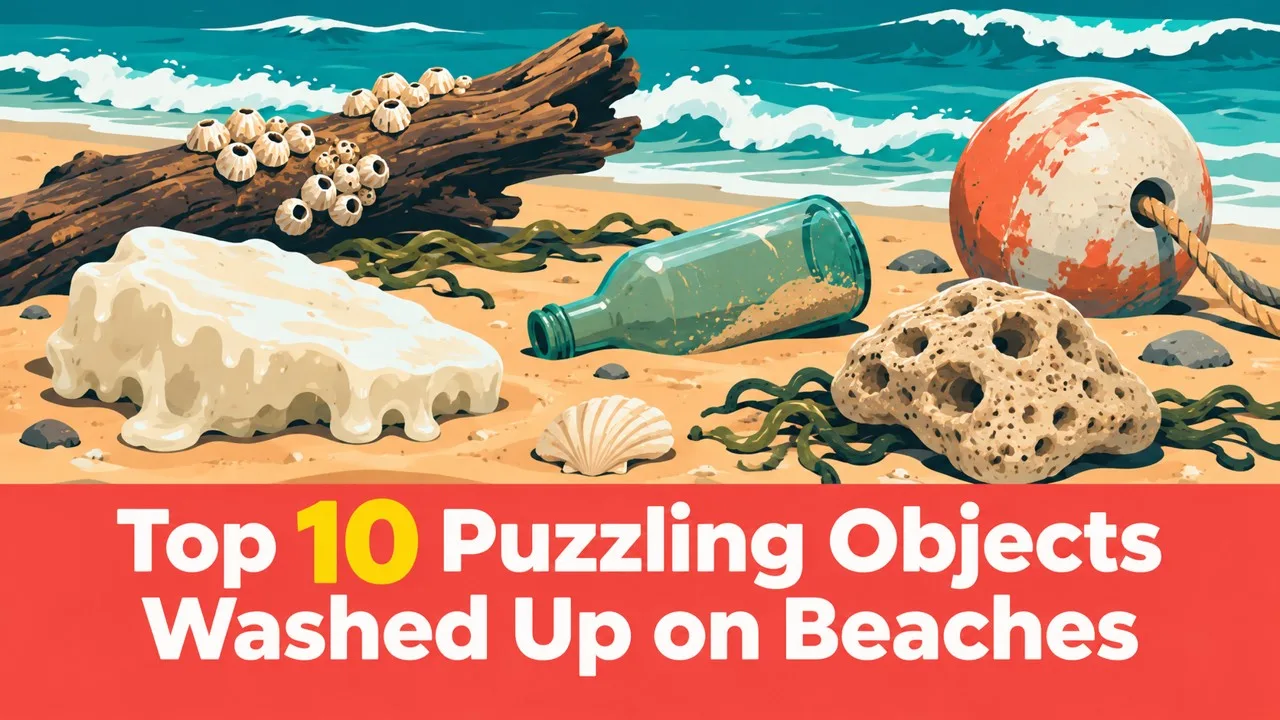
Many puzzling beach objects have later explanations, from paraffin wax to barnacled wood, and a first monster look is often a familiar thing in a bad state.
The ten cases below are a 2024 South Australian gelatinous find, black balls on Sydney beaches, yellow clumps on France's Opal Coast, a long timber structure at Daytona Beach Shores, a metal sphere at Hamamatsu, a "hairy" carcass in the Dinagat Islands, the Muriwai object in New Zealand, pale blobs in Newfoundland's Placentia Bay, a heavy cylinder on South Carolina's Seabrook Island, and disk-shaped foraminifera on Queensland beaches. This article prefers objects that later had a documented identification, and it qualifies the rest. It is distinct from a Finepedia list about the Great Pacific garbage patch. This article will not linger on gore or treat a carcass as a spectacle.
Key Facts
| Object | The better-supported account | A limit |
|---|---|---|
| 1 | A 2024 Horseshoe Bay find was almost certainly a marine organism or remains, not an extraterrestrial craft | A formal, published identification did not have to arrive on the first day of a social-media post |
| 2 | Black balls that closed Sydney beaches in 2024 were later described, after chemical work, as a fatberg-like mix of oils and waste, not a simple tar-only story | Spectacle details are not required to state the class of material |
| 3 | Yellow spongy clumps on the Opal Coast in 2017 were identified as paraffin wax, likely from a ship | A lawful or unlawful discharge is a separate question from the chemistry |
| 4 | A long wooden and metal object at Daytona Beach Shores in 2022 was judged by archaeologists as a likely nineteenth-century wreck remnant | Earlier guesses included a pier, a groyne, and old seating |
| 5 | A hollow metal sphere at Hamamatsu in 2023 was examined and found not to be an explosive; a buoy or similar marine equipment is the ordinary class of explanation | A formal public caption may have remained cautious |
| 6 | A 2017 "hairy" carcass in the Philippines was widely interpreted as a decomposed whale, with fibers mistaken for hair | Only a careful anatomical or genetic exam would settle the species |
| 7 | The Muriwai object was driftwood covered in goose barnacles | The "monster" was a first look, not a later verdict |
| 8 | Placentia Bay blobs in 2024 were tested as a possible synthetic rubber composite, with later official caution about that origin | The case remains a partly open identification |
| 9 | A heavy cylinder on Seabrook Island in 2018 was described as concrete-like or foam-like and lightly fouled, without a settled published identification | "Hunk of junk" is a description, not a caption |
| 10 | Calcium-carbonate disks on Queensland beaches are the remains of large foraminifera, including Marginopora | A perfect round hole is not, here, a manufactured object |
1. A Gelatinous Find, Not a Craft
In October 2024 a beach walker at Horseshoe Bay, in South Australia, photographed a long, gelatinous, tendrilled mass with attached shells and posted it as something never seen before [1]. "Alien" was the internet's first draft. Gelatinous colonial or solitary marine animals, and the remains of such animals, are the ordinary class of explanation for that shape on that coast. A formal paper does not have to appear overnight for the extraterrestrial reading to be the least likely one. Shells stuck to a mass are also a marine fact, not a hull marking [1].
The unexpected fact is that a genuine look of strangeness can be, in the water, a normal body plan [1]. This article will not invent a species name to close a post. The careful fact is a documented find and a documented, ordinary biological class of answers. Surprise is allowed. A spacecraft is not required.
A tendril can look wrong on sand and still have been, a day earlier, an animal or a piece of one.
2. Black Balls, as a Waste Mixture
In September 2024, black balls washed onto several Sydney beaches and led officials to close stretches of shore until they knew what they were dealing with [2]. First guesses mentioned tar. Later chemical work, including analysis reported from a University of New South Wales laboratory, pointed to a fatberg-like mixture of oils and other waste rather than to a simple, single cargo of tar. The exact pipe or ship, if any, is a later investigative question. The useful public fact is the class of material and the reason a beach can be closed for chemistry, not only for a shark or a storm [2].
The unexpected fact is that a sewer's logic can arrive, in a ball, on a famous surf beach [2]. This article will not inventory every compound as a spectacle. The careful fact is a documented closure and a documented later waste-mixture account. Disgust is understandable. Identification is the work.
A black ball can look like oil and still have been, in the lab, a more domestic mess.
3. Yellow Clumps That Were Paraffin
In 2017, yellow, spongy clumps came ashore in large numbers on France's Opal Coast [3]. They looked, at first, like a biological invasion or a foam. Analysis associated with the Cedre pollution-response center identified paraffin wax, a petroleum-related cargo that ships sometimes carry and sometimes lose. The chemistry closed the "what" fairly cleanly. The "which ship" is a separate, and not always public, question. Wax on a beach is a documented, if unwelcome, form of marine pollution [3].
Related: Top 25 Interesting Facts About the Solar System
The unexpected fact is that a cargo can arrive as a toy-like ball and still be, in a laboratory, a known industrial wax [3]. The careful fact is a documented 2017 stranding and a documented paraffin identification. Pretty sand was the setting. A tank cleaning or a leak is the usual suspected route.
A yellow clump can be fluffy in the hand and still not have been, except as a first guess, a sponge.
4. A Long Timber, Read as a Wreck
In 2022 a long, winding wooden and metal object, tens of meters in scale, appeared at Daytona Beach Shores in Florida and invited a set of guesses: a wreck, a lost pier, a groyne built to hold sand, even leftover seating from the years when races were run on the sand [4]. Archaeologists who looked at the fabric leaned toward a remnant of a nineteenth-century ship. That is a professional judgment, not a named wreck with a complete log, and later storms can uncover and then rebury such timbers. The first "snake" impression was a trick of length and of wet wood [4].
The unexpected fact is that a beach can grow, overnight, a structure that is older than the hotels [4]. The careful fact is a documented 2022 exposure and a documented later archaeological lean toward a wreck remnant. Memory of a pier is local and reasonable. The timbers still have to be read.
A groyne can be a fair guess and still not have been, in the later look, the better caption.
5. A Hollow Sphere, Probably Equipment
In 2023 a metal sphere washed ashore at Hamamatsu, in Japan, and was examined by police and a bomb squad [5]. It was found to be hollow and not an explosive. Later talk, some of it joking, some of it anxious in a year of balloon headlines, ran ahead of that result. A mooring buoy or similar marine equipment is the ordinary class of explanation for a hollow metal orb on a beach. A formal public caption may have remained cautious, which is not the same as leaving the object in the realm of fiction [5].
The unexpected fact is that a sphere can summon a bomb squad and still have been, after the X-ray, a container for air [5]. This article will not tour later geopolitical guesses. The careful fact is a documented examination and a documented non-explosive, hollow result. Caution at first was reasonable. A monster egg was the joke, not the finding.
Related: Top 25 Interesting Facts About the Universe
A ball can arrive in a nervous year and still not have been, in the ordinary inventory of the sea, anything but gear.
6. Hair That Was Probably Muscle
In 2017 a several-meter carcass came ashore in Cagdianao, in the Dinagat Islands of the Philippines, and looked, in photographs, shaggy enough to suggest an unknown animal [6]. The usual, and here widely suggested, explanation is a decomposed whale, with dried or loosened muscle fibers reading as hair. Species-level identification would need a skull, a clear anatomy, or a genetic test, and this article will not pretend those were published in every news report. "Globsters" of this type have a long record of being known animals in a bad state [6].
The unexpected fact is that a familiar whale can become, after a week in the sea, a stranger [6]. This article will not describe the body as a spectacle. The careful fact is a documented stranding and a documented, ordinary decomposition reading. Wonder is allowed for a day. A new species is the costly claim.
A fiber can look like hair and still have been, in a whale, a muscle that had begun to come apart.
7. A Monster That Was Wood and Barnacles
An object that washed up at Muriwai, west of Auckland, looked shaggy, barnacled, and large enough to earn a monster nickname in posts [7]. It was driftwood covered in goose barnacles, animals that often settle on floating objects and can make a log look furred or plated. Once that identification is seen, it is hard to unsee. The first "creature" reading was a fair reaction to an unfamiliar silhouette, not a later scientific verdict. New Zealand coasts, like many others, regularly receive wood that has been at sea long enough to grow a second surface [7].
The unexpected fact is that a barnacle can be better than a costume department at suggesting a beast [7]. The careful fact is a documented driftwood-and-barnacle identification. Folklore wanted a monster. The tide delivered a tree.
Related: Top 10 Mythical Creatures in World Mythology - That Inspired Myths Across Civilizations (unchanged)
A log can wear a living coat and still not have been, except at first glance, a body.
8. Blobs in a Bay, with a Split Laboratory Story
In late 2024, pale blobs came ashore in the Placentia Bay area of Newfoundland, and guesses ranged from dough to wax to a fungus [8]. Tests reported from a Memorial University laboratory pointed toward a synthetic rubber composite of a kind used in some adhesives. Environment Canada, in later comment, was more cautious or at odds with that origin story. The honest public sentence is that the objects were not a fairytale organism, that a synthetic polymer is a leading laboratory idea, and that the official identification was not, in the first weeks, a single closed caption [8].
The unexpected fact is that two responsible voices can disagree, for a time, about a blob [8]. This article will not invent a ship to end the disagreement. The careful fact is documented testing and documented later official caution. Chemistry was done. A complete provenance was harder.
A pale mass can be tested and still not have been, in every agency's file, a finished name.
9. A Cylinder That Remained a Description
In 2018 a heavy, roughly cylindrical object, on the order of ninety kilograms, came ashore on Seabrook Island in South Carolina [9]. People who handled it described concrete, or a concrete-like foam, with little obvious metal and little fouling, as if it had not been in the water for a long time. Popular reports left it as a "hunk of junk," which is a description, not an identification. Without a later published caption from a museum or an agency, this item stays in the qualified column: a manufactured or mixed material object, not a monster, and not yet a named piece of equipment [9].
The unexpected fact is that a beach can deliver a heavy, made thing and then withhold, for years, the manual that named it [9]. The careful fact is a documented 2018 find and an absence, in the popular record, of a settled ID. Mystery, here, is thin. It is not a reason to invent a story.
Related: Top 25 Weird Facts About Left-Handed People
A cylinder can be real in the sand and still not have been, in any catalog this article could trust, given a part number.
10. Disks That Were Once Foraminifera
Pale, round, chambered disks with holes, found in numbers on some tropical Queensland beaches, including around the Whitsundays, have been identified as the remains of large foraminifera, including Marginopora [10]. These single-celled organisms build calcium-carbonate tests that can look, to a walker, like manufactured washers or like odd shells. They are neither. Queensland Museum staff and other naturalists have used the finds as a teaching moment: a perfect circle on a beach can still be biology. The puzzle was a first impression. The caption is a documented group of living, or once-living, organisms [10].
The unexpected fact is that a hole in a disk can be, in a foraminifer, part of a house [10]. The careful fact is a documented identification and a documented beach presence. Industry was the guess. A protozoan was the maker.
A washer-shaped object can be gathered by the handful and still not have been, except in the first minute, a factory part.
Conclusion
The ten objects above include a gelatinous mass, a waste-mixture ball, a paraffin clump, a probable wreck timber, a hollow sphere, a likely whale carcass, barnacled wood, a partly open polymer blob, a still-thinly-identified cylinder, and a foraminifer's disk. The sea is full of familiar things in unfamiliar states.
A beach can look like a cabinet of curiosities and still have been, by the end of a careful week, a catalog of wreckage, wax, waste, and ordinary biology.
- ^ [1] News and natural-history accounts of the October 2024 Horseshoe Bay gelatinous find, treated as a marine organism or remains rather than as an extraterrestrial object, without inventing a premature species name. https://www.britannica.com/science/flotsam-jetsam-and-lagan related Australian reporting
- ^ [2] Official and laboratory-reported accounts of the September 2024 Sydney black balls, including later description as a fatberg-like waste mixture, without a spectacle inventory of every compound. related University of New South Wales commentary https://www.britannica.com/technology/wastewater-treatment
- ^ [3] Pollution-response accounts of the 2017 Opal Coast yellow clumps, identified as paraffin wax likely lost from a ship. Cedre materials https://www.britannica.com/science/paraffin-wax
- ^ [4] Archaeological and news accounts of the 2022 Daytona Beach Shores timber, including a later professional lean toward a nineteenth-century wreck remnant and earlier alternative guesses. https://www.britannica.com/topic/shipwreck related maritime-archaeology materials
- ^ [5] Japanese official and news accounts of the 2023 Hamamatsu metal sphere, including the finding that it was hollow and not an explosive, with a buoy or similar equipment treated as the ordinary class of explanation. https://www.britannica.com/technology/buoy related contemporary reporting
- ^ [6] News and natural-history accounts of the 2017 Dinagat Islands carcass, treated as a likely decomposed whale with fibers mistaken for hair, without gore and without a premature species claim. https://www.britannica.com/animal/whale https://www.britannica.com/science/decomposition
- ^ [7] News and natural-history accounts of the Muriwai object as driftwood covered in goose barnacles, not as a monster. https://www.britannica.com/animal/barnacle https://www.britannica.com/place/Auckland-New-Zealand
- ^ [8] Laboratory and official accounts of the late-2024 Placentia Bay blobs, including a reported synthetic-rubber composite result and later official caution, treated as a partly open identification. Memorial University https://www.canada.ca/en/environment-climate-change.html
- ^ [9] Contemporary reports of the 2018 Seabrook Island cylinder, described as concrete-like or foam-like and left without a settled published identification. https://www.britannica.com/science/flotsam-jetsam-and-lagan related barrier-island materials
- ^ [10] Museum and natural-history accounts of calcium-carbonate disks on Queensland beaches as the remains of large foraminifera, including Marginopora. Queensland Museum https://www.britannica.com/science/foraminiferan






















Discussion
Log in with