





 By
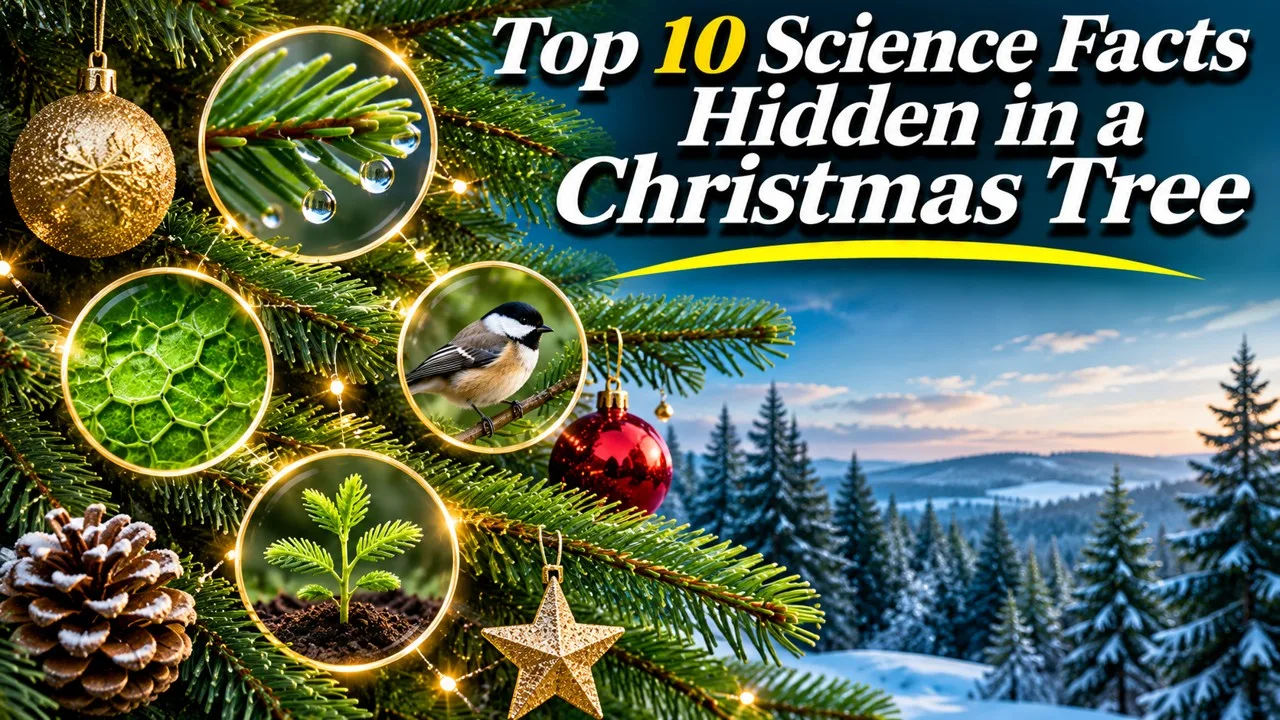
A holiday fir can be ancient in lineage, useful later as fish habitat and, in rare soils, a carrier of trace gold that is not a hidden fortune. The indoor tree is a seasonal object with a longer scientific life than the tinsel suggests [1][4]. It is a crop, a patient of plant pathologists, a fire-safety problem when it dries, and, after the holiday, sometimes a cheap structure for fish [3][4][6]. It is not a chemistry set, and this article will not offer recipes for "flameproofing" a tree or for doctoring the water in the stand [5][6].
A different list in this project already treated Christmas light displays. This one stays with biology, materials, and the afterlife of the tree itself.
Key Facts
Holiday evergreens are farmed plants with diseases, conservation worries, and a few surprising second uses, none of which requires a homemade chemical recipe.
Ten Facts at a Glance
| Rank | Claim | Careful version |
|---|---|---|
| 1 | Ancient trees | Midwinter evergreens are an old custom; the indoor decorated fir is a later, mostly early-modern, development |
| 2 | Humble trees | Many household trees are small, potted, or unfashionable species, not a cartoon prop |
| 3 | Pathologists | Specialists track needle casts, root rots, and insect pests that can hit Christmas-tree farms |
| 4 | Endangered firs | Some wild fir populations used, or formerly used, as holiday trees are under real conservation pressure |
| 5 | Flame retardants | Homemade "fireproofing" is not fire-safety advice; a dry tree remains a hazard |
| 6 | Tree-stand folklore | Household additives in the water are often unproven; this article gives no mixing instructions |
| 7 | Fish habitat | Some towns sink cleaned, undecorated trees as temporary shelter for fish, with conditions attached |
| 8 | "Immortal" spruces | Ancient clonal spruces such as Old Tjikko are old as root systems; the visible stems are younger |
| 9 | Road hazard | Loose, fallen, or dumped trees can obstruct roads; that is a waste and traffic fact, not a method |
| 10 | Trace gold | Some trees can take up tiny amounts of gold from unusual soils; a parlor fir is not a hidden mine |
1. Older than the Parlor, Younger than the Forest
Bringing evergreen boughs indoors in the dark of the year is an old habit in parts of Europe, with roots in midwinter customs that predate the modern Christmas tree [1]. The recognizable indoor tree, a whole fir or spruce stood in a room and dressed, is much younger: it is usually traced to early-modern German-speaking regions and to a later spread through Britain, North America, and beyond [1]. "Christmas trees are ancient" is therefore half right. The plants are ancient lineages, the midwinter greenery is old, and the decorated parlor tree is a historically dated fashion. Those three facts can sit together without collapsing into a single origin myth.
A custom can be old in spirit and still have a relatively late standard form. The tree in the living room is the late form.
2. The Small Tree in the Corner
Not every holiday tree is a tall, dense, farm-perfect fir. Households have long used tabletop trees, potted living trees that can go back outdoors, and species that nurseries treat as modest alternatives, including some pines and indoor evergreens kept small on purpose [2]. The "humblest" tree in popular memory is often a cultural image. This article will not borrow a copyrighted character, a comic-strip tree, or any trademarked sad fir [2]. The real, documentable point is more ordinary and more useful: a holiday tree can be small, living, rented, or slightly lopsided, and it is still doing the same botanical job of being a cut or potted conifer in a warm room.
A modest tree is a horticultural fact. It does not need a fictional mascot in order to be interesting.
Related: Top 10 Little-Known Facts About Christmas Traditions
3. The Doctors of the Tree Farm
Christmas trees are an agricultural crop, and they have pathologists. Specialists in universities, extension services, and plant-health agencies track needle-cast fungi, Phytophthora root rots, cankers, and insect pests such as adelgids that can thin or kill firs and spruces in plantations [3]. The work is unglamorous and essential: scouting, diagnosis, quarantine advice, and breeding or cultural practices that reduce loss. A holiday tree that looks perfect in December is, from this angle, a successful patient of a long growing cycle, not a wild forest that happened to be cut last week [3].
The unexpected fact is institutional. Behind the seasonal stall is a plant-disease literature, and people whose job is to keep that literature ahead of the next outbreak.
4. When the Wild Fir Is the One in Trouble
Some species that appear in living rooms have a harder life in the wild. The Fraser fir, a classic holiday tree in parts of eastern North America, has been badly hit in its native high-elevation range by the balsam woolly adelgid, and other firs used or tested by growers, including some geographically restricted species, are conservation concerns in their home forests [4]. A farmed tree can be abundant in commerce and still represent a wild lineage that is shrinking on the mountain. The careful version of "endangered Christmas trees" is therefore about wild populations and habitat, not about a shortage of retail trees in a given December [4].
Buying a farmed fir does not automatically rescue a wild stand, and it does not automatically destroy one. The two stories have to be told separately.
5. Dry Wood, and Claims That Do Not Put Out a Fire
A cut tree dries in a warm room, and a dry tree can burn. That is the fire-safety fact that fire services repeat every year: keep the stand watered, keep the tree away from heat, and take it out when it is dropping needles [5]. Claims that a homemade coating or a household "flame retardant" will fireproof a tree should not be trusted as fire-safety advice, and some treatments have been criticized as ineffective or as an added problem once they are dry [5]. This article will not name recipes, mixing ratios, or improvised coatings. Official, local fire guidance is the right authority, not a seasonal list.
Related: Top 10 Most Popular Christmas Foods in Different Countries
A retardant that might "cause fires" is a headline. The durable point is simpler. No coating in a kitchen cupboard turns a dry conifer into a safe object, and this is not the place to improvise one.
6. What Not to Invent for the Stand
Folklore about tree-stand water is almost as old, in household terms, as the indoor tree. People have suggested sugar, fertilizer, aspirin, bleach, and other kitchen or garage additives as ways to keep needles on, and extension services have repeatedly found that clean water, in a stand that actually holds it, is the intervention that matters [6]. Some of those folk mixtures are unproven. Some household chemicals do not belong in a reservoir that sits in a living room, around children and pets [6]. This article will not supply "unsafe tree recipes," even in order to denounce them in detail, because a denunciation that lists ingredients can still be used as a recipe.
Plain water, a fresh cut if a specialist recommends one, and a prompt end to the display when the tree is dry: that is the level of advice this list is willing to repeat. Anything more elaborate is outside its job.
7. A Second Life in the Water
After the holiday, some municipalities and conservation groups have placed discarded Christmas trees, stripped of tinsel, hooks, and other decorations, into ponds or along eroded shores as temporary structure for fish [7]. The branches offer shade and cover for a season or two before they break down. The practice is real, documented, and not a license to dump a flocked or wired tree into the nearest creek [7]. Conditions matter: clean the tree, use an approved site, and do not treat a lake as a landfill. Done that way, a used fir can be a modest habitat tool, which is an unexpected afterlife for an object that began as a parlor decoration.
The fish are not celebrating the holiday. They are using a pile of branches, and that is enough.
Related: Top 10 Rare Cloud Formations and How They Form
8. The Tree That Is Old in the Root
"Immortal" holiday-tree relatives exist only in a qualified sense. Old Tjikko, a Norway spruce on a Swedish mountain, has a root system dated to roughly nine and a half thousand years, while the visible stems above ground are much younger, having come and gone as the clone resprouted [8]. Other ancient clonal conifers and woody plants tell a similar story: the genet can be immensely old, the ramet you can put a hand on is not. Spruce is a Christmas-tree genus, so the example sits, a little sideways, on this list. It is not a parlor tree, and it is not literally immortal. It is a demonstration of how a species used in December can also, in the wild, be one of the oldest living woody clones on Earth [8].
A calendar-year trunk and a millennial root system can belong to the same organism. That is the surprise, and it does not require the word immortal except as a metaphor that then has to be taken back.
9. A Tree That Does Not Belong in the Lane
Cut trees become road hazards in ordinary, well-documented ways: poorly secured loads on vehicles, trees that fall from racks, and discarded trees left on verges or in the road after collection is missed [9]. Dry trees are light enough, in pieces, to move in wind, and heavy enough, as a whole, to block a lane. Transport and waste agencies treat the problem as a seasonal traffic and dumping issue [9]. This entry is a safety fact, not a method. It does not explain how to create a hazard, only that the hazard exists and is already in the official advice: tie a tree down, keep it out of the roadway, and use a proper collection point.
The unexpected part is only how often a decorative object becomes, for a week or two, a piece of debris in the wrong place.
Related: Top 10 Animals Once Thought Extinct That Turned Up Alive
10. Gold, but Not a Fortune in the Needles
Some trees, in soils that sit over gold-bearing rock, can take up tiny amounts of gold and even form or accumulate nanoscale gold particles in their tissues, a fact that researchers have used in biogeochemical prospecting, especially in parts of Australia and elsewhere, often with eucalypts rather than with parlor firs [10]. Headlines about "Christmas trees hiding real gold" flatten that research into a treasure story. The amounts are traces, the useful signal is for scientists and geologists, and a farmed holiday tree grown in ordinary soil is not a hidden mine [10]. No one should strip a living room fir for metal, and no one should read this paragraph as a prospecting tip.
The science is about how plants move elements. The gold is a tracer, not a payday, and it is the last unexpected fact this list needs.
Conclusion
A Christmas tree is a plant before it is a symbol. It has an old midwinter ancestry and a younger parlor history, a profession of pathologists, and wild relatives that may be rarer than the farmed stock. It can, after the ornaments come off, shelter fish, and it can, in unusual soils, carry a trace of gold that will not pay the rent. What it cannot safely be is a weekend chemistry experiment. Homemade coatings and folklore in the stand are not a substitute for water, caution, and an official recycling or collection route.
The science hidden in the tree is mostly quiet: disease, age, habitat, and a little metallurgy. That is a better list than a set of recipes.
- ^ [1] Historical overviews of midwinter evergreen customs and the early-modern German origins of the indoor Christmas tree. Britannica: Christmas tree
- ^ [2] Horticultural accounts of small, potted, and alternative holiday evergreens, described without copyrighted characters. Britannica: Christmas tree
- ^ [3] Extension and plant-pathology guidance on needle casts, root rots, and pests of Christmas-tree plantations. Britannica: Plant disease
- ^ [4] Conservation assessments of Fraser fir and other wild firs affected by the balsam woolly adelgid and related pressures. Britannica: Fraser fir
- ^ [5] Fire-service advice on watered, well-sited holiday trees, and cautions against treating homemade coatings as fireproofing. NFPA: Christmas tree fire safety
- ^ [6] Extension-service findings that clean water, not household additives, is the practical care for a cut tree, stated here without mixing instructions. Britannica: Christmas tree
- ^ [7] Municipal and conservation programs that place cleaned, undecorated discarded trees as temporary fish habitat. Britannica: Artificial reef
- ^ [8] Documentation of Old Tjikko, a clonal Norway spruce with an ancient root system in Sweden. Britannica: Norway spruce
- ^ [9] Transport and waste-agency notices about unsecured or discarded trees as seasonal road hazards. Britannica: Christmas tree
- ^ [10] Research on trace gold uptake in trees as a biogeochemical prospecting signal, distinguished here from any claim of a hidden fortune in a holiday fir. Britannica: Biogeochemistry























Discussion
Log in with