






Top 10 Technologies Being Tested Against Climate Change
 By Dhiraj Sharma · Published
Share Post
Loading…
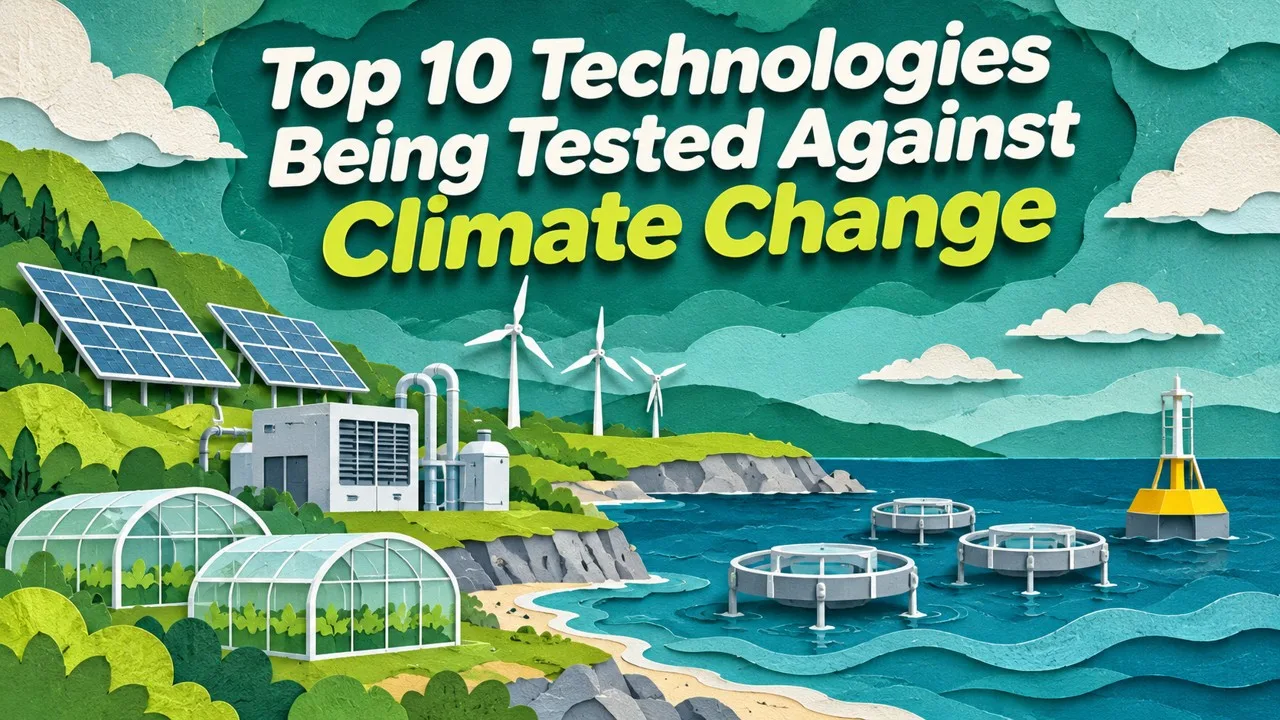
From machines that pull carbon dioxide from the air to cattle feed that cuts methane, scientists are testing many ways to slow climate change. Cutting emissions from fossil fuels remains the main way to slow climate change, and most scientists agree that no technology can replace that effort. But researchers and companies are also testing a wide range of other tools, from removing carbon dioxide from the air to changing how much sunlight reaches Earth.
Some of these technologies are already working at small scale, while others exist mainly in laboratories, computer models and short field tests. Several are controversial, raising questions about cost, side effects and who should decide whether to use them. Each one is being studied because the challenge of climate change is so large.
The ten technologies below are direct air capture, carbon capture and storage, enhanced rock weathering, ocean iron fertilization, stratospheric aerosol injection, marine cloud brightening, hydrogen-based steelmaking, methane-reducing cattle feed, super-white cooling paint and nuclear fusion. They are described as tests and possibilities, not as solutions already proven at global scale.
Key Facts
| # | Technology | Example or test | Status and debate |
|---|---|---|---|
| 1 | Direct air capture | Orca plant, Iceland, 2021 | Works, but expensive and small so far |
| 2 | Carbon capture and storage | Sleipner field, Norway, since 1996 | Proven at some sites, slow to expand |
| 3 | Enhanced weathering | Field trials in Britain, the United States and elsewhere | Promising, but hard to measure |
| 4 | Ocean iron fertilization | Experiments since the 1990s | Controversial and tightly restricted |
| 5 | Stratospheric aerosol injection | Proposed, tests halted | Based on volcanic cooling, highly controversial |
| 6 | Marine cloud brightening | Trials on the Great Barrier Reef and elsewhere | Small tests, many unknowns |
| 7 | Hydrogen-based steelmaking | Pilot projects in Sweden, from 2021 | Early production, scaling up |
| 8 | Methane-reducing cattle feed | Feed additives and seaweed | Approved in some countries, still being studied |
| 9 | Super-white cooling paint | Purdue University, 2021 | Reflects almost all sunlight |
| 10 | Nuclear fusion | National Ignition Facility, 2022 | A scientific milestone, still far from power plants |
1. Machines That Pull Carbon From the Air
Direct air capture uses machines with fans and chemical filters to remove carbon dioxide from ordinary air. The captured gas can then be stored underground or used in products. Because carbon dioxide is only a small fraction of air, the process requires a lot of energy [1].
In 2021, the Swiss company Climeworks opened a plant called Orca in Iceland, designed to capture about 4,000 tonnes of carbon dioxide a year. The gas is mixed with water and pumped underground by the Carbfix project, where it reacts with basalt rock and turns into stone within about two years. A larger plant, Mammoth, followed in 2024 [1].
Supporters say direct air capture could remove carbon that is hard to avoid emitting. Critics point out that current capacity is tiny compared with global emissions and that costs are still high. The technology's future depends on cheap clean energy and long-term funding.
2. Carbon Buried Under the Sea
Carbon capture and storage captures carbon dioxide from industrial sources, such as power plants or gas processing facilities, and stores it deep underground. It differs from direct air capture because the carbon is captured before it reaches the atmosphere [2].
At the Sleipner gas field in the North Sea, Norway's state energy company has injected about one million tonnes of carbon dioxide a year into a sandstone layer beneath the seabed since 1996. The project was partly motivated by a Norwegian tax on carbon emissions and is often cited as the first major offshore storage project [2].
Monitoring at Sleipner has shown that the gas has stayed in place. However, many other carbon capture projects around the world have struggled with costs and technical problems. Critics also worry that the technology can be used to extend the life of fossil fuel industries rather than replace them.
Related: Top 10 Lasting Traces of Nuclear Testing
3. Rocks Spread on Farmland
Natural weathering of rocks slowly removes carbon dioxide from the atmosphere over thousands of years. Enhanced weathering aims to speed up this process by crushing rocks such as basalt into fine powder and spreading it on farmland [3].
As rain falls, the powdered rock reacts with carbon dioxide, forming compounds that are eventually carried to the oceans, where the carbon can remain stored for a very long time. The rock can also improve soil quality and provide nutrients to crops [3].
Field trials are under way in several countries, and some companies already sell carbon removal credits based on the method. Scientists say more research is needed to measure how much carbon is actually removed and to check for side effects on soils and rivers.
4. Feeding the Ocean Iron
In parts of the ocean, the growth of tiny plants called phytoplankton is limited by a lack of iron. In the late twentieth century, scientists proposed adding iron to these waters to cause blooms of phytoplankton, which would absorb carbon dioxide as they grow [4].
More than a dozen experiments have tested the idea since the 1990s. They showed that adding iron can trigger blooms, but it was much less clear how much carbon sinks to the deep ocean and stays there, rather than returning to the atmosphere [4].
Concerns about effects on marine ecosystems led to international restrictions under agreements on ocean dumping. An unauthorized release of iron off the coast of Canada in 2012 drew strong criticism. Research continues, but ocean fertilization remains one of the most debated proposals.
5. Reflecting Sunlight From the Stratosphere
Large volcanic eruptions can cool the planet temporarily. After Mount Pinatubo erupted in the Philippines in 1991, sulfur particles in the stratosphere reflected sunlight and lowered average global temperatures by about half a degree Celsius for a year or two [5].
Related: Top 10 Interesting Facts About Antarctica
Stratospheric aerosol injection would deliberately release reflective particles in the upper atmosphere to imitate this effect. Studies using computer models suggest it could reduce warming, but it might also change rainfall patterns and would not stop ocean acidification [5].
A Harvard research project called SCoPEx planned a small balloon test in Sweden in 2021, but it was called off after objections, including from Sámi groups, and the project ended in 2024. Many scientists argue that governance rules are needed before any large tests. The idea remains among the most controversial in climate research.
6. Brightening Clouds Over the Sea
Marine cloud brightening aims to make low clouds over the ocean more reflective by spraying tiny droplets of seawater into the air. The salt particles act as seeds for cloud droplets, making clouds whiter and better at reflecting sunlight [6].
Researchers in Australia have tested the method over the Great Barrier Reef since 2020, hoping it might reduce heat stress on corals during marine heatwaves. In the United States, a small test of spraying equipment in Alameda, California, was halted by the city in 2024 pending review [6].
Scientists say the method could have local benefits but might also affect weather patterns elsewhere. Because clouds are complex, the size of the effect is uncertain. Like other sunlight-reflecting ideas, marine cloud brightening would treat symptoms rather than causes of warming.
7. Steel Made With Hydrogen
Steelmaking is responsible for a large share of global carbon emissions, because iron ore is traditionally converted into iron using coal in blast furnaces. A new approach uses hydrogen instead of coal to remove oxygen from iron ore, producing water instead of carbon dioxide [7].
In Sweden, a project called HYBRIT, a partnership of a steel company, a mining company and an energy company, produced steel using hydrogen made with renewable electricity. In 2021, it delivered its first fossil-free steel, which was used by the carmaker Volvo [7].
Related: Top 10 Rare Cloud Formations and How They Form
Other companies are building larger plants in Sweden and elsewhere. The approach requires large amounts of renewable electricity to produce hydrogen, and costs are higher than for conventional steel. If it can be scaled up, it could greatly reduce emissions from one of the most polluting industries.
8. Feed That Cuts Cow Burps
Cattle and other ruminant animals produce methane, a powerful greenhouse gas, as they digest food. Most of the methane is released when the animals burp. Livestock are a major source of methane emissions worldwide [8].
A feed additive called 3-nitrooxypropanol, sold as Bovaer, reduces methane production in the animals' stomachs by around 30 percent in many studies. It was approved for use in the European Union in 2022 and in the United States in 2024. Researchers are also testing red seaweeds of the genus Asparagopsis, which have produced large reductions in some trials [8].
Questions remain about cost, long-term effects and consumer acceptance. Farmers need incentives to use the additives, and the seaweed is difficult to grow at scale. Even so, feed additives are one of the more practical ways being tested to reduce emissions from agriculture.
9. The Whitest Paint
Buildings in hot climates use large amounts of energy for air conditioning. Researchers have long known that white roofs reflect sunlight and stay cooler. Recent work aims to create surfaces that cool themselves below the temperature of the surrounding air, a process called passive daytime radiative cooling [9].
In 2021, researchers at Purdue University in the United States developed a paint using barium sulfate particles that reflects about 98 percent of sunlight. It was recognized as one of the whitest paints ever made. In tests, surfaces painted with it stayed cooler than the surrounding air even in direct sunlight [9].
Related: Top 10 Largest Hydroelectric Dams by Capacity
The researchers suggested that such paints could reduce the need for air conditioning and lower energy use. Cool roofs and pavements are already used in many cities. The technology does not remove greenhouse gases, but it could help adapt to heat and reduce emissions from cooling.
10. Energy From Fusing Atoms
Nuclear fusion, the process that powers the Sun, combines light atoms to release energy. It could provide large amounts of energy without carbon emissions and with less long-lived radioactive waste than current nuclear reactors [10].
In December 2022, the National Ignition Facility in California announced that a fusion experiment had produced more energy than the laser energy delivered to the fuel, a milestone known as ignition. The experiment released about 3.15 megajoules from 2.05 megajoules of laser energy [10].
The result did not count the much larger amount of electricity needed to power the lasers, so it was not a net energy gain for the whole system. Large projects such as ITER in France and many private companies are working toward fusion power plants, but most experts expect commercial fusion electricity to take many years.
Conclusion
The ten technologies above range from working industrial projects to controversial ideas still largely confined to models. Carbon capture and storage, direct air capture, hydrogen steelmaking and cattle feed additives are already being used at small scale. Enhanced weathering and cooling paints are moving from trials to products. Ocean fertilization and sunlight reflection remain heavily debated.
Most scientists agree that none of these tools can replace rapid cuts in emissions. But as climate change continues, research into a wide range of options is likely to grow, along with debates about which ones are safe, fair and worth pursuing.
- ^ [1] Accounts of direct air capture, Orca and Carbfix. Wikipedia: direct air capture Wikipedia: Carbfix
- ^ [2] Accounts of carbon capture and storage at Sleipner. Wikipedia: Sleipner gas field Wikipedia: carbon capture and storage
- ^ [3] Accounts of enhanced weathering research. Wikipedia: enhanced weathering Wikipedia: carbon dioxide removal
- ^ [4] Accounts of ocean iron fertilization experiments. Wikipedia: iron fertilization Wikipedia: phytoplankton
- ^ [5] Accounts of stratospheric aerosol injection and SCoPEx. Wikipedia: stratospheric aerosol injection Wikipedia: SCoPEx
- ^ [6] Accounts of marine cloud brightening. Wikipedia: marine cloud brightening Wikipedia: solar radiation modification
- ^ [7] Accounts of hydrogen-based iron and steel production. Wikipedia: direct reduced iron Wikipedia: green steel
- ^ [8] Accounts of methane-reducing feed additives. Wikipedia: 3-nitrooxypropanol Wikipedia: Asparagopsis taxiformis
- ^ [9] Accounts of radiative cooling paints. Wikipedia: passive daytime radiative cooling Wikipedia: cool roof
- ^ [10] Accounts of the 2022 fusion ignition result. Wikipedia: National Ignition Facility Wikipedia: ITER





















Discussion
Log in with