






 By
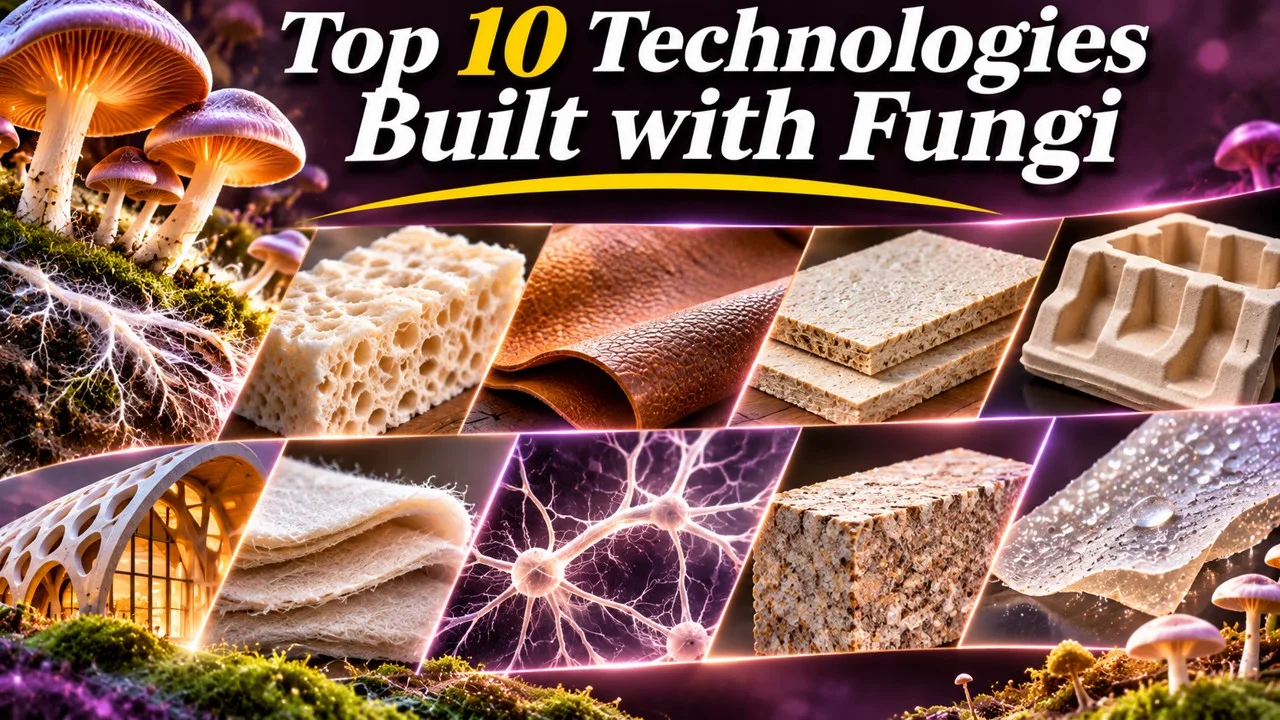
Mycelium can be made into foams, leather-like sheets and insulation; plastic-eating fungi and fungal computers are real research, not finished utilities. Fungi are already industrial in one old sense: yeast and molds make food, drink, and antibiotics [8]. The newer claim is that the vegetative body of a fungus, the mycelium, can be grown as a material, and that some species can break down plastics or even be asked to take part in unconventional computing [1][2][5]. Both halves of that claim are documented. Neither half is a reason to write as if the landfill, the concrete plant, or the laptop has already been replaced [2][10].
The ten technologies below are at very different stages. A mycelium foam you can hold is not the same kind of fact as a laboratory fungal circuit.
Key Facts
Mycelium is a network of hyphae. In these applications it is grown on agricultural waste or another substrate, then dried, pressed, or otherwise killed and set, unless the point is a living process such as remediation.
Ten Fungal Technologies at a Glance
| Rank | Application | What is reasonably shown | What is not |
|---|---|---|---|
| 1 | Unconventional computing | Fungal networks can show electrical and growth dynamics that researchers treat as computation | A fungal laptop is not on sale |
| 2 | Plastic-degrading fungi | Some species can break down certain plastics in laboratory and field-like tests | They are not a completed waste system |
| 3 | Insulation and building foams | Grown panels and packing foams exist as products and prototypes | They do not yet replace bulk insulation everywhere |
| 4 | Mycoremediation | Fungi can help take up or transform some pollutants in soil and wood | Each site is a case, not a universal broom |
| 5 | Leather-like sheets | Mycelium "leathers" have reached fashion and prototype goods | Durability and scale are still being proven |
| 6 | Battery parts | Researchers have tried fungal or fungal-derived components in experimental cells | This is lab work, not a grid technology |
| 7 | Foamed insoles and cushioning | The same mycelium foams used in packing have been cut for shoes | A niche product is not a new physiology |
| 8 | Food-protecting uses | Coatings, packaging, and some controlled cultures can slow spoilage | Not every fungus belongs near food |
| 9 | Experimental circuit boards | Groups have grown or formed mycelium as a board or substrate for electronics | It is a demonstration, not a standard PCB |
| 10 | Self-healing or living concretes | Fungi, like some bacteria, have been tested in crack-filling cement research | Bacterial systems are better known; fungal ones are earlier |
1. A Network Asked to Compute
Mycelial networks move signals, nutrients, and electrical spikes in ways that have tempted researchers to treat them as unconventional computers: slow, wet, and massively parallel [1]. Papers have reported that a living fungus can enter states that look like logical operations, or can be used as a sensor-memory hybrid, at least in a tightly controlled dish [1]. The work is real, and it sits beside other experiments in slime-mold and neuromorphic wetware. It is also early. No one is filing taxes on a mushroom. The unexpected fact is that a forest organism can be a model for computation at all, not that it has taken a product category away from silicon.
A headline about "fungal computers" should be read as a research program. That is already strange enough.
2. Fungi That Attack Plastic
Several fungi, including species in genera such as Pestalotiopsis and Aspergillus, have been shown to degrade certain plastics, among them polyurethane, in laboratory tests and in some more applied trials [2]. The enzymes they bring to the polymer are the point: a living chemistry that can, in principle, work at milder conditions than a furnace [2]. The limits are the ones cleanup stories often skip. Rate, completeness, by-products, and the difference between a clear plastic in a flask and a mixed, weathered waste stream all matter. A plastic-eating fungus is a candidate tool, not a finished public works department.
Related: Top 10 Most Bizarre Phobias: Strange Fears That Exist
The research should continue. The landfill should not be declared solved in the meantime.
3. Grown Insulation
Companies and labs have grown mycelium through agricultural waste to make foams and panels that can insulate, pack a product, or stand in for some plastics in a short-lived object [3]. Once the fungus has bound the substrate, the material is typically dried and killed, so the brick does not keep growing on a shelf [3]. The attraction is a low-energy forming process and a product that can, in the right design, go back to compost. The caution is performance in wet, load-bearing, or highly regulated building roles, which is why mycelium insulation is a real material still making its case, not a secret already known to every contractor.
A panel you can hold is the most convincing item on this list. It is also the one that should be judged like any other foam: by fire, moisture, and cost.
4. Cleaning with a Fungus
Mycoremediation is the use of fungi to reduce, transform, or bind pollutants in soil, wood, or waste, from some hydrocarbons to certain treated timbers [4]. The hyphae can reach into a matrix that a shovel does not, and the enzymes are versatile. Field results, as usual, are messier than laboratory graphs, and a site may need time, oxygen, the right species, and a realistic goal [4]. The technology is less photogenic than a leather handbag and older, in practice, than some of the start-up stories. It is also one of the more serious environmental uses of the kingdom.
A fungus is not a magic wick. It is a biology that can be hired for a dirty job, with a contract that should be specific.
Related: Top 10 Oldest Buildings in the World
5. A Sheet That Looks Like Hide
Mycelium can be grown in mats, finished, and dyed to make a leather-like sheet that has already appeared in prototype fashion and in small product lines [5]. The pitch is an animal-free material with a lower burden than some plastics. The open questions are familiar in materials science: scratch, water, years of flex, and whether the process scales without becoming just another industrial crop with a prettier story [5]. This article is not a product endorsement. It is a record that the sheet exists, that it is fungal, and that "leather" is here a resemblance, not a hide.
A new material earns its name in use, not in a runway paragraph.
6. A Battery, Still in the Lab
Researchers have experimented with fungal materials, including carbonized mycelium or fungal-derived carbons, as components in batteries and other electrochemical cells [6]. The hope is a cheaper, more degradable, or more sustainably sourced part, not a mushroom you plug into the wall [6]. Results are published as papers and posters, which is the right scale. Anyone promising a household fungal battery as a present fact is running ahead of the cells.
Electrochemistry is allowed to be slow. The unexpected part is only that a fungus got invited into the cell at all.
7. Softening a Shoe
Once a mycelium foam exists, someone will cut an insole out of it, and several designers and material firms have done exactly that [7]. The technology is not a separate invention from the packing foams and insulation already described; it is a use. Comfort, odor, durability, and sweat are the tests that matter, and they are ordinary product tests [7]. The reason the item belongs on a list of fungal technologies is pedagogical: the same grown foam can leave the lab as a shipping tray or as something a person stands on.
Related: 10 Sikh Gurus: The Pillars of Sikhism Who Shaped Faith, Equality, Courage, and Humanity
A shoe is a good ambassador. It is not a different physics.
8. Keeping Food, Carefully
Fungi already keep food in the old way, by making it: fermentations that are stable and flavorsome [8]. Newer work has looked at edible or compostable fungal packaging, at coatings, and at ways of using selected cultures to suppress spoilage organisms [8]. The word "keep" has to stay cautious. Many fungi ruin food, and a living culture near a meal is a controlled process or it is a hazard. The promising applications are the ones that treat that line as the design problem, not as a footnote.
A package that can return to the soil is a fair goal. A wild mold on the leftover is not a technology.
9. A Board That Was Grown
Experimental groups have grown mycelium into boards, sometimes with added conductive traces, as a biodegradable stand-in for a printed circuit substrate [9]. The demonstrations show that a grown material can hold a simple circuit for a short, useful life and then, in principle, be disposed of more gently than a stack of resins [9]. Heat, moisture, precision, and electronics-industry habit are all against a quick takeover. The unexpected fact is the photograph of a living, then dried, board, not a claim that phones will sprout.
A prototype board is a good teaching object. It is not yet a plant.
10. Concrete That Might Knit a Crack
Self-healing concrete is better known in its bacterial versions, in which spores and a food source sit in the mix and, when a crack lets in water, help deposit a filler [10]. Researchers have also tested fungi for a similar job, asking whether hyphae and their chemistry can help seal cement cracks [10]. The work is promising and preliminary, and it should not be confused with a claim that buildings already grow themselves well. If a fungal concrete reaches practice, it will do so as a carefully dosed admixture, not as a ruin that sprouts a helpful mushroom.
Related: Top 10 Tallest Buildings in the World
The unexpected fact is the invitation. A kingdom famous for rot is being asked, in a narrow brief, to help a crack close.
Conclusion
Fungi are already a technology in the kitchen and the pharmacy. The newer story is materials and cleanup: foams, leather-like sheets, insulation, remediation, and a set of laboratory ideas about plastics, boards, batteries, and cement. Those ideas are not all at the same stage, and a list that pretends they are will age badly.
The honest excitement is still substantial. A grown foam you can hold, a sheet that can pass for hide in a photograph, a fungus that can nibble a polymer in a flask: these are facts. A fungal computer, a fungal battery, a self-healing motorway, and a solved plastic ocean are not facts yet. They are research, and they should be allowed to remain research until the measurements say otherwise. The kingdom that rots wood and raises bread is large enough to hold both the products already in a hand and the experiments that should stay in a paper for a good while longer yet, until a factory, not a press release, is still the clearer evidence.
- ^ [1] Research on electrical activity and unconventional computing in mycelial networks. Britannica: Fungus
- ^ [2] Studies of fungi capable of degrading certain plastics, including polyurethane, in laboratory conditions. Britannica: Biodegradation
- ^ [3] Technical and company accounts of mycelium composite foams and insulation panels grown on agricultural waste. Britannica: Insulation
- ^ [4] Reviews of mycoremediation in soils and waste, including hydrocarbons and treated wood. Britannica: Bioremediation
- ^ [5] Materials-science and industry reporting on mycelium leather-like sheets, treated here as prototypes and limited products. Britannica: Fungus
- ^ [6] Experimental papers on fungal or fungal-derived components in electrochemical cells. Britannica: Battery
- ^ [7] Product and design reports of mycelium foams used as cushioning or insoles. Britannica: Foam
- ^ [8] Work on fungal packaging, coatings, and fermentations that help preserve food, distinct from spoilage molds. Britannica: Food preservation
- ^ [9] Demonstrations of mycelium-based substrates or boards for simple electronics. Britannica: Printed circuit
- ^ [10] Research on self-healing cement and concrete, including bacterial systems and earlier-stage fungal tests. Britannica: Concrete





















Discussion
Log in with