





 By
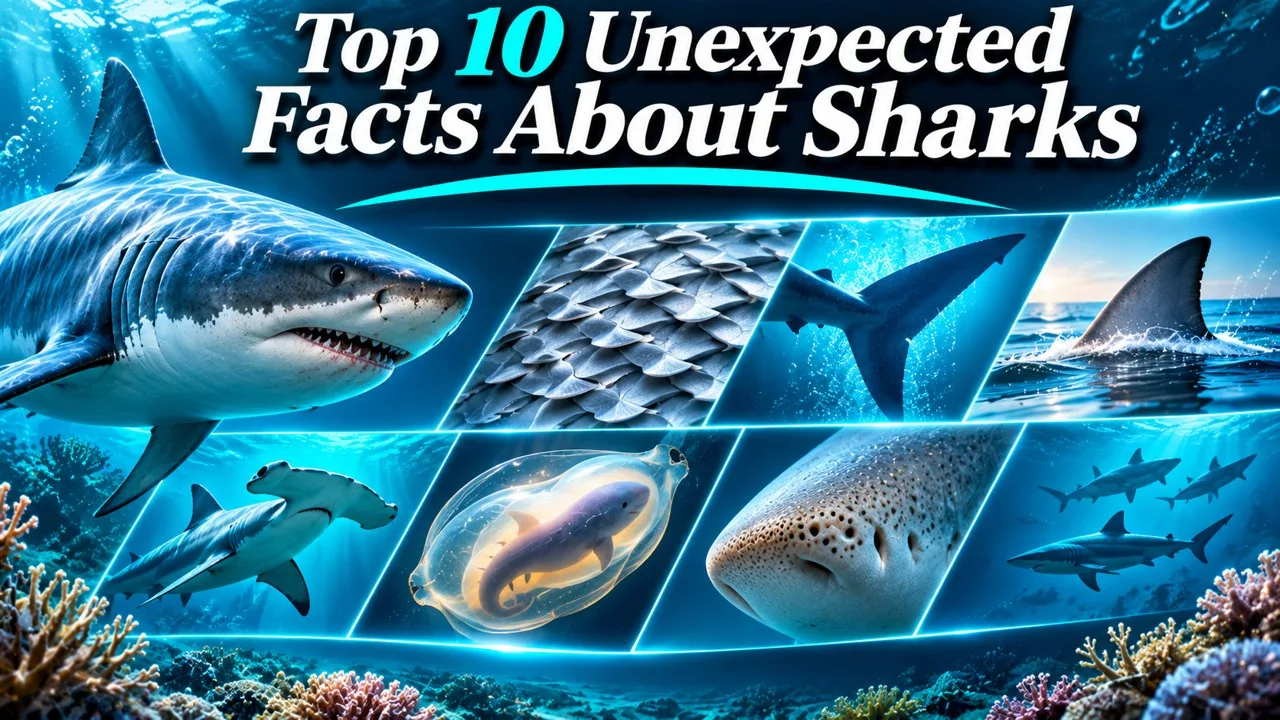
Sharks are cartilaginous, some can walk on reef flats, and a parasite can cloud a Greenland shark's eye, though not every individual is simply blind. A list of "wild facts" about sharks often turns into a catalog of bites. This one will not [6][8]. Cookiecutter marks on a submarine, a stomach that can be everted, and a swell shark's defensive gulp can all be described as anatomy and a historical record, without a feeding scene [4][6][8]. The ten entries below are documented, with the usual duty not to upgrade a tendency into a universal law, or a debated paper into a finished extinction story [2][3].
A companion list in the same project already treated a possible color shift in blue sharks. This one stays with other species and other facts, so that the two lists do not simply repeat the same skin, the same ocean, and the same ten surprises.
Key Facts
Sharks are a long-lived branch of cartilaginous fishes, diverse in habitat, reproduction, and sense organs, not a single cartoon predator.
Ten Facts at a Glance
| Rank | Claim | Careful version |
|---|---|---|
| 1 | Greenland sharks and sight | Many carry an eye parasite that can damage vision; "almost all are blind" overstates the case |
| 2 | Swell sharks | They gulp water or air and inflate as a defense; "double the size" is a popular rounding, not a surveyor's figure |
| 3 | Great whites and megalodon | Some research argues that competition with great whites helped end megalodon; it is a live debate, not a verdict |
| 4 | Spiral egg cases | Some sharks, including horn or Port Jackson sharks, lay corkscrew-shaped cases that wedge into rock |
| 5 | Cookiecutter sharks and submarines | Documented bites on submarines and other gear exist; they are a natural-history record, not a spectacle |
| 6 | No bones | The skeleton is cartilage, often calcified, not true bone |
| 7 | Stomach eversion | Some species can turn the stomach out to empty or clean it, a physiological fact |
| 8 | Skin of tiny teeth | Dermal denticles are tooth-like scales |
| 9 | Older than trees | The shark lineage predates true woody forests, if "trees" is used in the geological sense |
| 10 | Walking sharks | Epaulette sharks can walk on fins across reef flats, and briefly out of water |
1. A Clouded Eye, Not a Blanket Blindness
Greenland sharks, among the longest-lived vertebrates, often host a copepod, Ommatokoita elongata, that attaches to the eye and can damage the cornea or otherwise interfere with vision [1]. Popular summaries sometimes say that almost all of them go blind. The more careful version is that the parasite is very common in some samples, that vision can be badly impaired, and that the sharks still hunt successfully in the dark, using other senses [1]. "Go blind" as a species-wide absolute is too neat for a living animal that has lasted, in cold water, for centuries in some individuals.
A damaged eye is a fact. A totally sightless species is a headline.
2. A Shark That Becomes a Wedge
Swell sharks, in the genus Cephaloscyllium, can gulp water or air and balloon the body, a defense that makes them harder to swallow or to pull from a crevice [2]. Underwater films of the trick are easy to find, and they have invited the claim that the fish can "double its size." Volume and outline do change dramatically; a precise doubling is a popular rounding, not a standard measurement for every individual [2]. The unexpected ability is real and does not need the extra arithmetic.
An inflated shark is a temporary shape, not a new species.
3. A Giant, and a Younger Rival
Otodus megalodon, the giant extinct megatooth shark, disappeared in the Pliocene, and the reasons are still argued: cooling seas, a changing food web, and, in some recent papers, competition or overlap with the rising great white shark, Carcharodon carcharias [3]. The idea is biologically plausible and not yet a closed case. Great whites "helped drive" megalodon to extinction is a possible chapter, not a courtroom finding [3]. What is not in doubt is that both lineages were large, warm-region predators for a time, and that only one of those particular giants remains.
Related: Top 10 Longest-Living Animals on Earth
Extinction is usually a stack of pressures. A single later shark is allowed to be one of them, if the fossils and the dates keep saying so, and not before.
4. A Corkscrew Left on the Rock
Not all sharks give live young. Some are egg-layers, and a few, including the horn shark and the Port Jackson shark, produce a spiral, flanged egg case that a parent may wedge into a crevice, where the screw shape helps it hold [4]. The case is a "mermaid's purse" of a more architectural kind than the flattened pouches of many skates and catsharks [4]. Finding one in a tide pool is a small, precise surprise: reproduction as a piece of hardware, not as a myth.
The spiral is a design for staying put in moving water. It does not need a more romantic name to be interesting.
5. A Small Shark, a Large Record
The cookiecutter shark, Isistius, takes neat, circular plugs from larger animals, and it has, on a number of documented occasions, left the same kind of mark on submarines, sonar domes, and undersea equipment [5]. Navies and marine scientists have recorded the damage, which is a fact about a small, luminous, deep-water shark and a dark hull, not an invitation to dwell on flesh [5]. The unexpected point is ecological and historical: a fish the size of a forearm can become a line item in a maintenance report.
The bite is a feeding method. The submarine is only a hard, mistaken substitute for a whale, and that is as much scene as this entry requires.
Related: Top 25 Interesting Facts About the Solar System
6. A Skeleton without Ordinary Bone
Sharks, with the rest of the cartilaginous fishes, build their skeletons of cartilage, often stiffened with calcium, not of the true bone that supports a tuna or a human [6]. That is why a shark skull and spine feel, and fossilize, differently from a bony fish's, and why "sharks don't have any bones" is a classroom sentence that is almost right [6]. Teeth and denticles are mineralized and abundant in the record; the inner skeleton is the part that often disappears. The unexpected fact is not a trick. It is a different vertebrate solution, more than 400 million years old.
Cartilage is not an absence in the skeleton. It is a working material, and it has been a working material for a very long time indeed in the seas.
7. A Stomach That Can Be Turned
Some sharks can evert the stomach, pushing it out through the mouth and then drawing it back, a way to empty or clean the organ after a meal, or to reject something unwanted [7]. The behavior has been filmed and described in physiological terms, and it looks more dramatic than it needs to in a still picture [7]. This article will stay with the mechanism: a muscular, reversible protrusion, not a scene. The unexpected ability is control over an organ that most vertebrates keep strictly inside.
A body plan that can invert a stomach is still, afterward, an ordinary shark, swimming away.
Related: Top 25 Interesting Facts About the Universe
8. Skin That Is a Field of Tiny Teeth
Shark skin is not smooth in the mammalian sense. It is covered in dermal denticles, small scale-teeth with a pulp, dentine, and enamel-like surface, arranged in a pattern that affects drag, protection, and the way water flows [8]. Run a hand the wrong way along a dried skin and the roughness is obvious; run it the other way and the design shows its polish [8]. The same fact has already inspired some surface engineering, which is a different article. Here the point is only the anatomy: a hide that is, in a literal sense, toothy.
A denticle is a scale that never forgot it was a tooth. That is the right level of surprise.
9. Older than a Forest, Carefully Dated
The shark lineage, in the broad sense of early chondrichthyans and their close relatives, is already present in Silurian and early Devonian seas, before the first extensive woody forests had taken hold on land [9]. If "trees" means true, tall, wood-producing plants of the later Devonian and Carboniferous, then yes, sharks were swimming before those forests stood [9]. If the word is used loosely for any large land plant, the race is closer and needs more clauses. The unexpected comparison is still fair, and it is a way of saying that sharks are not a late, specialized footnote to bony life. They are an early, durable experiment.
A timeline is not a boast. It is a date, and the date is very old.
10. A Walk across the Flat
The epaulette shark, a small, patterned shark of Indo-Pacific reefs, can walk on its pectoral and pelvic fins over coral flats, and can even cross short stretches of air when the tide is out, using a gait that looks, at a glance, more like a salamander than like a cruising shark [10]. The trick is an adaptation to a habitat that turns into a maze of pools, not a bid to invade the land [10]. Researchers have also used the species as a model for how a fish can tolerate low oxygen during those crossings. The unexpected fact is the walk itself, which is modest in distance and large in implication: a shark is not required, by its name, to swim every mile of its life.
Related: Top 10 Mythical Creatures in World Mythology - That Inspired Myths Across Civilizations (unchanged)
A reef flat at low tide is a test of oxygen, of grip, and of a body plan that most people never think to picture walking. This shark, in a small way, has passed that test.
Conclusion
The ten facts above are enough without a gore reel. A Greenland shark may see poorly and still endure. A swell shark can change its outline. A spiral case can hold an embryo in the surge. A cookiecutter can become a footnote in a naval file. A skeleton can be cartilage, a skin can be a field of teeth, and a small reef shark can walk. Behind them is a lineage older than the forests, and a giant, megalodon, whose ending is still being argued, with the great white as one possible pressure among others.
Sharks are already strange in the ways that anatomy and deep time make strange. They do not need to be made monstrous in order to be unexpected, and they are not improved, as a subject, by a catalog of wounds. The walk, the spiral case, the cartilage, and the date before the forests are the facts that travel well without that catalog.
- ^ [1] Studies of the copepod Ommatokoita elongata on Greenland shark eyes, and of the species' hunting and longevity. Britannica: Greenland shark
- ^ [2] Natural-history accounts of swell sharks inflating by gulping water or air. Britannica: Cat shark
- ^ [3] Research and reviews on megalodon's extinction, including papers that discuss overlap or competition with great white sharks, treated here as a debate. Britannica: Megalodon
- ^ [4] Descriptions of spiral egg cases in horn sharks and Port Jackson sharks. Britannica: Shark
- ^ [5] Documented cookiecutter shark bites on submarines and undersea equipment, described without graphic detail. Britannica: Cookiecutter shark
- ^ [6] The cartilaginous skeleton of sharks and other chondrichthyans. Britannica: Chondrichthyan
- ^ [7] Physiological descriptions of gastric eversion in some sharks, treated here as anatomy only. Britannica: Shark
- ^ [8] Structure and function of dermal denticles. Britannica: Shark
- ^ [9] The early fossil record of sharks and the later appearance of woody forests in the Devonian and Carboniferous. Britannica: Shark
- ^ [10] Studies of walking and air-exposure tolerance in the epaulette shark. Britannica: Epaulette shark, and related reef-shark accounts





















Discussion
Log in with