






 By
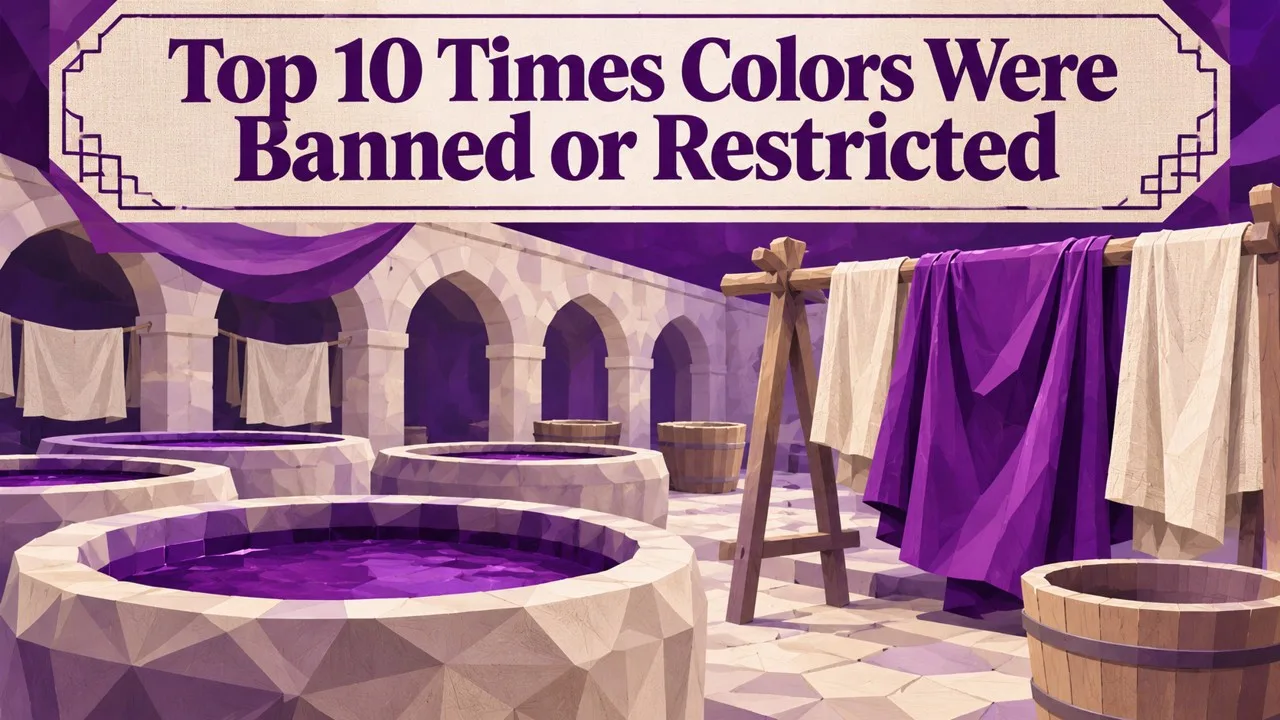
Colors have often been restricted, from Roman purple and Chinese imperial yellow to black gondolas, banned dyes, a guarded black pigment and yellow taxis. Color seems like one of the most personal choices people make. We pick clothes, cars, paint and food based partly on the colors we like. Yet throughout history, rulers, governments and even companies have tried to control who could use certain colors and how.
Some restrictions were about status. In many societies, rare and expensive dyes were reserved for rulers and elites, and laws known as sumptuary laws made sure ordinary people could not imitate their betters. Other restrictions protected local industries, preserved public order or protected health, as scientists discovered that some pigments and dyes were dangerous.
The ten examples below are Tyrian purple in the Roman and Byzantine empires, imperial yellow in China, the clothing laws of Tudor England, the sumptuary rules of Edo Japan, the battle against indigo in Europe, the black gondolas of Venice, bans on lead white paint, the banning of food dyes in the United States, an exclusive license for an ultra-black pigment and the rule that only licensed New York taxis may be yellow.
The examples cover more than two thousand years, and some of the details, especially from ancient and medieval times, are uncertain or come from later accounts. Where that is the case, it is noted.
Color restrictions reveal a great deal about the societies that made them. They show what people valued, what they feared and how they used appearance to mark rank, identity and authority.
They also show how the meaning of colors can change. A color reserved for emperors in one era may be available to anyone in the next, while a pigment once used freely may later be banned as a health hazard.
Key Facts
| # | Color | Who restricted it | Period |
|---|---|---|---|
| 1 | Tyrian purple | Roman and Byzantine rulers | Ancient Rome to the Byzantine Empire |
| 2 | Imperial yellow | Ming and Qing dynasty emperors of China | Fourteenth to twentieth centuries |
| 3 | Tudor clothing laws | English monarchs, especially Henry VIII and Elizabeth I | Sixteenth century |
| 4 | Edo sumptuary rules | The Tokugawa shogunate | Seventeenth to nineteenth centuries |
| 5 | Indigo | European rulers and dyers' guilds | Sixteenth to eighteenth centuries |
| 6 | Gondola color rules | The Venetian government | From the sixteenth century |
| 7 | Lead white paint | France and international labor agreements | Early twentieth century |
| 8 | Red No. 2 and Red No. 3 | United States Food and Drug Administration | 1976 and 2025 |
| 9 | Vantablack | An exclusive art license | 2016 |
| 10 | New York taxi yellow | New York City | 1967 onward |
1. A Color for Emperors
Tyrian purple was a dye made from the secretions of certain sea snails, produced especially in the Phoenician city of Tyre. Huge numbers of snails were needed to make a small amount of dye, making it one of the most expensive substances in the ancient world [1].
In Rome, purple became a symbol of power and rank. Senators wore togas with purple stripes, and victorious generals wore purple garments. According to the Roman historian Suetonius, the emperor Nero went further, forbidding the use of certain purple dyes and closing shops that sold them [1].
In the later Roman and Byzantine empires, laws restricted the finest purple silk to the imperial family. Children born to a reigning emperor were called porphyrogenitus, meaning born in the purple, because they were said to be born in a room decorated with purple stone.
2. The Emperor's Yellow
In imperial China, yellow was associated with the center, the earth and the emperor. During the Ming and especially the Qing dynasty, a bright shade known as imperial yellow was reserved for the emperor and his immediate family [2].
Related: Top 10 Most Bizarre Phobias: Strange Fears That Exist
Imperial robes, palace roof tiles and objects used by the emperor were often made in this color. Ordinary people were not permitted to wear it, and using it without permission could be a serious offense [2].
The emperor sometimes awarded the right to wear yellow to officials as a mark of special honor. The Qing dynasty, for example, granted a yellow riding jacket to officials for exceptional service, a high honor that was eagerly sought.
3. Purple and Gold for Royals Only
In Tudor England, a series of laws known as Acts of Apparel regulated what people could wear according to their rank and income. The laws aimed to keep social distinctions clear and to discourage spending on imported luxuries [3].
Purple silk and cloth of gold were restricted mainly to the royal family. Other fabrics, colors and furs were reserved for nobles of particular ranks. Elizabeth I issued proclamations reinforcing these rules, though enforcement was often difficult [3].
The English sumptuary laws were repealed in the early seventeenth century. By then, the growth of trade and the wealth of merchants had made it increasingly hard to control who wore what.
4. Hidden Colors in Japan
During the Edo period, the Tokugawa shogunate issued sumptuary laws to control how different social classes dressed. Merchants, who were growing wealthy, were officially placed below samurai and farmers in the social order, and the government tried to stop them from displaying their wealth [4].
Laws restricted the use of luxurious materials and certain bright colors, such as vivid reds and purples. In response, merchants and townspeople developed refined tastes for subtle browns, greys and dark blues. The phrase forty-eight browns and one hundred greys is often used to describe the variety of shades that emerged [4].
Some townspeople wore plain outer garments with rich linings or hidden decorations. The restrictions helped shape an aesthetic of understated elegance that remains influential in Japanese design.
5. The Devil's Dye
For centuries, European dyers made blue from woad, a plant grown in large quantities in parts of Germany, France and England. When Portuguese and other traders began importing indigo from Asia in the sixteenth century, it threatened the woad industry, because indigo produced a stronger blue [5].
Related: Top 10 Oldest Buildings in the World
Woad growers and merchants pressed for restrictions. In some German cities, dyers reportedly had to swear not to use indigo, which was called the devil's dye. France and other countries also passed laws limiting its use [5].
The restrictions could not hold back the superior dye forever. By the eighteenth century, indigo had largely replaced woad, and it later became the dye used for blue jeans.
6. Black Boats in Venice
Venice's gondolas are famous for their black color. But in earlier centuries, wealthy families decorated their gondolas with bright colors, rich fabrics and elaborate carvings to show off their status [6].
The Venetian government, concerned about competitive displays of wealth, passed sumptuary laws regulating gondola decoration. A law from the sixteenth century is commonly credited with requiring gondolas to be painted black, though historians differ on the exact date and wording [6].
The tradition has continued ever since. Today Venetian gondolas are still black, with only limited decoration, and they are one of the most recognizable symbols of the city.
7. A Poisonous White
Lead white was one of the most widely used pigments in history, valued by artists and house painters for its brightness and coverage. But it is highly toxic, and painters who worked with it often suffered lead poisoning [7].
In 1909, France passed a law banning the use of lead white by house painters, which took effect a few years later. In 1921, the International Labour Organization adopted a convention prohibiting the use of white lead in interior painting, which many countries ratified [7].
Related: 10 Sikh Gurus: The Pillars of Sikhism Who Shaped Faith, Equality, Courage, and Humanity
Lead-based paints remained in use in many places for decades. The United States banned lead paint for residential use in 1978. Lead white is still used by some artists, but with strict safety precautions.
8. Dyes Removed From Food
In the twentieth century, synthetic dyes were widely used to color food, drinks and cosmetics. Some of these dyes came under scrutiny as scientists studied their possible health effects [8].
In 1976, the United States Food and Drug Administration banned the dye known as Red No. 2, also called amaranth, after studies raised concerns that it might cause cancer. The ban was controversial, and the dye remains permitted in some other countries [8].
In January 2025, the FDA announced it would revoke approval of Red No. 3, also called erythrosine, in food and ingested drugs, citing a law that bans additives shown to cause cancer in animals. The dye had already been banned in cosmetics in 1990.
9. A Black Reserved for One Artist
Vantablack is a coating developed by the British company Surrey NanoSystems, made of tiny carbon nanotubes that absorb almost all visible light. Surfaces coated with it look like holes in space [9].
In 2016, the company gave the artist Anish Kapoor exclusive rights to use a version of Vantablack in art. Other artists protested, arguing that no single artist should control a material [9].
In response, the artist Stuart Semple created a pigment he called the pinkest pink, which he made available to everyone except Kapoor. He later released his own black pigments, available to other artists. The dispute drew attention to questions about ownership of colors and materials.
10. Yellow for Licensed Cabs Only
Yellow taxis are one of the most famous symbols of New York City. But the color became official in 1967, when the city required all licensed taxis that could pick up passengers on the street to be painted yellow [10].
Related: Top 10 Tallest Buildings in the World
The rule helped passengers tell licensed cabs from unlicensed vehicles. Yellow had already been popular for taxis since the early twentieth century, partly because it is easy to see. John Hertz, founder of the Yellow Cab Company in Chicago, is often credited with popularizing it [10].
In 2013, New York introduced green taxis that could pick up passengers in areas outside central Manhattan. Today the yellow cab remains a protected color for one class of licensed vehicles.
Conclusion
These examples show that color has often been tied to power, status and identity. Rulers reserved rare colors for themselves, and governments used laws to keep social distinctions visible.
They also show that color restrictions have changed over time. Many old sumptuary laws have disappeared, while new restrictions focus on health, safety and commerce.
Questions about who controls color are still debated today, from food safety to art materials and trademarks. The history of color restrictions reminds us that something as simple as a shade can carry great meaning.
Companies today also try to protect colors through trademarks, from shades associated with luxury jewelry boxes to the colors of chocolate wrappers and shoe soles. Courts in different countries have reached different conclusions about when a color can belong to one company.
Color, in short, has never been entirely free, and its rules continue to evolve.
- ^ [1] Accounts of Tyrian purple. Wikipedia: Tyrian purple Wikipedia: Porphyrogennetos
- ^ [2] Accounts of imperial yellow. Wikipedia: imperial yellow Wikipedia: imperial yellow jacket
- ^ [3] Accounts of English sumptuary laws. Wikipedia: sumptuary law Wikipedia: Elizabeth I
- ^ [4] Accounts of Edo period rules. Wikipedia: Edo period Wikipedia: iki
- ^ [5] Accounts of indigo and woad. Wikipedia: indigo dye Wikipedia: woad
- ^ [6] Accounts of Venetian gondolas. Wikipedia: gondola Wikipedia: Republic of Venice
- ^ [7] Accounts of lead white. Wikipedia: White Lead Convention Wikipedia: lead paint
- ^ [8] Accounts of banned food dyes. Wikipedia: amaranth (dye) Wikipedia: erythrosine
- ^ [9] Accounts of Vantablack. Wikipedia: Vantablack Wikipedia: Stuart Semple
- ^ [10] Accounts of New York taxis. Wikipedia: taxicabs of New York City Wikipedia: Yellow Cab Company






















Discussion
Log in with