




Top 10 Unexpected Things Scientists Have Made with DNA
 By Dhiraj Sharma · Published
Share Post
Loading…
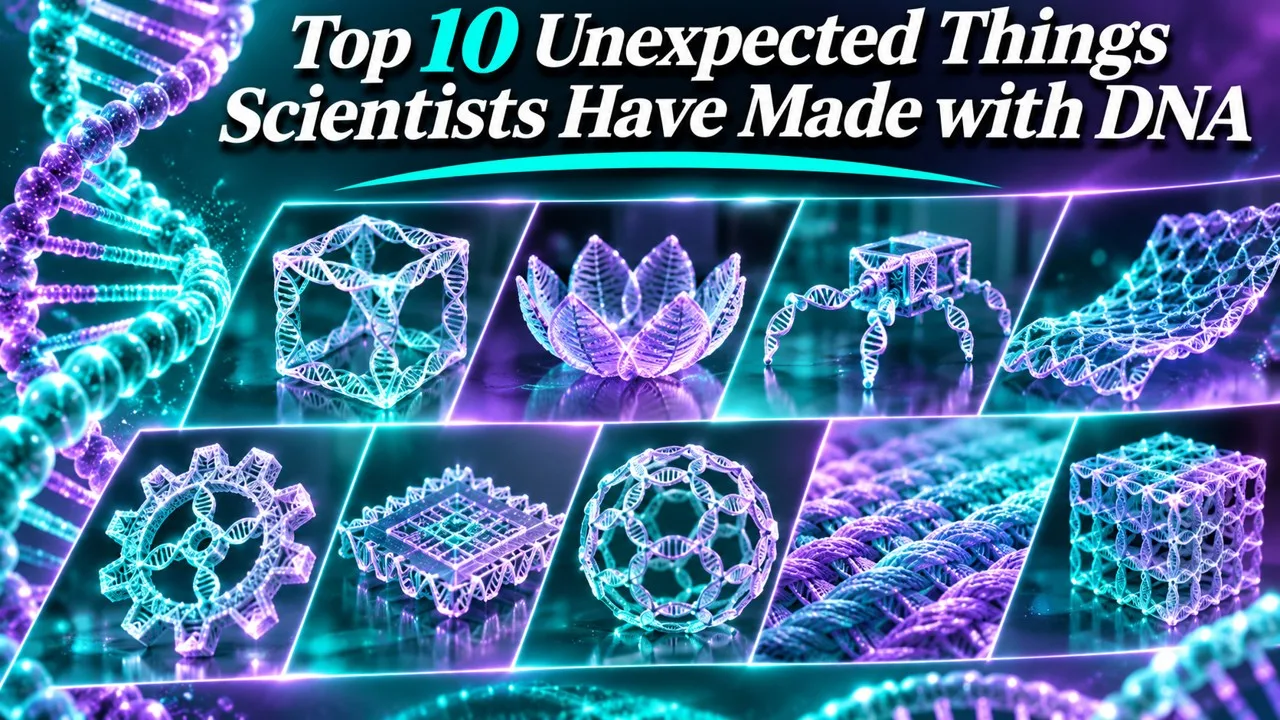
DNA has stored a short film, folded nanoscale shapes and inspired a cultured mammoth-style meatball; the list skips any AI-designed virus. That last omission is deliberate [5]. A public article can talk about origami, archives, and a laboratory demonstration of cultured meat. It cannot, and should not, walk through the design of new viruses, even as a curiosity [5]. What remains is still a list of unexpected objects, because DNA is not only a script for living bodies. It is also a polymer, an addressable tape, and a material that can be folded on purpose [3][5].
None of the ten items below is a recipe. None is a method for culturing, sequencing, or synthesizing a pathogen. The facts are historical and scientific, sourced from papers and reputable summaries, and they stop at the level a general reader needs [5][6].
Key Facts
Researchers have used DNA as a data store, a folding material, a biomaterial feedstock, and a source of computed peptide ideas, which is not the same as de-extincting an animal or inventing a virus.
Ten Objects at a Glance
| Rank | Claim | Careful version |
|---|---|---|
| 1 | A film in bacteria | A short, public-domain motion sequence was encoded in bacterial DNA; this article does not reproduce the frames |
| 2 | A DNA nano-antenna | DNA structures have been built as tiny optical or electronic antennas in the lab |
| 3 | A nanoscale game board | A three-by-three grid has been folded from DNA; no branded game art is needed or used |
| 4 | DNA origami | DNA can be folded into designed two- and three-dimensional shapes, including abstract demonstration figures |
| 5 | Plants as air cleaners | Some research has explored plants, and DNA-based or protein-based capture, as air-cleaning tools; results are early |
| 6 | Data storage, not a virus | DNA data storage is the safer, documented substitute for any "AI-created virus" item |
| 7 | Archaic peptides | Computational scans of extinct-hominin proteins have suggested antimicrobial peptides; this is not a lab manual |
| 8 | Fish-milt materials | DNA-rich fish milt has been studied as a feedstock for films and other materials, not as a kitchen product |
| 9 | Ancestral genes in mice | Researchers have tested reconstructed ancestral sequences in mice to study function, not to invent a new species for show |
| 10 | A mammoth-style meatball | A cultured meat demonstration used mammoth-inspired protein sequences; it was not a resurrected animal |
1. A Short Film, Written as Bases
In 2017, researchers led by Seth Shipman and colleagues showed that a short sequence of images could be encoded in DNA and written, using the CRISPR system as a recording device, into the genomes of living bacteria [1]. Popular accounts called it a movie stored in a cell. The demonstration used a brief motion study, in the public-domain tradition of early photographic gait studies, not a commercial feature, and this article will not restage or quote the frames [1]. The unexpected fact is the medium: a living cell as an archive, and a genome as a tape that can accept a designed message and later yield it back.
The point is storage and retrieval, not entertainment. A later reader can look up the paper if they need the exact clip. They do not need the clip reproduced here.
2. An Antenna Smaller than a Cell
DNA origami and related methods have been used to build nanostructures that act as antennas, gathering or guiding light, or coupling to electronic parts, at a scale far below a grain of dust [2]. Some designs are meant to read out molecular events; others explore how a nucleic-acid scaffold can place dyes or metal particles with a precision that ordinary lithography finds expensive [2]. "World's tiniest antenna" is a moving title, because the record, if it is a record, keeps being updated. The durable surprise is that a molecule famous for heredity can also be a carefully bent wire in an optical experiment.
An antenna of this kind is a lab object. It is not a phone tower, and it does not need to be one in order to count.
Related: Top 10 Life-Changing DNA Test Discoveries
3. A Grid Folded for a Game
Researchers have folded DNA into a three-by-three grid, a nanoscale board on which molecular "moves" can be made, sometimes described as a tic-tac-toe board [3]. The analogy is useful and also easy to oversell. The object is a demonstration of addressable sites on a folded scaffold, not a toy with a trademarked box or a set of official rules [3]. This article will not borrow branded board-game art, names as logos, or a photograph of a commercial set. The unexpected fact is the scale: a game-shaped lattice small enough to sit, in principle, on a bacterium.
A grid is a grid. The chemistry is the news. The brand, if any, can stay on the shelf.
4. Folding a Genome's Alphabet into a Shape
Paul Rothemund's DNA origami, published in 2006, showed that a long scaffold strand could be pinned by hundreds of short "staples" into a designed two-dimensional shape, and later work extended the method into three dimensions, into curved surfaces, and into objects that can open or close on cue [4]. Popular galleries of the method include abstract rectangles, letters, and a smiling demonstration face. Those pictures are experimental figures, not a license to reprint a trademarked character or a famous painting in an image prompt [4]. The science is the fold: a polymer that can be programmed, in a mix of strands, to assemble itself.
The "masterpiece" in the older headline is a laboratory pattern. The lasting fact is that sequence can be used as a folding instruction, not only as a gene.
5. Plants, Genes, and a Hope about Air
A recurring hope in environmental biotechnology is that plants, or materials derived from nucleic acids and proteins, might help clean indoor or outdoor air, by taking up gases or capturing particles [5]. Some studies have tested genetically modified plants with added enzymes, sometimes borrowed from animals, that can help break down certain volatile compounds; others have used DNA or protein coatings as capture layers in filters [5]. The results are early, uneven, and not a reason to treat a houseplant as a substitute for ventilation or for a tested filter. The unexpected item is the research program itself: DNA as a tool in air, not only in a cell.
Related: Top 10 Turning Points in the History of Biology
A potted plant can still be only a plant. The papers are allowed to be more ambitious, so long as the ambition is labeled as research.
6. An Archive, Not a Designed Virus
Lists of "unexpected DNA objects" sometimes include viruses designed or proposed with the help of machine-learning tools. That item is not going to be written up here as a how-to, a recipe, or even a semi-technical walkthrough, because it sits in the wrong category for a general-audience explainer [6]. The safer, and independently interesting, substitute is DNA digital data storage: the encoding of books, images, and archives into DNA sequences that can be synthesized, kept, and later read, a field associated with work by George Church, researchers at Microsoft and the University of Washington, and others [6]. The densities are remarkable on paper. The practical limits, cost, writing speed, and error correction, are still being negotiated.
An archive in a tube is unexpected enough. A public article does not need to add a designed pathogen in order to fill a tenth slot, and it will not do so.
7. Peptides Suggested by an Extinct Genome
In recent years, researchers have computationally translated protein sequences from extinct hominins, including Neanderthals and Denisovans, and have looked for short peptides with antimicrobial properties [7]. Some of those candidates have been tested in the laboratory as part of a search for new antibiotic leads, at a time when resistance has made that search urgent [7]. This article will not list sequences, give a synthesis protocol, or treat the work as a finished medicine. The unexpected fact is the source: a genome that no longer walks the Earth can still suggest a molecule, on a screen, that a chemist may later decide is worth a careful, regulated test.
A peptide idea is not a drug, and it is not a resurrected person. It is a hypothesis with an unusual family tree.
Related: Top 10 Most Bizarre Phobias: Strange Fears That Exist
8. A Film That Began as Milt
Fish milt, the sperm-rich milt of salmon and other species, is a concentrated source of DNA, and materials scientists have used that feedstock, sometimes after extraction and sometimes as a crude, DNA-rich stream, to make films, gels, and experimental plastics or coatings [8]. Headlines that say "plastic from fish sperm" are doing a lot of work with a few words. The objects are laboratory and pilot materials, with questions still attached about durability, cost, and whether they are truly a large-scale alternative to ordinary polymers [8]. They are not a kitchen project, and they are not a finished consumer product in the present tense.
The surprise is that a waste or side stream from fisheries can be a polymer feedstock. The chemistry, not the joke, is the item.
9. An Ancestral Sequence, Tested in a Mouse
Molecular evolution sometimes reconstructs a "best guess" ancestral protein or regulatory sequence and then places that sequence into a living model, often a mouse, to see what it does [9]. The experiment can shed light on how an old gene worked, or on what changed as mammals diversified. It is not the same as building a pre-mammal animal, and it is not a carnival of chimeric pets [9]. This article stays with the research aim: a test of function, described at a high level, without a protocol. The unexpected fact is temporal. A sequence that, in the strict sense, no longer exists in the wild can still be tried, carefully, in a modern genome, under ordinary laboratory rules.
The mouse remains a mouse. The question being asked is about the past, not about a new species for display.
Related: Top 10 Oldest Buildings in the World
10. A Meatball That Is Not a Mammoth
In 2023 a cultured-meat demonstration, associated with the company Vow and with work that drew on mammoth myoglobin-like sequences, produced a single, theatrical meatball as a proof of concept [10]. It was not a slice from a resurrected animal, and it was not a sign that de-extinction had reached the dinner table [10]. The protein idea came from an extinct lineage; the cells and the rest of the process were modern and cultivated. Taste was not independently established as a scientific result, and the object was as much a press event as a meal. The unexpected fact, kept in its right size, is that a sequence from a vanished elephant-relative can show up in a cultured product without bringing the animal back.
A demonstration plate is allowed to be striking. It is not allowed, in a careful article, to become a resurrection.
Conclusion
DNA is a well-known molecule with a less well-known second life as a material. It can record a short film, fold into a grid or an antenna, suggest a peptide, and thicken a film. It can be an archive for ordinary files, which is the right item to put in the place of any "AI-designed virus" slot. A mouse can carry a reconstructed ancestral sequence for a study, and a cultured meatball can borrow a mammoth-inspired protein without being a mammoth. In all ten cases the right tone is a raised eyebrow, not a protocol.
The list is fuller than it would have been if it had chased a dangerous headline. That is a feature of the list, not a gap in it.
- ^ [1] Shipman, S. L., and colleagues, work on encoding a short image sequence in bacterial DNA with CRISPR-based recording, 2017, described here without reproducing the frames. Nature: CRISPR-mediated recording in living cells
- ^ [2] Research on DNA nanostructures used as optical or electronic nano-antennas. Britannica: Nanotechnology
- ^ [3] Demonstrations of DNA-folded three-by-three grids described as nanoscale game boards, without branded art. Britannica: DNA origami, and related methods
- ^ [4] Rothemund, P. W. K., "Folding DNA to create nanoscale shapes and patterns," Nature, 2006, and later three-dimensional origami work. Nature: Folding DNA to create nanoscale shapes
- ^ [5] Reviews of plants and nucleic-acid or protein materials explored for air cleaning, treated as early research. Britannica: Bioremediation
- ^ [6] Overviews of DNA digital data storage, including work associated with George Church and with Microsoft and the University of Washington; this item substitutes for any AI-designed-virus headline. Britannica: DNA
- ^ [7] Computational studies of antimicrobial peptides suggested by archaic hominin protein sequences, described without sequences or protocols. Britannica: Antimicrobial peptide, and related research reports
- ^ [8] Materials research using DNA-rich fish milt as a feedstock for films and experimental polymers. Britannica: Deoxyribonucleic acid
- ^ [9] Studies that place reconstructed ancestral sequences into mice to test function, described at a high level. Britannica: Molecular evolution
- ^ [10] Contemporary reporting on the 2023 cultured-meat mammoth-style meatball demonstration, distinguished here from de-extinction. Britannica: Cultured meat, and contemporaneous news summaries




















Discussion
Log in with