





 By
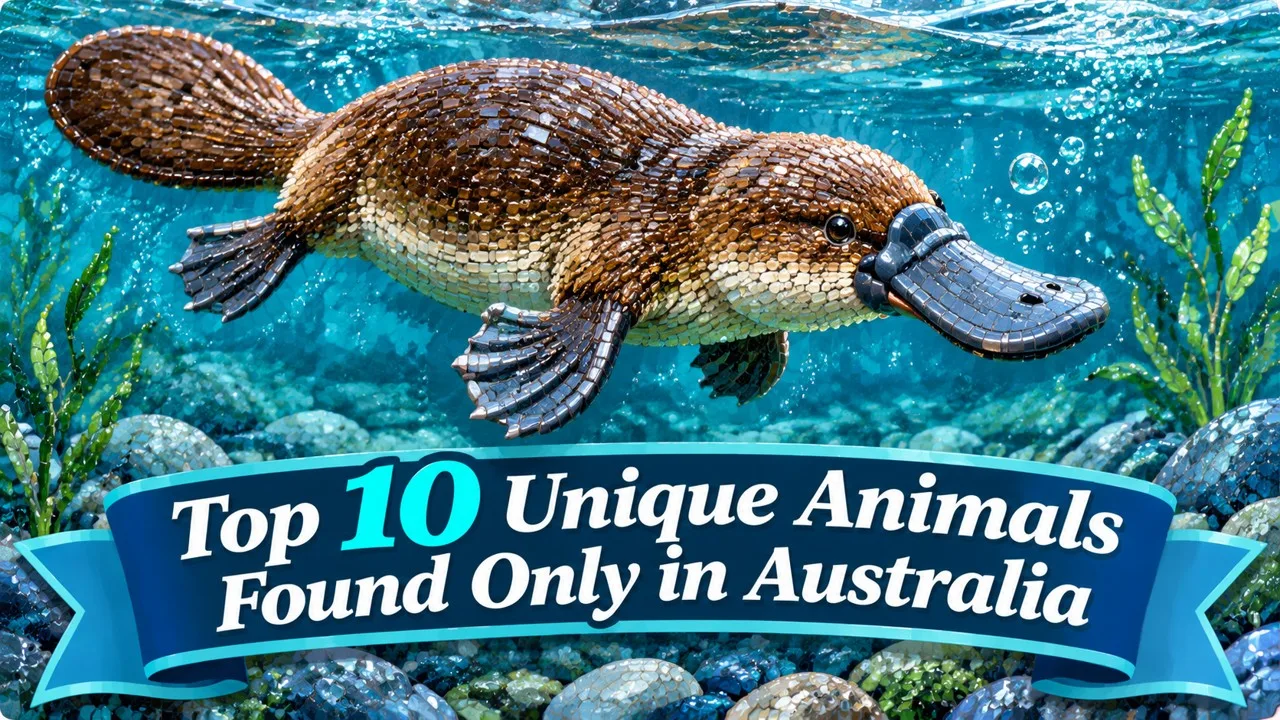
From the egg-laying platypus and cube-pooping wombat to the termite-eating numbat, these ten unique animals found only in Australia live nowhere else. Australia has been isolated from other continents for tens of millions of years. During that time, its wildlife evolved in its own direction, producing animals found nowhere else on Earth.
Most of Australia's native mammals are marsupials, which carry their young in pouches, and it is home to two of the world's few egg-laying mammals. Its birds and reptiles are just as unusual, from the laughing kookaburra to spiny desert lizards. This list features ten animals that live naturally only in Australia.
Key Facts
The ten animals below include monotremes, marsupials, birds and a reptile, all endemic to Australia.
Unique Animals of Australia at a Glance
| # | Animal | Group | Habitat | What makes it unique |
|---|---|---|---|---|
| 1 | Platypus | Monotreme | Rivers and streams of eastern Australia | A mammal that lays eggs |
| 2 | Red Kangaroo | Marsupial | Arid and semi-arid inland Australia | The largest marsupial |
| 3 | Koala | Marsupial | Eucalyptus forests of eastern Australia | A specialist leaf-eater |
| 4 | Common Wombat | Marsupial | Forests and hills of southeastern Australia | Produces cube-shaped droppings |
| 5 | Tasmanian Devil | Marsupial | Tasmania | The largest carnivorous marsupial |
| 6 | Quokka | Marsupial | Rottnest Island and southwestern Australia | The smiling marsupial |
| 7 | Numbat | Marsupial | Woodlands of southwestern Australia | A termite-eating specialist |
| 8 | Emu | Bird | Most of mainland Australia | The second-tallest bird |
| 9 | Superb Lyrebird | Bird | Forests of southeastern Australia | A master of mimicry |
| 10 | Thorny Devil | Reptile | Deserts of central and western Australia | Drinks through its skin |
1. Platypus
The platypus is one of the strangest animals on Earth. It has a duck-like bill, a beaver-like tail, webbed feet and thick waterproof fur. [1]
When the first specimen reached Britain around 1799, some scientists suspected it was a hoax made by sewing parts of different animals together. [1]
The platypus is a monotreme, one of a small group of mammals that lay eggs. Females feed their young milk that seeps from patches on their skin, as they have no nipples.
Its bill is packed with sensors that detect the tiny electrical signals made by the muscles of prey. It hunts underwater with its eyes, ears and nostrils closed.
Males have a sharp spur on each hind leg that delivers venom, which can cause severe pain to humans.
In 2020 scientists reported that platypus fur glows blue-green under ultraviolet light.
Key Figures
- Group: monotreme
- Habitat: rivers of eastern Australia
- Reproduction: lays eggs
- Special sense: electroreception
Why It Made the List
The platypus breaks many of the usual rules for mammals. It is a living link to ancient mammal history.
2. Red Kangaroo
The red kangaroo is the largest living marsupial. Large males can stand taller than an adult human and weigh around 85 kilograms. [2]
Kangaroos move by hopping on their powerful hind legs, using their tails for balance. Hopping is very energy-efficient at high speeds. [2]
A red kangaroo can cover several metres in a single bound and reach speeds above 50 kilometres per hour.
A newborn joey is tiny, about the size of a jellybean. It crawls into its mother's pouch, where it feeds and grows for months.
Females can pause the development of an embryo until conditions improve, a process called embryonic diapause, which helps them survive droughts.
The kangaroo is a national symbol of Australia and appears in countless stories and artworks.
Red kangaroos live in mobs and can survive long periods without drinking, getting much of their water from plants.
Related: Top 10 Amazing Animals of the Amazon Rainforest
Key Figures
- Group: marsupial
- Male weight: around 85 kg
- Speed: over 50 km/h
- Newborn size: about the size of a jellybean
Why It Made the List
The red kangaroo is the giant of the marsupial world. Its hopping and breeding strategies are perfect for a dry continent.
3. Koala
The koala is a tree-dwelling marsupial that feeds almost entirely on eucalyptus leaves. [3]
These leaves are tough, low in nutrients and toxic to most animals. Koalas have special gut bacteria and a long digestive tract to process them. [3]
Because their diet provides little energy, koalas sleep or rest for up to 18 to 22 hours a day.
Koalas have fingerprints remarkably similar to human fingerprints, a case of similar features evolving separately.
Despite their nickname, koala bears are not bears. Their closest living relatives are wombats.
In 2022, koalas in Queensland, New South Wales and the Australian Capital Territory were listed as Endangered because of habitat loss, bushfires, disease and drought.
A koala's loud bellowing call surprises many visitors.
Key Figures
- Group: marsupial
- Diet: eucalyptus leaves
- Rest: up to 18 to 22 hours a day
- Status: Endangered in parts of eastern Australia
Why It Made the List
The koala is Australia's best-known animal. Its specialised diet makes it fascinating and vulnerable.
4. Common Wombat
The common wombat is a stocky, burrowing marsupial that can weigh more than 25 kilograms. [4]
Wombats are famous for producing cube-shaped droppings. Scientists discovered that the shape forms in the last part of the intestine, where the walls stretch unevenly. [4]
Researchers who studied this received an Ig Nobel Prize in 2019, an award for science that first makes people laugh and then makes them think.
Wombats leave their cubes on rocks and logs to mark their territory, and the flat sides stop them from rolling away.
Their pouches face backwards, so soil does not get in while they dig.
Despite their chunky build, wombats can run surprisingly fast for short distances.
It is mainly active at night and spends the day underground in its burrow system.
Key Figures
- Group: marsupial
- Weight: over 25 kg
- Famous for: cube-shaped droppings
- Pouch: faces backwards
Why It Made the List
The wombat is an expert digger with a unique claim to fame. It shows how odd evolution can be.
Related: Top 10 Unique Animals of Madagascar
5. Tasmanian Devil
The Tasmanian devil is the largest living carnivorous marsupial. Today it is found in the wild only on the island of Tasmania. [5]
It is known for its loud screeches, fierce displays and one of the strongest bites for its size of any mammal, able to crunch through bone. [5]
Devils are mainly scavengers, feeding on dead animals at night.
Since the 1990s, a contagious cancer called devil facial tumour disease has killed a large share of the population.
Conservationists have set up disease-free insurance populations, and in 2020 devils were released into a sanctuary on the Australian mainland for the first time in thousands of years.
The species is listed as Endangered.
Devils disappeared from the mainland around 3,000 years ago, possibly because of competition with dingoes and changes in climate.
Key Figures
- Group: marsupial
- Range: Tasmania
- Threat: devil facial tumour disease
- Status: Endangered
Why It Made the List
The Tasmanian devil is a fierce survivor. Its fight against a contagious cancer has drawn worldwide attention.
6. Quokka
The quokka is a small wallaby about the size of a domestic cat. Its upturned mouth makes it look as if it is smiling. [6]
It lives mainly on Rottnest Island, off the coast of Perth, and in a few areas of southwestern Australia. [6]
Rottnest Island was named by the Dutch explorer Willem de Vlamingh in 1696, who mistook the quokkas for large rats. Its name means rat's nest.
Quokkas became famous on social media through selfies with tourists, which earned them the nickname the world's happiest animal.
Visitors are not allowed to feed or touch them, and heavy fines apply.
The species is listed as Vulnerable, threatened by introduced predators such as foxes and cats on the mainland.
Quokkas are mostly active at night and can survive on plants with little fresh water.
Key Figures
- Group: marsupial
- Main home: Rottnest Island
- Size: about that of a cat
- Status: Vulnerable
Why It Made the List
The quokka is Australia's internet star. Its island home helps protect it from predators.
7. Numbat
The numbat is a small, striped marsupial that feeds almost entirely on termites. [7]
Related: Top 10 Animals That Can Live Without Food for Months
It can eat up to about 20,000 termites a day, licking them up with a long, sticky tongue. [7]
Unlike most marsupials, numbats are active during the day, when termites are moving close to the surface.
Female numbats have no pouch. Their young cling to their mother's teats, protected by her fur.
The numbat is the state animal of Western Australia.
It is Endangered, with only a small number left in the wild, mainly because of foxes and cats introduced by Europeans.
It shelters at night in hollow logs and burrows, and its striped back helps it blend into dappled woodland light. Programmes to control foxes and release captive-bred numbats into fenced reserves have helped some populations recover.
Key Figures
- Group: marsupial
- Diet: termites, up to 20,000 a day
- Active: by day
- Status: Endangered
Why It Made the List
The numbat is one of Australia's most specialised mammals. Its survival depends on predator control.
8. Emu
The emu is the tallest bird in Australia and the second-tallest in the world after the ostrich, standing up to about 1.9 metres. [8]
It cannot fly but can run at around 50 kilometres per hour. [8]
Unusually, male emus incubate the eggs for about eight weeks, barely eating or drinking during that time, and then care for the chicks.
Emus roam widely in search of food and water, eating plants, fruits and insects.
In 1932, Western Australia deployed soldiers with machine guns against emus damaging crops. The so-called Emu War largely failed.
The emu appears on the Australian coat of arms alongside the kangaroo.
Its eggs are a striking dark green.
Emus are found across most of the mainland, from deserts to forests.
Key Figures
- Group: flightless bird
- Height: up to about 1.9 m
- Speed: about 50 km/h
- Parenting: males incubate the eggs
Why It Made the List
The emu is one of the world's largest birds. Its parenting and history make it a true Australian icon.
9. Superb Lyrebird
The superb lyrebird is one of the world's best mimics. Males copy the songs of many other birds with astonishing accuracy. [9]
Lyrebirds have also been recorded imitating human-made sounds, such as camera shutters and alarms, especially birds living near people. [9]
During courtship, males fan their long, lacy tail feathers over their heads while singing and dancing on mounds of earth.
Related: Top 10 Unique Animals Found Only in Africa
The shape of the male's tail feathers reminded early Europeans of a lyre, an ancient stringed instrument.
Lyrebirds rake through leaf litter for insects and other small animals, helping to turn over the forest floor.
They are found in the forests of southeastern Australia, including national parks near Melbourne and Sydney.
A male's song can include many borrowed calls in a single performance.
Key Figures
- Group: bird
- Skill: vocal mimicry
- Courtship: song and dance displays
- Range: southeastern Australia
Why It Made the List
The lyrebird is a superstar of mimicry. Its performances are among the most remarkable in the animal kingdom.
10. Thorny Devil
The thorny devil is a small lizard covered in sharp spikes. It lives in the sandy deserts of central and western Australia. [10]
It has a remarkable way of drinking. Tiny channels between its scales draw water by capillary action from dew or damp sand towards its mouth. [10]
Its diet consists almost entirely of small black ants, which it eats one at a time, sometimes thousands in a single meal.
The lizard has a spiny knob on the back of its neck, often called a false head. When threatened, it tucks its real head down and presents the knob.
Its colours change with temperature and activity, helping it blend into the desert.
Despite its fearsome look, it is harmless to people.
It moves with a slow, jerky, rocking walk that may help it avoid the notice of predators.
Key Figures
- Group: reptile
- Habitat: deserts
- Diet: small ants
- Special skill: drinking through skin channels
Why It Made the List
The thorny devil is a master of desert survival. Its water-collecting skin is a natural marvel.
Conclusion
Australia's isolation produced some of the most unusual animals on Earth, from egg-laying mammals to mimicking birds. Many of them exist nowhere else.
Introduced predators, habitat loss and bushfires threaten many of these species. Conservation efforts are vital to protecting Australia's unique wildlife.
- ^ [1] "Platypus". Wikipedia. Wikipedia: Platypus Wikipedia: Monotreme
- ^ [2] "Red Kangaroo". Wikipedia. Wikipedia: Red kangaroo Wikipedia: Marsupial
- ^ [3] "Koala". Wikipedia. Wikipedia: Koala Wikipedia: Eucalyptus
- ^ [4] "Common Wombat". Wikipedia. Wikipedia: Common wombat Wikipedia: Ig Nobel Prize
- ^ [5] "Tasmanian Devil". Wikipedia. Wikipedia: Tasmanian devil Wikipedia: Devil facial tumour disease
- ^ [6] "Quokka". Wikipedia. Wikipedia: Quokka Wikipedia: Rottnest Island
- ^ [7] "Numbat". Wikipedia. Wikipedia: Numbat Wikipedia: Termite
- ^ [8] "Emu". Wikipedia. Wikipedia: Emu Wikipedia: Emu War
- ^ [9] "Superb Lyrebird". Wikipedia. Wikipedia: Superb lyrebird Wikipedia: Animal mimicry
- ^ [10] "Thorny Devil". Wikipedia. Wikipedia: Thorny devil Wikipedia: Capillary action

















Discussion
Log in with