






 By
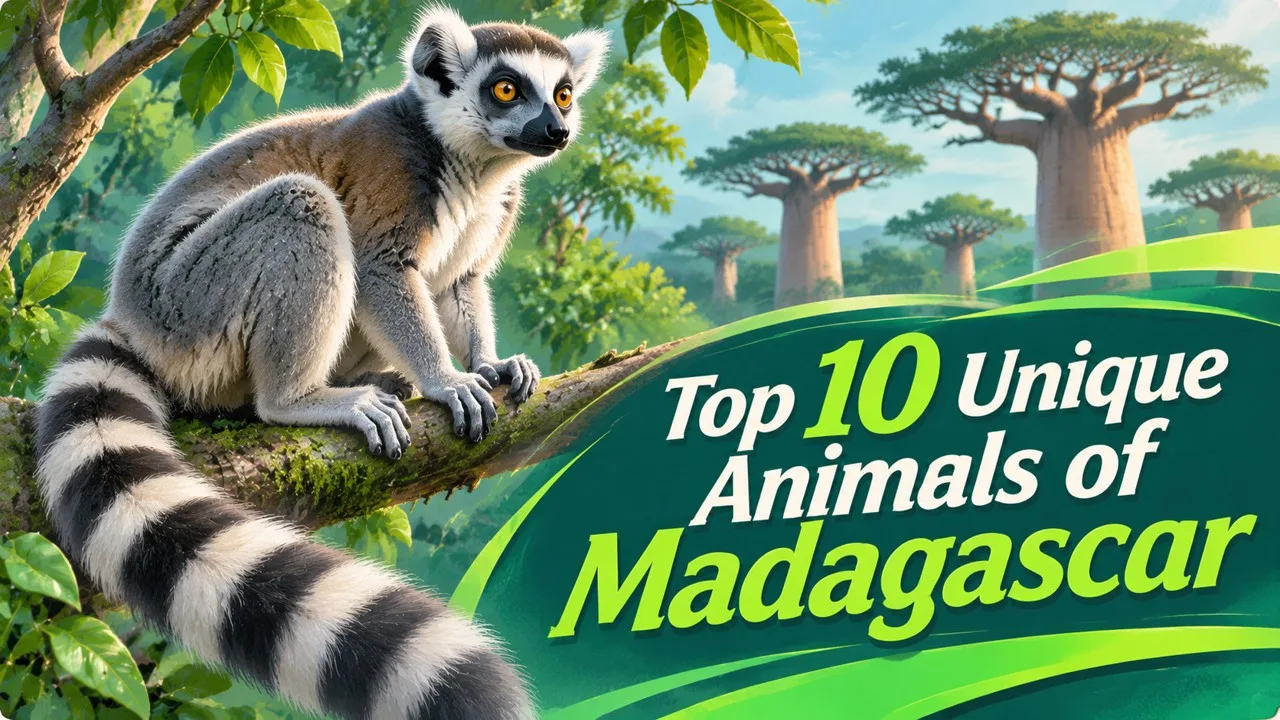
From dancing sifakas and the lemur-hunting fossa to the world's smallest primate and a tiny chameleon, meet ten unique animals of Madagascar found nowhere else. Madagascar is the fourth-largest island in the world, lying in the Indian Ocean off the coast of Africa. It separated from Africa around 180 million years ago and from the Indian subcontinent around 90 million years ago.
This long isolation allowed its plants and animals to evolve in their own way. Most of its mammals, reptiles and amphibians are found nowhere else on Earth. Lemurs, for example, live naturally only on Madagascar. This list introduces ten of the island's most remarkable animals.
Key Facts
The ten animals below include primates, a carnivore, reptiles, insects and a mammal that communicates with its quills.
Unique Animals of Madagascar at a Glance
| # | Animal | Group | Habitat | What makes it unique |
|---|---|---|---|---|
| 1 | Ring-tailed Lemur | Primate | Dry forests and scrub of southern Madagascar | Female-led troops and stink fights |
| 2 | Verreaux's Sifaka | Primate | Dry forests of southwestern Madagascar | Dances across the ground |
| 3 | Fossa | Carnivore | Forests across Madagascar | The island's top predator |
| 4 | Madame Berthe's Mouse Lemur | Primate | Kirindy Forest, western Madagascar | The world's smallest primate |
| 5 | Panther Chameleon | Reptile | Northern and eastern coasts of Madagascar | A living rainbow |
| 6 | Brookesia nana | Reptile | Rainforest of northern Madagascar | Possibly the world's smallest reptile |
| 7 | Satanic Leaf-tailed Gecko | Reptile | Rainforests of eastern Madagascar | A living dead leaf |
| 8 | Giraffe Weevil | Insect | Rainforests of Madagascar | A beetle with a giraffe-like neck |
| 9 | Lowland Streaked Tenrec | Mammal | Rainforests of northern and eastern Madagascar | Communicates by rubbing its quills |
| 10 | Comet Moth | Insect | Rainforests of Madagascar | Spectacular tails and a short life |
1. Ring-tailed Lemur
The ring-tailed lemur is the most famous lemur, recognised by its long tail with black and white rings. [1]
It lives in groups called troops, usually led by females, who get first choice of food and mates. [1]
Males compete in stink fights. They rub their tails with scent from glands on their wrists and wave them at rivals.
Unlike most lemurs, ring-tails spend a lot of time on the ground. They often sit upright with their arms outstretched to warm themselves in the morning.
They eat fruit, leaves, flowers and insects, and can survive in very dry habitats.
The species is Endangered, threatened by habitat loss and capture for the pet trade.
Troops keep in contact with a range of calls, and their striped tails, held high like flags while walking, help members stay together. Ring-tails can live for more than 20 years in captivity.
Key Figures
- Group: primate, lemur
- Social life: female-led troops
- Behaviour: stink fights
- Status: Endangered
Why It Made the List
The ring-tailed lemur is Madagascar's best-known animal. Its social life is unusual among primates.
2. Verreaux's Sifaka
Verreaux's sifaka is a large lemur with white fur and a dark face. It is an extraordinary leaper. [2]
In the trees, it can jump several metres from trunk to trunk, pushing off with its powerful legs. [2]
On the ground, where its long legs make walking awkward, it moves by hopping sideways with its arms raised, a movement often described as dancing.
Its name comes from its alarm call, which sounds like shi-fak.
Sifakas eat mainly leaves, flowers and fruit, and live in small family groups.
The species is Critically Endangered, with its forests shrinking because of logging and farming.
Related: Top 10 Extraordinary Lizards of the World
Its long hind legs are much stronger than its arms, so it clings upright to trunks between leaps. Sifakas get most of the water they need from the leaves they eat, which helps them survive long dry seasons.
Key Figures
- Group: primate, lemur
- Movement: sideways dancing hops
- Name origin: its call
- Status: Critically Endangered
Why It Made the List
The sifaka's dance is one of nature's most delightful sights. It is a symbol of Madagascar's dry forests.
3. Fossa
The fossa is the largest carnivorous mammal on Madagascar. It looks like a small cougar, but it is more closely related to mongooses. [3]
It is slender and long-tailed, with a head-and-body length of about 70 to 80 centimetres. [3]
The fossa is an expert climber. Its flexible ankles allow it to climb up and down trees head-first and leap between branches.
Lemurs make up a large part of its diet, and it is one of their few natural predators.
Fossas are mostly solitary, coming together only to breed.
The species is listed as Vulnerable because of forest loss and conflict with farmers.
Its semi-retractable claws and long tail help it balance in the canopy. Female fossas raise their young alone, and the cubs stay with their mother for more than a year while they learn to hunt.
Key Figures
- Group: carnivore
- Length: about 70 to 80 cm, head and body
- Prey: mainly lemurs
- Status: Vulnerable
Why It Made the List
The fossa is Madagascar's apex predator. Its cat-like features evolved independently.
4. Madame Berthe's Mouse Lemur
Madame Berthe's mouse lemur is the smallest primate in the world. Its body is only about 9 centimetres long, and it weighs around 30 grams. [4]
It lives mainly in the Kirindy Forest of western Madagascar. [4]
The species was described as new to science in 2000, after scientists compared it with similar mouse lemurs.
It is active at night, feeding on insects and sugary secretions produced by other insects.
Its huge eyes help it find food in the dark.
The species is Endangered because its small forest habitat is threatened.
It was named in honour of Berthe Rakotosamimanana, a Malagasy primatologist who supported research on the island. Like other mouse lemurs, it can lower its body temperature and slow its metabolism to save energy when food is scarce.
Key Figures
- Group: primate
- Body length: about 9 cm
- Weight: about 30 g
- Status: Endangered
Why It Made the List
This tiny lemur is the smallest primate on Earth. It shows the remarkable diversity of Madagascar's lemurs.
Related: Top 10 Amazing Animals of the Amazon Rainforest
5. Panther Chameleon
The panther chameleon is one of the most colourful reptiles in the world. Males can be bright green, blue, red or yellow, depending on where they live. [5]
Chameleons change colour by adjusting tiny crystals in special skin cells, which changes the way light is reflected. [5]
Colour changes are used for communication, especially when males compete or court females.
Its eyes can move independently, so it can look in two directions at once.
It catches insects with a sticky tongue that can be longer than its body and shoots out at great speed.
Madagascar is home to around half of the world's chameleon species.
Females are usually duller, with pink or peach colours, and they lay clutches of eggs buried in the soil. Panther chameleons are popular in the pet trade, and export is regulated to protect wild populations.
Key Figures
- Group: reptile
- Colour change: tiny skin crystals
- Tongue: longer than its body
- Madagascar: about half of all chameleon species
Why It Made the List
The panther chameleon is a showpiece of colour. It highlights Madagascar's chameleon diversity.
6. Brookesia nana
In 2021, German and Malagasy scientists described Brookesia nana, a chameleon so tiny that it can sit on a fingertip. [6]
Adult males have a body only about 13.5 millimetres long, making it possibly the smallest reptile known. [6]
It was found on the Sorata massif in the rainforests of northern Madagascar.
Unlike many chameleons, it does not change colour. It lives on the forest floor, hunting tiny insects among the leaf litter.
At night it climbs onto low grass stems to sleep.
Scientists believe it is threatened by deforestation, as its known range is very small.
The discovery team noted that the forest where it lives has been affected by logging and farming. Scientists recommended that the species be listed as threatened.
Females are slightly larger than males.
Key Figures
- Group: reptile
- Described: 2021
- Male body length: about 13.5 mm
- Range: Sorata massif
Why It Made the List
Brookesia nana is one of the tiniest vertebrates on Earth. It shows that Madagascar still holds new discoveries.
Related: Top 10 Remarkable Frogs of the World
7. Satanic Leaf-tailed Gecko
The satanic leaf-tailed gecko is a master of camouflage. Its flat tail looks like a dead, curled leaf, complete with notches and veins. [7]
Its body is mottled brown, and it can flatten itself against branches to avoid casting shadows. [7]
It is active at night, hunting insects in the forest understorey.
Like many geckos, it has no eyelids. It licks its eyes to keep them clean and moist.
When threatened, it may open its mouth wide to reveal a bright red interior and give a loud distress call.
Its spiky eyebrows give it a devilish look, which is how it got its name.
It is one of the smallest leaf-tailed geckos, and it is threatened by habitat loss and collection for the pet trade.
Females lay small clutches of eggs.
Key Figures
- Group: reptile
- Camouflage: leaf-shaped tail
- Active: at night
- Feature: no eyelids
Why It Made the List
The leaf-tailed gecko is one of nature's best disguises. It almost disappears among dead leaves.
8. Giraffe Weevil
The giraffe weevil is a small beetle with a black body, bright red wing covers and an extraordinarily long neck. [8]
Males have necks two to three times longer than females. They use them to fight rivals for mates. [8]
Females use their shorter necks to roll leaves into tubes, laying a single egg inside each one.
The leaf tube protects the larva, which feeds on it as it grows.
Giraffe weevils feed on the leaves of a particular tree, which they depend on.
The beetle's strange shape makes it a favourite of nature photographers.
It is often found on Dichaetanthera trees, its main food plant, in the eastern rainforests. Like many weevils, it is harmless to people.
Its total length is only about 2.5 centimetres.
Key Figures
- Group: insect, beetle
- Feature: long neck, especially in males
- Nesting: rolled leaf tubes
- Range: Madagascar
Why It Made the List
The giraffe weevil is one of the strangest-looking insects. Its neck is a striking example of sexual selection.
9. Lowland Streaked Tenrec
The lowland streaked tenrec is a small, spiny mammal with black and yellow stripes. It looks a little like a hedgehog but is not closely related. [9]
Tenrecs evolved on Madagascar from a common ancestor, and their spines are an example of convergent evolution. [9]
Related: Top 10 Largest Birds in the World
The streaked tenrec has special quills on its back that it rubs together to make a high-pitched sound, a process called stridulation.
It is the only mammal known to communicate in this way, a method more typical of insects such as crickets.
It feeds mainly on earthworms, which it finds in the soft soil of the forest floor.
Tenrecs show amazing variety, with some resembling shrews, others hedgehogs and others otters.
It lives in family groups.
Key Figures
- Group: mammal, tenrec
- Communication: stridulation with quills
- Diet: mainly earthworms
- Range: northern and eastern Madagascar
Why It Made the List
The streaked tenrec is a mammal that communicates like an insect. It shows how isolation produces unique solutions.
10. Comet Moth
The comet moth is one of the largest silk moths in the world, with long, trailing tails on its hindwings. [10]
The tails may help confuse bats, which hunt using echolocation, by drawing attacks away from the body. [10]
Its wings are decorated with eyespots, which may scare predators.
The adult moth has no working mouthparts and cannot feed. It lives for only about four to five days, long enough to find a mate and lay eggs.
Its caterpillars feed on the leaves of several trees and spin silk cocoons with holes to let rainwater drain out.
The moth is threatened by habitat loss in the wild but is bred in captivity.
Its wingspan can reach about 14 centimetres.
Key Figures
- Group: insect, moth
- Feature: long hindwing tails
- Adult lifespan: about 4 to 5 days
- Defence: eyespots and tails
Why It Made the List
The comet moth is one of the world's most beautiful insects. Its short adult life is spent entirely on reproduction.
Conclusion
Madagascar's long isolation created a world of unique animals, from dancing lemurs to tiny chameleons. Many species are still being discovered.
Deforestation is a serious threat, and much of the island's original forest has been lost. Protecting what remains is vital for these extraordinary creatures.
- ^ [1] "Ring-tailed Lemur". Wikipedia. Wikipedia: Ring-tailed lemur Wikipedia: Lemur
- ^ [2] "Verreaux's Sifaka". Wikipedia. Wikipedia: Verreaux's sifaka Wikipedia: Sifaka
- ^ [3] "Fossa". Wikipedia. Wikipedia: Fossa (animal) Wikipedia: Eupleridae
- ^ [4] "Madame Berthe's Mouse Lemur". Wikipedia. Wikipedia: Madame Berthe's mouse lemur Wikipedia: Kirindy Forest
- ^ [5] "Panther Chameleon". Wikipedia. Wikipedia: Panther chameleon Wikipedia: Chameleon
- ^ [6] "Brookesia nana". Wikipedia. Wikipedia: Brookesia nana Wikipedia: Brookesia
- ^ [7] "Satanic Leaf-tailed Gecko". Wikipedia. Wikipedia: Uroplatus phantasticus Wikipedia: Camouflage
- ^ [8] "Giraffe Weevil". Wikipedia. Wikipedia: Giraffe weevil Wikipedia: Sexual dimorphism
- ^ [9] "Lowland Streaked Tenrec". Wikipedia. Wikipedia: Lowland streaked tenrec Wikipedia: Stridulation
- ^ [10] "Comet Moth". Wikipedia. Wikipedia: Comet moth Wikipedia: Saturniidae




















Discussion
Log in with