





 By
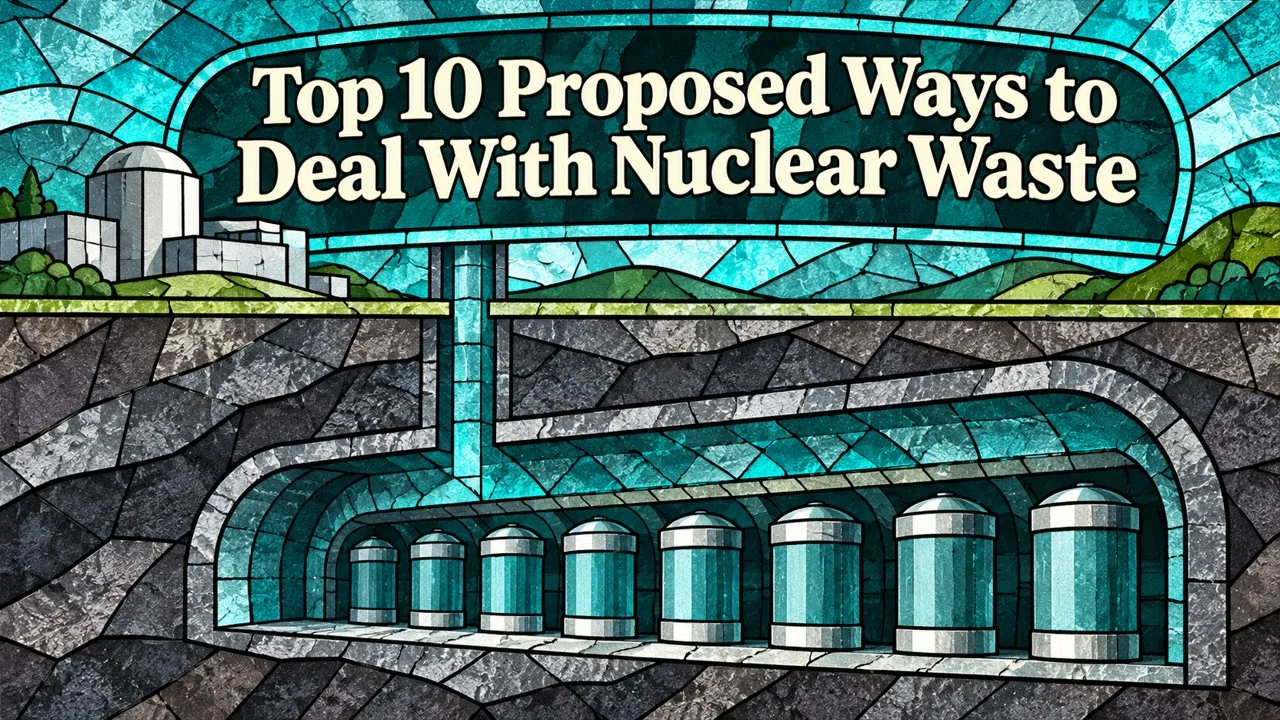
From launching it into space to burying it in ice sheets or deep rock, here are ten ideas, some adopted and some abandoned, for dealing with nuclear waste. Nuclear power produces large amounts of electricity without burning fossil fuels, but it leaves behind a difficult problem. Spent fuel and other high-level radioactive waste remain hazardous for thousands of years, far longer than any human institution has lasted.
Since the 1950s, scientists, engineers and governments have proposed many ways to deal with this waste. Some ideas were practical and are now being put into practice. Others were bold, strange or risky, and were abandoned after careful study.
The challenge is not just technical but also political and social. Communities often oppose having waste stored nearby, and plans must account for future generations who may not understand the danger or even speak the same languages.
Most spent fuel today is kept in cooling pools or in dry casks at the power stations where it was produced. These are seen as temporary solutions, while countries work on permanent options.
The ten proposals below range from burying waste deep underground to launching it into space. Each one shows a different way of thinking about a problem that will outlast everyone alive today.
Looking at both the successful and abandoned ideas helps explain why the issue remains so difficult, and why progress has often been slow.
Radioactive waste comes in several categories. Low-level waste, such as protective clothing and tools, makes up most of the volume but is relatively easy to handle. High-level waste, mainly spent fuel and the leftovers from reprocessing, makes up a small share of the volume but contains most of the radioactivity, and it is this waste that poses the greatest long-term challenge.
Key Facts
| # | Proposal | Where | Status |
|---|---|---|---|
| 1 | Onkalo repository | Olkiluoto, Finland | Under construction and testing |
| 2 | Yucca Mountain | Nevada, United States | Designated in 1987, stalled since 2010 |
| 3 | Waste Isolation Pilot Plant | New Mexico, United States | Operating since 1999 |
| 4 | Space disposal | Studied in the United States and elsewhere | 1970s and 1980s |
| 5 | Ice sheet disposal | Proposed for Antarctica and Greenland | 1970s |
| 6 | Ocean disposal | Atlantic, Pacific and Arctic oceans | 1946 to 1993 |
| 7 | Deep borehole disposal | Proposed in several countries | Under study |
| 8 | Reprocessing | France, United Kingdom, Russia and others | Since the 1940s |
| 9 | Transmutation | Research projects in Europe and Asia | Under development |
| 10 | Long-term warning messages | United States and Europe | 1980s onward |
1. Burying It Deep in Ancient Rock
The most widely supported long-term solution is the deep geological repository, in which waste is sealed in sturdy containers and buried hundreds of meters underground in stable rock. Finland has led the way with a facility known as Onkalo, which means cave or cavity in Finnish [1].
At Onkalo, spent fuel is to be placed in copper canisters, surrounded by bentonite clay and buried in tunnels around four hundred meters down in ancient bedrock. The site is designed to keep the waste isolated for around one hundred thousand years [1].
Onkalo is widely described as the first such repository for spent fuel in the world to reach the stage of final testing. Sweden and other countries are developing similar plans, though some face delays and local opposition.
Related: Natural Nuclear Fission Reactors: Unique Geological Phenomena Explained
2. A Mountain in the Desert
In 1987, the United States Congress chose Yucca Mountain in Nevada as the site for a national repository for spent nuclear fuel and high-level waste. Scientists spent years studying the geology and water flow in the area, and tunnels were dug for research [2].
The project faced strong opposition from the state of Nevada and many residents, who argued that it was unsafe and unfair to place the nation's waste in their state. Debates also arose over the long-term movement of water through the rock [2].
In 2010, the federal government moved to halt the project, and funding largely dried up. The United States still does not have a permanent repository for spent fuel from its commercial reactors, which remains stored at power plants across the country.
3. Salt Beds Underground
The Waste Isolation Pilot Plant in New Mexico stores radioactive waste in ancient salt beds deep underground. Salt slowly flows and closes around objects over time, which helps seal the waste in place, and the presence of salt suggests that water has not flowed through the rock for millions of years [3].
The facility handles waste from the production of nuclear weapons, such as contaminated clothing, tools and equipment, rather than spent fuel from power stations. It has received thousands of shipments since opening [3].
In 2014, a waste drum burst underground after it was packed with an unsuitable material, releasing a small amount of radiation and closing the facility for several years. It later reopened with new safety measures, and the incident led to changes in how waste is packed.
4. Launching It Into Space
One of the most dramatic ideas was to launch nuclear waste into space, sending it toward the sun or into a distant orbit where it could never return. Studies were carried out by NASA and others in the 1970s and 1980s [4].
The concept faced major problems. The cost of launching enough waste would be enormous, and the risk of a rocket failure could scatter radioactive material in the atmosphere or across a wide area. The loss of the Space Shuttle Challenger in 1986 highlighted these dangers [4].
The idea has largely been abandoned. It shows how attractive a seemingly permanent solution can be, and how the risks of getting it wrong can outweigh the benefits.
Related: Top 10 Most Bizarre Phobias: Strange Fears That Exist
5. Melting Into the Ice
Another proposal was to place heat-producing waste containers on or in the ice sheets of Antarctica or Greenland. The heat from the waste would melt the ice, allowing the containers to sink slowly toward the bedrock far below [5].
Supporters argued that the thick ice would isolate the waste from people. Critics pointed out that scientists did not fully understand how ice sheets behaved, and that meltwater and ice movement could carry the waste to the sea [5].
The Antarctic Treaty bans the disposal of radioactive waste in Antarctica, and the idea was never put into practice. Today, concerns about melting ice sheets make it seem even less wise.
6. Dumping at Sea
For several decades, some countries dumped radioactive waste into the ocean, often in drums filled with concrete. Mostly this was low-level waste, but some reactors and other materials were also disposed of at sea. Proponents argued that the vast ocean would dilute any leaks [6].
Scientists also studied the possibility of burying waste in the thick sediment of the deep seabed, where it might remain isolated for long periods. Experiments explored how canisters would behave in this environment [6].
International opposition grew, and in 1993, parties to the London Convention agreed to ban the dumping of radioactive waste at sea. Monitoring of old dumping sites continues to this day.
7. Drilling Very Deep Holes
Deep borehole disposal involves drilling narrow holes several kilometers into the Earth's crust and placing waste containers at the bottom. The holes would then be sealed, putting the waste far deeper than in a typical mined repository [7].
Supporters argue that the great depth and stable rock would keep the waste isolated, and that boreholes could be drilled in many places using techniques developed by the oil and gas industry. This could reduce the need to transport waste over long distances [7].
Related: Top 10 Oldest Buildings in the World
The idea has been studied in the United States, the United Kingdom and other countries, and some private companies are developing designs. Challenges include placing containers accurately at great depths and retrieving them if something goes wrong.
8. Recycling Spent Fuel
Spent nuclear fuel still contains usable uranium and plutonium. Reprocessing separates these materials so they can be made into new fuel, while the remaining waste is turned into glass through a process called vitrification for long-term storage [8].
France reprocesses much of its spent fuel at the La Hague site, and several other countries have operated reprocessing plants. Supporters say it reduces the volume of high-level waste and makes better use of uranium [8].
Critics argue that reprocessing is expensive and creates separated plutonium, which could be used in nuclear weapons if stolen or diverted. The United States stopped commercial reprocessing in the 1970s, partly for these reasons.
9. Changing the Atoms
Some of the most long-lived radioactive elements in nuclear waste could, in theory, be converted into shorter-lived or stable elements by bombarding them with neutrons. This process is called transmutation [9].
Research projects, including the MYRRHA project in Belgium, aim to build accelerator-driven systems that could transmute waste. If successful, the approach could reduce the time that some waste remains dangerous from hundreds of thousands of years to a few hundred [9].
Transmutation is still at the research stage and would not eliminate the need for repositories altogether. But it could make the problem more manageable in the future.
10. Warning Future Generations
Any repository must remain safe for thousands of years, long after current languages and governments may have disappeared. In the 1980s, the United States government asked experts to consider how to warn future people not to dig into waste sites [10].
Related: 10 Sikh Gurus: The Pillars of Sikhism Who Shaped Faith, Equality, Courage, and Humanity
Proposals included giant hostile landscapes of spikes, messages carved in many languages, and even the idea of an atomic priesthood that would pass down warnings through rituals. Another unusual suggestion involved breeding cats that would change color near radiation, with songs and stories teaching people to fear the change [10].
These ideas show how hard it is to communicate across vast spans of time. Most current plans rely on a mix of markers, records and the hope that sites will be forgotten and left undisturbed.
Conclusion
Nuclear waste presents one of the longest-lasting challenges that humanity has ever created. The proposals range from careful engineering to wild speculation, and each reflects the knowledge and concerns of its time.
Deep geological repositories have emerged as the most widely supported option, and Finland's progress offers a model that other countries may follow. Yet political and social challenges remain as important as technical ones.
The debate over nuclear waste is closely linked to wider questions about energy and climate change. Some see nuclear power as an essential low-carbon source, while others see the waste problem as a reason to avoid it.
Whatever the future of nuclear energy, the waste that already exists must be managed safely for generations to come.
International cooperation has become increasingly important. Countries share research through bodies such as the International Atomic Energy Agency, and some have discussed shared regional repositories. Public trust, built through openness and local consent, has proved just as vital as good geology in deciding where waste will finally rest.
- ^ [1] Accounts of radioactive waste. Wikipedia: radioactive waste Wikipedia: radioactive waste management
- ^ [2] Accounts of Onkalo. Wikipedia: Onkalo spent nuclear fuel repository Wikipedia: deep geological repository
- ^ [3] Accounts of Yucca Mountain. Wikipedia: Yucca Mountain nuclear waste repository Wikipedia: spent nuclear fuel
- ^ [4] Accounts of WIPP. Wikipedia: Waste Isolation Pilot Plant Wikipedia: dry cask storage
- ^ [5] Accounts of space disposal. Wikipedia: Space Shuttle Challenger disaster Wikipedia: high-level radioactive waste management
- ^ [6] Accounts of ice sheet disposal. Wikipedia: Antarctic Treaty System Wikipedia: ice sheet
- ^ [7] Accounts of ocean disposal. Wikipedia: ocean disposal of radioactive waste Wikipedia: London Convention
- ^ [8] Accounts of deep boreholes. Wikipedia: deep borehole disposal Wikipedia: borehole
- ^ [9] Accounts of reprocessing. Wikipedia: nuclear reprocessing Wikipedia: La Hague site
- ^ [10] Accounts of transmutation and warnings. Wikipedia: nuclear transmutation Wikipedia: long-term nuclear waste warning messages





















Discussion
Log in with