






 By
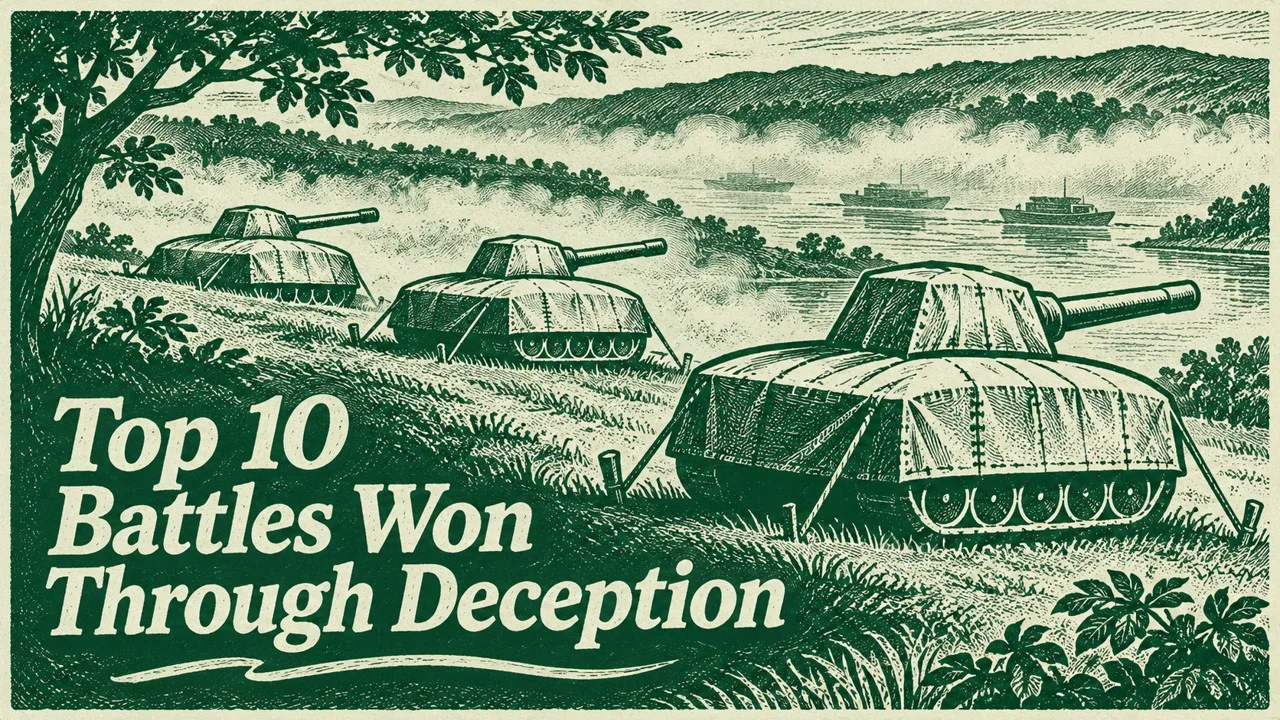
Fake retreats, false defections, canvas horses and a corpse carrying forged letters: ten battles and campaigns that were won through deception. In war, strength and courage matter, but so does trickery. Military leaders have long understood that convincing an enemy to make the wrong move can be just as decisive as winning a head-on fight.
The ancient Chinese strategist Sun Tzu wrote that all warfare is based on deception. Commanders throughout history have followed this advice, using ambushes, feigned retreats, false information and fake armies to mislead their opponents.
Deception can take many forms. Some commanders hid their troops in fog or behind hills. Others pretended to flee, drawing enemies into traps. In the twentieth century, entire fictional armies were created, complete with fake radio traffic and inflatable tanks.
Not every deception works, and some famous stories have grown in the retelling. Historians sometimes debate whether a retreat was truly feigned or a real rout that turned around by chance. Where that is the case, it is noted.
The ten battles and campaigns below span more than two thousand years, from ancient Italy and China to the Second World War. In each case, deception played a key role in the outcome.
Together, they show that in war, what the enemy believes can be as important as what is real.
They also show how the tools of deception have changed with technology, from hidden soldiers and fire ships to forged documents, radio signals and double agents, while the underlying principle has stayed the same.
Studying these cases remains part of military education today, as commanders learn how to deceive their opponents and how to avoid being deceived themselves.
Deception has a long history in literature as well as in war. The story of the Trojan Horse, told in ancient Greek and Roman poetry, describes how Greek soldiers hid inside a giant wooden horse that the Trojans pulled into their city. Whether or not it happened, the tale became a lasting symbol of trickery in war, and today the phrase Trojan horse is used for everything from political schemes to computer malware.
Key Facts
| # | Battle | Where | When |
|---|---|---|---|
| 1 | Battle of Lake Trasimene | Central Italy | 217 BC |
| 2 | Battle of Red Cliffs | Yangtze River, China | 208 or 209 AD |
| 3 | Battle of Hastings | Southern England | 1066 |
| 4 | Battle of the Kalka River | Present-day Ukraine | 1223 |
| 5 | Siege of Yorktown | Virginia, United States | 1781 |
| 6 | Battle of Cowpens | South Carolina, United States | January 1781 |
| 7 | Battle of Austerlitz | Moravia, present-day Czech Republic | December 1805 |
| 8 | Battle of Megiddo | Palestine | September 1918 |
| 9 | Operation Mincemeat | Spain and Sicily | 1943 |
| 10 | Operation Fortitude | Britain and Normandy | 1944 |
1. An Ambush in the Fog
During the Second Punic War, the Carthaginian general Hannibal invaded Italy and faced a Roman army led by the consul Gaius Flaminius. Hannibal set a trap along the northern shore of Lake Trasimene, where a narrow road ran between the hills and the water [1].
He hid his troops in the hills overnight. In the morning, as the Roman army marched along the shore through thick fog, Hannibal's forces attacked from several directions at once, trapping the Romans against the lake [1].
Related: Stalingrad Was a Major Turning Point
The Roman army was largely destroyed, and Flaminius was killed. Ancient sources say that around fifteen thousand Romans died, making it one of the largest ambushes in military history.
2. A False Defection and Fire Ships
At the end of the Han dynasty, the powerful warlord Cao Cao led a large army south to conquer his rivals. An alliance of the warlords Sun Quan and Liu Bei opposed him along the Yangtze River [2].
According to historical accounts, one of Sun Quan's officers, Huang Gai, sent a message pretending that he wanted to defect to Cao Cao. He then sailed toward Cao Cao's fleet with ships filled with flammable material, which were set on fire as they approached [2].
The fire spread through Cao Cao's ships and camps, causing heavy losses. The defeat stopped his advance south and helped lead to the division of China into three kingdoms.
3. Retreats That Broke a Shield Wall
At the Battle of Hastings, the Norman army of William, Duke of Normandy, faced the English army of King Harold II, which formed a strong shield wall on a ridge. Early Norman attacks failed to break the English line [3].
According to some medieval chroniclers, the Normans then used feigned retreats, pretending to flee and drawing English soldiers down from the ridge. Once the English broke ranks, the Normans turned and attacked them [3].
Historians debate whether these retreats were planned or whether real retreats turned into opportunities. Either way, the weakening of the shield wall contributed to the Norman victory and the conquest of England.
4. A Retreat That Lasted Days
In 1223, a Mongol force led by the generals Jebe and Subutai faced a combined army of Rus' princes and Cuman warriors. Instead of fighting immediately, the Mongols retreated for several days [4].
The pursuing armies became spread out and disorganized. When they reached the Kalka River, the Mongols suddenly turned and attacked, defeating them in detail [4].
Related: Top 10 Inventions That Changed Warfare: Chariots to Drones
The feigned retreat was a favorite tactic of steppe armies, who used their skill as mounted archers to draw enemies into vulnerable positions. The battle was the first major clash between the Mongols and the Rus'.
5. A Feint Toward New York
In 1781, George Washington and his French allies considered attacking the British in New York City. Instead, they decided to march south to trap a British army under Lord Cornwallis at Yorktown, Virginia [5].
To keep the British commander in New York from realizing their plan, they made it appear that an attack on New York was coming. Troops built camps and ovens in New Jersey, and misleading information was allowed to reach the British [5].
By the time the British understood what was happening, the allied armies were far to the south. Together with a French fleet, they besieged Yorktown, and Cornwallis surrendered in October 1781, a decisive moment in the American Revolutionary War.
6. The Militia That Pulled Back on Purpose
At Cowpens, the American general Daniel Morgan faced a British force under Banastre Tarleton, known for aggressive attacks. Morgan arranged his troops in lines, with militia at the front and experienced Continental soldiers behind [6].
He asked the militia to fire two volleys and then withdraw. When they did so, the British believed the Americans were fleeing and charged forward [6].
The British then ran into the steady fire of the Continentals, and American cavalry attacked their flanks. The British force was nearly destroyed, in one of the most complete American victories of the war.
7. Pretending to Be Weak
Before the Battle of Austerlitz, Napoleon made his army appear weaker than it was. He gave up the strong position on the Pratzen Heights and showed signs of wanting to negotiate [7].
The Russian and Austrian commanders believed they had the advantage. They attacked Napoleon's right flank, which he had deliberately weakened, moving troops away from the center of their line [7].
Related: Midway Turned the Tide in the Pacific
Napoleon then launched a powerful attack on the Pratzen Heights, splitting the allied army in two. The victory, often called his greatest, led to the end of the Third Coalition.
8. Canvas Horses in the Desert
In 1918, the British general Edmund Allenby planned an offensive against Ottoman forces in Palestine. He wanted the Ottomans to believe that he would attack inland, in the Jordan Valley, rather than along the coast [8].
His forces built fake camps in the Jordan Valley, filled with thousands of dummy horses made of canvas. Mules dragged branches to raise dust as if troops were moving, and a hotel in Jerusalem was prepared as if for a headquarters [8].
Meanwhile, the real attack force gathered near the coast, hidden in orchards. When the offensive began, it broke through quickly, and cavalry swept north in one of the most successful campaigns of the war.
9. A Corpse With Fake Plans
In 1943, British intelligence wanted to persuade Germany that the Allies would invade Greece and Sardinia, rather than Sicily. They obtained the body of a man who had died in London and dressed him as a Royal Marines officer, with a fictional identity [9].
The body was carried by submarine and released off the coast of Spain, along with a briefcase containing forged letters referring to the false invasion plans. Spanish officials allowed the Germans to see the documents [9].
German intelligence believed the documents, and some forces were moved to Greece and Sardinia. When the Allies invaded Sicily in July 1943, the deception helped reduce resistance, at least initially.
10. A Fake Army for D-Day
Before the invasion of Normandy in June 1944, the Allies launched a huge deception campaign called Operation Fortitude. Its aim was to convince Germany that the main invasion would come at the Pas-de-Calais, or even in Norway [10].
Related: Top 10 Surprise Attacks That Changed Military History
The Allies created a fictional army group in southeast England, complete with fake radio traffic, dummy landing craft and inflatable tanks. Double agents, who were secretly working for the British, sent false information to German intelligence [10].
After the Normandy landings, the Germans continued to believe that a larger attack was coming at Calais, and they held back forces there for weeks. The deception is widely regarded as one of the most successful in military history.
Conclusion
These battles show the power of deception in war. Ambushes, feigned retreats, false defections and fake armies have all helped commanders win victories that might otherwise have been impossible.
Deception works by exploiting what an enemy expects or wants to believe. Hannibal used fog, Napoleon used the appearance of weakness and the Allies used forged documents and inflatable tanks.
The methods have changed with technology, but the principle remains the same. Modern militaries still invest heavily in deception and in defending against it.
Behind each of these stories lies a human cost, as deception led to the deaths of many soldiers. But they remain powerful examples of how the mind can be as important a battlefield as any field or sea.
Understanding them helps explain why secrecy, intelligence and imagination have always been among the most important weapons of war.
Deception also carries risks. A plan that relies on fooling the enemy can collapse if a single document is lost, a spy is uncovered or the enemy simply refuses to take the bait. The most successful deceptions were carefully planned, consistent in every detail and designed to confirm what the enemy already suspected, rather than trying to persuade them of something entirely new.
In war, as in so much else, appearances can be the most powerful weapon of all.
- ^ [1] Accounts of Lake Trasimene. Wikipedia: Battle of Lake Trasimene Wikipedia: Hannibal
- ^ [2] Accounts of Red Cliffs. Wikipedia: Battle of Red Cliffs Wikipedia: Huang Gai
- ^ [3] Accounts of Hastings. Wikipedia: Battle of Hastings Wikipedia: feigned retreat
- ^ [4] Accounts of the Kalka River. Wikipedia: Battle of the Kalka River Wikipedia: Subutai
- ^ [5] Accounts of Yorktown. Wikipedia: Siege of Yorktown Wikipedia: military deception
- ^ [6] Accounts of Cowpens. Wikipedia: Battle of Cowpens Wikipedia: Daniel Morgan
- ^ [7] Accounts of Austerlitz. Wikipedia: Battle of Austerlitz Wikipedia: War of the Third Coalition
- ^ [8] Accounts of Megiddo. Wikipedia: Battle of Megiddo (1918) Wikipedia: Edmund Allenby
- ^ [9] Accounts of Operation Mincemeat. Wikipedia: Operation Mincemeat Wikipedia: Allied invasion of Sicily
- ^ [10] Accounts of Operation Fortitude. Wikipedia: Operation Fortitude Wikipedia: Ghost Army























Discussion
Log in with