






 By
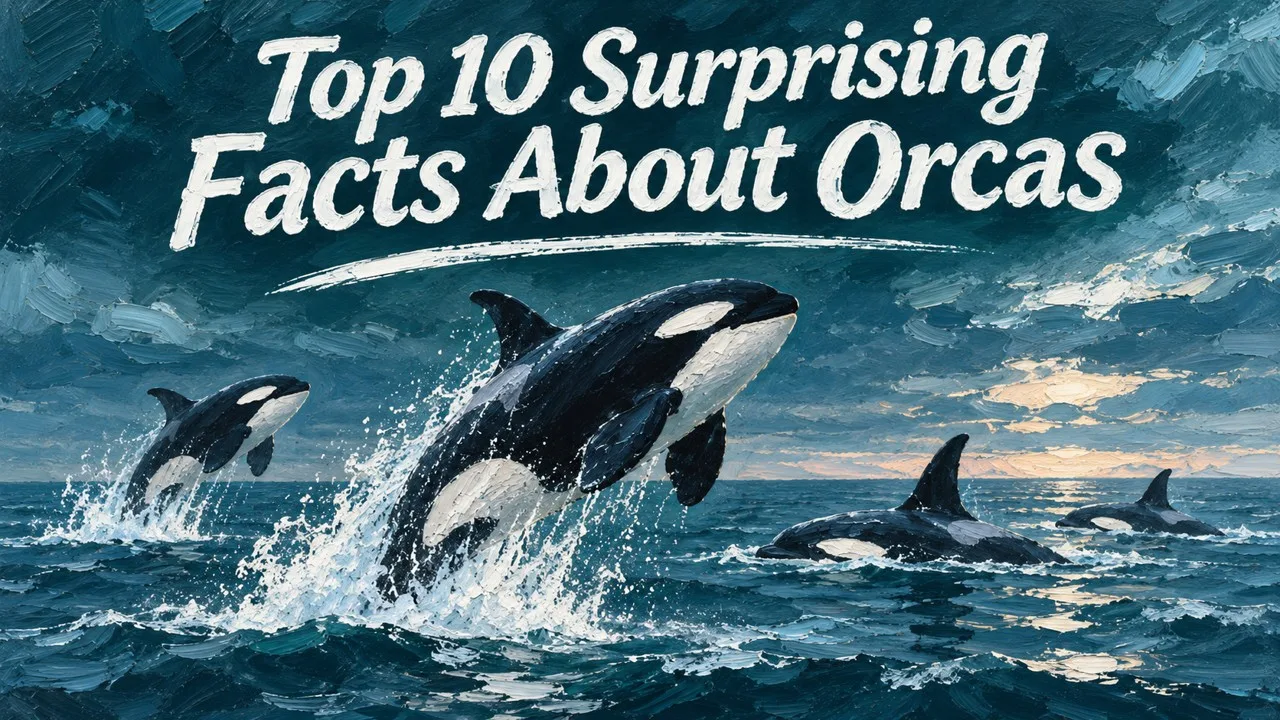
Orcas are giant dolphins with dialects, grandmothers that lead, salmon hats and a taste for shark livers. Ten surprising facts about killer whales. Orcas, also called killer whales, are found in every ocean, from the Arctic and Antarctic to tropical seas. With their striking black and white markings, they are among the most recognizable animals on Earth.
They are top predators that hunt fish, seals, whales and even sharks. Yet research over the past half century has shown that orcas also have complex family lives, distinct cultures and behaviors that are passed from one generation to the next.
Much of what is known comes from long-term studies in the Pacific Northwest, Norway, Argentina, the Antarctic and elsewhere. Researchers identify individuals by the shape of their dorsal fins and the gray saddle patches behind them.
These ten facts show why orcas continue to fascinate scientists and the public.
Key Facts
| # | Fact | Population or place | Why it stands out |
|---|---|---|---|
| 1 | Orca anatomy | Worldwide | Not a whale in the usual sense |
| 2 | Orca ecotypes | Northeast Pacific and beyond | Groups that do not interbreed |
| 3 | Matrilineal families | Resident orcas | Sons never leave home |
| 4 | Menopause | Resident orcas | One of very few species with menopause |
| 5 | Orca calls | Pods worldwide | Learned sounds passed through generations |
| 6 | Hunting strategies | Antarctica and Argentina | Techniques taught by adults |
| 7 | Shark predation | South Africa and California | Livers on the menu |
| 8 | Iberian orcas | Spain and Portugal | A mystery behavior |
| 9 | Tahlequah | Southern resident orcas | Carried her dead calf for seventeen days |
| 10 | Salmon hats | Southern resident orcas | A trend that came back |
1. The Largest Dolphin
Despite the name killer whale, the orca is the largest member of the oceanic dolphin family. Adult males can reach about eight meters in length and weigh several tonnes, while females are smaller [1].
Males have a tall, straight dorsal fin that can reach about 1.8 meters in height, while females have a shorter, curved fin. The name killer whale is thought to come from sailors who called orcas whale killers after seeing them attack larger whales [1].
Orcas are among the fastest marine mammals, capable of short bursts of more than 50 kilometers per hour. In the wild, there are no confirmed records of orcas killing a human. Their scientific name, Orcinus orca, was given in the eighteenth century. Orcas have a thick layer of blubber and can dive to depths of several hundred meters, and their teeth, which interlock when the mouth closes, can each be several centimeters long.
2. Different Diets, Different Lives
In the northeastern Pacific, scientists have identified different types of orcas that share the same waters but live very differently. Resident orcas eat mainly fish, especially Chinook salmon, while Bigg's orcas hunt marine mammals such as seals and porpoises [2].
The groups differ in their vocalizations, social structure and behavior, and they generally avoid each other and do not interbreed. Similar distinct types have been described in the Antarctic and other regions. A third northeast Pacific type, known as offshore orcas, travels in large groups far from the coast and appears to feed heavily on sharks, which wears down their teeth [2].
In 2024, a team of researchers proposed that the resident and Bigg's orcas should be recognized as separate species, based on genetic, physical and behavioral differences. The proposal has not yet been universally accepted. The proposed scientific names were Orcinus ater for residents and Orcinus rectipinnus for Bigg's orcas. Bigg's orcas are named after Michael Bigg, a Canadian scientist who pioneered the photo-identification of individual orcas in the 1970s.
Related: Top 10 Unexpected Abilities Found in Animals
3. Mothers for Life
Resident orcas in the northeastern Pacific live in family groups centered on mothers. Both sons and daughters stay with their mothers for life, which is unusual among mammals [3].
Several related family groups travel together as pods. When a mother dies, her adult sons face a much higher risk of dying within the following year, according to long-term studies [3].
Mothers continue to share food with their adult sons, sometimes at a cost to their own reproduction. Researchers think this support helps explain the close bonds within families. A pod may include four generations traveling together. Researchers have tracked some southern resident families for more than fifty years, building detailed family trees from photographs and observations collected since the 1970s.
4. Grandmothers That Lead
Female orcas stop reproducing in their thirties or forties but can live for decades afterward. Orcas are one of only a handful of animal species, along with humans and a few other toothed whales, known to go through menopause [4].
Studies of resident orcas show that older females often lead their groups during foraging, especially in years when salmon are scarce. Their knowledge of where to find food may help the whole group survive [4].
The presence of a grandmother has been linked to better survival of her grandchildren. Some females in the wild are estimated to have lived into their eighties or nineties. One southern resident female, known as Granny or J2, was estimated by some researchers to be more than a hundred years old when she was last seen in 2016, although that estimate is uncertain. Other toothed whales known to experience menopause include short-finned pilot whales and belugas.
5. Family Dialects
Orcas communicate using clicks, whistles and pulsed calls. Each pod has its own set of calls, known as a dialect, which young orcas learn from their families [5].
Pods that share some calls belong to the same acoustic clan, which researchers believe reflects shared ancestry. The dialects can remain stable for decades [5].
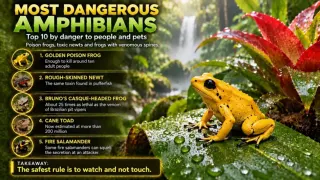
Related: Top 10 Most Dangerous Amphibians in the World
This learned communication is one reason scientists describe orcas as having culture. In some studies, captive orcas have even imitated sounds made by humans and other species. In a study published in 2018, an orca named Wikie at a marine park in France learned to copy several human words, such as hello. Acoustic monitoring is now used to track wild pods by their calls, which can be recognized by experts and software.
6. Waves and Beaches as Hunting Tools
In the Antarctic, some orcas hunt seals resting on ice floes by swimming in formation to create a wave that washes the seal into the water. This technique requires close coordination [6].
On the beaches of Punta Norte in Argentina and at the Crozet Islands in the southern Indian Ocean, some orcas deliberately strand themselves on the shore to grab sea lion or elephant seal pups before wriggling back into the sea [6].
Adults appear to teach young orcas these risky techniques, which are known only from certain populations. Wave-washing has been documented in detail by researchers working on the Antarctic Peninsula, where the orcas often target Weddell seals. At Punta Norte, on Peninsula Valdes, the stranding hunts take place when sea lion pups enter the water close to shore at high tide.
7. Hunters of Great White Sharks
Orcas sometimes hunt great white sharks, one of the ocean's top predators. Off South Africa, a pair of male orcas known as Port and Starboard have been linked to the deaths of numerous great whites since around 2017 [7].
The orcas appear to target the sharks' large, nutrient-rich livers, leaving much of the rest of the body. After attacks, great white sharks have been observed leaving the area for long periods [7].
Similar behavior was recorded near California's Farallon Islands, where white sharks left after orcas killed one in 1997. In 2022, a drone filmed orcas hunting a great white off South Africa. Researchers also documented Starboard killing a young great white shark on his own in under two minutes. Orcas have also been recorded hunting other sharks and rays, including whale sharks, in various parts of the world.
Related: Top 10 Amazing Animals of the Amazon Rainforest
8. Interactions With Sailing Boats
Since 2020, orcas in the waters off Spain and Portugal have repeatedly approached sailing boats and struck or bitten their rudders. Several boats have sunk after being damaged, although no people have been seriously hurt [8].
The Iberian orca population is small, numbering only a few dozen animals, and is considered critically endangered. Researchers have identified a limited number of individuals involved in most interactions [8].
Scientists do not know why the behavior began. Explanations include play, curiosity or a response to a negative experience, and the behavior appears to have spread among young orcas. Most interactions take place in summer along the coasts of Portugal and Galicia in Spain, and in spring and autumn in the Strait of Gibraltar. Authorities have issued guidance to sailors, such as stopping the boat and avoiding contact.
9. A Mother's Grief
In 2018, an orca known as Tahlequah, or J35, gave birth to a calf off the coast of Washington State, but the calf died within an hour. She then carried its body for seventeen days, covering around 1,600 kilometers [9].
Scientists interpreted the behavior as a possible sign of grief, although it is difficult to know what an animal feels. Other members of her pod appeared to help her [9].
The event drew international attention to the endangered southern resident orcas, which number only about 75 animals and face threats from declining salmon, pollution and vessel noise. Researchers reported in early 2025 that Tahlequah was again carrying a dead calf, a newborn that had died shortly after birth. In 2020, she had given birth to a healthy male calf, which gave hope to scientists working to protect the population.
10. The Salmon Hat Fad
In 1987, researchers observed southern resident orcas swimming with dead salmon balanced on their heads. The behavior spread to several pods and then disappeared after about a year [10].
Related: Top 10 Most Intelligent Animals
In 2024, researchers reported seeing an orca wearing a salmon hat again, decades after the fad had ended. The reasons for the behavior are unknown [10].
Scientists consider such short-lived trends to be an example of social learning in orcas, similar to fads in human societies. The original fad began with a female from one pod and was picked up by members of others, much as a new style spreads through a human community.
Conclusion
Orcas show that intelligence and culture are not unique to humans. Their families, dialects and hunting traditions vary from place to place and are passed down through generations.
At the same time, some orca populations are under threat. Pollution, declining prey, underwater noise and shipping traffic affect their survival, and conservation efforts are underway in several regions.
Research continues to reveal surprises, from new behaviors to possible new species. Every year, scientists learn more about how these animals live and communicate, using drones, underwater microphones, satellite tags and DNA collected from feces and shed skin.
Orcas remain one of the most compelling animals in the sea, both for scientists and for the public.
- ^ [1] Accounts of orcas. Wikipedia: Orca Wikipedia: oceanic dolphin
- ^ [2] Accounts of orca types. Wikipedia: Bigg's killer whale Wikipedia: Southern resident orcas
- ^ [3] Accounts of orca families. Wikipedia: Southern resident orcas Wikipedia: matriline
- ^ [4] Accounts of menopause. Wikipedia: Menopause Wikipedia: grandmother hypothesis
- ^ [5] Accounts of orca communication. Wikipedia: Orca Wikipedia: animal culture
- ^ [6] Accounts of hunting strategies. Wikipedia: Orca Wikipedia: Peninsula Valdes
- ^ [7] Accounts of shark predation. Wikipedia: Port and Starboard Wikipedia: Great white shark
- ^ [8] Accounts of the Iberian orcas. Wikipedia: Iberian orca attacks Wikipedia: Orca attacks
- ^ [9] Accounts of Tahlequah. Wikipedia: Tahlequah Wikipedia: Southern resident orcas
- ^ [10] Accounts of animal fads. Wikipedia: Southern resident orcas Wikipedia: social learning in animals


















Discussion
Log in with