




 By
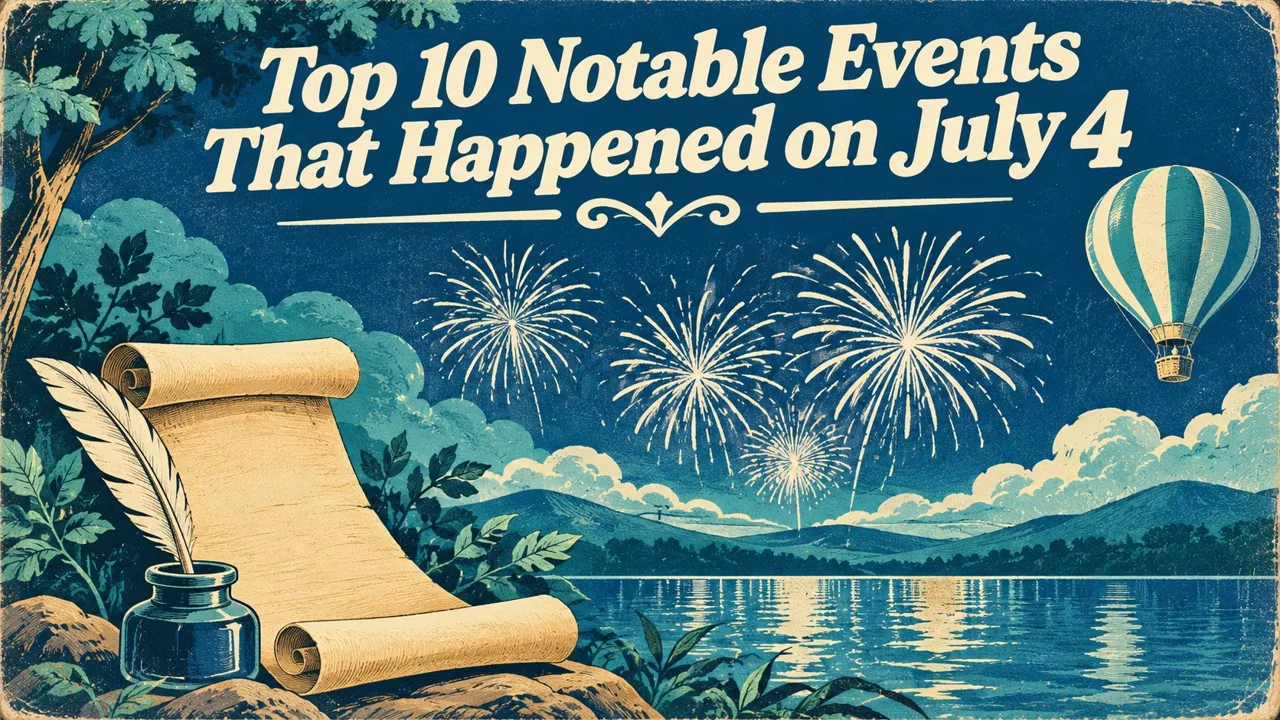
July 4 is best known for 1776, but it also saw a star explode, two founders die, Alice in Wonderland begin and the Higgs boson announced. For Americans, July 4 means one thing above all: the adoption of the Declaration of Independence in 1776 and the fireworks, parades and barbecues that celebrate it. But the date has collected an unusual number of other notable events, some connected to American history and others that simply happened to fall on the same day.
Some of these coincidences have become part of national folklore, such as the deaths of two founding presidents on the fiftieth anniversary of independence. Others, like a children's story told on a rowing trip in England or a supernova recorded by Chinese astronomers, have nothing to do with the United States at all.
Several organizations deliberately chose the date for its symbolism, while in other cases the timing was pure chance. Telling the two apart is part of the fun.
The ten events below span nearly a thousand years and range from astronomy and particle physics to literature, war and sport.
Key Facts
| # | Event | Year | Where |
|---|---|---|---|
| 1 | Supernova recorded in China | 1054 | Visible worldwide, recorded in China |
| 2 | The Declaration of Independence | 1776 | Philadelphia |
| 3 | Deaths of Jefferson and Adams | 1826 | Virginia and Massachusetts |
| 4 | End of slavery in New York State | 1827 | New York |
| 5 | Thoreau moves to Walden | 1845 | Concord, Massachusetts |
| 6 | The origin of Alice in Wonderland | 1862 | Oxford, England |
| 7 | The fall of Vicksburg | 1863 | Vicksburg, Mississippi |
| 8 | Lou Gehrig's farewell speech | 1939 | New York City |
| 9 | Mars Pathfinder lands | 1997 | Ares Vallis, Mars |
| 10 | The Higgs boson announcement | 2012 | Geneva, Switzerland |
1. A Guest Star in Daylight
On July 4, 1054, astronomers of the Song dynasty in China recorded the appearance of a guest star in the constellation now known as Taurus. According to their records, it was bright enough to be seen in daylight for more than three weeks and remained visible at night for nearly two years [1].
Modern astronomers have identified the event as a supernova, the explosion of a massive star. Its remains form the Crab Nebula, an expanding cloud of gas that is one of the most studied objects in the sky [1].
At the center of the nebula lies a pulsar, the collapsed core of the star, which spins about thirty times per second. The Chinese records, along with Japanese and Arab accounts, have allowed scientists to date the explosion precisely. Some researchers have suggested that rock art left by Ancestral Puebloan people at Chaco Canyon in New Mexico may depict the same event, though this is debated.
2. Independence Is Declared
The Second Continental Congress actually voted for independence from Britain on July 2, 1776. Two days later, on July 4, it approved the final wording of the Declaration of Independence, drafted mainly by Thomas Jefferson [2].
John Adams wrote to his wife Abigail that July 2 would be celebrated by future generations with pomp, parades and illuminations. He was right about the celebrations but wrong about the date, since the anniversary of the approved text became the national holiday [2].
Contrary to popular belief, most delegates did not sign the famous engrossed copy on July 4. Most signed on August 2, 1776, and a few added their names later still. The famous handwritten copy now displayed at the National Archives in Washington was written out by a clerk in large, clear lettering after the vote.
Related: Top 10 Historic Documents That Changed the World
3. Two Founders Die on the Same Day
On July 4, 1826, exactly fifty years after the Declaration was adopted, Thomas Jefferson died at his home, Monticello, in Virginia. A few hours later, John Adams died at his home in Quincy, Massachusetts [3].
The two men had been allies during the Revolution, then bitter political rivals, and finally friends who exchanged a remarkable series of letters in old age. Their correspondence, renewed in 1812 with encouragement from their mutual friend Benjamin Rush, ran to well over a hundred letters. Adams's last words were reported to be Thomas Jefferson survives, unaware that his friend had died earlier that day [3].
Many Americans saw the timing as a sign of divine favor. The coincidence deepened when James Monroe, the fifth president, also died on July 4, in 1831.
4. Final Emancipation in New York
New York abolished slavery gradually. A law passed in 1799 freed children born to enslaved mothers after that date, but only after long periods of servitude, and a further law in 1817 set a final date for emancipation [4].
On July 4, 1827, the remaining enslaved people in New York State were legally freed. Many Black New Yorkers chose to hold their celebrations on July 5, in part to avoid hostile crowds and in part because July 4 celebrated a freedom not yet shared by all [4].
The anniversary was marked with parades and speeches for years afterward. Slavery remained legal in much of the United States until the Thirteenth Amendment in 1865. Among those who had been enslaved in New York was Sojourner Truth, who escaped with her infant daughter in 1826, shortly before the final emancipation date.
5. A Cabin by the Pond
On July 4, 1845, the writer Henry David Thoreau moved into a small cabin he had built beside Walden Pond, on land owned by his friend Ralph Waldo Emerson near Concord, Massachusetts [5].
He lived there for two years, two months and two days, growing beans, reading, writing and observing nature. He said he went to the woods because he wished to live deliberately. During his stay, he spent a night in jail for refusing to pay a poll tax, an episode that inspired his famous essay on civil disobedience [5].
Related: Top 10 Most Bizarre Phobias: Strange Fears That Exist
His book Walden, published in 1854, became a classic of American literature and an inspiration for the environmental movement and for people seeking simpler lives. Some readers have noted the symbolism of starting his experiment in independence on Independence Day.
6. A Story Told on a Boat
On July 4, 1862, the Oxford mathematician Charles Dodgson and his friend Robinson Duckworth took three young sisters, Lorina, Alice and Edith Liddell, on a rowing trip up the River Thames from Oxford to Godstow [6].
During the trip, Dodgson told the girls a story about a girl named Alice who fell down a rabbit hole. Alice Liddell asked him to write it down, and he later expanded it into Alice's Adventures in Wonderland, published in 1865 under the pen name Lewis Carroll. The original handwritten version, titled Alice's Adventures Under Ground, was given to Alice Liddell as a gift and is now held by the British Library [6].
Dodgson later remembered the day as a golden afternoon. Some researchers have pointed out that weather records suggest it may have been cooler and wetter than his memory implied.
7. A City Surrenders
During the American Civil War, the Confederate stronghold of Vicksburg controlled a key stretch of the Mississippi River. Union forces under Ulysses S. Grant besieged the city for forty-seven days, cutting off supplies. Residents endured heavy shelling, and many dug caves into the hillsides to shelter from the bombardment [7].
On July 4, 1863, the Confederate commander John Pemberton surrendered the city and around thirty thousand soldiers. Coming one day after the Union victory at Gettysburg, the surrender marked a turning point in the war [7].
The Union gained control of the Mississippi, splitting the Confederacy in two. According to local tradition, the people of Vicksburg were reluctant to celebrate July 4 for many decades afterward.
Related: Top 10 Oldest Buildings in the World
8. The Luckiest Man
Lou Gehrig, the New York Yankees first baseman, had played in 2,130 consecutive games, a record that stood for more than half a century. In 1939, he was diagnosed with amyotrophic lateral sclerosis, a fatal disease that attacks the nerves controlling the muscles [8].
On July 4, 1939, the Yankees held Lou Gehrig Appreciation Day at Yankee Stadium. Before a crowd of around sixty thousand, Gehrig gave a short speech in which he said that he considered himself the luckiest man on the face of the earth [8].
The speech is often called one of the most moving moments in sports history. His number 4 was retired by the Yankees that year, the first uniform number to be retired in Major League Baseball. Gehrig died in 1941, and the disease is still widely known in the United States as Lou Gehrig's disease.
9. Bouncing Onto Mars
On July 4, 1997, NASA's Mars Pathfinder spacecraft landed on Mars, cushioned by giant airbags that let it bounce across the surface before coming to rest in a region called Ares Vallis [9].
Pathfinder carried Sojourner, a small six-wheeled rover about the size of a microwave oven. It became the first wheeled vehicle to operate on another planet, studying rocks and soil near the lander for nearly three months [9].
The mission was designed to show that Mars exploration could be done more cheaply. Its images drew enormous public interest, and NASA's websites recorded huge numbers of visits in the days after the landing, an early sign of the internet's power to share science. The mission's success and its low-cost approach paved the way for later rovers such as Spirit, Opportunity and Curiosity.
10. A Particle Found
On July 4, 2012, scientists at CERN, the European particle physics laboratory near Geneva, announced that two experiments at the Large Hadron Collider had found a new particle consistent with the Higgs boson [10].
Related: 10 Sikh Gurus: The Pillars of Sikhism Who Shaped Faith, Equality, Courage, and Humanity
The particle had been predicted in the 1960s as part of the mechanism that gives other fundamental particles their mass. Finding it required decades of work and one of the largest scientific instruments ever built [10].
The following year, Peter Higgs and Francois Englert were awarded the Nobel Prize in Physics for their theoretical work. The discovery completed the Standard Model of particle physics, though many questions about the universe remain open. The press often called the particle the God particle, a nickname that many physicists dislike.
Conclusion
July 4 shows how a single date can gather a surprising mix of history. A supernova, a declaration, the deaths of two presidents and the birth of a famous children's story all share the same place on the calendar.
Some of these coincidences have taken on symbolic meaning, while others are simply chance. Every date of the year has its own collection of events, but few are as rich as this one.
For Americans, the day will always belong first to 1776. Yet remembering the other events, from New York's final emancipation to the Higgs boson, adds depth to the celebration.
The next time fireworks light up the sky on July 4, it may be worth recalling the guest star that lit up the sky over China nearly a thousand years ago.
- ^ [1] Accounts of SN 1054. Wikipedia: SN 1054 Wikipedia: Crab Nebula
- ^ [2] Accounts of the Declaration. Wikipedia: United States Declaration of Independence Wikipedia: Independence Day (United States)
- ^ [3] Accounts of Jefferson and Adams. Wikipedia: Thomas Jefferson Wikipedia: John Adams
- ^ [4] Accounts of emancipation in New York. Wikipedia: History of slavery in New York Wikipedia: gradual emancipation
- ^ [5] Accounts of Thoreau. Wikipedia: Walden Wikipedia: Henry David Thoreau
- ^ [6] Accounts of Alice. Wikipedia: Alice Liddell Wikipedia: Alice's Adventures in Wonderland
- ^ [7] Accounts of Vicksburg. Wikipedia: Siege of Vicksburg Wikipedia: Ulysses S. Grant
- ^ [8] Accounts of Lou Gehrig. Wikipedia: Lou Gehrig Wikipedia: ALS
- ^ [9] Accounts of Mars Pathfinder. Wikipedia: Mars Pathfinder Wikipedia: Sojourner (rover)
- ^ [10] Accounts of the Higgs boson. Wikipedia: Higgs boson Wikipedia: Large Hadron Collider






















Discussion
Log in with