





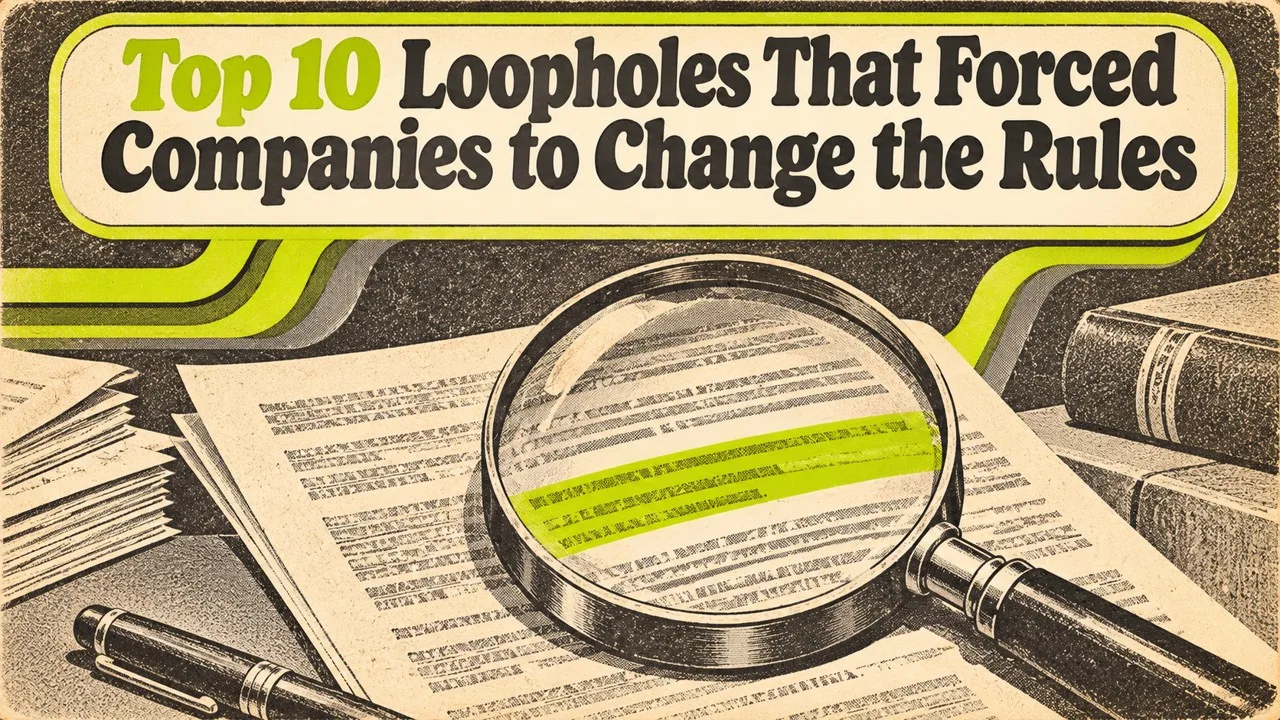
Top 10 Loopholes That Forced Companies to Change the Rules
 By Dhiraj Sharma · Published
Share Post
Loading…
Clever customers and rivals have found loopholes in promotions, taxes and rules, from pudding cups worth air miles to coins bought for credit card points. Every set of rules has gaps. Companies write promotions, loyalty programs and contracts expecting customers to behave in certain ways, and governments write tax and trade laws with particular situations in mind. Sooner or later, someone reads the fine print more carefully than the authors did.
Sometimes the people who spot a loophole are ordinary customers who realize that a promotion is worth far more than it costs. Sometimes they are rival companies, engineers or investors who find a legal way around a rule. In each case, the people who made the rules eventually had to respond.
The responses varied. Some companies honored their promises and quietly rewrote their terms. Others went to court or changed their products. Governments closed tax gaps and redesigned games to prevent the same thing happening again.
The ten cases below include loyalty programs, advertising campaigns, coins, cars, taxes, motor racing and a state lottery. In every case, the loophole was legal, or at least argued to be, at the time it was used.
The stories offer lessons for anyone who designs rules. Small details matter, people respond to incentives, and a reward that seems generous on paper can become very expensive when someone finds a way to collect it on a large scale.
They are also a reminder that reading the fine print can pay off, sometimes in surprising ways.
Key Facts
| # | Case | Where | When |
|---|---|---|---|
| 1 | Healthy Choice promotion | United States | 1999 |
| 2 | Leonard v. PepsiCo | United States | 1996 to 1999 |
| 3 | AAirpass | United States | 1981 onward |
| 4 | Presidential dollar coins | United States | 2007 to 2011 |
| 5 | Hoover promotion | United Kingdom and Ireland | 1992 and 1993 |
| 6 | Ford Transit Connect | United States | 2009 onward |
| 7 | Double Irish | Ireland | 1980s to 2020 |
| 8 | Double diffuser | Formula One | 2009 |
| 9 | Cash WinFall | Massachusetts, United States | 2004 to 2012 |
| 10 | Mileage runs | Worldwide | 1980s to 2010s |
1. The Pudding Cups Worth Air Miles
In 1999, the food brand Healthy Choice ran a promotion that awarded frequent flyer miles for barcodes collected from its products. A civil engineer named David Phillips noticed that individual cups of pudding were among the cheapest eligible items, and that the promotion included a bonus for early entries [1].
He bought more than twelve thousand cups of pudding, spending a few thousand dollars, and collected well over a million miles. He reportedly donated the pudding to charities, which also allowed him to claim a tax deduction [1].
The story spread widely and is said to have inspired part of the plot of the film Punch-Drunk Love. It became a classic example of how a promotion can be worth far more than its designers expected, and later loyalty promotions commonly included caps on how much one person could earn.
2. The Fighter Jet in a Soft Drink Advert
In the mid-1990s, Pepsi ran a promotion called Pepsi Stuff, in which customers collected points from drinks to exchange for merchandise. A television advertisement jokingly showed a teenager arriving at school in a Harrier jump jet, priced at seven million Pepsi Points [2].
Related: Top 10 Advertising Campaigns That Backfired
A student named John Leonard noticed that the rules allowed customers to buy additional points for a small sum each. He raised enough money to buy the remaining points and sent a check to Pepsi, asking for the jet. Pepsi refused, saying the advertisement was a joke [2].
The case went to court, and in 1999 a federal judge ruled that no reasonable person would have taken the advertisement as a serious offer. Pepsi nevertheless changed the advertisement to show a much higher number of points for the jet. The case is now studied in law schools.
3. The Lifetime Unlimited Flight Pass
In 1981, American Airlines began selling the AAirpass, which offered lifetime unlimited first-class travel for a large one-time payment. The airline needed cash, and it assumed that few customers would fly often enough to make the pass a bad deal [3].
Some pass holders flew constantly, taking thousands of flights, sometimes for business and sometimes just for fun, and inviting companions to fly with them. Over time, the airline calculated that the most active pass holders were costing it large sums in lost revenue [3].
American Airlines raised prices and stopped selling the lifetime pass. In the late 2000s, it revoked the passes of some heavy users, accusing them of breaking the rules, which led to lawsuits. The pass became a cautionary tale about selling unlimited services.
4. Buying Coins for Credit Card Rewards
To encourage the use of new dollar coins, the United States Mint offered to sell them at face value with free shipping. Customers could pay with a credit card, which meant they could earn rewards points or airline miles on the purchase [4].
Some people bought large amounts of coins, then simply deposited them at their banks to pay off their credit card bills. The result was free rewards points for the buyers, while the Mint paid for shipping and the coins went straight back into storage [4].
In 2011, the Mint stopped allowing the purchase of the coins with credit cards through the program. Many of the coins ended up in government vaults, since Americans did not widely adopt them in everyday use.
Related: Top 10 Most Bizarre Phobias: Strange Fears That Exist
5. Free Flights With a Vacuum Cleaner
In 1992, the British arm of the appliance maker Hoover offered two free return flights to anyone who spent at least one hundred pounds on its products. At first the flights were to European destinations, and later the offer was extended to the United States [5].
Customers quickly realized that the flights were worth far more than the products. Huge numbers of people bought Hoover vacuum cleaners and washing machines just to claim the tickets. The company struggled to supply the flights, and many customers complained or took legal action [5].
The promotion cost Hoover tens of millions of pounds, and several senior executives lost their jobs. It became one of the most famous marketing disasters in British business history and a warning for companies planning similar offers.
6. Vans Built With Seats to Avoid a Tariff
Since the 1960s, the United States has imposed a high tariff on imported light trucks, known as the chicken tax because it began in a trade dispute over chicken. Passenger vehicles face a much lower tariff [6].
Ford built its Transit Connect vans in Turkey and imported them with rear seats and windows, so they would be classified as passenger vehicles. After they arrived, the seats were removed and the windows replaced with panels, turning many of them into cargo vans [6].
United States customs officials later challenged the practice, leading to a long legal dispute over how the vehicles should be classified. The case showed how manufacturers adapt to trade rules, and how governments respond.
7. A Famous Tax Arrangement
The double Irish arrangement was a tax strategy used by some large multinational companies, especially technology firms. It involved two Irish companies, one of them managed from a country with no corporate tax, which allowed profits to flow out of Ireland with little tax paid [7].
The arrangement was legal under the rules of the time but attracted growing criticism from other governments and campaigners. It became a symbol of debates about how multinational companies were taxed [7].
Related: Top 10 Oldest Buildings in the World
In 2014, Ireland announced that it would close the loophole for new companies, with existing users given until the end of 2020 to stop using it. International tax rules were also changed through efforts led by the Organisation for Economic Co-operation and Development.
8. A Clever Part Under a Racing Car
New rules for Formula One in 2009 aimed to reduce the aerodynamic downforce of cars. Several teams, including the new Brawn GP team, found a way to interpret the rules that allowed them to build a double diffuser under the rear of the car, regaining much of the lost downforce [8].
Rival teams protested, but the sport's governing body ruled that the design was legal. Brawn GP, which had been formed from the remains of the Honda team, won both the drivers' and constructors' championships in its only season [8].
Other teams quickly copied the idea, and the double diffuser was banned under new rules from the 2011 season. The story is one of the most famous examples of engineers exploiting a gap in the rules.
9. The Lottery Game With a Flaw
The Massachusetts lottery game Cash WinFall included a rule that, when the jackpot grew large and nobody won it, the money would roll down to smaller prizes. During these roll-down drawings, the expected value of a ticket could be higher than its price [9].
Several groups of players, including a group of students and a retired couple, noticed the flaw and bought very large numbers of tickets during roll-down weeks, earning substantial profits. Their activity was legal under the game's rules [9].
After news reports drew attention to the practice, investigations followed, and the lottery ended the game in early 2012. The case showed how mathematics can turn a game of chance into a calculated investment.
Related: 10 Sikh Gurus: The Pillars of Sikhism Who Shaped Faith, Equality, Courage, and Humanity
10. Flying to Nowhere for Status
For decades, many airlines awarded frequent flyer miles based on the distance flown rather than the price paid. Some travelers took cheap but long flights, sometimes with no reason to visit the destination, simply to earn miles and elite status. These trips became known as mileage runs [10].
Mileage runs, along with the occasional mistake fare offered by error at very low prices, allowed some travelers to enjoy luxury perks at little cost. Online communities shared tips on how to find the best deals [10].
Starting around 2015, several major airlines in the United States changed their programs so that miles were awarded based on how much a ticket cost. The change made mileage runs far less rewarding.
Conclusion
These loopholes show how rules can produce unexpected results. Whether it was pudding, fighter jets, coins or lottery tickets, someone found a way to use the fine print to their advantage.
The companies and governments involved responded in different ways, from honoring promises to fighting in court. Most eventually rewrote their rules to close the gap.
For businesses, the lesson is to test promotions and policies carefully, imagining how the most determined customer might use them. For customers, the lesson is that careful reading can sometimes reveal remarkable opportunities.
Loopholes will never disappear completely, because no set of rules can anticipate every situation. That is part of what makes these stories so entertaining.
The fine print, it turns out, is rarely as dull as it looks.
- ^ [1] Accounts of the Healthy Choice promotion. Wikipedia: Healthy Choice Wikipedia: frequent-flyer program
- ^ [2] Accounts of the Pepsi Harrier case. Wikipedia: Leonard v. PepsiCo, Inc. Wikipedia: PepsiCo
- ^ [3] Accounts of the AAirpass. Wikipedia: AAirpass Wikipedia: American Airlines
- ^ [4] Accounts of Presidential dollar coins. Wikipedia: Presidential dollar coins Wikipedia: United States Mint
- ^ [5] Accounts of the Hoover promotion. Wikipedia: Hoover free flights promotion Wikipedia: Hoover Company
- ^ [6] Accounts of the chicken tax. Wikipedia: Chicken Tax Wikipedia: Ford Transit Connect
- ^ [7] Accounts of the double Irish. Wikipedia: Double Irish arrangement Wikipedia: base erosion and profit shifting
- ^ [8] Accounts of Brawn GP. Wikipedia: Brawn GP Wikipedia: diffuser (automotive)
- ^ [9] Accounts of Cash WinFall. Wikipedia: Cash WinFall Wikipedia: expected value
- ^ [10] Accounts of mileage runs. Wikipedia: mileage run Wikipedia: mistake fare




















Discussion
Log in with