






 By
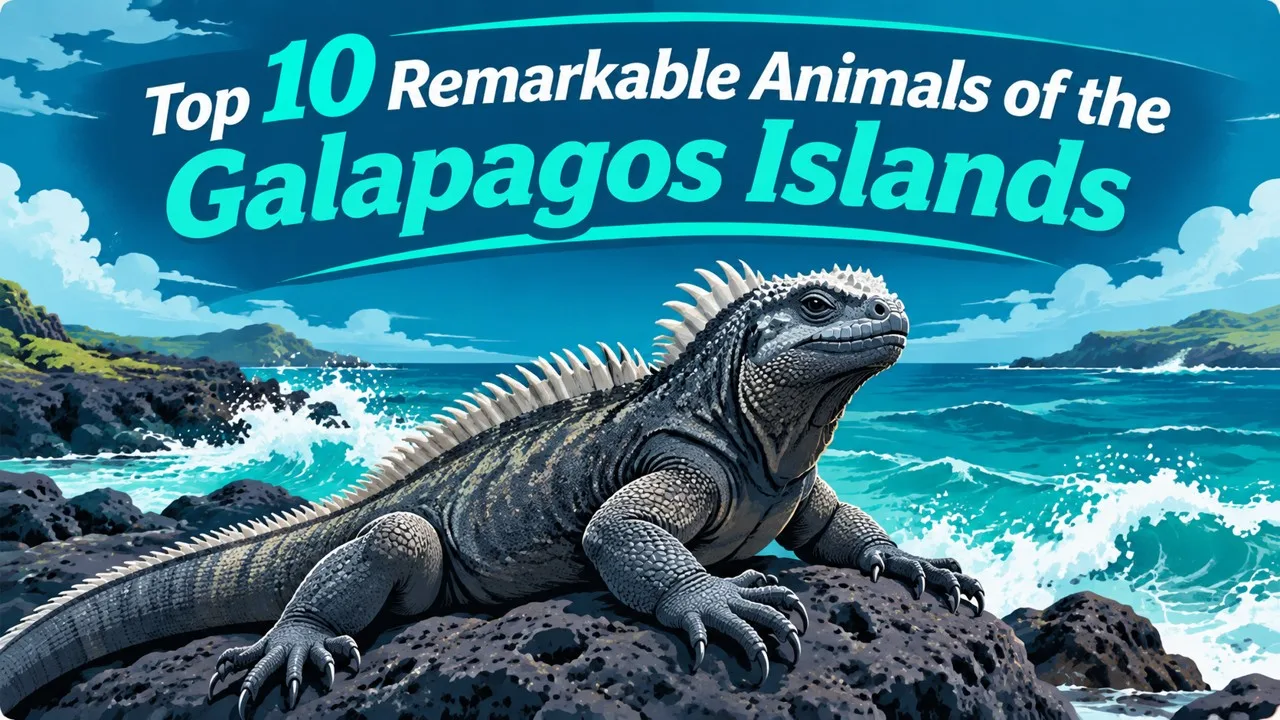
From giant tortoises and sea-diving iguanas to Darwin's finches and a pink iguana, these ten remarkable animals of the Galapagos Islands helped shape biology. The Galapagos Islands are a volcanic archipelago in the Pacific Ocean, about 1,000 kilometres off the coast of Ecuador. Because they were never connected to the mainland, every animal that lives there had to arrive by sea or air.
Over time, these colonists evolved into species found nowhere else. When Charles Darwin visited in 1835 aboard HMS Beagle, the islands' wildlife helped inspire his ideas about evolution. Today the Galapagos is a national park and was among the first places named a UNESCO World Heritage Site, in 1978. Here are ten of its most remarkable animals.
Key Facts
The ten animals below include reptiles, birds, a mammal and a crab, most of them unique to the islands.
Remarkable Animals of the Galapagos at a Glance
| # | Animal | Group | Where on the islands | Why it is remarkable |
|---|---|---|---|---|
| 1 | Galapagos Giant Tortoise | Reptile | Several islands, including Santa Cruz and Isabela | The islands' namesake |
| 2 | Marine Iguana | Reptile | Rocky shores throughout the islands | The only lizard that feeds in the sea |
| 3 | Darwin's Finches | Birds | Throughout the islands | A textbook example of evolution |
| 4 | Blue-footed Booby | Bird | Coasts and islands, including Espanola and North Seymour | Dancing on bright blue feet |
| 5 | Galapagos Penguin | Bird | Fernandina and western Isabela | The only penguin north of the equator |
| 6 | Flightless Cormorant | Bird | Fernandina and Isabela | The only cormorant that cannot fly |
| 7 | Galapagos Sea Lion | Mammal | Beaches and harbours throughout the islands | The islands' playful residents |
| 8 | Waved Albatross | Bird | Espanola Island | A seabird with an elaborate dance |
| 9 | Galapagos Pink Land Iguana | Reptile | Wolf Volcano, Isabela Island | A pink iguana found only on one volcano |
| 10 | Sally Lightfoot Crab | Crustacean | Rocky shores throughout the islands | A brilliantly coloured acrobat |
1. Galapagos Giant Tortoise
The Galapagos giant tortoise is the largest living tortoise, able to weigh more than 400 kilograms. Wild tortoises can live for more than 100 years. [1]
The islands are named after them. Galapago is an old Spanish word associated with tortoises and saddles. [1]
Tortoises on different islands evolved different shell shapes. Those on wetter islands have dome-shaped shells, while those on dry islands have saddle-shaped shells that let them stretch their necks to reach higher plants.
In past centuries, sailors and whalers took huge numbers of tortoises aboard ships as a source of fresh meat, because they could survive months without food or water.
Several populations were wiped out. Breeding programmes run by the Galapagos National Park have since returned thousands of young tortoises to the wild.
Tortoises are important gardeners of the islands, spreading seeds and shaping vegetation as they graze.
Key Figures
- Group: reptile
- Weight: over 400 kg
- Lifespan: over 100 years in the wild
- Shell types: dome and saddleback
Why It Made the List
The giant tortoise is the symbol of the Galapagos. Its shells illustrate evolution in action.
2. Marine Iguana
The marine iguana is the only lizard in the world that forages in the sea. It feeds almost entirely on algae growing on underwater rocks. [2]
Large males dive into the cold water to graze, while smaller iguanas feed on rocks exposed at low tide. [2]
After swimming, they bask on dark lava rocks to warm up, often piled on top of each other.
They have special glands that remove excess salt from their bodies. They sneeze it out, and their heads are often crusted white with salt.
During El Nino years, when food becomes scarce, marine iguanas can actually shrink in length, then grow again when conditions improve.
Darwin was not impressed by them, describing them as ugly, but scientists now regard them as one of the most fascinating reptiles.
Related: Top 10 Unique Animals Found Only in Africa
Key Figures
- Group: reptile
- Diet: marine algae
- Special feature: salt-sneezing glands
- Survival trick: shrinking during famine
Why It Made the List
The marine iguana is a reptile adapted to life in the sea. It is unique among living lizards.
3. Darwin's Finches
Darwin's finches are a group of about 18 species of small birds. Despite their name, they belong to the tanager family and are not true finches. [3]
Each species has a beak shaped for a particular diet, from cracking hard seeds to probing cactus flowers or catching insects. [3]
Their variety descends from a single ancestor that reached the islands from South America, an example of adaptive radiation.
Since 1973, biologists Peter and Rosemary Grant have studied finches on the small island of Daphne Major. They recorded beak sizes changing after droughts, showing evolution happening within a few generations.
One species, the vampire ground finch, sometimes drinks the blood of seabirds.
Another, the woodpecker finch, uses cactus spines as tools to pull insects out of wood.
Key Figures
- Group: birds
- Species: about 18
- Concept: adaptive radiation
- Famous study: the Grants on Daphne Major
Why It Made the List
Darwin's finches are one of the best-known examples of evolution. Scientists have watched them change in real time.
4. Blue-footed Booby
The blue-footed booby is a seabird famous for its bright blue feet. [4]
The colour comes from pigments in the fresh fish it eats. Brighter feet are a sign of a healthy, well-fed bird. [4]
During courtship, males show off their feet in a slow, high-stepping dance, lifting one foot and then the other in front of the female.
Boobies hunt by diving into the sea from heights of many metres, folding their wings back just before they hit the water.
About half of all breeding pairs of this species nest on the Galapagos, although it also lives along the Pacific coast of the Americas.
Its name may come from the Spanish word bobo, meaning foolish, because of its clumsy walk on land.
Key Figures
- Group: bird
- Feet: blue from food pigments
- Courtship: foot-showing dance
- Hunting: plunge diving
Why It Made the List
The blue-footed booby is one of the most charming Galapagos animals. Its feet are an honest signal of health.
5. Galapagos Penguin
The Galapagos penguin is one of the smallest penguins and the only one found north of the equator. [5]
It survives in the tropics thanks to cold ocean currents, the Humboldt and the Cromwell, which bring cool, food-rich water to the western islands. [5]
Related: Top 10 Open Puzzles in Evolutionary Biology
To stay cool on land, it stands with its flippers held out, pants and shades its feet.
Most Galapagos penguins live on Fernandina Island and the west coast of Isabela Island.
It is Endangered, with a small population that can fall sharply during El Nino years, when warm water reduces food supplies.
Penguins nest in caves and cracks in the lava, where their eggs are protected from the sun.
Pairs often stay together for years and can breed several times a year when food is plentiful.
Key Figures
- Group: bird
- Distinction: only penguin north of the equator
- Survival key: cold ocean currents
- Status: Endangered
Why It Made the List
The Galapagos penguin is a tropical penguin. It shows how ocean currents shape where animals can live.
6. Flightless Cormorant
The flightless cormorant is the only cormorant in the world that has lost the ability to fly. [6]
With no land predators on its islands and plenty of food in the sea, flight was no longer necessary, and its wings became small and stubby. [6]
Instead, it became a powerful swimmer, using its strong legs and webbed feet to chase fish, eels and octopus along the seabed.
After diving, it holds its tiny wings out to dry, just like flying cormorants.
It lives only on the coasts of Fernandina and Isabela, where cold, rich waters provide abundant food.
Its small population makes it vulnerable to oil spills, disease and El Nino events.
Its population is estimated at only a couple of thousand birds.
Key Figures
- Group: bird
- Distinction: the only flightless cormorant
- Range: Fernandina and Isabela
- Hunting: underwater with powerful legs
Why It Made the List
The flightless cormorant shows how island life can change a species. It traded flight for swimming.
7. Galapagos Sea Lion
The Galapagos sea lion is the smallest sea lion species. It lives mainly on the Galapagos Islands, with smaller numbers on an island off mainland Ecuador. [7]
Sea lions are everywhere on the islands, lounging on beaches, rocks and even park benches and boats in harbour towns. [7]
Related: Top 10 Cases Where Evolution Seemed to Run Backward
They are curious and playful, often swimming alongside snorkellers.
Males guard stretches of beach and water, barking loudly to defend their territory.
Females give birth to a single pup, which they nurse for a year or more.
The species is Endangered, and its numbers fall during El Nino events, when fish become scarce.
Young sea lions spend hours playing in shallow lagoons, chasing each other and tossing pieces of seaweed. They often rest on the steps of piers in Puerto Ayora and Puerto Baquerizo Moreno.
Key Figures
- Group: mammal
- Distinction: the smallest sea lion
- Behaviour: playful with swimmers
- Status: Endangered
Why It Made the List
The Galapagos sea lion is the islands' friendliest resident. It offers visitors unforgettable encounters.
8. Waved Albatross
The waved albatross is the only albatross that lives in the tropics. Almost the entire population breeds on Espanola Island. [8]
It has a wingspan of more than two metres and spends most of its life gliding over the ocean. [8]
Pairs mate for life and perform an elaborate courtship dance, fencing with their bills, bowing, clacking and calling to strengthen their bond.
Because the cliffs of Espanola are its launching point, the birds waddle to the edge and take off into the wind.
When feeding, they fly to waters off the coast of Peru, about 1,000 kilometres away.
The species is Critically Endangered, threatened by fishing lines and nets, in which birds are accidentally caught.
Young birds may spend several years at sea before returning to Espanola to breed.
Key Figures
- Group: bird
- Breeding site: Espanola Island
- Courtship: bill fencing
- Status: Critically Endangered
Why It Made the List
The waved albatross is the Galapagos' great ocean wanderer. Its dances are among the most remarkable in the bird world.
9. Galapagos Pink Land Iguana
The Galapagos pink land iguana lives only on the slopes of Wolf Volcano, at the northern end of Isabela Island. [9]
Its body is pink with dark stripes, unlike the yellowish land iguanas found elsewhere on the islands. [9]
Related: Top 10 Unsettling Facts About Nature
Park rangers first noticed it in 1986, but it was not recognised as a separate species until 2009.
Genetic studies suggest it split from other land iguanas long ago, making it one of the oldest lineages on the islands.
Only a few hundred are thought to survive, and it is Critically Endangered.
Conservationists are working to control introduced cats and rats that may threaten its eggs and young.
Its small, isolated range makes it especially vulnerable, as Wolf Volcano is active and erupted in 2015 and again in 2022.
Key Figures
- Group: reptile
- Range: Wolf Volcano, Isabela
- Recognised as a species: 2009
- Status: Critically Endangered
Why It Made the List
The pink iguana is one of the rarest reptiles on Earth. Its discovery shows that the Galapagos still holds surprises.
10. Sally Lightfoot Crab
The Sally Lightfoot crab is one of the most colourful sights on Galapagos shores, scampering across black lava rocks. [10]
It is extremely agile and can leap from rock to rock, avoiding waves and predators. [10]
Its name may come from a dancer, because of its quick, light-footed movement.
The crab feeds on algae, dead animals and small creatures, and it is known to pick ticks off the skin of marine iguanas.
Young crabs are dark, helping them blend into the lava. Adults develop bright colours as they grow.
The crab is found along the Pacific coasts of the Americas as well as in the Galapagos.
It is a favourite subject of photographers visiting the islands.
Adults can be bright red with blue undersides.
Key Figures
- Group: crustacean
- Habitat: rocky shores
- Skill: leaping across rocks
- Partnership: cleans ticks from iguanas
Why It Made the List
The Sally Lightfoot crab brings colour to the black lava coasts. Its relationship with iguanas shows how island species interact.
Conclusion
The Galapagos Islands are a living laboratory of evolution, where animals have adapted in astonishing ways. Many species remain unafraid of humans, allowing close encounters.
Strict rules protect the islands from invasive species and overuse. Careful tourism and conservation help keep this unique ecosystem healthy.
- ^ [1] "Galapagos Giant Tortoise". Wikipedia. Wikipedia: Galápagos tortoise Wikipedia: Galápagos National Park
- ^ [2] "Marine Iguana". Wikipedia. Wikipedia: Marine iguana Wikipedia: El Niño
- ^ [3] "Darwin's Finches". Wikipedia. Wikipedia: Darwin's finches Wikipedia: Peter and Rosemary Grant
- ^ [4] "Blue-footed Booby". Wikipedia. Wikipedia: Blue-footed booby Wikipedia: Plunge diving
- ^ [5] "Galapagos Penguin". Wikipedia. Wikipedia: Galápagos penguin Wikipedia: Cromwell Current
- ^ [6] "Flightless Cormorant". Wikipedia. Wikipedia: Flightless cormorant Wikipedia: Flightless bird
- ^ [7] "Galapagos Sea Lion". Wikipedia. Wikipedia: Galápagos sea lion Wikipedia: Sea lion
- ^ [8] "Waved Albatross". Wikipedia. Wikipedia: Waved albatross Wikipedia: Española Island
- ^ [9] "Galapagos Pink Land Iguana". Wikipedia. Wikipedia: Conolophus marthae Wikipedia: Wolf Volcano
- ^ [10] "Sally Lightfoot Crab". Wikipedia. Wikipedia: Grapsus grapsus Wikipedia: Rocky shore





















Discussion
Log in with