






 By
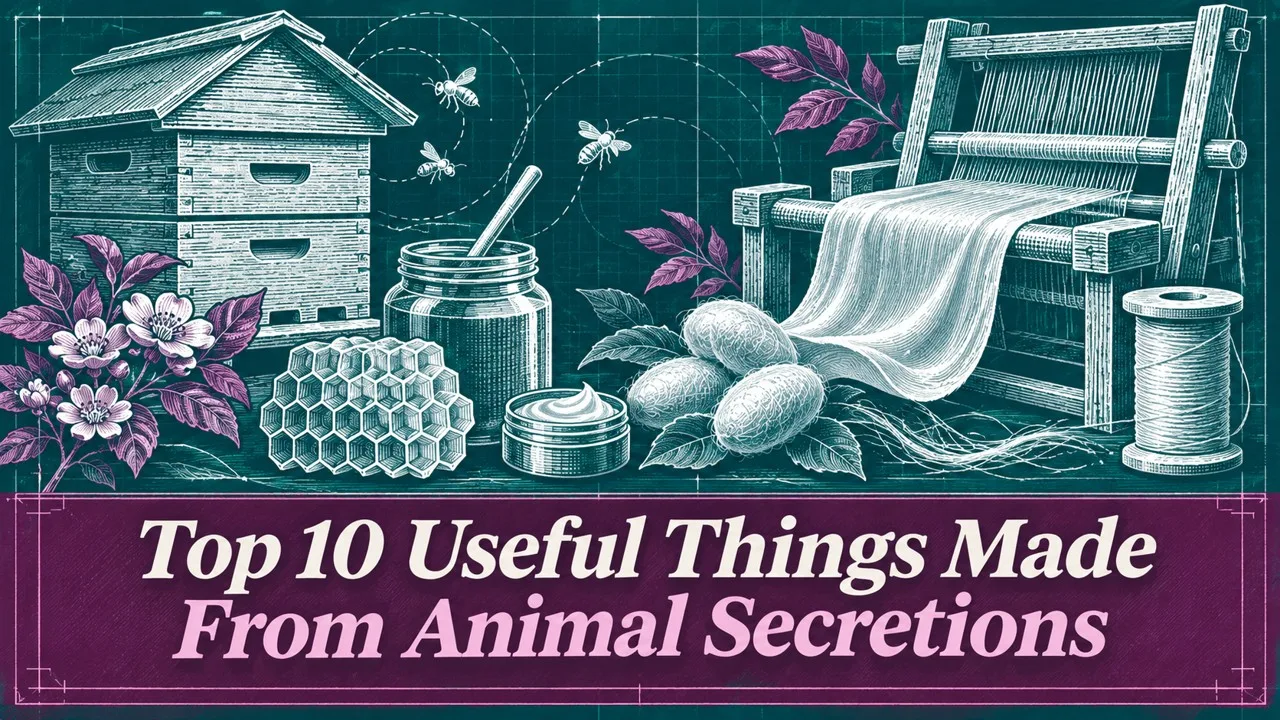
People have long used what animals secrete, from silk and honey to shellac, lanolin and ambergris, and even drugs inspired by lizard saliva and snake venom. Animals produce an astonishing variety of substances. Some spin fibers, some make sweet foods or waxes, and others produce oils, scents and venoms for defense or communication. For thousands of years, people have collected these secretions and turned them into clothing, food, cosmetics, perfumes and medicines.
Some of these products are among the oldest traded goods in history, while others have only recently been used in modern medicine. In several cases, synthetic alternatives have replaced animal products, often because of animal welfare concerns or cost. In other cases, the natural substance remains hard to copy.
The ten products below are silk, honey, beeswax, shellac, lanolin, ambergris, musk, castoreum, a diabetes drug based on Gila monster saliva and a blood pressure drug inspired by snake venom. Each shows how closely human life has been linked to the biology of other animals.
Where these products raise welfare or conservation concerns, that is noted. Several of the animals involved are protected today, and trade in some of their products is restricted by international law.
Insects provide several of the most important examples. Bees, silkworms and lac insects have been managed by people for thousands of years, and whole rural economies have depended on them. In parts of India and Thailand, lac cultivation still supports many farming families, while silk production remains important in China, India and Uzbekistan. These traditions are also part of cultural heritage, with festivals, crafts and techniques passed down through generations.
Key Facts
| # | Product | Animal source | How people use it |
|---|---|---|---|
| 1 | Silk | Silkworm caterpillars | Fine fabric traded for thousands of years |
| 2 | Honey | Honeybees | One of the oldest sweeteners |
| 3 | Beeswax | Honeybees | Candles, polishes and cosmetics |
| 4 | Shellac | Lac insects | Finishes for wood, records and food |
| 5 | Lanolin | Sheep | Moisturizers and ointments |
| 6 | Ambergris | Sperm whales | Prized in perfume making |
| 7 | Musk | Male musk deer | Once one of the most valuable perfume ingredients |
| 8 | Castoreum | Beavers | Used in perfume and rarely as a flavoring |
| 9 | Exenatide | Gila monster | A treatment for type 2 diabetes |
| 10 | Captopril | Brazilian pit viper | Led to a major class of heart medicines |
1. Thread From a Caterpillar
Silk is a protein fiber produced by the caterpillars of the domesticated silk moth, Bombyx mori, which spin cocoons of a single continuous thread. When the cocoons are softened in hot water, the thread can be unwound and spun into yarn [1].
Silk production began in China thousands of years ago, and the secret of making it was closely guarded. Silk became so valuable in trade that the network of routes linking China with Central Asia, the Middle East and Europe became known as the Silk Road [1].
Silk is still prized for its softness, shine and strength. It is used in clothing, medical sutures and research into new materials. Producing silk usually kills the pupae inside the cocoons, which has led some producers to develop methods that allow the moths to emerge.
2. Sweet Food From Flowers
Honey is made by honeybees from flower nectar. The bees collect nectar, process it with enzymes and store it in wax cells, where water evaporates until the honey becomes thick and stable [2].
People have collected honey for thousands of years. Rock paintings in Spain, thought to be about 8,000 years old, appear to show a person gathering honey from a wild nest. Pots of honey have been found in ancient Egyptian tombs, and honey was used as a food, a medicine and an offering [2].
Related: Top 10 Most Bizarre Phobias: Strange Fears That Exist
Honey's high sugar content and low water make it resistant to spoiling. Some kinds of honey have antibacterial properties and are used in modern wound dressings. Beekeeping remains important worldwide, both for honey and for the pollination of crops.
3. Wax From the Hive
Beeswax is produced by worker honeybees from glands on their abdomens. They use it to build the hexagonal cells of the honeycomb, where they store honey and raise their young [3].
People have used beeswax for candles, sealing documents, waterproofing, polishing wood and making cosmetics. In the lost-wax method of metal casting, artists used beeswax to make models that were melted away and replaced with bronze or gold [3].
Beeswax candles were valued in medieval churches because they burned cleanly and smelled pleasant. Today, beeswax is used in food wraps, lip balms, furniture polish and art materials. Encaustic painting, which uses hot wax mixed with pigments, dates back to ancient times.
4. Varnish From an Insect
Shellac is made from a resin secreted by tiny lac insects, which live on trees in India and Thailand. The insects cover themselves and the branches with the resin to protect themselves. Workers scrape the resin from the branches and process it into flakes [4].
Dissolved in alcohol, shellac forms a glossy varnish used on furniture and musical instruments. Before vinyl, early gramophone records, often called 78s, were made from a material containing shellac [4].
Today, shellac is used as a coating on some candies and fruits, where it may be listed as confectioner's glaze, and in medicines and cosmetics. The word lac comes from a Sanskrit word meaning one hundred thousand, possibly referring to the enormous numbers of insects.
5. Grease From Wool
Lanolin is a waxy substance secreted by glands in the skin of sheep. It coats their wool, helping to protect it and the sheep's skin from rain and weather [5].
Related: Top 10 Oldest Buildings in the World
When wool is washed after shearing, the lanolin is removed and can be purified. Lanolin is used in skin creams, lip balms and ointments, including products for breastfeeding mothers, because it helps hold moisture in the skin [5].
Lanolin is also a source of vitamin D3 used in supplements, produced by exposing a substance derived from lanolin to ultraviolet light. Some people are allergic to lanolin, but it remains widely used in cosmetics and medicines.
6. Treasure From a Whale
Ambergris is a waxy substance produced in the digestive system of sperm whales, probably to protect the intestines from the hard beaks of squid. It is expelled by the whales and can float in the ocean for years before washing ashore [6].
Fresh ambergris has an unpleasant smell, but after long exposure to sunlight and seawater it develops a sweet, earthy scent. It has been used for centuries in perfume as a fixative, helping fragrances last longer. Lumps found on beaches have sold for large sums [6].
Because sperm whales are protected, trade in ambergris is restricted or banned in some countries, including the United States, even though it is found naturally. Many perfumers now use synthetic substitutes such as ambroxide.
7. A Scent From a Deer
Musk originally came from a gland of the male musk deer, a small deer living in the mountains of Asia. The gland produces a strong-smelling substance, probably used to attract females [7].
Musk was used in perfumes and traditional medicines for centuries and was extremely valuable. Collecting it often involved killing the deer, and hunting caused severe declines in their populations [7].
Related: 10 Sikh Gurus: The Pillars of Sikhism Who Shaped Faith, Equality, Courage, and Humanity
Musk deer are now protected, and international trade in musk is restricted. Most musk used in perfumes today is synthetic, created in laboratories to imitate the scent. The word musk is used for a whole family of fragrance ingredients, most of which have no connection to animals.
8. A Beaver's Scent
Castoreum is a substance from the castor sacs of beavers, which they use with urine to mark their territory. It has a leathery, slightly sweet smell [8].
Historically, castoreum was used in medicine and perfume. In the twentieth century, it was occasionally used as a food flavoring, sometimes in vanilla or raspberry flavors, and it is approved as safe in the United States [8].
Stories claiming that vanilla ice cream commonly contains castoreum have spread widely online. In reality, its use in food today is extremely rare, because it is expensive and difficult to collect, and most vanilla flavoring comes from vanilla beans or synthetic vanillin.
9. A Diabetes Drug From Lizard Saliva
The Gila monster is a venomous lizard of the southwestern United States and Mexico. In the early 1990s, the endocrinologist John Eng discovered a hormone-like substance in its saliva, which he named exendin-4 [9].
Exendin-4 acts like a human hormone called GLP-1, which helps control blood sugar after meals, but it lasts much longer in the body. A synthetic version, called exenatide, was approved in the United States in 2005 as a treatment for type 2 diabetes [9].
Exenatide was the first of a class of drugs called GLP-1 receptor agonists. Later drugs in this family are now widely used for diabetes and weight loss. The story is a striking example of how research on unusual animals can lead to important medicines.
Related: Top 10 Tallest Buildings in the World
10. A Blood Pressure Drug From Snake Venom
The venom of the Brazilian pit viper Bothrops jararaca causes a sudden drop in blood pressure in its prey. In the 1960s, scientists studying the venom found peptides that blocked an enzyme involved in regulating blood pressure [10].
Researchers at the pharmaceutical company Squibb used this discovery to design a drug that could be taken by mouth. Captopril was approved in 1981 and became the first ACE inhibitor, a class of drugs used to treat high blood pressure and heart failure [10].
ACE inhibitors are now among the most widely prescribed medicines in the world. Captopril is a classic example of drug development based on natural toxins. Researchers continue to study venoms from snakes, spiders, cone snails and other animals for new medicines.
Conclusion
The ten products above show how much people have borrowed from animal biology. Silk, honey, beeswax, shellac and lanolin have been used for thousands of years. Ambergris, musk and castoreum have shaped the history of perfume, and lizard saliva and snake venom have inspired important medicines.
Concerns about animal welfare and conservation have led to synthetic substitutes for some products. Yet research on animal secretions continues, especially in medicine and materials science, where nature still offers solutions that are hard to invent from scratch.
Scientists are also studying secretions for new materials. Mussels produce adhesive proteins that stick to wet surfaces, inspiring research into surgical glues. Spider silk, which is stronger than steel by weight, has been produced experimentally by engineered bacteria and yeasts. Hagfish slime, which expands enormously in water, has been studied as a possible source of fibers. Each of these projects shows that animal secretions continue to inspire inventors, even as many traditional products are replaced.
For consumers, reading labels is one way to learn where these substances appear, from glazes on sweets to ingredients in creams and medicines, and to make informed choices about them.
- ^ [1] Accounts of silk and sericulture. Wikipedia: silk Wikipedia: sericulture
- ^ [2] Accounts of honey and its history. Wikipedia: honey Wikipedia: Cuevas de la Araña
- ^ [3] Accounts of beeswax and its uses. Wikipedia: beeswax Wikipedia: lost-wax casting
- ^ [4] Accounts of shellac and lac insects. Wikipedia: shellac Wikipedia: Kerria lacca
- ^ [5] Accounts of lanolin. Wikipedia: lanolin Wikipedia: cholecalciferol
- ^ [6] Accounts of ambergris. Wikipedia: ambergris Wikipedia: sperm whale
- ^ [7] Accounts of musk and musk deer. Wikipedia: musk Wikipedia: musk deer
- ^ [8] Accounts of castoreum. Wikipedia: castoreum Wikipedia: beaver
- ^ [9] Accounts of exenatide and the Gila monster. Wikipedia: exenatide Wikipedia: Gila monster
- ^ [10] Accounts of captopril and Bothrops jararaca. Wikipedia: captopril Wikipedia: Bothrops jararaca






















Discussion
Log in with