





 By
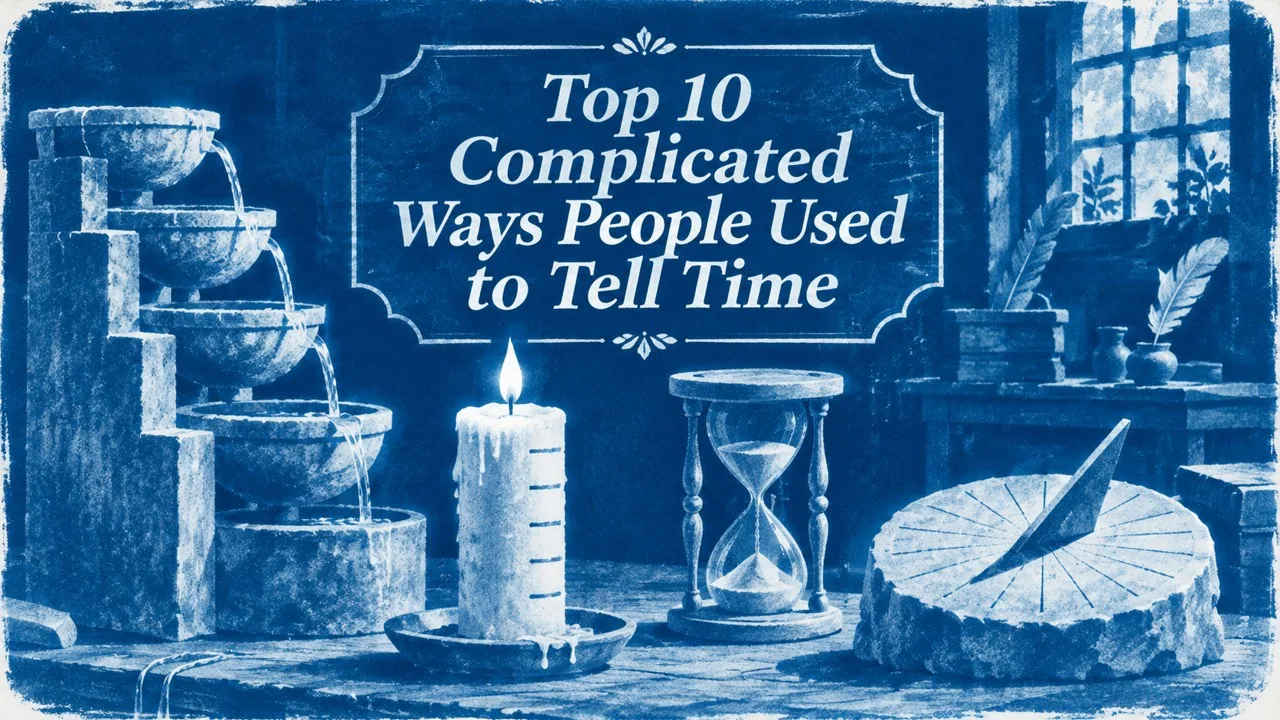
Before wristwatches, people told time with dripping water, burning incense, flowers, cannons and clocks with hours that changed length with the seasons. Today, telling the time could hardly be easier. Phones, computers, cars and ovens all display the exact time, synchronized automatically with atomic clocks. For most of human history, however, knowing the time was a much more complicated business.
Early methods relied on the sun and the stars, which worked well on clear days and nights but failed in cloudy weather. People needed ways to measure time indoors, at night and in all seasons, and they came up with remarkably creative solutions.
Some cultures measured time with flowing water or burning materials. Others built elaborate machines, combining astronomy, engineering and art. Several societies used hours that changed length through the year, making timekeeping even more complex.
As trade, travel and science expanded, accurate timekeeping became increasingly important. Sailors needed it to find their position at sea, railways needed it to run trains safely and scientists needed it to measure the natural world.
The ten methods below come from many times and places, from ancient Egypt and medieval China to Victorian Britain and revolutionary France. Some were practical tools used daily, while others were grand displays of technical skill.
Together, they show the enormous ingenuity that people have devoted to measuring something we now take for granted.
They also remind us that the way we divide the day is not natural but a choice. Hours, minutes and seconds are human inventions, and different cultures have organized time in very different ways.
Many of these devices were as much about prestige as practicality. Rulers and religious institutions commissioned elaborate clocks to show their wealth, learning and connection to the order of the heavens.
Key Facts
| # | Method | Where | When |
|---|---|---|---|
| 1 | Water clocks | Ancient Egypt, Greece and beyond | From around the fifteenth century BC |
| 2 | Su Song's astronomical clock | Kaifeng, China | Late eleventh century |
| 3 | Al-Jazari's elephant clock | Upper Mesopotamia | Early thirteenth century |
| 4 | Incense clocks | China and Japan | From at least the sixth century |
| 5 | Candle clocks | England and elsewhere | Ninth century and later |
| 6 | Japanese temporal clocks | Japan | Edo period, seventeenth to nineteenth centuries |
| 7 | Linnaeus's flower clock | Sweden | 1751 |
| 8 | Time balls | Greenwich, England and many ports | From 1829 and 1833 |
| 9 | Noon guns | Cape Town and other cities | From the early nineteenth century |
| 10 | French decimal time | France | 1793 to 1795 |
1. Dripping Water
One of the oldest ways of measuring time without the sun was the water clock. A simple version was a vessel with a small hole near the bottom, which let water drip out at a steady rate. Marks on the inside showed how much time had passed as the level fell [1].
One of the oldest known surviving examples comes from ancient Egypt and dates to the reign of Amenhotep III, in the fourteenth century BC. Water clocks were also used in Babylon, India, China and Greece [1].
The Greek inventor Ctesibius, who worked in Alexandria in the third century BC, improved the water clock with a float and regulating system that kept the flow more constant. His designs influenced clockmakers for centuries.
Related: Top 10 Calendars That Changed How People Count Time
2. A Clock Tower Driven by Water
In the late eleventh century, the Chinese scholar and official Su Song designed an extraordinary clock tower in the capital, Kaifeng. The tower was about twelve meters tall and was driven by a water wheel [2].
The clock used a kind of escapement mechanism to regulate the movement of the wheel. It powered an armillary sphere for observing the heavens, a rotating celestial globe and figures that appeared to announce the time with bells, gongs and drums [2].
Su Song wrote a detailed description of the clock, including illustrations. After the city was captured by invaders in the twelfth century, the clock was dismantled, but his writings have allowed modern engineers to build replicas.
3. A Mechanical Elephant
The engineer Ismail al-Jazari described many ingenious machines in his Book of Knowledge of Ingenious Mechanical Devices, completed around 1206. One of the most famous was the elephant clock [3].
The clock was powered by a bowl that slowly sank in a tank of water. As it sank, it triggered a series of mechanisms, including a bird that whistled, figures that moved and balls that dropped into the mouths of serpents, marking the passing of time [3].
The design combined elements from many cultures, including an Indian elephant, Chinese dragons and an Egyptian phoenix. Modern replicas have been built, including a large one displayed in a shopping mall in Dubai.
4. Burning Incense
In China, people used burning incense to measure time. Powdered incense was laid in a pattern in a tray of ash, and because it burned at a steady rate, people could tell how much time had passed by how far the fire had traveled [4].
Some incense clocks used different scents for different hours, allowing people to tell the time by smell. Others had threads with small weights tied across the incense, which dropped onto a metal plate when the thread burned through, acting as an alarm [4].
Incense clocks were used in temples, homes and offices. In Japan, similar devices were used, and incense was also used to measure the length of time paid for by visitors to entertainment districts.
Related: Top 10 Cultures With Unusual Ways of Measuring Time
5. Marked Candles
Candle clocks were candles marked with lines that showed the passing of hours as they burned down. They were simple to use but could be affected by drafts and the quality of the wax [5].
According to a biography written by the monk Asser, King Alfred the Great of England used candle clocks to divide his day between prayer, government and rest. Asser describes six candles, each burning for about four hours [5].
To protect the candles from drafts, Alfred is said to have placed them inside lanterns with thin panels of horn. Candle clocks were also used in China and Japan, and they remained in use in some places for centuries.
6. Hours That Changed Length
In Edo-period Japan, the day and the night were each divided into six hours. Because daylight lasts longer in summer than in winter, the length of each hour changed through the year [6].
Japanese clockmakers adapted European mechanical clocks to follow this system. Some clocks had adjustable weights that changed the speed of the mechanism, while others had movable hour markers on their dials, which had to be adjusted regularly [6].
These clocks, known as wadokei, were remarkable feats of engineering. Japan switched to equal hours in 1873, when it adopted the Western calendar, and the old clocks became collectors' items.
7. A Garden That Told Time
The Swedish botanist Carl Linnaeus noticed that many flowers open and close at particular times of day. In 1751, he proposed planting a garden of different species arranged so that they would open in sequence, allowing people to tell the time by looking at the flowers [7].
He listed plants that opened or closed at specific hours, based on his observations in Uppsala. The idea depended on local climate, latitude and weather, so a flower clock would only work accurately in certain conditions [7].
Related: Top 10 Ways Humans Might Still Be Evolving
There is no evidence that Linnaeus actually planted such a garden, but the idea inspired later gardeners. Floral clocks with mechanical hands and flower beds became popular in parks in the twentieth century.
8. A Ball That Drops at One
Sailors needed to set their ship's chronometers accurately in order to calculate longitude at sea. In the nineteenth century, many ports installed time balls, large balls on masts that dropped at a precise moment each day [8].
The first time ball was installed in Portsmouth in 1829, and the famous one at the Royal Observatory in Greenwich began operating in 1833. It drops at one o'clock in the afternoon, a time chosen because astronomers were busy taking measurements at noon [8].
Ships in the river could watch the ball and set their clocks precisely. The Greenwich time ball still drops every day, and the idea lives on in the New Year's Eve ball drop in Times Square.
9. A Cannon at Noon
In some cities, a cannon was fired at a precise time each day so that people, especially sailors, could set their clocks. These were known as noon guns [9].
The Noon Gun in Cape Town, South Africa, has been fired from Signal Hill since the early nineteenth century. It is one of the oldest traditions in the city and is still fired every day except Sundays and public holidays [9].
Other cities, including Hong Kong and Halifax in Canada, also have noon or time guns. They have become tourist attractions and reminders of a time when sound was used to share the correct time across a city.
10. Ten Hours in a Day
After the French Revolution, the new government sought to make all measurements rational and based on tens. In 1793, it introduced decimal time, dividing the day into ten hours, each hour into one hundred minutes and each minute into one hundred seconds [10].
Related: Top 10 Attempts to Redesign the Calendar
Clockmakers produced decimal clocks and watches, some showing both decimal and traditional time. However, the new system was unpopular and confusing, and replacing clocks was expensive [10].
Mandatory use of decimal time was suspended in 1795, after only about a year and a half. The metric system for length and weight survived, but the decimal day became a historical curiosity.
Conclusion
These methods show the remarkable creativity that people have brought to the challenge of telling time. Water, fire, flowers, cannons and complex machines were all used to divide the day into measurable parts.
Many of these inventions were also works of art and engineering, combining practical needs with beauty and prestige. Some, like Su Song's tower and al-Jazari's elephant clock, still inspire engineers today.
Others, like time balls and noon guns, show how important accurate time became for navigation and daily life. They paved the way for the standardized time zones and precise clocks we rely on now.
The next time you glance at your phone to check the time, it may be worth remembering the long history of human effort behind that simple act.
From dripping water to atomic clocks, the story of timekeeping is one of the great journeys of human invention.
Today, the most precise clocks in the world use the vibrations of atoms and would lose less than a second over many millions of years. They keep satellites, phone networks and financial markets in step. Yet they are the descendants of the dripping vessels, burning sticks and patient observers who first tried to capture the passing of time.
- ^ [1] Accounts of water clocks. Wikipedia: water clock Wikipedia: Ctesibius
- ^ [2] Accounts of Su Song. Wikipedia: Su Song Wikipedia: escapement
- ^ [3] Accounts of al-Jazari. Wikipedia: al-Jazari Wikipedia: elephant clock
- ^ [4] Accounts of incense clocks. Wikipedia: incense clock Wikipedia: incense
- ^ [5] Accounts of candle clocks. Wikipedia: candle clock Wikipedia: Alfred the Great
- ^ [6] Accounts of Japanese clocks. Wikipedia: Japanese clock Wikipedia: temporal hour
- ^ [7] Accounts of the flower clock. Wikipedia: Linnaeus's flower clock Wikipedia: Carl Linnaeus
- ^ [8] Accounts of time balls. Wikipedia: time ball Wikipedia: Royal Observatory, Greenwich
- ^ [9] Accounts of noon guns. Wikipedia: Noon Gun Wikipedia: Signal Hill (Cape Town)
- ^ [10] Accounts of decimal time. Wikipedia: decimal time Wikipedia: French Republican calendar





















Discussion
Log in with