




Top 10 Facts About the History of the Texas Rangers
 By Dhiraj Sharma · Published
Share Post
Loading…
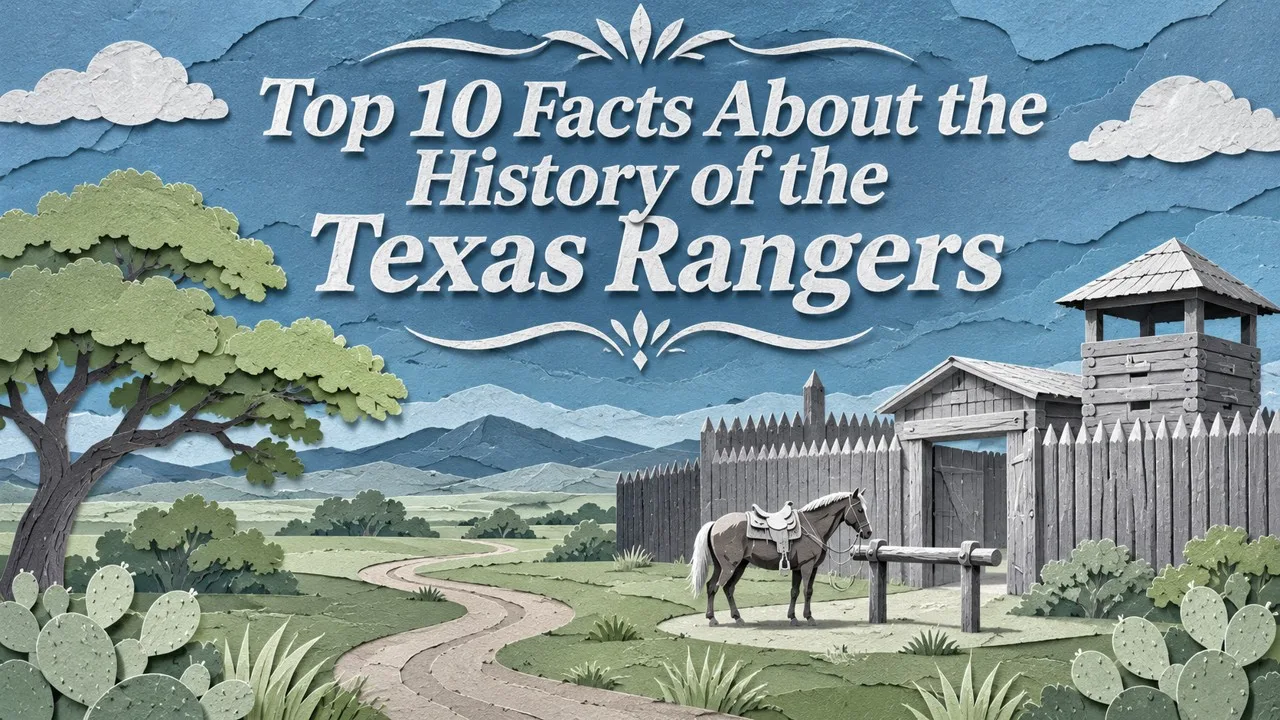
The Texas Rangers began with ten men hired in 1823 and became a legendary law agency, with a history that includes Colt revolvers, outlaws and dark chapters. The Texas Rangers are one of the most famous law enforcement agencies in the world. Their image, shaped by legends, novels, films and television, is that of tough, independent lawmen riding across the frontier to bring outlaws to justice.
The real history of the Rangers is longer and more complicated than the legend. They began as small groups of armed volunteers protecting early settlers, fought in wars, pursued criminals and evolved into a modern investigative agency.
Their history also includes dark chapters. During some periods, Rangers were involved in serious abuses, particularly against Mexican Americans and Native Americans, and historians and communities in Texas have increasingly sought to acknowledge these events.
Today, the Texas Rangers are a division of the Texas Department of Public Safety, specializing in major crimes, investigations of public corruption and other serious cases. They are a small, elite force with a strong sense of tradition.
The ten facts below trace the Rangers from their beginnings in the 1820s to the present day, covering their weapons, their wars, famous cases and the controversies that have shaped their reputation.
Where stories are legends or disputed, that is noted. The Rangers have inspired so many tales that separating fact from fiction can be a challenge.
Together, they show how a frontier militia became a lasting symbol of Texas, admired by many and criticized by others.
The name has also spread far beyond law enforcement. A Major League Baseball team, countless films and television series and a host of novels have all borrowed it, making the Texas Rangers one of the best-known names in American popular culture.
Texas itself went through dramatic changes during the Rangers' early history. It was part of Mexico until the revolution of 1835 and 1836, then an independent republic for nearly a decade, and finally a state of the United States from 1845. It joined the Confederacy during the Civil War and was later readmitted to the Union. Each of these changes affected how the Rangers were organized, funded and used, and their role shifted with every new government.
Key Facts
| # | Fact | When | Where |
|---|---|---|---|
| 1 | Origins under Stephen F. Austin | 1823 | Mexican Texas |
| 2 | Colt Paterson and Colt Walker | 1840s | Texas and the Southwest |
| 3 | Service in Mexico | 1846 to 1848 | Mexico |
| 4 | A permanent force | 1874 | Texas frontier |
| 5 | A famous saying | Late nineteenth century | Texas |
| 6 | Violence in the 1910s | 1910s | South Texas and the border region |
| 7 | Frank Hamer | 1934 | Louisiana |
| 8 | Department of Public Safety | 1935 | Texas |
| 9 | The cinco peso badge | Twentieth century onward | Texas |
| 10 | First women Rangers | 1993 | Texas |
1. Ten Men to Act as Rangers
The roots of the Texas Rangers go back to 1823, when Texas was part of Mexico. Stephen F. Austin, who had brought American settlers to the region, called for ten men to act as rangers to protect the colony [1].
These early rangers were not a formal police force but groups of armed volunteers who ranged over the land, patrolling and responding to threats. They were often organized for short periods and then disbanded [1].
Related: Top 10 Most Bizarre Phobias: Strange Fears That Exist
In 1835, during the Texas Revolution, the provisional government formally created a corps of rangers. The Rangers often describe themselves as the oldest state law enforcement agency in the United States.
2. The Revolvers That Changed Frontier Fighting
In the 1840s, Rangers led by John Coffee Hays adopted the Colt Paterson revolver, one of the first practical repeating firearms. Unlike single-shot pistols, it allowed riders to fire several shots without reloading [2].
At the Battle of Walker's Creek in 1844, a small group of Rangers armed with these revolvers fought a much larger Comanche force. The battle became famous as an early demonstration of the revolver's power [2].
The Ranger Samuel Walker later worked with Samuel Colt to design a more powerful revolver, the Colt Walker, introduced in 1847. The order for these guns helped revive Colt's struggling business.
3. Feared in the Mexican-American War
During the Mexican-American War, Ranger companies served with the United States Army as scouts and fighters. They were valued for their knowledge of the terrain and their skill as mounted riflemen [3].
The Rangers gained a fearsome reputation, and some Mexicans called them los diablos Tejanos, the Texan devils. They were also accused of acts of violence against civilians [3].
American military commanders praised their effectiveness but sometimes struggled to control them. Their service in the war helped spread the Ranger legend across the United States.
4. The Frontier Battalion
After the Civil War, Texas created the Frontier Battalion in 1874, a more permanent force of Rangers. At around the same time, a Special Force was created to deal with lawlessness in South Texas [4].
The Frontier Battalion fought in conflicts with Native American groups and pursued outlaws, cattle thieves and feuding families. As the frontier closed, the Rangers increasingly focused on law enforcement [4].
Famous outlaws such as John Wesley Hardin and Sam Bass were pursued by Rangers during this period. Hardin was arrested in Florida in 1877, and Bass was mortally wounded in a shootout with Rangers at Round Rock in 1878.
Related: Top 10 Oldest Buildings in the World
5. One Riot, One Ranger
One of the most famous phrases associated with the Rangers is one riot, one Ranger. It suggests that a single Ranger was enough to handle any trouble [5].
The saying is often linked to Captain Bill McDonald, a well-known Ranger of the late nineteenth and early twentieth centuries. According to the story, when a town asked for help with a riot, McDonald arrived alone and asked whether there was only one riot [5].
Historians doubt that the event happened exactly as told, and the saying may have been popularized by a biography of McDonald. Nonetheless, it captures the confident image that the Rangers cultivated.
6. A Dark Chapter on the Border
During the Mexican Revolution in the 1910s, tensions ran high along the border. Some Rangers, along with special Rangers and local vigilantes, were involved in widespread violence against Mexican Americans and Mexicans [6].
One of the most notorious events was the Porvenir massacre in January 1918, when Rangers, soldiers and local ranchers killed fifteen unarmed Mexican and Mexican American men and boys in the village of Porvenir. Historians estimate that hundreds of people, and possibly more, were killed during this period of violence [6].
In 1919, a state legislator named Jose Tomas Canales led an investigation into Ranger abuses. The investigation led to reforms and a reduction in the size of the force. In recent years, historians and community groups have worked to document and commemorate the victims.
7. The End of Bonnie and Clyde
Frank Hamer was one of the most famous Rangers of the early twentieth century. In 1934, after retiring from active Ranger service, he was hired by Texas prison officials to track down the outlaws Bonnie Parker and Clyde Barrow [7].
Hamer followed the pair for months. In May 1934, he and other lawmen ambushed them on a road in Louisiana, killing both in a hail of gunfire [7].
Related: 10 Sikh Gurus: The Pillars of Sikhism Who Shaped Faith, Equality, Courage, and Humanity
The ambush has been debated ever since, with some criticizing the lack of a warning. Hamer's role was later portrayed in films, including the 2019 film The Highwaymen.
8. Becoming Part of a Modern Agency
By the early 1930s, the Rangers had been weakened by politics. In 1932, they supported a governor who lost the election, and the new administration dismissed many of them and appointed less qualified replacements [8].
In 1935, the Texas legislature created the Department of Public Safety, combining the Rangers with the state highway patrol. The Rangers became the department's investigative arm [8].
The reorganization helped professionalize the force, introducing modern methods of crime investigation. Today, the Rangers work on major crimes, unsolved cases, public corruption and border security.
9. Badges Made From Mexican Coins
The traditional Texas Ranger badge is a star inside a circle, often called a wheel. Many early badges were made by cutting the design from Mexican silver coins, especially the five peso coin [9].
Ranger badges were not standardized in the early years, and individual Rangers often had their own made by local craftsmen. The cinco peso style became the most iconic design [9].
The official badge used by modern Rangers continues this tradition, and it is one of the most recognizable law enforcement symbols in the United States.
10. Women Join the Rangers
For most of their history, the Rangers were an all-male force. In 1993, the first women joined the Rangers, marking a significant change in the organization's history [10].
Since then, more women have served as Rangers, though they remain a small proportion of the force. Their inclusion reflected wider changes in law enforcement and society [10].
Related: Top 10 Tallest Buildings in the World
The Rangers have also become more diverse in other ways, though critics have argued that progress has been slow. Their history and traditions are preserved at the Texas Ranger Hall of Fame and Museum in Waco.
Conclusion
The Texas Rangers have a long and complex history. From small groups of volunteers in the 1820s, they grew into one of the most famous law enforcement agencies in the world.
Their story includes courage, skill and service, but also violence and abuse, particularly during the early twentieth century. Acknowledging both sides is essential to understanding their history.
The Rangers have adapted to changing times, evolving from frontier fighters to modern investigators. They remain a powerful symbol of Texas identity.
Their legend will likely continue to inspire stories, while historians continue to uncover the full truth about their past.
For Texans, the Rangers are part of a shared history that continues to be debated, celebrated and reexamined.
Popular culture has played a huge role in shaping how people see the Rangers. The Lone Ranger, a fictional masked hero who first appeared on radio in 1933, was presented as the last survivor of a group of Texas Rangers. Later, television series such as Walker, Texas Ranger brought the image to new audiences. These stories often bore little resemblance to the real work of the force, but they helped make the Rangers famous around the world.
Modern Rangers often say that their greatest strength lies in careful investigation rather than gunfights. Much of their work today involves interviewing witnesses, examining evidence and working with other agencies on complex cases, including cold cases that have gone unsolved for decades. It is a long way from the image of the lone rider on the frontier, but it reflects how policing has changed.
Their story is still being written.
It is a history worth knowing in full.
- ^ [1] Accounts of the Texas Rangers. Wikipedia: Texas Ranger Division Wikipedia: Stephen F. Austin
- ^ [2] Accounts of Ranger revolvers. Wikipedia: Colt Paterson Wikipedia: Colt Walker
- ^ [3] Accounts of John Coffee Hays. Wikipedia: John Coffee Hays Wikipedia: Battle of Walker's Creek
- ^ [4] Accounts of the Mexican-American War. Wikipedia: Mexican-American War Wikipedia: Samuel Hamilton Walker
- ^ [5] Accounts of the Frontier Battalion. Wikipedia: Frontier Battalion Wikipedia: John Wesley Hardin
- ^ [6] Accounts of Bill McDonald. Wikipedia: William Jesse McDonald Wikipedia: Sam Bass
- ^ [7] Accounts of the Porvenir massacre. Wikipedia: Porvenir massacre Wikipedia: Jose Tomas Canales
- ^ [8] Accounts of Frank Hamer. Wikipedia: Frank Hamer Wikipedia: Bonnie and Clyde
- ^ [9] Accounts of the Department of Public Safety. Wikipedia: Texas Department of Public Safety Wikipedia: badge
- ^ [10] Accounts of the Ranger museum. Wikipedia: Texas Ranger Hall of Fame and Museum Wikipedia: Waco, Texas





















Discussion
Log in with