





 By
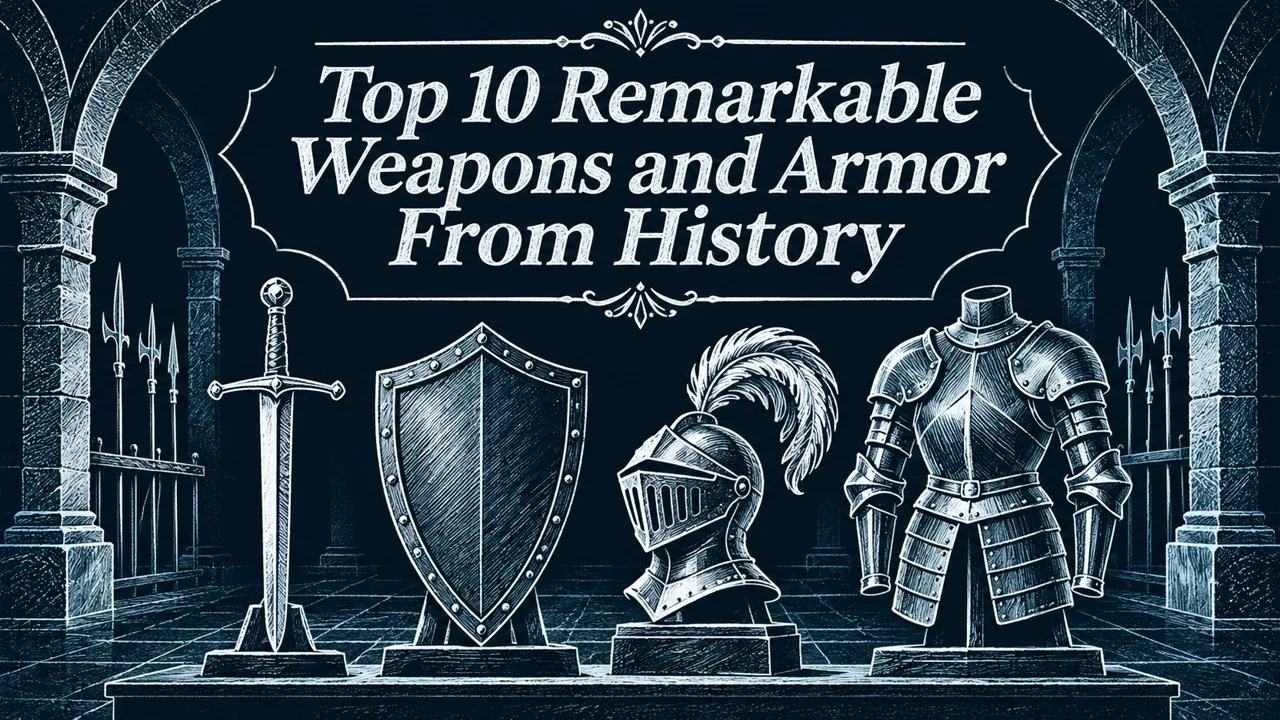
From a Bronze Age suit tested by modern marines to a sword still sharp after 2,500 years and a gun with square bullets, ten remarkable weapons and armor. For as long as people have fought wars, they have tried to build better weapons to attack and better armor to protect themselves. The result is a remarkable range of objects, from simple clubs and shields to complex mechanical devices.
Some of these objects were technological marvels for their time, showing advanced skills in metalworking, engineering and materials science. Others were unusual or experimental designs that never caught on, or that reflect the beliefs and customs of the people who made them.
Many weapons and pieces of armor have survived in museums, burial sites and battlefields. Archaeologists, historians and engineers study them to understand how they were made and used, sometimes building replicas and testing them in experiments.
These studies can overturn long-held assumptions. Armor once thought to be purely ceremonial has proved practical in tests, and ancient metals have turned out to be more sophisticated than expected.
The ten items below come from Europe, Asia and the Americas, spanning more than three thousand years. They include famous archaeological finds, weapons associated with particular martial traditions and one invention that remains a historical curiosity.
Where details are uncertain or based on later accounts, that is noted. Many famous stories about historic weapons have grown in the retelling.
Together, they show the creativity, skill and sometimes the strange thinking that went into the tools of war.
They also remind us that weapons and armor were often works of art, decorated with precious metals and symbols that expressed the status and identity of their owners.
Key Facts
| # | Item | Culture | Period |
|---|---|---|---|
| 1 | Dendra panoply | Mycenaean Greece | Around the fifteenth century BC |
| 2 | Linothorax | Ancient Greece and Macedon | Sixth to fourth centuries BC |
| 3 | Sword of Goujian | Ancient China | Fifth century BC |
| 4 | Lorica segmentata | Roman Empire | First to third centuries AD |
| 5 | Sutton Hoo helmet | Anglo-Saxon England | Early seventh century |
| 6 | Macuahuitl | Aztec Empire | Fifteenth and sixteenth centuries |
| 7 | Urumi | Kerala, India | Traditional martial art weapon |
| 8 | Repeating crossbow | Ancient and imperial China | From the fourth century BC to the nineteenth century |
| 9 | Japanese o-yoroi | Japan | Tenth to fourteenth centuries |
| 10 | Puckle gun | Great Britain | 1718 |
1. A Bronze Age Suit of Armor
In 1960, archaeologists excavating a tomb at Dendra, near the ancient city of Mycenae in Greece, discovered a complete suit of bronze armor. Dating to around the fifteenth century BC, it is one of the oldest known suits of body armor from Europe [1].
The armor is made of bronze plates that cover the body, shoulders and thighs, and it was found with a helmet made of boar's tusks. For many years, some scholars thought it was too heavy and awkward to be used in battle and must have been ceremonial [1].
In a study published in 2024, researchers had Greek marines wear a replica of the armor while performing tasks based on ancient combat for hours. They concluded that it was practical for battle, suggesting that Mycenaean warriors could have fought in it.
Related: Top 10 Ancient Sites That Keep Yielding New Finds
2. Armor Made of Linen
Ancient Greek art and writings describe armor made from layers of linen, known today as the linothorax. Because linen decays, no original examples have survived, and scholars long debated how effective it could have been [2].
Ancient images, including a famous mosaic thought to depict Alexander the Great, appear to show warriors wearing armor of this type. It would have been lighter and cooler than bronze armor [2].
Researchers in the United States made replicas by gluing layers of linen together and tested them against arrows. They found that the armor could stop many arrows, suggesting that it offered real protection at a fraction of the weight of metal.
3. A Sword Still Sharp After Millennia
In 1965, archaeologists in Hubei province, China, discovered a bronze sword in a tomb. An inscription on the blade identified it as belonging to Goujian, a king of the state of Yue who ruled in the fifth century BC [3].
The sword was remarkably well preserved, with little corrosion and a blade that was reported to still be sharp. Its surface is decorated with a diamond pattern, and its hilt was wrapped in silk [3].
Scientists have studied the sword to understand its resistance to corrosion, pointing to the composition of its metals and the conditions inside the sealed tomb. It is now one of the treasures of the Hubei Provincial Museum.
4. Strips of Iron
The image of a Roman legionary often includes armor made of overlapping iron strips covering the chest and shoulders. Modern historians call this type of armor the lorica segmentata, though the Romans themselves may not have used that name [4].
Our understanding of the armor comes largely from fragments found at archaeological sites, including a hoard discovered at Corbridge in northern England and finds near the site of a famous Roman defeat at Kalkriese in Germany [4].
The armor offered strong protection and could be taken apart for repair. However, it required careful maintenance, and other types of Roman armor, such as mail, remained common throughout the empire.
Related: Top 10 War Relics With Remarkable Stories
5. A Helmet From a Ship Burial
In 1939, archaeologists excavating a burial mound at Sutton Hoo in Suffolk, England, discovered the remains of a ship that had been used as a grave for an important person, possibly a king. Among the treasures was a decorated iron helmet [5].
The helmet had corroded and been crushed into hundreds of fragments. Conservators at the British Museum spent years reconstructing it, revealing a face mask with eyebrows, a nose and a mustache, and decorative panels showing warriors and animals [5].
The helmet is one of the most famous objects from Anglo-Saxon England. It is often linked to Raedwald, a king of East Anglia who died around 624, though this identification is not certain.
6. A Club Edged With Obsidian
The macuahuitl was a wooden weapon used by the Aztecs and other peoples of Mesoamerica. Its edges were lined with sharp blades of obsidian, a volcanic glass that can be sharper than steel [6].
Spanish accounts from the conquest of Mexico describe the weapon as extremely dangerous, with some claiming that it could cut off the head of a horse. Such claims may be exaggerated, but experiments with replicas have shown that the weapon could cause serious wounds [6].
No original macuahuitl is known to survive. The last known example was destroyed in a fire at the Royal Armoury in Madrid in the nineteenth century, so our knowledge comes from drawings, descriptions and modern reconstructions.
7. A Sword That Bends
The urumi is a flexible sword made of thin strips of steel, associated with the martial art of Kalaripayattu from Kerala in southern India. The blades are so flexible that the weapon can be coiled and worn around the waist like a belt [7].
In skilled hands, the urumi is swung in fast, sweeping movements, making it difficult for opponents to approach. It can have several blades attached to a single handle [7].
Related: Top 10 Famous Shipwrecks That Rewrote History
The urumi is considered one of the most difficult weapons to master, since it is as dangerous to an inexperienced user as to an opponent. It is still taught by some Kalaripayattu masters as part of advanced training.
8. A Crossbow With a Magazine
The repeating crossbow was a Chinese weapon that could fire several bolts in rapid succession from a magazine on top of the bow. The user pulled a lever back and forth to cock the bow, load a bolt and fire it [8].
The weapon is often associated with Zhuge Liang, a famous strategist of the third century AD, but archaeological finds show that repeating crossbows existed several centuries earlier. Later versions were widely used for defense [8].
Repeating crossbows were less powerful than standard crossbows, but they could fire quickly. Remarkably, they were still in use in China in the late nineteenth century.
9. Armor of Lacquer and Silk
The o-yoroi, or great armor, was worn by mounted samurai warriors in medieval Japan. It was made of small scales of iron and leather, lacquered to protect against moisture and laced together with colorful silk cords [9].
The armor had a boxy shape, designed for warriors who fought mainly as mounted archers. Large shoulder guards protected the arms, and a heavy helmet protected the head [9].
As warfare in Japan changed and fighting on foot became more common, lighter types of armor became popular. Surviving examples of o-yoroi are treasured as works of art and some are designated as national treasures.
10. A Gun With Square Bullets
In 1718, the London lawyer and inventor James Puckle patented a gun that he called the Defence. It was a large flintlock weapon mounted on a tripod, with a revolving cylinder that allowed it to fire several shots without reloading [10].
Related: Top 10 Overlooked Ancient Mysteries
Puckle's patent described two versions, one firing round bullets for use against Christian enemies and another firing square bullets, which he claimed would cause more severe wounds, for use against Muslim Turks. The proposal reflected the religious prejudices of the time [10].
The gun was not a commercial success, and few were made. However, it is sometimes described as an early forerunner of the machine gun, showing how inventors were already trying to increase the rate of fire.
Conclusion
These weapons and armor show the remarkable ingenuity that people have brought to warfare throughout history. From Bronze Age plates to flexible swords and early repeating guns, each reflects the materials, skills and ideas of its time.
Many of these objects were also works of art, decorated with care and buried with their owners. They tell us not only how people fought but also how they saw themselves and their world.
Modern research continues to reveal new insights. Experiments with replicas have shown that some armor once thought impractical was effective, while scientific analysis has explained the remarkable preservation of ancient weapons.
Studying these objects helps us understand the past, including the human costs of war that lie behind even the most beautiful weapons.
Museums around the world preserve many of these items, allowing visitors to see them up close and appreciate the skill of the people who made them.
Experimental archaeology, in which researchers build and test replicas, has become an important tool in this work. By recreating ancient techniques with authentic materials, scholars can test claims made in old texts and gain a hands-on understanding of how weapons and armor really performed. The results often surprise even the experts, and they keep the conversation about ancient warfare lively.
Each object, in its own way, is a window onto the people who made it.
- ^ [1] Accounts of the Dendra panoply. Wikipedia: Dendra panoply Wikipedia: Mycenaean Greece
- ^ [2] Accounts of the linothorax. Wikipedia: linothorax Wikipedia: Alexander Mosaic
- ^ [3] Accounts of the Sword of Goujian. Wikipedia: Sword of Goujian Wikipedia: Hubei Provincial Museum
- ^ [4] Accounts of the lorica segmentata. Wikipedia: lorica segmentata Wikipedia: Kalkriese
- ^ [5] Accounts of the Sutton Hoo helmet. Wikipedia: Sutton Hoo helmet Wikipedia: Sutton Hoo
- ^ [6] Accounts of the macuahuitl. Wikipedia: macuahuitl Wikipedia: obsidian
- ^ [7] Accounts of the urumi. Wikipedia: urumi Wikipedia: Kalaripayattu
- ^ [8] Accounts of the repeating crossbow. Wikipedia: repeating crossbow Wikipedia: Zhuge Liang
- ^ [9] Accounts of Japanese armor. Wikipedia: O-yoroi Wikipedia: Japanese armour
- ^ [10] Accounts of the Puckle gun. Wikipedia: Puckle gun Wikipedia: machine gun























Discussion
Log in with