





 By
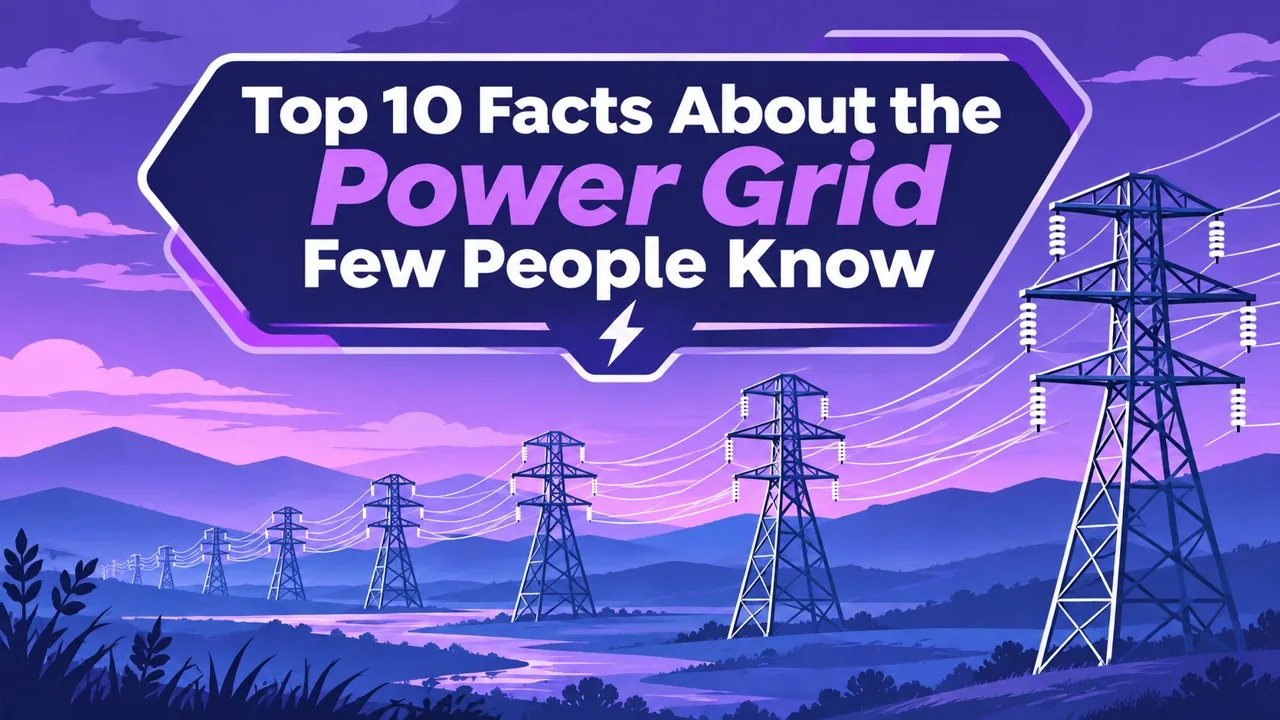
The power grid is a vast machine balanced second by second, from Japan's split frequency to clocks that drifted when Europe's grid fell slightly behind. The electrical grid is often described as the largest machine ever built. It links power stations, transmission lines, substations and millions of homes and businesses into a single system that must work every second of every day.
Most people only think about the grid when it fails. Flip a switch and the lights come on, so the complex engineering behind that simple act is easy to ignore. Yet keeping the grid running requires constant balancing, careful planning and a surprising amount of history.
Electricity is hard to store in large amounts, so power stations must produce almost exactly as much as people use at every moment. If supply and demand drift apart, the frequency of the alternating current changes, and if the gap grows too large, parts of the grid can shut down.
The ten facts below cover the history of the grid, the way it is divided, the tricks engineers use to keep it stable and some of the strange events that have tested it, from television breaks to solar storms.
They show that the grid is not just a set of wires, but a living system shaped by decisions made more than a century ago and by the daily habits of millions of people.
As countries add more wind and solar power and more electric cars, the grid is changing faster than at any time since it was built. Understanding how it works has never been more important.
Key Facts
| # | Fact | Where | When |
|---|---|---|---|
| 1 | A country split in half | Japan | Since the late nineteenth century |
| 2 | AC versus DC | United States | 1880s and 1890s |
| 3 | Three main interconnections | United States and Canada | Today |
| 4 | Clocks that follow the frequency | Europe | 2018 |
| 5 | Black start | Worldwide | Ongoing |
| 6 | Pumped-storage hydroelectricity | Worldwide | Since the late nineteenth century |
| 7 | TV pickup | United Kingdom | Since the 1960s and 1970s |
| 8 | Northeast blackout of 2003 | United States and Canada | August 2003 |
| 9 | Geomagnetic storms | Quebec, Canada | March 1989 |
| 10 | High-voltage direct current lines | China and worldwide | Today |
1. Japan Runs on Two Frequencies
Most countries use a single grid frequency, either 50 or 60 cycles per second. Japan is unusual because it uses both. The eastern part of the country, including Tokyo, runs at 50 hertz, while the western part, including Osaka, runs at 60 hertz [1].
The split dates back to the 1890s, when Tokyo bought generators from a German company that used 50 hertz, and Osaka bought generators from an American company that used 60 hertz. The two systems grew up separately and were never unified, because changing one side would have been enormously expensive [1].
The divide matters most in emergencies. After the 2011 Tohoku earthquake and tsunami knocked out power stations in the east, the west could send only a limited amount of electricity across, because the two halves are linked through a small number of frequency converter stations.
2. The War of the Currents
In the early days of electricity, there was a fierce battle over which type of current to use. Thomas Edison promoted direct current, in which electricity flows in one direction. George Westinghouse, using patents by Nikola Tesla, promoted alternating current, which reverses direction many times per second [2].
Related: Top 10 Largest Hydroelectric Dams by Capacity
Alternating current had a major advantage. Its voltage could easily be raised with transformers to send power long distances with little loss, then lowered for safe use in homes. Direct current systems of the time needed power stations close to customers [2].
The rivalry included public campaigns to portray alternating current as dangerous. In the end, alternating current won and became the standard for grids around the world, although direct current has made a comeback for some long-distance lines.
3. North America Has Several Separate Grids
The grid in the United States and Canada is not one single system. It is divided into several large interconnections, mainly the Eastern Interconnection, the Western Interconnection and the grid run by the Electric Reliability Council of Texas, known as ERCOT [3].
Within each interconnection, the generators spin in step with one another at the same frequency. The interconnections are linked only by a small number of direct current ties, so power cannot flow freely between them [3].
Texas has kept its grid largely separate, partly to avoid federal regulation of interstate power sales. This independence came under scrutiny in February 2021, when a severe winter storm caused widespread blackouts in the state, and only a small amount of power could be imported from neighbors.
4. The Grid Keeps Time
Some electric clocks, including many on ovens and older alarm clocks, keep time by counting the cycles of the alternating current. Grid operators traditionally keep the average frequency precise over the long term, so these clocks stay accurate [4].
In early 2018, clocks across much of continental Europe began running slow, eventually falling about six minutes behind. The cause was a shortfall of power in part of the synchronized grid linked to a dispute between Serbia and Kosovo over who would pay for some electricity, which slightly lowered the frequency over several weeks [4].
Grid operators fixed the problem and then ran the frequency slightly high to help the clocks catch up. The episode showed how a local political dispute could affect devices in homes across a whole continent.
Related: Top 10 Technologies Being Tested Against Climate Change
5. Restarting a Dead Grid Is Hard
If a large part of the grid shuts down completely, it cannot simply be switched back on. Many power stations need electricity from the grid to start up their own equipment, such as pumps and fans, so a total blackout creates a chicken and egg problem [5].
To solve this, grid operators keep special black start resources. These are usually smaller power stations, such as hydroelectric plants or gas turbines with their own diesel generators, that can start without outside power. They are used to energize parts of the grid step by step [5].
Restarting a grid can take hours or days, because operators must carefully balance new generation with the demand that comes back online. Black start plans are tested and updated regularly, even though they are rarely needed.
6. Water as a Giant Battery
Storing electricity in large amounts is difficult, but one method has been used for more than a century. Pumped-storage hydroelectricity uses spare power to pump water uphill into a reservoir, then lets it flow back down through turbines to generate electricity when needed [6].
Pumped storage accounts for the great majority of grid energy storage capacity worldwide. It can respond within minutes to sudden changes in demand, making it valuable for keeping the grid stable [6].
Large batteries are now being built in many countries as costs fall, but pumped storage remains important. New projects are being planned to help store power from wind and solar farms, whose output varies with the weather.
7. The Kettle Surge
In Britain, grid operators have long watched television schedules. When a popular program ends or reaches a commercial break, millions of people get up at the same time to switch on electric kettles, turn on lights and open refrigerators [7].
This sudden jump in demand is known as TV pickup. Some of the largest surges have followed major events such as important football matches and the final episodes of popular dramas. Operators prepare by arranging for extra power, often from pumped storage, to be ready at the right moment [7].
Related: Top 10 Disasters Caused by a Single Point of Failure
TV pickup shows how closely the grid is linked to everyday habits. As streaming and on-demand viewing grow, these surges have become less predictable, but they still occur during major live events.
8. A Software Bug and Overgrown Trees
On August 14, 2003, a huge blackout cut power to about 55 million people in the northeastern United States and Ontario. Some areas were without electricity for days [8].
Investigators found that the blackout began in Ohio, when high-voltage lines sagged into overgrown trees and shut down. A software bug in an alarm system at a utility's control room meant that operators did not realize what was happening, so they did not take action before the problem spread [8].
The investigation led to new mandatory reliability standards for the grid in North America, including rules on tree trimming near power lines. The blackout showed how small problems could cascade into a disaster.
9. The Sun Can Knock Out Power
Powerful eruptions on the sun can send streams of charged particles toward Earth. When they hit the magnetic field, they can cause geomagnetic storms that induce currents in long power lines and damage transformers [9].
In March 1989, a strong geomagnetic storm caused the grid in Quebec to collapse in less than two minutes. About six million people lost power for around nine hours on a cold winter night. Auroras were seen as far south as Texas [9].
Grid operators now monitor space weather forecasts and have taken steps to protect equipment. Scientists warn that an even stronger storm, like the Carrington Event of 1859, could cause widespread damage to modern grids.
Related: Top 10 Most Bizarre Phobias: Strange Fears That Exist
10. Direct Current Returns
Although alternating current won the war of the currents, direct current is now used for some of the longest and most powerful transmission lines in the world. High-voltage direct current lines lose less energy over very long distances and can connect grids that run at different frequencies [10].
China has built many of the most powerful lines, carrying power from remote hydroelectric, coal, wind and solar plants in the west to cities in the east, often thousands of kilometers away. Some lines operate at more than a million volts [10].
Undersea cables between countries also often use direct current. These links allow countries to share power, helping balance supply and demand across larger regions.
Conclusion
The power grid is a remarkable achievement of engineering and cooperation. It must balance supply and demand every second, respond to the habits of millions of people and survive storms, software bugs and political disputes.
Its history explains many of its quirks, from Japan's split frequency to the separate grids of North America. Decisions made more than a century ago still shape how electricity reaches homes today.
As the world adds more renewable energy and electric vehicles, engineers are working to make the grid smarter, more flexible and more resilient. Batteries, new transmission lines and better forecasting will all play a role.
The next time the lights come on at the flick of a switch, it is worth remembering the vast and complex machine that makes it possible.
It is quiet, invisible work, and it rarely gets the credit it deserves.
- ^ [1] Accounts of the electrical grid. Wikipedia: electrical grid Wikipedia: utility frequency
- ^ [2] Accounts of Japan's split grid. Wikipedia: Electricity sector in Japan Wikipedia: 2011 Tohoku earthquake and tsunami
- ^ [3] Accounts of the war of the currents. Wikipedia: War of the currents Wikipedia: transformer
- ^ [4] Accounts of North American interconnections. Wikipedia: North American power transmission grid Wikipedia: ERCOT
- ^ [5] Accounts of grid-timed clocks. Wikipedia: Synchronous grid of Continental Europe Wikipedia: electric clock
- ^ [6] Accounts of black start. Wikipedia: black start Wikipedia: power outage
- ^ [7] Accounts of pumped storage. Wikipedia: pumped-storage hydroelectricity Wikipedia: grid energy storage
- ^ [8] Accounts of TV pickup. Wikipedia: TV pickup Wikipedia: National Grid (Great Britain)
- ^ [9] Accounts of the 2003 blackout. Wikipedia: Northeast blackout of 2003 Wikipedia: cascading failure
- ^ [10] Accounts of geomagnetic storms and HVDC. Wikipedia: March 1989 geomagnetic storm Wikipedia: high-voltage direct current




















Discussion
Log in with