




Top 10 Strange Effects of the Year Without a Summer
 By Dhiraj Sharma · Published
Share Post
Loading…
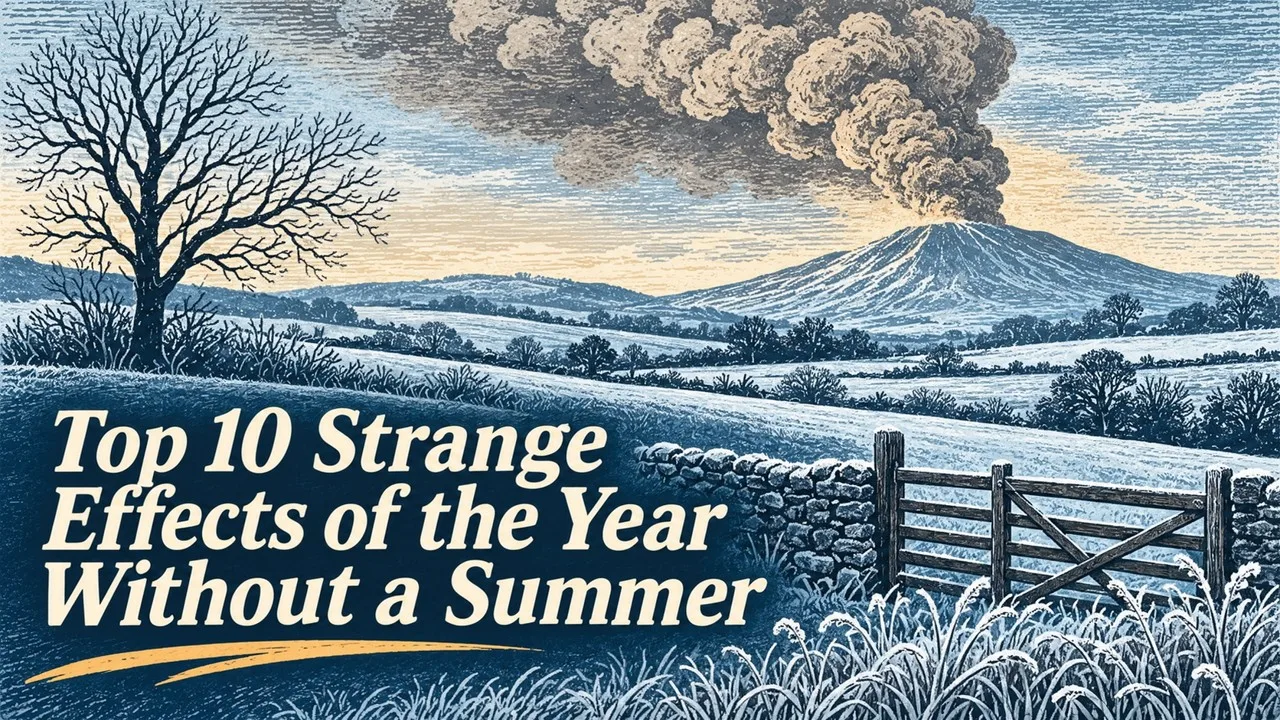
A volcano in 1815 caused the Year Without a Summer, bringing June snow, famine and migration, and helping inspire Frankenstein and a forerunner of the bicycle. In April 1815, Mount Tambora on the island of Sumbawa, in what is now Indonesia, exploded in the largest volcanic eruption in recorded history. It killed tens of thousands of people in the region and blasted huge amounts of ash and gas high into the atmosphere.
The sulfur gases formed a veil of tiny particles in the stratosphere that spread around the globe and reflected sunlight back into space. Over the following year, average temperatures fell across much of the Northern Hemisphere. The year 1816 became known as the Year Without a Summer.
The effects were felt far beyond Indonesia. Crops failed, prices soared and people migrated in search of better land. The strange weather also left its mark on literature, art and technology, in ways that people at the time could not have connected to a distant volcano.
The ten effects below include the eruption itself, snow in New England in June, the birth of Frankenstein, a dark poem by Lord Byron, the invention of an early two-wheeled machine, migration to the American West, famine in Europe, vivid sunsets in paintings, famine in southwest China and disruptions to India's monsoon.
Some links, especially those connecting the volcano to inventions, artworks and disease, are hypotheses proposed by historians and scientists rather than proven facts. Where that is the case, it is noted.
The story of 1816 has gained new interest in recent decades as scientists study how volcanic eruptions and climate change can affect food supplies, health and society around the world.
At the time, few people knew about the eruption, and even fewer connected it with the cold weather. News traveled slowly, and the science of how volcanic particles affect the climate was not developed until much later. Some people blamed sunspots, while others saw the strange weather as a sign of divine displeasure.
Key Facts
| # | Effect | Where | When |
|---|---|---|---|
| 1 | Mount Tambora erupts | Sumbawa, Indonesia | April 1815 |
| 2 | Summer snow in New England | Northeastern United States and Canada | 1816 |
| 3 | A ghost story contest | Villa Diodati, near Geneva, Switzerland | June 1816 |
| 4 | Byron's Darkness | Lake Geneva, Switzerland | 1816 |
| 5 | Karl Drais's running machine | Mannheim, Germany | 1817 |
| 6 | Migration from New England | Northeastern United States | Late 1810s |
| 7 | Food crisis | Europe, especially Switzerland and Germany | 1816 and 1817 |
| 8 | Vivid skies in art | Britain and Europe | 1815 onward |
| 9 | Crop failures in Yunnan | Yunnan province, China | 1815 to 1817 |
| 10 | Possible link to cholera | Bengal, India | 1817 |
1. The Largest Eruption in Recorded History
Mount Tambora had been quiet for centuries before it began rumbling in early April 1815. On April 10 and 11, it erupted with enormous force, in an event rated seven on the Volcanic Explosivity Index. The explosions were heard more than a thousand kilometers away [1].
Pyroclastic flows and ash buried villages, and the mountain lost much of its height. Tens of thousands of people died from the eruption and from the famine and disease that followed on Sumbawa and neighboring islands. Estimates of the total death toll vary widely [1].
The eruption injected large amounts of sulfur dioxide into the stratosphere, where it formed sulfate aerosols. These spread around the world and cooled the climate over the following year, setting the stage for the Year Without a Summer.
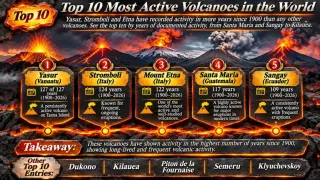
Related: Top 10 Most Active Volcanoes in the World
2. Snow in June
In June 1816, snow fell in parts of New England and eastern Canada. Frosts continued into July and August, killing crops in the fields. Some farmers had to replant several times, only to see their crops destroyed again [2].
Diaries and newspapers recorded the strange weather. People in Vermont and Maine reported ice on ponds in summer. The year was later nicknamed Eighteen Hundred and Froze to Death [2].
Crop failures pushed up food prices, and many farm animals died or were slaughtered because there was not enough feed. The hardship shaped the memories of a generation and contributed to major changes in where people chose to live.
3. The Birth of Frankenstein
In June 1816, the poet Lord Byron rented the Villa Diodati near Lake Geneva. His guests included Percy Bysshe Shelley, Mary Godwin, who would soon marry Shelley, and Byron's physician John Polidori. Cold, stormy weather kept them indoors for days [3].
Byron suggested that each of them write a ghost story. Mary began the story that became Frankenstein, published in 1818, often considered one of the first works of science fiction. Polidori wrote The Vampyre, published in 1819, which helped shape the modern image of the aristocratic vampire [3].
Mary Shelley later described the summer as wet and ungenial. The gloomy weather, caused in part by Tambora's eruption, helped create the conditions for two of the most influential horror stories in literature.
4. A Poem About the End of the Sun
During the same strange summer, Lord Byron wrote a poem called Darkness. It describes a world in which the sun has gone out, and humanity descends into desperation and despair as the cold and dark spread [4].
The poem opens with the line I had a dream, which was not all a dream. Many readers have connected its imagery to the unusual weather of 1816, when darkened skies and failed harvests seemed to some like signs of the end of the world [4].
Darkness has been read as a reflection on fear, catastrophe and human nature. It shows how the climate of 1816 influenced not only the lives of farmers but also the imagination of writers.
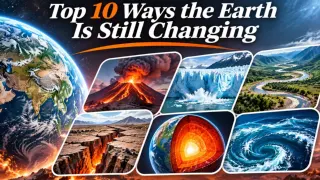
Related: Top 10 Ways the Earth Is Still Changing
5. A Machine to Replace Horses
In 1817, the German inventor Karl Drais demonstrated a two-wheeled running machine, which riders pushed along with their feet. Often called a dandy horse or draisine, it is considered an important forerunner of the bicycle [5].
Some historians have suggested that the invention was inspired by the food crisis after 1816, when the price of oats rose and many horses died or were slaughtered. A machine that did not need to be fed might have seemed especially appealing [5].
This link is a hypothesis rather than a proven fact, since Drais had been working on inventions for some time. But the timing is striking, and the story is often told in histories of the bicycle.
6. Moving West
After the disastrous harvests of 1816, many farming families in New England decided to leave. They moved west to places such as Ohio, Indiana and western New York, where the land was more fertile and the growing season longer [6].
One family that moved was that of Joseph Smith Sr., who left Vermont for Palmyra, New York, after repeated crop failures. His son, Joseph Smith, later founded the Latter Day Saint movement in the region [6].
Historians see the Year Without a Summer as one of several factors that encouraged migration westward. The movement of people helped shape the development of the American Midwest.
7. Famine and Riots in Europe
Europe was still recovering from the Napoleonic Wars when the cold, wet summer of 1816 destroyed harvests. Grain prices rose sharply, and famine spread in parts of Switzerland, Germany and other regions [7].
There were food riots in several countries, and many people resorted to eating whatever they could find. Some historians have described the crisis as the last great subsistence crisis in the Western world [7].
Related: Top 10 Strange Things That Have Fallen From the Sky
The hardship encouraged emigration, as thousands of Europeans left for America. It also prompted some governments to improve food storage and relief systems.
8. Sunsets in Paintings
After major volcanic eruptions, the particles in the atmosphere can produce unusually colorful sunsets. Some scientists have studied paintings from the period after 1815 to see whether artists recorded these effects [8].
In 2007, a team of researchers analyzed the colors of sunsets in hundreds of paintings, including works by J. M. W. Turner, and found that the ratio of red to green tended to be higher in the years following major eruptions. They suggested that the paintings could serve as a rough record of atmospheric conditions [8].
The idea is intriguing but debated, since artists painted for many reasons and did not aim to record the weather precisely. Still, Turner's dramatic skies are often linked in popular accounts to the aftermath of Tambora.
9. Famine in Southwest China
The cold weather after Tambora's eruption also affected parts of Asia. In Yunnan province in southwest China, unusually cold summers caused rice crops to fail for several years in a row, leading to severe famine [9].
Records from the period describe terrible suffering, with people eating clay and selling their children. Some historians have argued that the crisis encouraged farmers in Yunnan to turn to opium poppy cultivation, a hardier and more profitable crop [9].
The link between Tambora and the rise of opium farming in Yunnan is a hypothesis, proposed in particular by the historian Gillen D'Arcy Wood. It shows how a single eruption might have long-lasting effects on regional economies.
10. A Disrupted Monsoon
In 1817, a major outbreak of cholera began in Bengal and spread across Asia and beyond, becoming the first of several cholera pandemics in the nineteenth century. It killed vast numbers of people [10].
Related: Top 10 Interesting Facts About Antarctica
Some historians have suggested that the disruption of the Indian monsoon after Tambora's eruption, with unusual droughts and floods, may have helped create conditions for the cholera bacteria to spread. Changes in water and temperature can affect the bacteria in rivers and coastal waters [10].
The connection is uncertain, and cholera had many causes, including trade and military movements that carried it to new regions. But the possibility highlights how climate shocks can affect public health.
Conclusion
These effects show how a single volcanic eruption could ripple across the globe. Crops failed, people migrated, and writers, artists and inventors responded to the strange new conditions.
They also show how connected the world was, even in the early nineteenth century. Weather in Indonesia affected harvests in Vermont, food prices in Switzerland and stories written by English poets.
Scientists study the Year Without a Summer to understand how large eruptions can affect the climate. A similar eruption today could disrupt food supplies for billions of people.
The events of 1816 are a reminder that natural disasters do not respect borders, and that preparation and cooperation are essential when the climate suddenly changes.
Today, scientists monitor volcanoes and the atmosphere with satellites and instruments that did not exist in 1816. They can measure how much sulfur an eruption releases and predict how much it may cool the planet. That knowledge could help governments plan for food shortages after the next great eruption, whenever it comes.
- ^ [1] Accounts of the Year Without a Summer. Wikipedia: Year Without a Summer Wikipedia: volcanic winter
- ^ [2] Accounts of the Tambora eruption. Wikipedia: 1815 eruption of Mount Tambora Wikipedia: Volcanic Explosivity Index
- ^ [3] Accounts of the Villa Diodati summer. Wikipedia: Villa Diodati Wikipedia: The Vampyre
- ^ [4] Accounts of Byron's Darkness. Wikipedia: Darkness (poem) Wikipedia: Lord Byron
- ^ [5] Accounts of Karl Drais. Wikipedia: Karl Drais Wikipedia: dandy horse
- ^ [6] Accounts of migration from New England. Wikipedia: Joseph Smith Sr. Wikipedia: Frankenstein
- ^ [7] Accounts of the European food crisis. Wikipedia: subsistence crisis Wikipedia: famine
- ^ [8] Accounts of Turner's skies. Wikipedia: J. M. W. Turner Wikipedia: sunset
- ^ [9] Accounts of Yunnan. Wikipedia: Yunnan Wikipedia: opium in China
- ^ [10] Accounts of the 1817 cholera pandemic. Wikipedia: 1817-1824 cholera pandemic Wikipedia: South Asian monsoon


















Discussion
Log in with