


 By
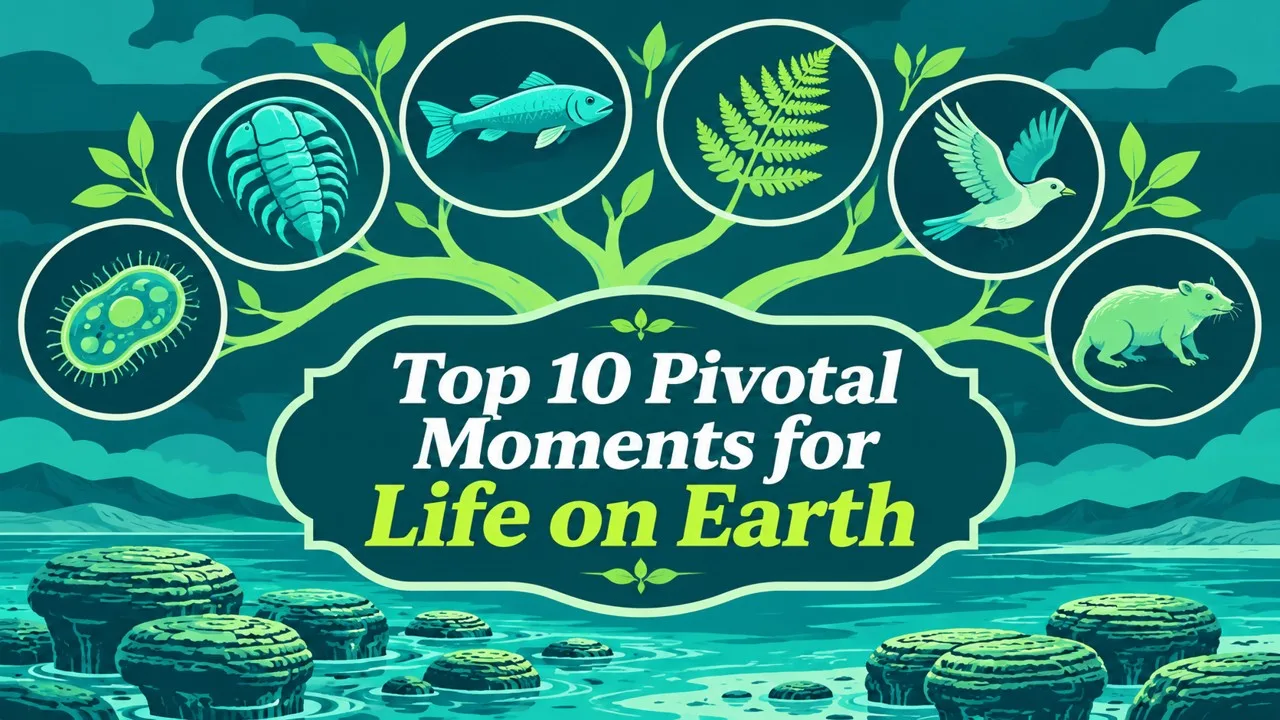
From the first microbes to oxygen, complex cells, sex, a frozen planet and two mass extinctions, ten turning points that shaped the history of life on Earth. Earth is about 4.5 billion years old, and for most of that time it has been home to life. Yet for billions of years, that life consisted only of single cells. Animals, plants and fungi large enough to see are latecomers, appearing only in the last fraction of the planet's history.
The path from the first microbes to today's rainforests, coral reefs and cities was not a smooth climb. It was shaped by a series of turning points, some biological innovations and others planetary catastrophes, that opened new possibilities or wiped the slate almost clean.
Scientists reconstruct these events from fossils, chemical traces in ancient rocks and comparisons of the DNA of living organisms. The dates are approximate and are regularly revised as new evidence appears, and several of the events below are still actively debated.
The ten moments below run from the origin of life to the asteroid that ended the age of dinosaurs. Each changed the course of evolution, and without any one of them the living world, including our own species, would look very different or might not exist at all.
Key Facts
| # | Moment | Approximate date | Why it mattered |
|---|---|---|---|
| 1 | Origin of life | At least 3.5 billion years ago | Every living thing descends from these early microbes |
| 2 | Great Oxidation Event | About 2.4 to 2.1 billion years ago | It made complex, energy-hungry life possible |
| 3 | The origin of complex cells | Roughly 2 billion years ago | It gave rise to all plants, animals and fungi |
| 4 | Bangiomorpha | About 1 billion years ago | Mixing genes sped up evolution |
| 5 | Snowball Earth | About 720 to 635 million years ago | Life survived and complex organisms followed |
| 6 | Cambrian explosion | About 538 million years ago | Most major animal groups appeared |
| 7 | The greening of the continents | From about 470 million years ago | It transformed soils, climate and the air |
| 8 | Tiktaalik | About 375 million years ago | It illustrates the step from water to land |
| 9 | End-Permian extinction | About 252 million years ago | The worst mass extinction in Earth's history |
| 10 | Chicxulub impact | About 66 million years ago | It opened the way for mammals |
1. The First Living Cells
Nobody knows exactly how or when life began. Some of the oldest widely accepted evidence comes from stromatolites in the Pilbara region of Western Australia, layered structures built by microbial communities around 3.5 billion years ago. Claims of even older traces, such as in rocks from Greenland, remain debated [1].
All living organisms share the same genetic code and many of the same molecular machines, which suggests that they descend from a single population known as the last universal common ancestor. A study published in 2024 estimated that this ancestor may have lived as early as about 4.2 billion years ago, although such estimates carry large uncertainties [1].
How chemistry became biology remains one of the great open questions in science. Researchers study hydrothermal vents, shallow pools and the chemistry of RNA, a molecule that can both store information and speed up chemical reactions, in search of an answer.
2. Oxygen Fills the Air
Early Earth's atmosphere contained almost no free oxygen. That changed after cyanobacteria evolved photosynthesis that splits water and releases oxygen as a waste product. Around 2.4 billion years ago, oxygen began to build up in the atmosphere in what scientists call the Great Oxidation Event [2].
For many microbes, oxygen was toxic, and the change is sometimes described as one of the first great pollution crises. It also transformed the planet's chemistry, rusting dissolved iron out of the oceans and leaving behind thick layers of banded iron formations that are now mined for iron ore [2].
In the long run, oxygen allowed organisms to extract far more energy from food, and it led to the formation of the ozone layer, which shields the surface from harmful ultraviolet light. Both were essential for the later rise of large, active animals.
Related: Top 10 Ancient Earth Events That Sound Like Science Fiction
3. A Cell Swallows a Bacterium
Bacteria and archaea have simple cells without a nucleus. Complex cells, known as eukaryotic cells, are larger and contain internal compartments, including mitochondria that produce energy. The leading explanation for their origin is endosymbiosis, in which one cell engulfed a bacterium that went on living inside it [3].
Over time, the engulfed bacterium became the mitochondrion, which still carries its own small genome. In the ancestors of plants and algae, a similar event involving a cyanobacterium produced the chloroplast. The biologist Lynn Margulis championed the theory from the 1960s, when it was widely doubted [3].
Evidence from genetics has since strongly supported it. The extra energy supplied by mitochondria may have been what allowed eukaryotic cells to grow larger and more complex, paving the way for multicellular life.
4. The Invention of Sex
Sexual reproduction, in which offspring inherit a mix of genes from two parents, is common among complex organisms, but it is costly compared with simply copying oneself. Biologists think it persisted because shuffling genes helps populations adapt and resist parasites [4].
The oldest known fossil of an organism that reproduced sexually is a red alga called Bangiomorpha pubescens, found in rocks on Somerset Island in Arctic Canada. It was first dated to about 1.2 billion years ago and later revised to around 1.05 billion years [4].
Bangiomorpha also shows signs of being multicellular, with cells specialized for different tasks. It is a reminder that some of the most important innovations in the history of life arose in organisms far simpler than animals.
5. The Planet Freezes Over
Geological evidence suggests that during the Cryogenian period, ice sheets reached close to the equator, possibly covering most or all of the planet. There appear to have been at least two such episodes, known as the Sturtian and Marinoan glaciations [5].
The idea was named Snowball Earth by the geologist Joseph Kirschvink in 1992. Scientists still debate whether the oceans froze completely or whether open water remained near the equator, which would have helped life survive [5].
Related: Top 10 Most Bizarre Dinosaurs
The glaciations ended as volcanic carbon dioxide built up and warmed the planet. Not long afterward, in geological terms, the first large multicellular organisms appear in the fossil record, and some scientists suggest the extreme climate swings may have helped set the stage for them.
6. An Explosion of Animal Forms
At the beginning of the Cambrian period, the fossil record changes dramatically. Over roughly twenty million years, representatives of most major animal groups appear, many with shells, skeletons, legs and eyes [6].
Exceptionally preserved fossils from sites such as the Burgess Shale in Canada and Chengjiang in China show soft-bodied creatures in remarkable detail, including early arthropods, worms and the ancestors of vertebrates. Some look so strange that scientists struggled for decades to classify them [6].
Explanations for the explosion include rising oxygen levels, the evolution of predators and prey locked in an arms race, and genetic innovations that allowed new body plans. Most experts think several factors worked together.
7. Plants Move Onto Land
For billions of years, the land was largely barren rock, perhaps with thin crusts of microbes. Fossil spores show that small, simple plants related to modern liverworts had begun to colonize the land by about 470 million years ago [7].
Plants evolved roots, waxy coatings and internal tubes for carrying water, allowing them to grow taller. By the middle Devonian period, around 385 million years ago, the first forests had appeared. Fossil tree stumps from this time have been found in New York State [7].
Land plants broke down rock into soil, changed river systems and drew carbon dioxide from the air, cooling the climate. They also created new habitats and food sources for animals that followed them onto land.
Related: Top 10 Misidentified Prehistoric Animals and How Science Corrected Them
8. Fish With Necks and Wrists
Four-limbed animals, including amphibians, reptiles, birds and mammals, evolved from fish. In 2004, a team of paleontologists working on Ellesmere Island in Arctic Canada discovered fossils of Tiktaalik, a creature that blends features of both [8].
Tiktaalik had scales and fins, but also a flat head, a flexible neck and sturdy fin bones resembling those of a wrist. It probably lived in shallow water and may have propped itself up on its fins. Its discovery, published in 2006, became a famous example of a predicted transitional form [8].
Fossil footprints found in Poland suggest that four-limbed animals may have existed even earlier, so Tiktaalik is best seen as a close relative of the ancestors of land vertebrates rather than a direct ancestor.
9. The Great Dying
At the end of the Permian period, life on Earth came closer to being wiped out than at any other time. Estimates suggest that more than eighty percent of marine species and a large share of land vertebrates disappeared [9].
The leading explanation is massive volcanic activity in what is now Siberia, known as the Siberian Traps. The eruptions released huge amounts of carbon dioxide and other gases, causing intense global warming, ocean acidification and a loss of oxygen in the seas [9].
Recovery took millions of years. The survivors, however, gave rise to new groups, and in the following Triassic period the first dinosaurs and early mammals appeared.
10. The Asteroid That Ended the Dinosaurs
In 1980, the physicist Luis Alvarez and his son Walter, a geologist, and colleagues reported unusually high levels of iridium, an element rare on Earth but common in asteroids, in rocks marking the end of the Cretaceous period. They proposed that a large impact had caused a mass extinction [10].
Related: Top 10 Things We Now Know About Neanderthals
The impact crater was later identified beneath the Yucatan Peninsula in Mexico. Known as Chicxulub, it is about 180 kilometers wide and was created by an object around ten kilometers across. The impact threw debris into the atmosphere, blocking sunlight and collapsing food chains [10].
About three quarters of species died out, including all dinosaurs except the ancestors of birds. Mammals, which had lived in the shadows of dinosaurs, diversified rapidly, eventually giving rise to primates and humans.
Conclusion
These moments show that the history of life has been shaped by both creativity and catastrophe. Innovations such as photosynthesis, complex cells and sex opened new possibilities, while extinctions cleared the way for new groups to flourish.
Many of the details are still uncertain, and new fossils and techniques regularly change the picture. Dates are refined, old ideas are challenged and new questions emerge.
What is clear is that our own existence depends on a long chain of improbable events. Had the asteroid missed, or had the Great Dying been even more severe, the living world today would be very different.
Today, humans have become a force capable of changing the planet on a geological scale, and many scientists warn that biodiversity is declining rapidly. Understanding the turning points of the past can help us appreciate how fragile and resilient life can be.
- ^ [1] Accounts of the origin of life. Wikipedia: abiogenesis Wikipedia: last universal common ancestor
- ^ [2] Accounts of early microbial life. Wikipedia: stromatolite Wikipedia: cyanobacteria
- ^ [3] Accounts of oxygenation. Wikipedia: Great Oxidation Event Wikipedia: banded iron formation
- ^ [4] Accounts of complex cells. Wikipedia: symbiogenesis Wikipedia: eukaryote
- ^ [5] Accounts of early sex. Wikipedia: Bangiomorpha Wikipedia: evolution of sexual reproduction
- ^ [6] Accounts of Snowball Earth. Wikipedia: Snowball Earth Wikipedia: Cryogenian
- ^ [7] Accounts of the Cambrian explosion. Wikipedia: Cambrian explosion Wikipedia: Burgess Shale
- ^ [8] Accounts of land plants and tetrapods. Wikipedia: evolutionary history of plants Wikipedia: Tiktaalik
- ^ [9] Accounts of the Great Dying. Wikipedia: Permian-Triassic extinction event Wikipedia: Siberian Traps
- ^ [10] Accounts of the Chicxulub impact. Wikipedia: Chicxulub crater Wikipedia: Cretaceous-Paleogene extinction event



















Discussion
Log in with